
- Joined
- Jul 27, 2003
- Messages
- 5,708
.....................Some may call it "Voodoo", or whatever they want, but its proven that it creates a MUCH better blade from 52100, than one that has been treated to industry standards.
Correct.

The BladeForums.com 2024 Traditional Knife is available! Price is $250 ea (shipped within CONUS).
Order here: https://www.bladeforums.com/help/2024-traditional/
.....................Some may call it "Voodoo", or whatever they want, but its proven that it creates a MUCH better blade from 52100, than one that has been treated to industry standards.

Quirky why? What's so quirky about it?


Quirky Example #1: 52100 is very sensitive to overheating. It will give you no outward signs that overheating has occurred, until you have a finished blade and it simply cuts poorly and will not hold an edge.
Quirky Example #2: Refer to post #39
Mitch is proceeding in what I would call the correct manner. 52100 IS NOT a steel for beginners. If you think you want to work with 52100, then start with 5160 first, as its MUCH more forgiving. Learn 5160 and then apply what you've learned to 52100. 52100 does not give you second chances. If you don't nail things the first time, whether it be in the forging, or any other step there after, you come out with way less blade than what is possible with this steel.
People might look at it as me being prejudiced, but the fact is that I can make two identical blades from 52100, one via stock removal, using the "industry standards" and another forged, using what I have learned, and there is absolutely no comparison, the forged blade will out perform the stock removal blade in every single area.
Sam: I'm not trying to be condescending, so please don't take it that way..... If you stick with this, in about 10 years, you will understand what we're getting at....you just need a little more experience under your belt.

Quirky Example #1: 52100 is very sensitive to overheating. It will give you no outward signs that overheating has occurred, until you have a finished blade and it simply cuts poorly and will not hold an edge.
Quirky Example #2: Refer to post #39
Mitch is proceeding in what I would call the correct manner. 52100 IS NOT a steel for beginners. If you think you want to work with 52100, then start with 5160 first, as its MUCH more forgiving. Learn 5160 and then apply what you've learned to 52100. 52100 does not give you second chances. If you don't nail things the first time, whether it be in the forging, or any other step there after, you come out with way less blade than what is possible with this steel.
People might look at it as me being prejudiced, but the fact is that I can make two identical blades from 52100, one via stock removal, using the "industry standards" and another forged, using what I have learned, and there is absolutely no comparison, the forged blade will out perform the stock removal blade in every single area.
Sam: I'm not trying to be condescending, so please don't take it that way..... If you stick with this, in about 10 years, you will understand what we're getting at....you just need a little more experience under your belt.


This is one of the 52100 blades I made to test and while grinding I noticed what I thought was a hardening line, so I thought "Cool!" and etched it overnight in vinegar.
I cleaned it up under running water with 4x0 steel wool and it revealed something that I think is weird. Three distinct bands, the upper, softer band and the middle band which I thought would be the hardened martensite but there is a third band at the edge that is dark but has light splotches in it.
In thinking about it, I would have to assume that this band at the edge is probably a result of overheating. This blade has only been snap tempered; I put a bit of oil on the blade and a few drops of water and hold in front of the forge, tang first, until the water starts boiling and after another second or two I quench it.
Any comments?
This looks to me like you are close. I would go ahead and temper three times at 350 for two hours per cycle and let cool to room temperature in the oven. then do as Ed F. suggests and do some edge flexes and cutting with it. It is common to see two or more zones of hardness when edge/diffrentially hardening 52100. here is a picture of one of Ed's knives to show what I mean.
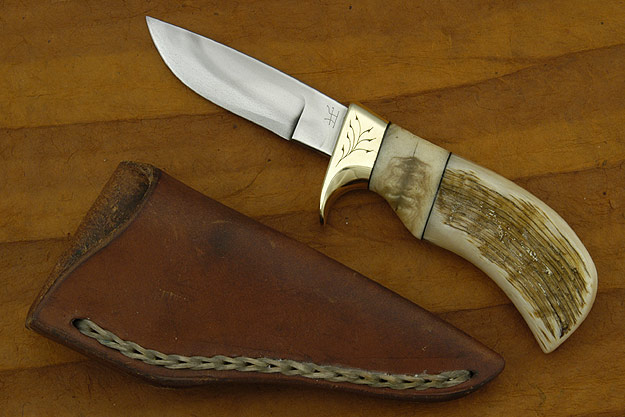
Some hold tenaciously to the science of steels like a drunk hangs onto a lampost for support, rather than using the illumination provded to explore where none have gone before.

It is common to see two or more zones of hardness when edge/diffrentially hardening 52100.
This is likely not the result of different areas of hardness, more likely it's alloy banding.
