- Joined
- Aug 28, 2010
- Messages
- 5,431
My friend Peter, an ax user who lives off-grid in Canada, asked me to post this to the forum, as he has limited access to the internet, but he wanted to make the following contribution. So, here's Peter:
Ahh! Here you are the ax lovers, its users and semi-users, the collectors of cool sharp objects and those just beginning to explore the basics of the subject debating the merits of this or that ax. More power to you all because not only could our present civilization not have evolved without the ax it may be incapable of surviving very long into the future without serious re- embracing of this essential tool. Its contribution to some grim history notwithstanding, a good ax is clearly one of those potentially green/sustainable/eco tools which is likely to help the generations to come making their stand upon this Earth.
As I attempt to join the talking circle, I should explain that Steve just recently sent us the link to this forum. Now, given my Luddite streak, our off-grid homestead and that devil-damned quirky laptop, I have not yet read most of what has probably been said on these pages. But Ive read enough already to have my pencil jump out at me, begging to contribute. Steve also helped me set up an ax blog which I invite you to visit at
http://axeconnected.blogspot.com/
Now, I have a long record of whining about the shortcomings of snaths (scythe handles) which in recent decades have been sold (internationally) to the indiscriminating public and Ive felt the same about ax handles. And, to be honest, I was much surprised (disappointed may be a more accurate term) that in this forum the issue of handle dimension was hardly mentioned. For this reason the subject of ax handles is the first topic I decided to address in the above mentioned blog. Here's an excerpt:
The Devolution of Axe Handles:
To cut across the grain of what appears to be popular, I choose to focus first on the blunt rather than the sharp end of the ax.
You see, in many cases a truly good (meaning well-designed and sized) handle can effectively elevate the efficiency of a tools working edge. Conversely, a fine tools potential can quickly be depreciated by fitting to it a poor handle.
These are facts most experienced tool users would agree with, period. Yet, the numbers of top of the line blades outfitted with what Id refer to as bottom of the line handles is large indeed. In the case with axes, that number is growing steadily... or I should say, alarmingly. (The number I am talking about is a percentage of axes sold and/or used -- which today is many less than in the past, of course.)
Therefore, as a subset of ax-related discussion, I begin with the issue of handles.
Reflecting on the devolution of ax handles and how to refine (up to a point) the abominations many of you end up buying nowadays:
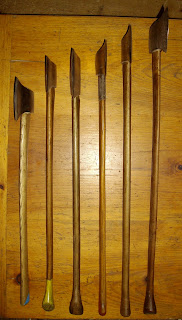
...The photo below is meant to demonstrate the devolution. It is, in fact, a brief documentation of history, because what you see here are commercially-produced ax handles, purchased in Canada between 1975 and 2011. All of them are hickory. (To further qualify, the third handle is a version possibly turned in Sweden -- and sold globally on what presumably is one of the hand-forged connoisseur axes today.)
Here (from left to right) are their respective dimensions and weights of the heads they came with:
1. (1975) 18x32mm, 31 inch long, head 3 ½ lb (my very first ax)
2. (1995) 23x37mm, 27 inch long, head 2 ¾ lb
3. (2010) 26x 39mm, 26 inch long, head 2 lb
4. (2011) 29x40mm, 27 inch long, head 2 ½ lb
Whats the problem?, some people may exclaim, if anything, we are getting progressively more wood (and presumably strength) for the money. Well, yes, there is nearly twice the volume of wood in each foot of the 2011 as opposed to the 1975 handle. However, as I hope to explain below, this is clearly a case of too much of a good thing...
During the 35 years of living in New Brunswick, Canada, Ive come to appreciate the local old timers love for slim and limber handles (examples to follow). These now 80-90 year olds, who did grow up with an ax in their hands so to speak, consider contemporary boughten handles way too clumsy and oversize, fit perhaps for a pickax but not a wood chopping ax.
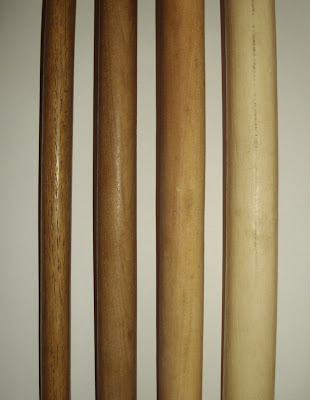
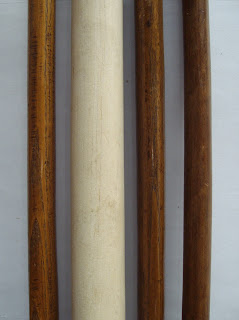
In the photo below you see three locally made handles with the 2011 white elephant in-between. While measuring these three (for the purpose of this piece) I was surprised that their cross sections were exactly the same 16x33mm!
The respective lengths and weights of these axes are (from left to right):
32 (sugar maple) with single bit 3 ¼ lb head
27" (hickory) with single bit 2 ½ lb head
29 (ash) with double bit 2 ½ lb head
29 (ash) with single bit 2 ¼ lb head
A good ax handle needs some spring to it, the old-timers say, or a man gets all beat up in a day of chopping. To fully appreciate what they mean, one may have to get serious about ax work, and use the tool more extensively than most folks do nowadays.
Yet, I think that if most of you out there tried to chop for only 10 minutes with the exact same two ax heads, one fitted with that 1975 and the other with the 2011 handle, you would want to take home the older, and leave the modern version behind...
Besides the inevitable jar that a thick handle gives to the users body when the steel head on its end contacts solid wood, there is another benefit of a slimmer design. By slim I am referring primarily to handles thickness, not width -- the latter being the larger of the two numbers given in the dimension above. Because, if the overall wood volume in a limber handle was of a perfectly round shape, it could still be called slim and indeed function well enough as a shock absorber. HOWEVER (beside being weaker than an oval) it wouldnt help the choppers accuracy to the extent that a handle should.
The flatness of a good handle provides an effective reference between the hand and the axs edge ( which is one reason why the handles of many other tools have an oval rather than round shape). A thicker (and usually more rounded) profile requires more squeezing to achieve equivalent effect... and when a body focuses on squeezing, it inevitably loses some of its potential to center. Centering leads to accuracy and accuracy is what effective wood chopping is about...
To sum up:
AX HANDLES SHOULD BE FLATTER THAN MOST OF THEM ARE.
Now, there are two other features of ax design that significantly effect accuracy. One of them is related to the shape of the head, and it will be addressed later. The other will keep us on the issue of handle design a little longer.
The notoriously popular curvature in the bottom end of single-bitted ax handles is one of those insidious aspects of ax design in general that people have accepted without realizing that by using it they are (sort of) working against themselves, so to speak.
For quite some time before we came across Dudley Cooks "Keeping Warm with an Ax" (the new editions title is The Ax Book), I had noticed that I could not do as well with axes the handles of which sported this curve. I could not put my finger on exactly where the problem laid but Dudley explains it all very well. Hence I now turn to him for help:
The most baneful defect of the modern single-bitted ax handle is its short bottom curve. The lower end is the grip where the chopper guides the ax. The grip portion bends from the adjoining shaft of the handle by about 10 degrees. Unfortunately, this pretty little curve magnifies the effect of wrist pivoting...
"The axis of pivot for a straight-handled ax lies in the center of the handle throughout its entire length from end knob to top side of the eye.
"But with the curved handle, any rotation is controlled by the choppers hands grasping the lower curve at the grip. Therefore the real axis of pivot does not pass through the ax head at all because the 10 degree bend of the lower handgrip is not pointed in that direction. The effective and real axis lies in an extension of the grip and passes somewhere to the rear of the entire axhead.
"The trouble-making grip with its 10 degree bend subtends an arc of 4½ at the handle's residual length of 25". That means that the curved-handle axe already has a constructive "foresection" of 4½ behind what we have hitherto termed the axis of pivot. But there is also an additional 4½ waiting at that point. Remember, we stated that each ax has a fore-section distance of 4½ forward of the axis of pivot (by the string-suspension method). For curved-handle ax then, the constructive fore-section length between the real axis of pivot and the bit is: 2x4½, or 9.
"So the ax with a curved handle will act as if it had an imposing bit 9 long. For a rotation of only 5 degrees, its bit will swing .78, exactly twice what that same ax would deviate if hung on a straight handle. Greater rotation would bring greater deviation in the same proportion. This is the most damning case against the curved handle. It is substantially less accurate than a straight handle.
"However, the human body is a marvelous machine. It can adapt to nearly anything. If the handle of a golf club were shaped like a pretzel, some people would still play golf. A chopper soon adapts himself to a curved ax handle even though that handle is designed to frustrate accuracy. The chopper acts as if there were a straight axis throughout the entire length of the handle, even though there is not.
"But this unconscious adaptation has a price. Use of the curved handle requires more practice to cut well. And even with practice, the chopper cannot attain the results possible with a straight handle. In our history, this is at least partially confirmed by the woods professionals of the era when trees were felled with axes. These men graduated from single-bitted axes on straight handles to double-bitted axes, also on straight handles. Curved ax handles do not seem to have ever attained widespread professional acceptance."
(From "Keeping Warm with an Ax, A Woodcutter's Manual", by D. Cook, 1981, Universe Books, page 90)
There you have it try a straighter (as well as slimmer) handle; you will likely enjoy the ax-work more and also be more efficient!
Refining commercial handle models:
Commercial (that is, lathe-turned) handles do come in a variety of shapes. Most of them sport the curve near the grip. The handle supplied with the "Trail Boss" (far left in the photo below) is one of the few exceptions.
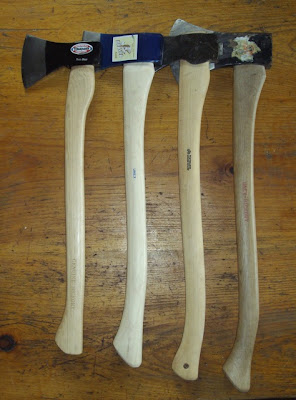
To slim down a thick handle is a relatively easy task. To straighten that devilish short curve near the knob is another matter. When the curve is as pronounced (and the overall amount of wood not excessive) as in Example 4. no alteration is realistically possible. On the other hand, the Example 2 can be made almost completely straight (as we will show in a later post). Example 3 is somewhere in-between, while the lower handle curvature on #1 (the "Trail Boss" on the far left) is good as is.
Full post can be read at
http://axeconnected.blogspot.com/
Ahh! Here you are the ax lovers, its users and semi-users, the collectors of cool sharp objects and those just beginning to explore the basics of the subject debating the merits of this or that ax. More power to you all because not only could our present civilization not have evolved without the ax it may be incapable of surviving very long into the future without serious re- embracing of this essential tool. Its contribution to some grim history notwithstanding, a good ax is clearly one of those potentially green/sustainable/eco tools which is likely to help the generations to come making their stand upon this Earth.
As I attempt to join the talking circle, I should explain that Steve just recently sent us the link to this forum. Now, given my Luddite streak, our off-grid homestead and that devil-damned quirky laptop, I have not yet read most of what has probably been said on these pages. But Ive read enough already to have my pencil jump out at me, begging to contribute. Steve also helped me set up an ax blog which I invite you to visit at
http://axeconnected.blogspot.com/
Now, I have a long record of whining about the shortcomings of snaths (scythe handles) which in recent decades have been sold (internationally) to the indiscriminating public and Ive felt the same about ax handles. And, to be honest, I was much surprised (disappointed may be a more accurate term) that in this forum the issue of handle dimension was hardly mentioned. For this reason the subject of ax handles is the first topic I decided to address in the above mentioned blog. Here's an excerpt:
The Devolution of Axe Handles:
To cut across the grain of what appears to be popular, I choose to focus first on the blunt rather than the sharp end of the ax.
You see, in many cases a truly good (meaning well-designed and sized) handle can effectively elevate the efficiency of a tools working edge. Conversely, a fine tools potential can quickly be depreciated by fitting to it a poor handle.
These are facts most experienced tool users would agree with, period. Yet, the numbers of top of the line blades outfitted with what Id refer to as bottom of the line handles is large indeed. In the case with axes, that number is growing steadily... or I should say, alarmingly. (The number I am talking about is a percentage of axes sold and/or used -- which today is many less than in the past, of course.)
Therefore, as a subset of ax-related discussion, I begin with the issue of handles.
Reflecting on the devolution of ax handles and how to refine (up to a point) the abominations many of you end up buying nowadays:
...The photo below is meant to demonstrate the devolution. It is, in fact, a brief documentation of history, because what you see here are commercially-produced ax handles, purchased in Canada between 1975 and 2011. All of them are hickory. (To further qualify, the third handle is a version possibly turned in Sweden -- and sold globally on what presumably is one of the hand-forged connoisseur axes today.)
Here (from left to right) are their respective dimensions and weights of the heads they came with:
1. (1975) 18x32mm, 31 inch long, head 3 ½ lb (my very first ax)
2. (1995) 23x37mm, 27 inch long, head 2 ¾ lb
3. (2010) 26x 39mm, 26 inch long, head 2 lb
4. (2011) 29x40mm, 27 inch long, head 2 ½ lb
Whats the problem?, some people may exclaim, if anything, we are getting progressively more wood (and presumably strength) for the money. Well, yes, there is nearly twice the volume of wood in each foot of the 2011 as opposed to the 1975 handle. However, as I hope to explain below, this is clearly a case of too much of a good thing...
During the 35 years of living in New Brunswick, Canada, Ive come to appreciate the local old timers love for slim and limber handles (examples to follow). These now 80-90 year olds, who did grow up with an ax in their hands so to speak, consider contemporary boughten handles way too clumsy and oversize, fit perhaps for a pickax but not a wood chopping ax.
In the photo below you see three locally made handles with the 2011 white elephant in-between. While measuring these three (for the purpose of this piece) I was surprised that their cross sections were exactly the same 16x33mm!
The respective lengths and weights of these axes are (from left to right):
32 (sugar maple) with single bit 3 ¼ lb head
27" (hickory) with single bit 2 ½ lb head
29 (ash) with double bit 2 ½ lb head
29 (ash) with single bit 2 ¼ lb head
A good ax handle needs some spring to it, the old-timers say, or a man gets all beat up in a day of chopping. To fully appreciate what they mean, one may have to get serious about ax work, and use the tool more extensively than most folks do nowadays.
Yet, I think that if most of you out there tried to chop for only 10 minutes with the exact same two ax heads, one fitted with that 1975 and the other with the 2011 handle, you would want to take home the older, and leave the modern version behind...
Besides the inevitable jar that a thick handle gives to the users body when the steel head on its end contacts solid wood, there is another benefit of a slimmer design. By slim I am referring primarily to handles thickness, not width -- the latter being the larger of the two numbers given in the dimension above. Because, if the overall wood volume in a limber handle was of a perfectly round shape, it could still be called slim and indeed function well enough as a shock absorber. HOWEVER (beside being weaker than an oval) it wouldnt help the choppers accuracy to the extent that a handle should.
The flatness of a good handle provides an effective reference between the hand and the axs edge ( which is one reason why the handles of many other tools have an oval rather than round shape). A thicker (and usually more rounded) profile requires more squeezing to achieve equivalent effect... and when a body focuses on squeezing, it inevitably loses some of its potential to center. Centering leads to accuracy and accuracy is what effective wood chopping is about...
To sum up:
AX HANDLES SHOULD BE FLATTER THAN MOST OF THEM ARE.
Now, there are two other features of ax design that significantly effect accuracy. One of them is related to the shape of the head, and it will be addressed later. The other will keep us on the issue of handle design a little longer.
The notoriously popular curvature in the bottom end of single-bitted ax handles is one of those insidious aspects of ax design in general that people have accepted without realizing that by using it they are (sort of) working against themselves, so to speak.
For quite some time before we came across Dudley Cooks "Keeping Warm with an Ax" (the new editions title is The Ax Book), I had noticed that I could not do as well with axes the handles of which sported this curve. I could not put my finger on exactly where the problem laid but Dudley explains it all very well. Hence I now turn to him for help:
The most baneful defect of the modern single-bitted ax handle is its short bottom curve. The lower end is the grip where the chopper guides the ax. The grip portion bends from the adjoining shaft of the handle by about 10 degrees. Unfortunately, this pretty little curve magnifies the effect of wrist pivoting...
"The axis of pivot for a straight-handled ax lies in the center of the handle throughout its entire length from end knob to top side of the eye.
"But with the curved handle, any rotation is controlled by the choppers hands grasping the lower curve at the grip. Therefore the real axis of pivot does not pass through the ax head at all because the 10 degree bend of the lower handgrip is not pointed in that direction. The effective and real axis lies in an extension of the grip and passes somewhere to the rear of the entire axhead.
"The trouble-making grip with its 10 degree bend subtends an arc of 4½ at the handle's residual length of 25". That means that the curved-handle axe already has a constructive "foresection" of 4½ behind what we have hitherto termed the axis of pivot. But there is also an additional 4½ waiting at that point. Remember, we stated that each ax has a fore-section distance of 4½ forward of the axis of pivot (by the string-suspension method). For curved-handle ax then, the constructive fore-section length between the real axis of pivot and the bit is: 2x4½, or 9.
"So the ax with a curved handle will act as if it had an imposing bit 9 long. For a rotation of only 5 degrees, its bit will swing .78, exactly twice what that same ax would deviate if hung on a straight handle. Greater rotation would bring greater deviation in the same proportion. This is the most damning case against the curved handle. It is substantially less accurate than a straight handle.
"However, the human body is a marvelous machine. It can adapt to nearly anything. If the handle of a golf club were shaped like a pretzel, some people would still play golf. A chopper soon adapts himself to a curved ax handle even though that handle is designed to frustrate accuracy. The chopper acts as if there were a straight axis throughout the entire length of the handle, even though there is not.
"But this unconscious adaptation has a price. Use of the curved handle requires more practice to cut well. And even with practice, the chopper cannot attain the results possible with a straight handle. In our history, this is at least partially confirmed by the woods professionals of the era when trees were felled with axes. These men graduated from single-bitted axes on straight handles to double-bitted axes, also on straight handles. Curved ax handles do not seem to have ever attained widespread professional acceptance."
(From "Keeping Warm with an Ax, A Woodcutter's Manual", by D. Cook, 1981, Universe Books, page 90)
There you have it try a straighter (as well as slimmer) handle; you will likely enjoy the ax-work more and also be more efficient!
Refining commercial handle models:
Commercial (that is, lathe-turned) handles do come in a variety of shapes. Most of them sport the curve near the grip. The handle supplied with the "Trail Boss" (far left in the photo below) is one of the few exceptions.
To slim down a thick handle is a relatively easy task. To straighten that devilish short curve near the knob is another matter. When the curve is as pronounced (and the overall amount of wood not excessive) as in Example 4. no alteration is realistically possible. On the other hand, the Example 2 can be made almost completely straight (as we will show in a later post). Example 3 is somewhere in-between, while the lower handle curvature on #1 (the "Trail Boss" on the far left) is good as is.
Full post can be read at
http://axeconnected.blogspot.com/

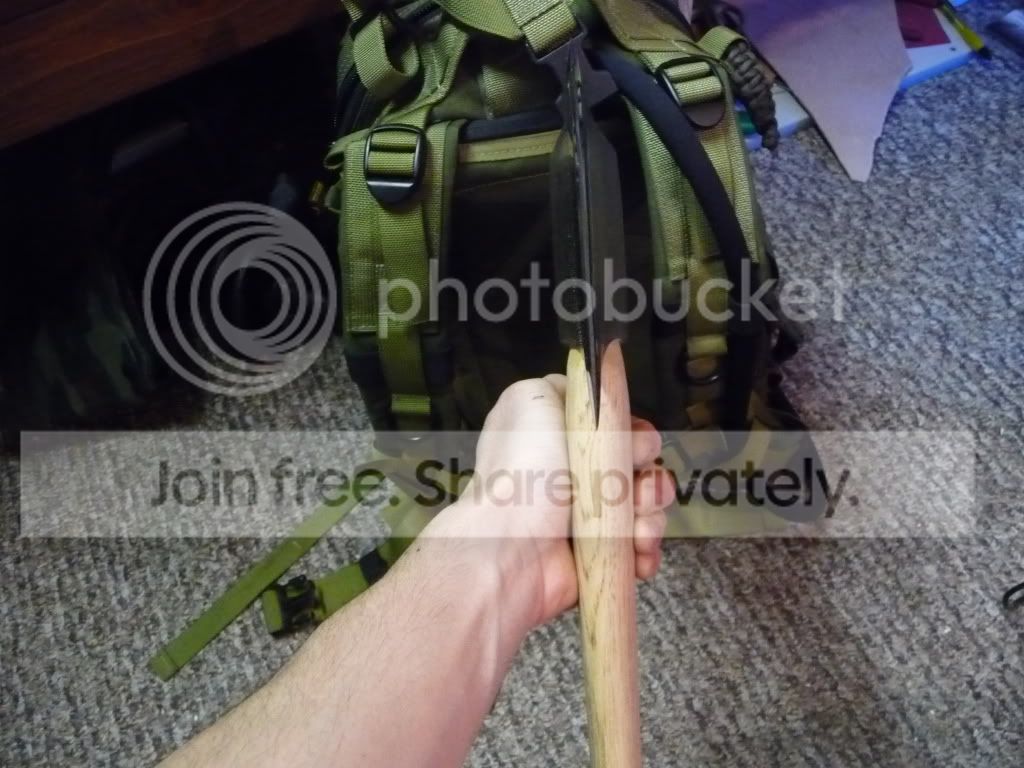
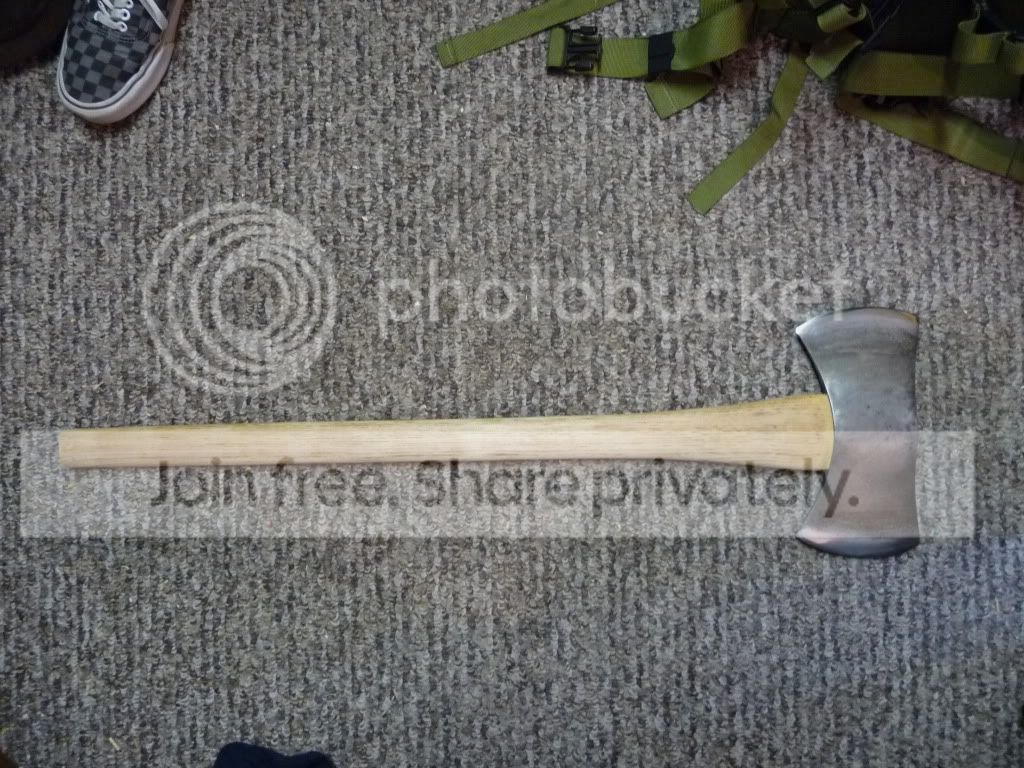
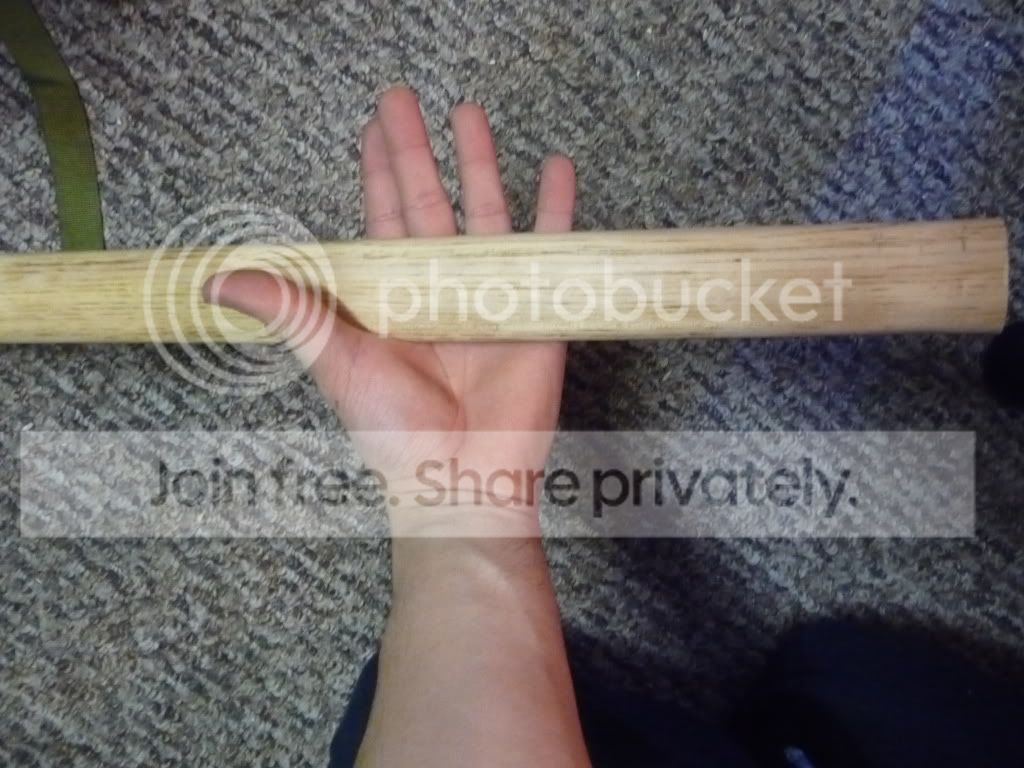
 ). My first idea was that the handle was too long - I think 36" tends to be excessive for a felling/limbing axe and is really only necessary for wood splitting. Anyways, I cut it down to about 32.5" and that helped with the balance somewhat, but it still felt off...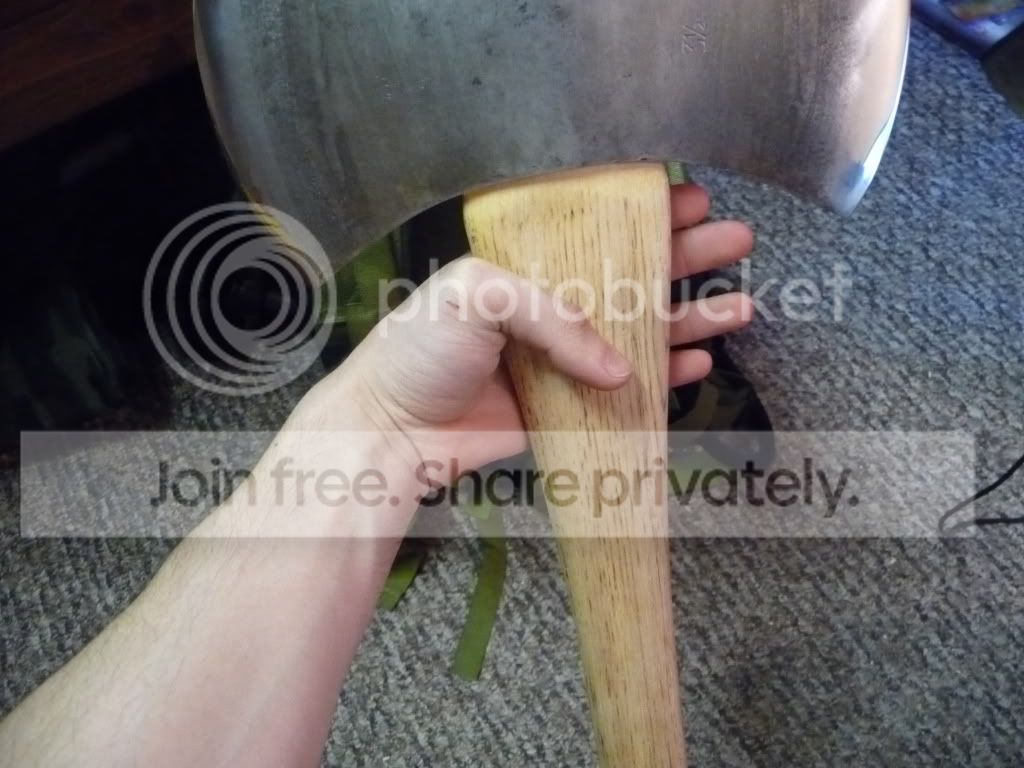
 .
.