Is it traditional or something else?

Status
Not open for further replies.
Well I have been holding back on my opinion on the materials question because I wanted to see what other people had to say about it...BUT...

...I personally feel that the material used doesn't necessarily make or break it as far as "traditional" goes. There is some pretty funky looking handle materials on some very old knives. I think if they had Ti back in the day, they would have put it on pocketknives...knowmsayin? ;)

The reason I posted this specific knife is because of the handle material. There are many examples of vintage traditional knives with handles made of variety of metals....brass.....silver...steel....etc. Does a metal handle make it non-traditional? I don't think it does. If modern materials are being used that were not available in the past disqualify a knife from being categorized as traditional, then clearly this knife isn't traditional. To be honest...I don't know if this can honestly be considered traditional or not.
 
NOT Muskrats, but I would consider them to both be double-end trappers, which a muskrat is also a double-end trapper. The difference is obvious.

What's the difference in a double-end trapper and a double-end jack?

Thanks for answering my question, but, I have a few more.

If they are not considered a "moose" pattern then what is considered a moose?

Couldn't you call a pen knife a double ended jack knife?

If the makers can't agree on the pattern names, is this a losing battle? or do you think it is a battle worth fighting even though only a very very small amount of traditional knife enthuiasts will care?


Paul
Paul
 
I like to use the correct terminology and learn about it, but it can be confusing. Bull-head is a new one for me.

Double-end trappers and double-end jacks - I though those were oxymorons until this thread. Can a double-end jack be what is usually referred to as a pen knife by Case?

The Buck and Moore Maker that were linked look like Moose to me...?

I would personally consider that Dowell to be non-traditional. Unless it is based on an old pattern I am not familiar with... I think I am with kamagong on that one. As an aside, I have a Dowell mini-zulu in micarta; not sure if that is traditional or not but it is awesome!
 
Thanks for answering my question, but, I have a few more.

If they are not considered a "moose" pattern then what is considered a moose?

Couldn't you call a pen knife a double ended jack knife?

If the makers can't agree on the pattern names, is this a losing battle? or do you think it is a battle worth fighting even though only a very very small amount of traditional knife enthuiasts will care?


Paul
Paul

Moose is controversial...I will not touch that one except to say both the moose/jack patterns are much more beefier than a pen pattern. Pens are typically a relatively slim knife and, of the two-blade flavor...on a single spring. Jacks are bold suckers with double springs.
 
I like to use the correct terminology and learn about it, but it can be confusing. Bull-head is a new one for me.

Double-end trappers and double-end jacks - I though those were oxymorons until this thread. Can a double-end jack be what is usually referred to as a pen knife by Case?

The Buck and Moore Maker that were linked look like Moose to me...?

I would personally consider that Dowell to be non-traditional. Unless it is based on an old pattern I am not familiar with... I think I am with kamagong on that one. As an aside, I have a Dowell mini-zulu in micarta; not sure if that is traditional or not but it is awesome!

It's an old, simple, curved-jack handle. Traditional. ;)
 
I remember my first conversation with T.Bose about trappers and half-trappers and single-blade trappers. I came away wanting to slap the guys that came up with these terms because they just don't make sense but there you have it.

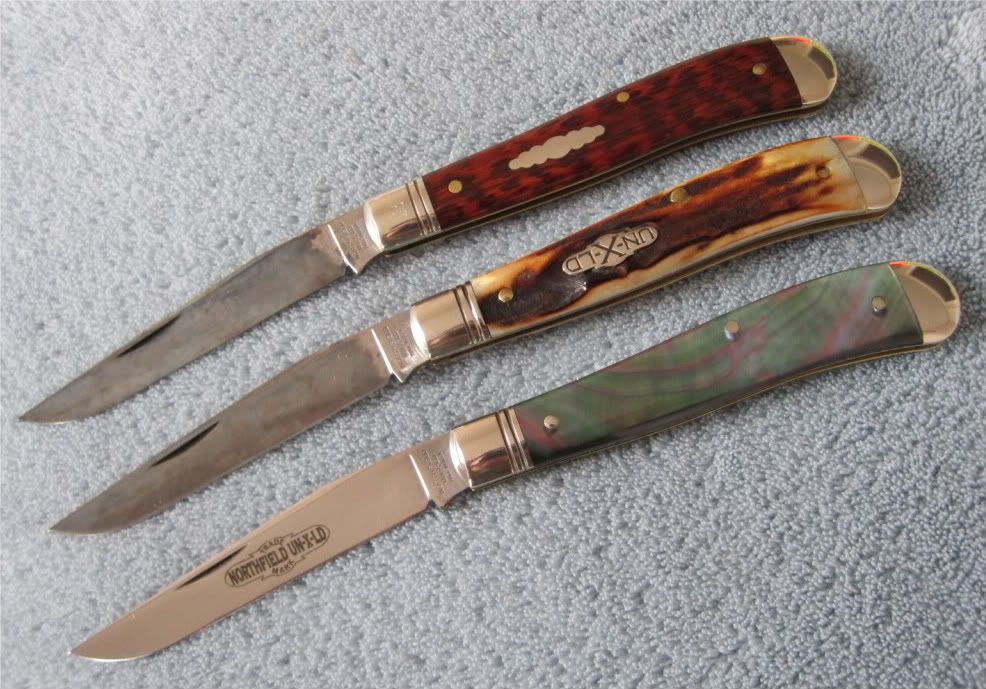
Hi Kerry, so what would you call these? They've been called Dogleg Trappers, Slimline Trappers, Single-blade Trappers...
IMG_0550.jpg
 
"what would you call these? "
I'm not Kerry and i'm sure he will answer but using Levine's terms, those are all Slim Serpentine Jacks.
roland
 
Would a 2 spring muskrat (Case) be considered a jack and a single spring muskrat(queen) a pen??? It wouldn't seem that you could call these the same knife pattern if that was the case (no pun intended).

Paul
 
Paraphrasing former Associate Supreme Court Justice Potter Stewart:

A Traditional Knife may be hard to define but I know one when I see it.

;)

This definition works best for me:D


I could make a long list of what is not traditional, imo, but I'll spare y'all and just say that any knife with handle material not commonly used by 1940 or before doesn't meet the criteria for me whether it's a slipjoint or not. These style knives (and I own lots of them) fall into a category I would call "traditionally inspired".

Then there are knives that are simply slipjoints and nothing else about them is traditional:cool:


I think too much leeway is given with the definition in this forum at times and not enough at others...but again, it's subjective:p
 
...also in my "working definition" I tend to allow modern materials for frames, pins and blades as long as the pattern is traditional and recognizable as such, but then I exclude by handle material regardless of how traditional the pattern is:o


An example of "Simply a slipjoint" would be Ray Cover's #4 pattern or any other slipjoint not based on an existing factory pattern. Some of T.A. Davison's knives also come to mind, but some of them resemble factory patterns close enough to fit:confused:
 
Last edited:
Would a 2 spring muskrat (Case) be considered a jack and a single spring muskrat(queen) a pen??? It wouldn't seem that you could call these the same knife pattern if that was the case (no pun intended).

Paul

A muskrat can have one or two springs. A two spring is more desirable as a full time working knife, just because of its built in backup. You can break a spring and stay in business. They are also double end trappers, with a special use, hence "Muskrats. A trapper is a special jack!
Isn't that special??

A pen is usually about 3 1/4" or less and of slimmer/lighter construction.
 
Durwood, so called tactical folders could be considered traditionally inspired, if you use your imagination. "traditional" is vague enough to allow some wiggle room and I like that. I agree that there are traditional standards though and some folks don't understand that and are toying with them...that kinda bugs me.
 
To me a traditional knife is more about the type of construction than the pattern or materials used. It should be pinned, either a slipjoint or lockback, and have have no one hand opening method or clip. You can be sure that if micarta, G10, titanium, carbon fiber, and other modern materials were available in the past they would have been used then. There aren't many people here who would argue that Queen/Schatt & Morgan or Canal Street aren't traditional knives because they use modern steels. I don't see how that's any different.

It can be a traditionally made knife without being a "traditional" pattern as well. If it doesn't fit into an existing pattern that's fine, just come up with a new name for it instead of trying to force it into a place it doesn't belong.
 
I agree Kerry, I guess my definition needs work:o I'm sure you knew I meant "traditionally inspired, non-tactical, folksy slipjoints with dead animal or plant matter for handle material or man made stuff used on old factory knives by 1940 or before"


It's funny how "we" (the knife community) continue to (I hate to say evolve) change our definition of what is acceptable for certain styles of knives.


For example, I'm perfectly content with Nickel Silver and Brass on a Fight'n Rooster. On an older Case I want Nickel Silver...save your brass:D

On a custom Nickel Silver is a cuss word:eek:
 
...snip...

... no one hand opening method or clip. You can be sure that if micarta, G10, titanium, carbon fiber, and other modern materials were available in the past they would have been used then. There aren't many people here who would argue that Queen/Schatt & Morgan or Canal Street aren't traditional knives because they use modern steels. I don't see how that's any different.

It can be a traditionally made knife without being a "traditional" pattern as well. If it doesn't fit into an existing pattern that's fine, just come up with a new name for it instead of trying to force it into a place it doesn't belong.


I'm not say'n it's really all that different...but from my experience most folks are more forgiving on blade and frame composition as long as the knife has pinned construction
than they are for pattern and handle material.

FWIW, I agree with your idea of not forcing a fit and naming the pattern...but that don't make it traditional in my book!

Not to pick on anyone, but take Jerry Halfrich's Rounder for example.

1) It's a slipjoint
2) It's not based directly on any pattern that I know of
3) Haft it in carbon fiber and leave off the bolsters and it's just a "modern slipjoint" Well made as it may be--not much "Traditional" about it no matter what you call it.
 
Let me see if I can get whats in my head into this post.

For a knife to be traditional it must be a traditional pattern and use traditional scales or handle material i.e. Stag, bone, ivory, some woods, celluloid, and I'm sure there are a few I have left out. It has to be hafted in a material that was available to the old makers.

To put Canvas Micarta on a traditional pattern then say if they had it they would have used it doesn't really work with me because they didn't have it. If a Saddle Horn (for example) is built and it is a shadow pattern with Canvas Micarta, to me it is a "slip joint" if the same pattern is built say in barehead with bone scales I would call it "traditional." I'm not saying one is better than the other, just that one is traditional and one is not.
 
Hi Kerry, so what would you call these? They've been called Dogleg Trappers, Slimline Trappers, Single-blade Trappers...
IMG_0550.jpg

They are pretty doggone nice! ;)

The first time I saw a single-blade trapper :confused:, I called it a "half-trapper". I was summarily corrected because a half-trapper is typically your basic trapper with the slim spey blade replaced with a pen blade...that's what I have been told.

Anyway, as far as I know, trappers are jack knives so it would be correct to call those serpentine jacks as well. The contemporary naming we use of single-blade trapper seems also correct due to the long, slim nature of the frame and blade. I think "dogleg trapper" has been brandished about and is incorrect.
 
I found this old M&G catalog page that Jason posted in another thread a while back. The M&G swell-center jack #34 has screws holding on the handle material. UHOH...Not traditional!!!! Those scallywags went and harshed our traditional mellow clear back in 1906!!! DAMN THEIR HIDES! :D

1906knifeadvert.jpg
 
Status
Not open for further replies.
Back
Top