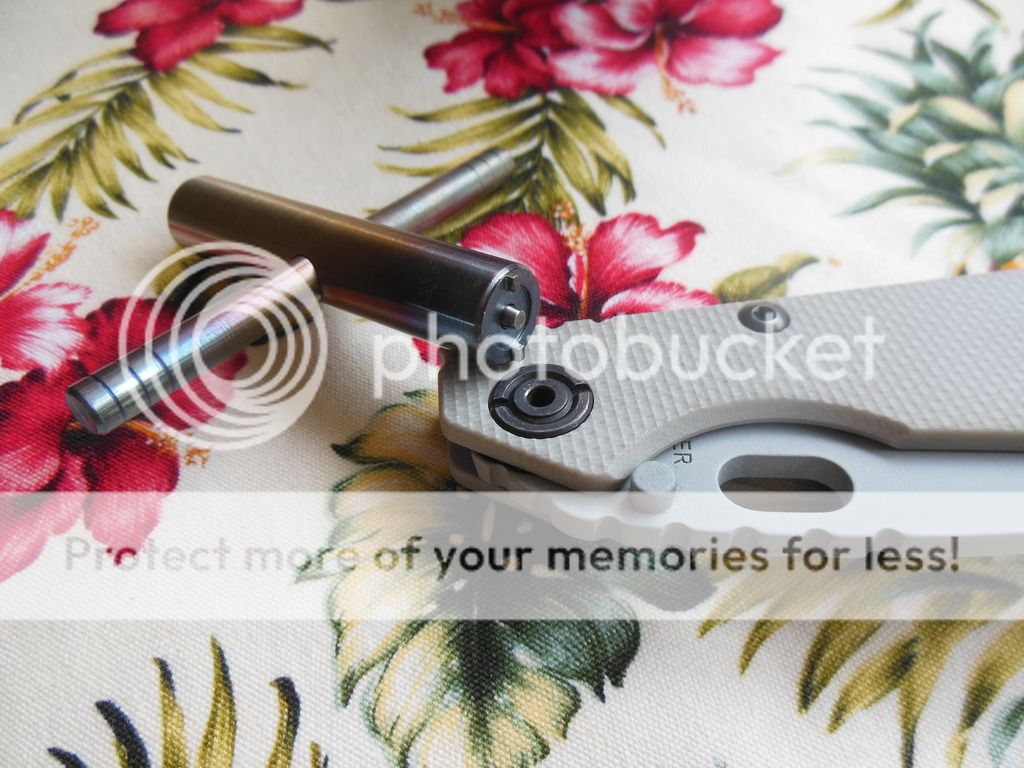
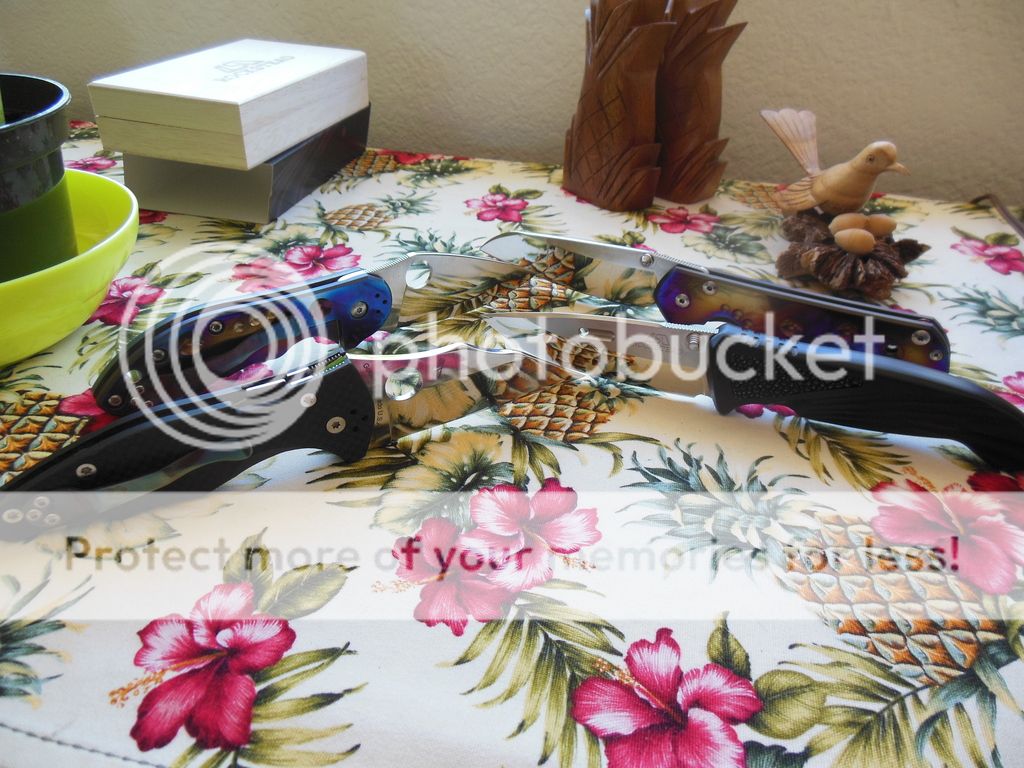
Is there anything else like the Sebenza pivot?

Maybe the phrase "Far greater tolerances" shouldn't have been used - But when speaking in differences of 5 ten thousandths of an inch, that is quite a lot, considering what it takes to achieve these tolerances. The CRK that was measured had tolerances of .001

The rockstead's back pillar was measured, than the pivot bushing, and than the blade +washers. Backspacer was .1585 - The pivot bushing, and the blade+washers were both .1580 - That's a difference of .0005. I don't know what's "down right BS" about that math, but I don't just throw numbers and conjecture around just to hear myself speak.
 
My 10 dollar Opinell locks closed as well as open and outslices my customs. Who cares what kind of miracle steel it is made of or how long it will hold an edge? It can be sharpened on just about anything, and the lockup is always solid.

If you are useing a knife to cut, who cares how smooth it is? Who cares what steel it is made of? Who cares what the pivot is like?

The answer::: we all care. Some of us like certain lock types, some of us like exotic steels, some of us like natural handles, and some of us like certain manufactures. Put it all together, and no knife is better than any other.
 
Maybe the phrase "Far greater tolerances" shouldn't have been used - But when speaking in differences of 5 ten thousandths of an inch, that is quite a lot, considering what it takes to achieve these tolerances. The CRK that was measured had tolerances of .001

The rockstead's back pillar was measured, than the pivot bushing, and than the blade +washers. Backspacer was .1585 - The pivot bushing, and the blade+washers were both .1580 - That's a difference of .0005. I don't know what's "down right BS" about that math, but I don't just throw numbers and conjecture around just to hear myself speak.

Apparently you do throw them around..I have seen the prints (blueprints for the uneducated) for alot of CRK's products. Can you say the same?
It's one thing to measure something, but without the actual numbers in front of you, the data is useless.

So, while you may be able to measure something, may being the operative word, you have no idea how to interepret that as you don't have the baseline.

While I am at it..HOW did you measure these parts?
 
Apparently you do throw them around..I have seen the prints (blueprints for the uneducated) for alot of CRK's products. Can you say the same?
It's one thing to measure something, but without the actual numbers in front of you, the data is useless.

So, while you may be able to measure something, may being the operative word, you have no idea how to interepret that as you don't have the baseline.

While I am at it..HOW did you measure these parts?

Also, exactly which parts, and which tolerances were you measuring? It doesn't mean much unless you were comparing apples to apples.
 
Also, exactly which parts, and which tolerances were you measuring? It doesn't mean much unless you were comparing apples to apples.

What do you mean?..I MADE parts for CRK,..beit the stop sleeves to the threaded barrels, spacers, as well as the scales. The only parts I didn't make was the blade.

Derp- I think I get what you mean.. Been a long few weeks. :foot:
 
Last edited:
Apparently you do throw them around..I have seen the prints (blueprints for the uneducated) for alot of CRK's products. Can you say the same?
It's one thing to measure something, but without the actual numbers in front of you, the data is useless.

So, while you may be able to measure something, may being the operative word, you have no idea how to interepret that as you don't have the baseline.

While I am at it..HOW did you measure these parts?

I don't need the factory specs to measure the gap between the size of the standoff and the combined sized of the blade+washers or pivot bushing. Obviously I'm measuring the tolerances of the knife, not the difference between the actual size and the targeted size of the hardware.

For example, if you have a backspacer that's .1580 and a blade+washers that's .1540 - That's a .004" gap. You could be feeling blade play at that point. That's why it's important to machine those components to the same size. The smaller the gap, the tighter the tolerances.
 
I don't need the factory specs to measure the gap between the size of the standoff and the combined sized of the blade+washers or pivot bushing. Obviously I'm measuring the tolerances of the knife, not the difference between the actual size and the targeted size of the hardware.

For example, if you have a backspacer that's .1580 and a blade+washers that's .1540 - That's a .004" gap. You could be feeling blade play at that point. That's why it's important to machine those components to the same size. The smaller the gap, the tighter the tolerances.


HOW did you measure this?
And because you can measure something, it doesn't mean that you have the specified tolerances, you have only narrowed down the tolerances.

For example,..If you are using calipers, the standard tolerance range for calipers is only .002, plus or minus. That isn't a definitive either as measuring using calipers, micrometer or any tool is subject to the person using them. If you are using a micrometer, then that has it's own range that it's good for measuring as well as the calibration for said tool.
I have a metrology lab calibrate my tools on a quarterly basis,..the same lab is about 50yds away from my toolbox if that says anything.
 
The Kingdom Armory Mini Samaritan has a sleeve bushing nearly identical to CRK, but it was never quite as smooth as my Sebenza even with a good polishing job on the Mini.
 
What do you mean?..I MADE parts for CRK,..beit the stop sleeves to the threaded barrels, spacers, as well as the scales. The only parts I didn't make was the blade.

Derp- I think I get what you mean.. Been a long few weeks. :foot:

bhyde, I wasn't directing the question at you, I was just expanding on the question you posed in your quote. Sorry for the confusion.
 
HOW did you measure this?
And because you can measure something, it doesn't mean that you have the specified tolerances, you have only narrowed down the tolerances.

For example,..If you are using calipers, the standard tolerance range for calipers is only .002, plus or minus. That isn't a definitive either as measuring using calipers, micrometer or any tool is subject to the person using them. If you are using a micrometer, then that has it's own range that it's good for measuring as well as the calibration for said tool.
I have a metrology lab calibrate my tools on a quarterly basis,..the same lab is about 50yds away from my toolbox if that says anything.

I can see it's no use discussing this further. Either my tools weren't calibrated correctly, or I don't know how to use them. Either way, I measured them both using the same Mitutoyo micrometer. The Rockstead's fittings were machined closest to optimal. (Optimal meaning spacer = total pivot length). Now, if CRK intentionally leaves a gap between the frame, I can't speak to that, maybe you can?

You act like I'm knocking crk, which couldn't be farther from the truth. To achieve similar quality as rockstead at such a large reduction in price isn't easy.
 
bhyde, I wasn't directing the question at you, I was just expanding on the question you posed in your quote. Sorry for the confusion.

No, it's not you that needs to apologise at all,..I had to re-read what you posted about 3x to understand what you meant,..So my apologies!

You may well not be the only one I need to apologise to.

Egally08-

I think I am coming off as an ass when I re-read my post. I'm sorry,..totally not my intention.
It's not too unusual for me to misinterpret data, as I accused you of.


There is something else to add to this-

Sonnydaze kindof touched on this, but I will expant a little from my experience.
Tighter tolerances are a tough thing to achieve,..For every .0001in of tolerance, you can just about guarantee a big jump in cost. Perhaps exponential depending on the part. IT's not easy to measure and even harder to achieve on the best of CNC machines without a controlled environment as well as many other factors.
There are only a few parts you would expect to find something like this on.. The pivot and pivot bushing, if being used,being the main items.. You might also consider using it on thickness controlling items such as spacers,.but these probably would not need to be quite this tightly controlled as there is compliance of sorts.

Anyway, to sum it up,..I usually want to help whenever I can, so if there is anything I can help with, I am usually around..

Again Egally08, sorry for coming off as the orange assed ape of sorts!
 
No, it's not you that needs to apologise at all,..I had to re-read what you posted about 3x to understand what you meant,..So my apologies!

You may well not be the only one I need to apologise to.

Egally08-

I think I am coming off as an ass when I re-read my post. I'm sorry,..totally not my intention.
It's not too unusual for me to misinterpret data, as I accused you of.


There is something else to add to this-

Sonnydaze kindof touched on this, but I will expant a little from my experience.
Tighter tolerances are a tough thing to achieve,..For every .0001in of tolerance, you can just about guarantee a big jump in cost. Perhaps exponential depending on the part. IT's not easy to measure and even harder to achieve on the best of CNC machines without a controlled environment as well as many other factors.
There are only a few parts you would expect to find something like this on.. The pivot and pivot bushing, if being used,being the main items.. You might also consider using it on thickness controlling items such as spacers,.but these probably would not need to be quite this tightly controlled as there is compliance of sorts.

Anyway, to sum it up,..I usually want to help whenever I can, so if there is anything I can help with, I am usually around..

Again Egally08, sorry for coming off as the orange assed ape of sorts!

No apology necessary, but I appreciate you going deeper into the mechanics. I shouldn't have stated it like I'm an authority on the topic. I do have faith in my abilities, but there are always variables I haven't considered. Either way, both makers machine one hell of a tight knife.
 
I surely didn't mean to start any fires, but this conversation proved fruitful and everybody came out on top. I learned some important stuff about the specs on Chris' parts, and most of us seem to agree that Rockstead makes one heck of a blade with a great ht...which few of us feel the need to drop the necessary bucks to buy one. They surely are pretty, however.
Cheers, my friends. I tip my hat to all of you.
Don aka sonnydaze
 
Well, he sure doesn't want to waste his time debating with CRK fanboys, that's for sure😜

He wouldn't be able to debate us with anything other than conjecture, half-scientific evaluations, and introductory level knowledge of engineering/machining. He has openly admitted that he does not use his CRK Insingo, he simply keeps it around the house to photograph and play with, on occasion. Legend has it, the inside of that Insingo's scales have been "skeletonized". Ask him for a picture :)
 
Spartan Blades Akribis have a pivot bushing like a sebenza. The prices are very close if not the same when compared to the inlayed models. So it's not just the Rocksteads, though Rocksteads are in a class of its own.
 
If memory serves me correctly, I believe the Buck 110 also uses a pivot bushing of sorts as well. Not sure if other Buck knives use it.
 
I don't need the factory specs to measure the gap between the size of the standoff and the combined sized of the blade+washers or pivot bushing. Obviously I'm measuring the tolerances of the knife, not the difference between the actual size and the targeted size of the hardware.

For example, if you have a backspacer that's .1580 and a blade+washers that's .1540 - That's a .004" gap. You could be feeling blade play at that point. That's why it's important to machine those components to the same size. The smaller the gap, the tighter the tolerances.

Nicely explained!

Clearly from someone who understands a thing or two!
 
He wouldn't be able to debate us with anything other than conjecture, half-scientific evaluations, and introductory level knowledge of engineering/machining. He has openly admitted that he does not use his CRK Insingo, he simply keeps it around the house to photograph and play with, on occasion. Legend has it, the inside of that Insingo's scales have been "skeletonized". Ask him for a picture :)

You really have no idea on how much I do know about anything.

Conjecture is an interesting subject.

I do know you have the identical SnG and you had no idea on problems your had with it! You sent it in for warrenty and bitched on ends about Strider's Customer Service - but you know what, your problems is gonna come back - give it time!

I am just a little bit more capable then you and certainly, will also not gonna share how I can permanently eliminate the problems you had.

Here is a few "just 4 you":

DSCN2235_zpszwgsqq2a.jpg


DSCN2242_zpspe6bnuh6.jpg


DSCN2239_zps8mm1bqcr.jpg


Further more, I do enjoy having the ability, modifying knives as well as in other areas, solely for my enjoyment - all without soliciting services from self taught amateur service providers:

DSCN2250_zpsxmq815ej.jpg


*****

Let it rest Zeta33!

Suggest you stay on subject! Your unsubstantiated accusations can tarnish you as an Anodizing Service Provider.
 
Last edited:
Let it rest Zeta33!

Suggest you stay on subject! Your unsubstantiated accusations can tarnish you as an Anodizing Service Provider.

You really have no idea on how much I do know about anything.
They are absolutely substained accusations but since you've asked nicely, for once, I will let it rest. Have a good day Victor!
 
Im not sure what is going on here...deleted....Ill let a mod sort it out.
 
Back
Top