- Joined
- Jun 25, 2001
- Messages
- 8,474
This thread is for the results of the JDM 5160 control shaft steel
that Ed (Fowler) uses in pursuit for the high performance Blade.
steel I've found, not used steel, but steel from the out-fit that makes the
John Deere control Shafts here in the US for John Deere some times called a Pin or a rock shaft. this steel is the end drops of the shafts themselves during manufacture.
one of shaft P#S R52185--is the John deer part number for a 4630 tractor Load Control Shaft/pin
more on the original finds here
http://www.bladeforums.com/forums/showthread.php?t=334803
and more here
http://www.bladeforums.com/forums/showthread.php?p=3023191#post3023191
Ed is the first to start working this new find. Thanks Ed..
I'm Glad to help see this JDM steel not die with the lack of being able to get it.
by this date at least 17 of you have this steel in hand now, please post
your findings on this steel,
Ed has been gracious enough to tell us he will help lead us in the way he uses it with testing and results of the testing..
This is a great opportunity for those that want to learn from an ABS Master knife maker.
thanks again Ed..
great
I was looking through the last blade mag
at the tests Ed did on mutable heats and the higher up was like 17 flexes
so this JDM 5160 work is good news so far at the very least to me..
to comparing to the 52100
sorry to hear about the reason you'll be gone,,funerals are a bummer ,
I wish the best for the grieving..
edited: adding some test results
http://www.bladeforums.com/forums/showthread.php?t=351717 this is with the new JDM5160 I have access to,
that Ed (Fowler) uses in pursuit for the high performance Blade.
steel I've found, not used steel, but steel from the out-fit that makes the
John Deere control Shafts here in the US for John Deere some times called a Pin or a rock shaft. this steel is the end drops of the shafts themselves during manufacture.
one of shaft P#S R52185--is the John deer part number for a 4630 tractor Load Control Shaft/pin
more on the original finds here
http://www.bladeforums.com/forums/showthread.php?t=334803
and more here
http://www.bladeforums.com/forums/showthread.php?p=3023191#post3023191
Ed is the first to start working this new find. Thanks Ed..
thanks EdEd Fowler said:Hello Dan:
The first blade is forged and in the 950 degree soak right now. It forges great, no faults in the steel were observed as we worked it down. Will be about a week before we can have any performance results.
Again We really appreciate your work
Ed
I'm Glad to help see this JDM steel not die with the lack of being able to get it.
by this date at least 17 of you have this steel in hand now, please post
your findings on this steel,
Ed has been gracious enough to tell us he will help lead us in the way he uses it with testing and results of the testing..
This is a great opportunity for those that want to learn from an ABS Master knife maker.
thanks again Ed..
Deveraux said:Dan, Ed and I finished grinding the 2 blades last night and I started performing the edge flexing on them. I worked on them until after 11pm and decided to wait and finish the testing later. Unfortunately it will be a few days before I can get back to them because I have to attend a funeral in CO. I will say that one of the blades did very well withstanding 15 edge flexes before chipping. We will give you a detailed report as soon as we can get back to them. Butch
great
I was looking through the last blade mag
at the tests Ed did on mutable heats and the higher up was like 17 flexes
so this JDM 5160 work is good news so far at the very least to me..
to comparing to the 52100
sorry to hear about the reason you'll be gone,,funerals are a bummer ,
I wish the best for the grieving..
edited: adding some test results
http://www.bladeforums.com/forums/showthread.php?t=351717
this is with the new JDM5160 I have access to,Ed Fowler said:Hello Dan:
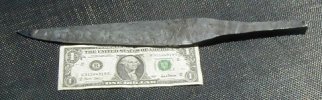
Last night we finished the first part of testing two blades made from the steel you sent us. We started forging the first blade just as we got the steel from you. The second blade was frorged from a companion bar from the same package. We Soaked the second bar for 2 hours in my Paragon at a temperature just above critical and let it cool slowly to rooom temp.
Both bars then received a full normalizing cycle being heated in the forge then allowed to cool to room temp.
We carefully forged blades from these bars, keeping our forging temp low, the forging temp range was from 1625, down until the steel quit moving. about 950 degrees.
Both blades were subjected to three 35 second quenches, after the front of the blade was forged, from above critical in room temp Texaco Type A quenching fluid. Then the tangs were forged,
Both blades were provided two flash normalizing cycles and one full normalizing cycle after forging. Then placed in the Mankel ceramic forge at about 1,000 f. and allowed to cool slowly to room temp overnight
Both blades were then provided 24 hour cycles in the paragon, Heated to
950, held at that temp for two hours then allowed to cool to rooom temp in the Paragon, in the household freezer overnight and back for the final 950 f. soak.
Both blades where ground, then hardened three times in Texaco Type A at 165 f., then kept in the oil until at room temp than back in the freezer until the next day. these steps were done in three 24 hour cycles,
Tempering was accomplished at 350 degrees, again three cycles in the Paragon, then to the freezer in 24 hour cycles.
We then sharpened the blades and did the edge flex test.
Blade 1 No soak
19 edge flexes before any chips.
550 cuts and still going on hemp rope
1 90 degree flex, then 7 complete 180 degree flexes before the edge cracked.
it broke on the eighth 180 degree flex. Very stong, required an extension on the tang to bend.
Blade 2 with soak
19 edge flexes before edge chipped.
550 cuts on hemp rope, was getting dull.
1 90 degree flex, then 17 complete 180 degree flexes then the cutting edge cracked. This blade was not as strong as blade 1. We were barely able to flex it with out the use of a cheater pipe.
Considering the results of these first test blades I would say your 5160 is every bit as good as the steel from John Deer load control shafts. When carefully forged and heat treated it will provide knives that can definately hold and edge, are easy to sharpen and can be depended on by those who
need a good knife.
Thanks for the opportunity Dan!
Ed Fowler
Bill Burke
Butch Deveraux
Jeff Davidson
Darren Cutsforth
Dan Gray said:Blade 1 No soak
19 edge flexes before any chips.
550 cuts and still going on hemp rope
1 90 degree flex, then 7 complete 180 degree flexes before the edge cracked.
it broke on the eighth 180 degree flex. Very stong, required an extension on the tang to bend.
Thanks Ed
I'm Happy
result..
this steel will take the place of the used JD shafts when needed..
JD seams to have kept their mix steady
looks like the results of the no soak is the way to go so far, better edge retention and the edge same
flexes but much stronger,,
what do you believe is causing that soaking problem, it did make the steel softer for sure..
carbon Loss??
I wonder if the soaked blade was tempered at 325 if it would have kept up with the non soaked blade.
Ed Fowler said:Hello Dan: We are working without a laboratory right now and have no difenitive answer for you right now. I believe more experimentation may show us something (?)
I do not believe there was any carbon loss at the temps we were working at.
I forgot to add we found no faults in the steel, it was clean and we had good times working it.
Take Care