John White Hunter

Thanks for the additional pics and descrpition, John. And thanks to all for the supportive comments--I'm excited.

Stuart--yeah, it's true, can't argue with that one. :D

Guna be a nice one!
Will, are you going to use it in the field?

Hi Kevin,

As you know, this is one of several knives in this same pattern I’ve requested from top makers over the past few years, and I still have a few orders for the pattern out to makers I admire.

The particulars designed into this knife form a composite of all the little things I’ve enjoyed from different knives I’ve used over the years, so I can assure with confidence that every one of these knives will be a delight to use—whether or not every one gets carried into the field, or whether some become gifts to loved ones and hunting companions, or whether some simply give me a few minutes pleasure now and then as objects of supremely functional art.

That said, John and I have discussed edge geometry and taper with an eye to using this one, and I intend every one of these to be “field ready”. Whether it gets the nod or not is a question only time will answer.

Thanks to all,
Will
 
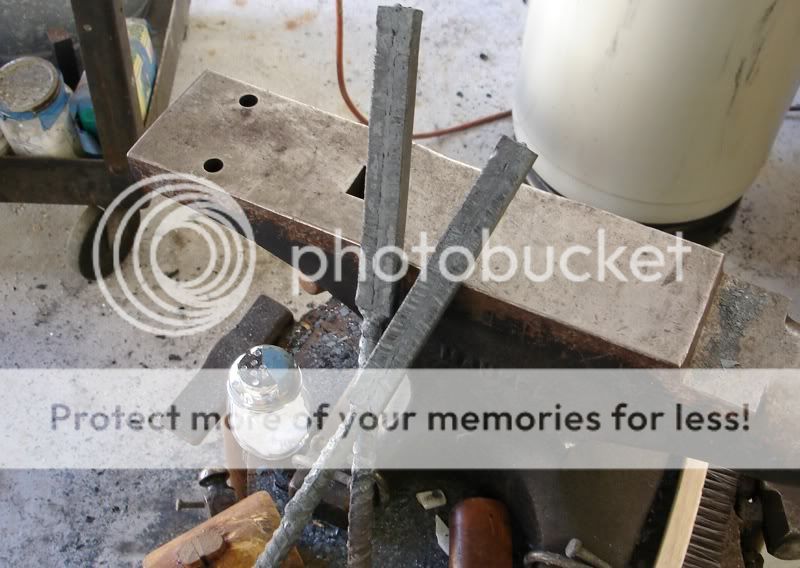
The bars were twisted two right-handed, and two left-handed, at a welding heat.

One right-hand bar is welded to one left-hand, and the other two similarly, to give two matching 2-bars.

Here's where we start the matching patterns, cleaning and etching the ends of the bars, to align the layers in each bar, matching the starts of the twists closely, and welding the bars as straight and evenly as possible.

41bb1840.jpg


Now it gets a little tricky. I should have taken more photos to make a good WIP, but here's a description.

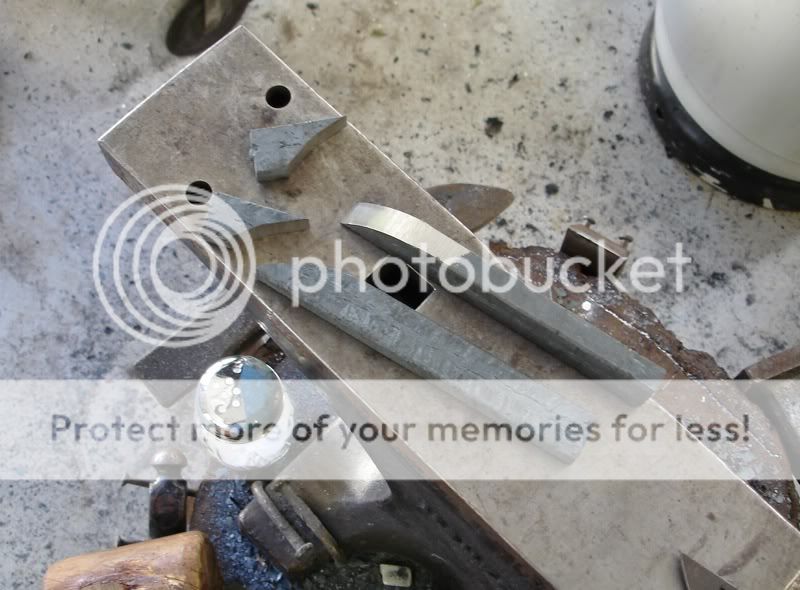
I come down the soon to be mating and welded edges of each of the double bars, the length of the tip taper of the blade.

Then I cut a curved triangle off the tip end of each bar.

523d7093.jpg


This curved tip is then forged down straight, so that the weld lines of each bar will meet at the center line.

I'll grind the new mating edges clean, and quickly etch to be able to match the lines exactly.

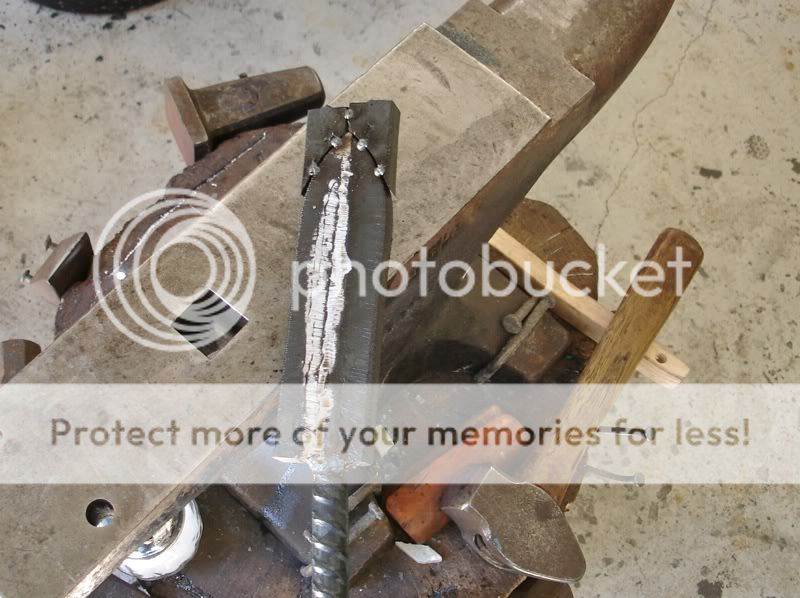
Then I'll "zip up" the two bars with MIG welds to form an air-tight "box" for dry forge-welding.

The cut-off triangles are tack-welded to the new tip, so I can weld the bars together in a straight line.

406b9f84.jpg


Usually, I can knock the triangles off with the power hammer after welding. If not, I cut them loose with the side grinder.

Here's where I can never get any photos without someone else in the shop.

I now have a pointed, straight, 4-bar billet, with the center weld line coming out the center of the tip, and all other lines meeting in pairs.

The billet is still 9/16 thick, and I can forge it down straight to the max width, in this case, about 1 1/4," of the blade.

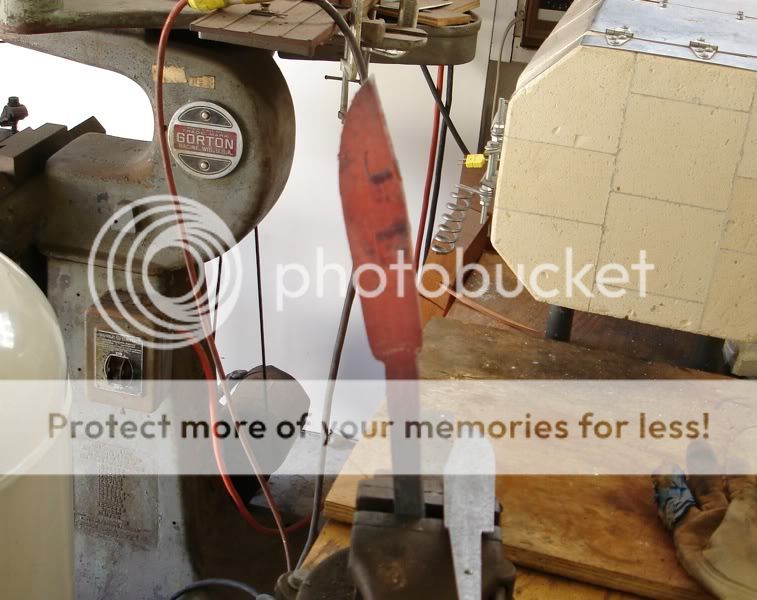
The trick is to forge this billet to the profile of my pattern, placing the tip of the billet at the tip of the blade, without hitting the billet in any way that will distort the (unseen) pattern within, while maintaining an exact 9/16 thickness.

In this case, we have two straight, intersecting lines on the spine, a curved front cutting edge, and a straight taper for the back 40% of the cutting edge.

Here we go.

14cfb441.jpg


a7859a16.jpg


BTW, if it seems like i'm a little proud of making this forging thing work out, I'd better admit that there's a bucket under my work bench that's pretty full of damascus that just didn't make the grade. Some days you get the bear, and some days...

More tomorrow.

John
 
Last edited:
Thats looking good John thanks for doing the WIP. I have a stack of blades much like your bucket I know one day I will make something from them but not a knife.
 
This is fun! A thread that turns into a WIP after the fact. Will, your project of various makers for this personal design is inspiring. John, your work is totally inspiring. Loving the damascus. You both are pairing up for an outstanding final product. Enjoying every post. :thumbup:

- Joe
 
I love this forum.
 
Excellent John!
Hey I need to know how you prepared the twisted bars to weld together. Did you grind them flat first or forge them square and grind them clean?
 
Oh man this is awesome! Just the kick in the butt I needed to try this turkish twist thing that all the cool kids are doing:)
 
Will,

Congratulations on a beautiful knife. All of John's Damascus is great but my favorite is his Turkish Twist. If you do use this knife I'm sure that it will perform well.

John,

Thanks for posting the WIP photos. They really help everyone understand the process. Great job.

Jim Treacy
 
Your 4 bar turkish twist turned out really nice John. Time for more pocorn for the rest of the show.
Ron
 
Thanks everyone for the comments, and thanks to Will especially. This knife is his personal design, and it's a privilege to be one of the makers selected to execute it.

Bruce, ( and anyone who's interested)

As I draw out the welded billet, I'm using spacers in my press to square up the bar, in this case to 9/16ths square. When I'm ready to twist, I'll set 5/8 spacers, and knock the corners, to "octagon" the cut bar to within a half inch of the ends. This lets the bar twist tight without the "threads" being too deep. I haven't seen any difference in the pattern from twisting square or octagon. Immediately after twisting, I'll re-square the bar to 9/16. Then, when ready to weld bars together, I'll grind the mating faces of the bars flat and straight on the platen. I'm taking pains to keep the bars straight and square at all times.

To allow a dry weld, I'll knock a tiny bevel along the clean edges, and with the feed turned up a bit on the MIG, I'll run a bead along the seams to seal the billet. Then I'll grind the bead flat to reduce the amount of weld metal that gets press into the billet as I keep pressing it back to 9/16ths during the weld. You can see this in the photo where the "triangles" are tacked on.

This mild steel MIG material will only extend a bit less than 1/16th into the billet, and since the pattern is in the center third of the billet, will be ground off entirely. I've found that this "dry"method not only gives a cleaner weld, but eliminates the penetration of the "threads" into the center of the billet. The billet welds "up to" the Mig, and is solid. ( Does this make any sense? )

I know all this is both anal compulsive and pretty much nuts, but I can't help myself, and besides, Nicky's worse!

( I'll post more pics later today)

John
 
This is a special treat for me, John. Thanks for taking this on--both the knife pattern and this thread. :thumbup:

And thanks again to all for the congratulations and interest--John sure knows how to put on a show! :D
 
Tacking the triangles back onto the pointed billet i very clever. How much do you have to squish the billet standing on its edge to get it to weld up solid? If my math is right, it appears you start with the billet being over 2 inches wide.
 
John, thats the exact explaination missing for this pattern, thanks for the details. You're a miricle man!
 
This thread keeps getting better - the detailed WIP pics are much appreciated!

Roger
 
Thanks again, guys.

Joe,

The billet only has to be hammered lightly to make the weld itself. Since I'm after the pattern in the center third, and i'm going to lose about an eight of an inch in the Mig grind-off, I like to stay at least at 1/2 x 1/2 for the initial bar. Most of the patterns I like look better the more that is ground off the outside.

Starting here with 9/16 x 9/16, I ground the inside edges of the first (double bar) weld. That left the two double bars at about an inch x 9/16ths after welding , and squeezing back to 9/16 ths thickness. Grinding off the new mating edges, and welding up still left me at about 1 7/8ths wide x 9/16ths. I'm careful not to hammer heavily while welding, both because I may be after a wider blade, and because I don't want to distort the pattern. I do most of my welding along the long axis of the power hammer dies for this reason.

When the weld is set, I can then put spacers in the flat dies in the press, and squeeze down to my max blade width+ about an eighth. Since I wanted a blade max of 1 1/4, I squeezed the billet to 1 5/16ths exactly. The hand forging to profile loses a little, and I want to end up only enough wider than the blade to profile grind off decarb. The profile forging usually gets rid of most of the "thread" grooves.

Planning ahead on these low number bars has to take into account all the elongation and reducing that is planned. For example, knowing that I was starting with a wide billet that I'd elongate, I twisted the billet tighter( 12 to the inch) than I would have for the same Bowie blade from that same width billet (probably 9 to the inch.)

This may be way too much information for some, but we makers are nuts about this stuff.

John
 
Last edited:
Back
Top