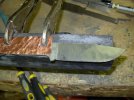
Knife in Progress.

...The 3 main problems are:
1. It takes forever, is very draining and there is no satisfaction in working. Some said that they found filing therapeutic and enjoyable, I beg to differ. :grumpy:
2. The file flexes, that is why my grind line is "S" shaped on one side. :mad:
3. My grind is too shallow to have crisp grind lines, which I love the looks of.

I cut, shaped and drilled two blanks out of leaf spring (5mm) on Sunday. I also cut the bevels of one of the blanks with the help of an angle grinder + jig/files. It took me about 1h30' to cut those bevels (4"+ blades). You are about to build yourself a KMG but until then, maybe it is worth giving the angle grinder a try as I suggested you long ago. You are almost finished on this one, so do it with the next.

If you are having problems with the grind line it could be for a lot of different reasons like the stock not being perfectly flat, the stock flexing, your jig flexing, etc. I guess that the file flexing is not one of them. If there is some absolutely rigid steel in your shop... ¡then it is on your files!

If you are not happy with the grind lines, instead of a saber grind, make them full flats. It helps covering imperfections.

Mikel
 
Keith, great work! WHen I found out how to use files, I almost, ALMOST thought "now why did I go spend that money on the grinder?" :) .

I will trade you my file for your grinder :)

Keith, I forgot to mention tool dye. If you add some tool dye (like Dykem) then it makes it much easier to see where you're high/low and where you're approaching your desired shape. :)

I use magic marker to see if my grind is going all the way up when I change the angle on the jig. Since the angle stays the same, it should be even if the grind line is straight. (theoretically)

If you don't have tool dye (dykem) just laying around your shop :) magic marker works too ;)

Keith, remember this... knifemaking is one of those things where just being stubborn is probably more important than being talented. I know a lot of talented guys that get stalled or quit because they couldn't work through a problem, I know pigheaded guys with no talent that do well because they refuse to quit.

What I think is that you're probably real close to getting finished, a lot of knives stall out where you're at... right before you're finished. So finish the knife and become a knifemaker.
Kieth, work toward excellence not perfection. Perfection is nearly impossible to achieve, excellence is not. Look up the definitions and understand the distinction between the 2 well. It will make a big difference in many areas of your life.

Knife making is all about the journey not the destination. Each knife is a jouney of different operations that if done properly in the proper order will produce a quality knife. Your dedication to achieve excellence while moving through these operations is only limited by your knowledge, skills and determination. The knife becomes a true reflection of you. If the journey goes well the destination, or the finished knife, will be an extension of you and your ability.

In a very small way tools determine how nice a knife you can make. You must have the basics, but you do not need anything fancy to make a nice knife.

I like making knives because it is simple in concept, but very complicated in process if you want to make a good one. Also there is a lot of science that needs to be learned on the heat treating side. Knife making is humbling and things like filing and sanding are mundane, but when you are done with the journey and you have a knife that is made to the best of your ability, it is really cool. It is also cool to see the reaction of someone when you hand them one of your knives and they use it and it holds an edge better than any knife they have ever used.

Enough of my BS, go draw file the heck out of that knife and then get on with the sanding. I am sure when you are done it will be bad a$$.
It's coming along nicely Keith. Good job! :thumbup:

Unfortunately, age has nothing to do with impatience. After 46 years, this past year of learning to make knives has finally taught me to be patient. Like you have choice with steel. It's a lesson better learned early on, I promise. Hang in there buddy, it will come together in good time. :)
Don't ever ask to learn patience..... you'll be put in situations to practice it ;)

The motivation has been fantastic. I found the part about excellence vs. perfection very relevant in my day to day life, thanks again, guys.

Keith, I have found the best motivation is to put notches into your knife. It gives you an extra reason to keep draw filing until its perfect.

I could try that by filing my knife in one spot till it is perfect, that is what I did with my first knife, seemed to go faster (It was 2" shorter though :o)

hi, nice job.
what is the angle of your blade

The primary bevel is around 2 degrees.

Keith,

Draw filing:

The single cut mill file (bastard, second, smooth cut and they run from 4" to 16" but "bastard cut" is not the same fineness across that range) only cuts in one direction. If you are pulling it, the tang needs to be in your left hand to cut... tang in your right hand if pushing to cut.

Bear down on the cut stroke, ease up to return. Your files will stay sharp longer if you don't drag across the steel on the return.

And don't buy cheap files... they will try your patience and they will win.

Mike

Thanks, I will try that. I don't like it when I see people trying to cut on the back stroke. Just bothers me. I am using a 2nd cut Nicholson (double cut) file so far because it was new, I am trying out a "Handy file" (double cut on one side, single on the other, extra long and with built in handle like and axe file).

I cut, shaped and drilled two blanks out of leaf spring (5mm) on Sunday. I also cut the bevels of one of the blanks with the help of an angle grinder + jig/files. It took me about 1h30' to cut those bevels (4"+ blades). You are about to build yourself a KMG but until then, maybe it is worth giving the angle grinder a try as I suggested you long ago. You are almost finished on this one, so do it with the next.

If you are having problems with the grind line it could be for a lot of different reasons like the stock not being perfectly flat, the stock flexing, your jig flexing, etc. I guess that the file flexing is not one of them. If there is some absolutely rigid steel in your shop... ¡then it is on your files!

If you are not happy with the grind lines, instead of a saber grind, make them full flats. It helps covering imperfections.

Mikel

The files don't flex that much, it is just that my angle is so shallow that any bearing down will cause it to go off a little. I am positive that this is the reason because the stock is precision ground and solid and with the handle I added, all of the force goes into the file and not onto the jig. It should clean up fine, it is only out less than 1/16".
 
I am using a 2nd cut Nicholson (double cut) file so far because it was new, I am trying out a "Handy file" (double cut on one side, single on the other, extra long and with built in handle like and axe file).

Keith,

I've got a number of mill files. I draw file a lot. A 12" smooth mill file moves a lot of metal. If I were not doing bulk metal removal with a 2x72 grinder, I'd do it with an angle grinder, then draw file with a large, bastard cut, mill file then refine the finish draw filing with a 6", smooth cut, mill file.

That doesn't deal with the ricasso/plunge cut. See if you can come across a round edge joint file. They will cut down and/or sideways, depending on the direction of pressure. A piece of tape on the bottom or edge can be helpful.

Goto > http://www.falcontool.com At the bottom of the page there is an e-mail link to request a free catalog. Falcon Tool doesn't sell junk files, though some are better than others. I buy my polishing stones there, too.

One last thing... Keith Kilby (ABS MS & principal in Wyoming Armoury, Cody, Wyo.) told me this summer if he was only allowed to have one grinder, it would be a 9" disc grinder. 9" disc grinders are cheaper to get into than a 2x72, by and large.

Mike
 
Kieth, I was in your exact same shoes at the start of this year. The advice of some of the best makers in this thread is fantastic and I could have used some of the encouragement here. My first 4 knives were 70 to 90% shaped by filing and it sometimes is tough to get back out to the shop when it seems as your shoulders and arms are ready to sieze.

I like the advice about stubborn, my first 3 are almost done and stubborn was a good attribute to have. The part about wanting to make knives and being a knifemaker makes me think, I can't call myself a knifemaker yet, but I'm enjoying the process, for the most part.

I read once that the average knifemaker quits 6 times, I'm up to 2 now, once when my arms were going to fall off and a week ago when I dropped an almost complete Santouku that is sold and had to repair it (remove and replace/refinish scales).

Keep up the good work Kieth, there is nothing I can add other than to echo the great advice given.
 
Those are pretty cool filing jigs. I saw one on utube in action. I believe the gentleman is from the outback as he uses very little primitive tools.
 
Now I am really pissed off.

I have very cautious not to bugger up the grind line, which is aesthetically one of my favourite parts of a knife, and now I managed to ruin it. I have made it a full flat grind, it will probably look like a piece of crap.

and to think that I could have ground this on a friends 4/132" grinder and be done by now and have a better grind.
 
and to think that I could have ground this on a friends 4/132" grinder and be done by now and have a better grind.
That may be true Keith. However, it's all about experience, good and bad. Forget the end result and think about what you have learned doing it by hand. Not only what to do, but more importantly, what not to do. All of that experience will carry forward into your next knives.
I'll get off of my soap box now, starting to sound like an old coot.:D
 
I dont think I learned that much more than I did filing out my first knife :)

I tried a bit of draw filing today because of it's rave reviews, and I all I managed to do with my new single cut file was causing scratches. I used it in the correct direction, and cleaned regularly, but was not satisfactory compared to conventional filing.
 
Keith,

When I draw file... Nicholson 12" mill smooth... I get little wires if the surface is flat and I'm steady. It's hard to tell from here what you are doing that isn't working. Take a look at the teeth of your new file under a light and see if there are little shine lines along the edges. Usually starts as a specks of silver and progresses to lines, actually.

Mike
 
I have seen them, but what is a mill file? The file I am using now, the "handy file" is probably the same as 2nd cut. I was still using my guide so it was running flat and straight. I didn't try for very long when I realized that it was just scratching and not removing metal maybe if I tried longer I could get it cutting but I don't see the point when the normal filing does such a good job.
 
I don't have a filing jig like yours but I find that drawfiling really helped me get flat surfaces. It's much easier to hold the angle steady when you have two long levers on either side of the piece. There was a post a while back about sanding blocks and the original poster stated that his hand sanding improved enormously when he switched from a short chunk of wood ( a pen blank IIRC) to a foot-long, i.e. file-sized, board. I also highly recommend Nicholson Magicut files. I had to get mine online but they were worth the wait. And in the interest of full disclosure, I have a metric shitload of files AND a NWGS 2x72 but I still use the files more. My grinder scares the hell out of me. I can screw up a grind in 1/100th the time it takes with a file. :D
 
One other thing that's worked for me is, if your current knife is pissing you off, quit it! Start on another one. When that one pisses you off, switch back to the first. That's the luxury of not making knives for a living. :)
 
I have seen them, but what is a mill file? The file I am using now, the "handy file" is probably the same as 2nd cut. I was still using my guide so it was running flat and straight. I didn't try for very long when I realized that it was just scratching and not removing metal maybe if I tried longer I could get it cutting but I don't see the point when the normal filing does such a good job.

A couple of things, Keith... Mill file are single cut. That is, have a single line of teeth angled across the faces. Double cut files have two lines of teeth intersecting and making little diamonds on the faces.

A person gets choices and makes them or not, so don't draw file.
--------------------------------------------------

Jackrabbitslim,

And there is some short versed wisdom a person doesn't often find... good lick, "Jack".

Mike
 
I am running with the full flat grind, and am almost done filing. I just need to do some filing near the tip on one side.

Here is a picture of the less finished side. I plan to leave a sliver at the top so that I keep the full thickness at the spine.

attachment.php


One other thing that's worked for me is, if your current knife is pissing you off, quit it! Start on another one. When that one pisses you off, switch back to the first. That's the luxury of not making knives for a living. :)

I was close! I almost started making a 3 1/2" hunter/camp knife.

A couple of things, Keith... Mill file are single cut. That is, have a single line of teeth angled across the faces. Double cut files have two lines of teeth intersecting and making little diamonds on the faces.

A person gets choices and makes them or not, so don't draw file.
--------------------------------------------------

Jackrabbitslim,

And there is some short versed wisdom a person doesn't often find... good lick, "Jack".

Mike

Ok, so what would be the difference between a smooth single cut file and a file marked mill?

It is nice to have the option, so I decided not to do any draw filing, I could get it flat with my jig and I am getting a pretty good finish.
 

Attachments

  • DSCN2664_800x600.jpg
    DSCN2664_800x600.jpg
    72.2 KB · Views: 623
Keith

Looking good! Patience my friend, it is supposed to be fun and it looks like you are doing a great job. No troubles, it is about time to sand and before you know it you will have a knife ready to heat treat. Carry on with the good work!!!
 
Ok, so what would be the difference between a smooth single cut file and a file marked mill?

Shape... Mill files were/are used in saw mills so the shape evolution of a mill file is condusive to working on big saw blades... not like mill files aren't/haven't been used in a lot of places for a lot of things. Big ones make things flat, either drawn or struck.

Mike
 
A quick update, I spent today redoing the filing in some parts and squaring the plunge lines with a lathe bit clamped to the blade. I then sanded one side to 120, that took a while! Maybe I will get some pictures up later.
 
I am going to need some help:

I think I over did the bevels and made the edge about 0.02"
Is this too thin?

I found out that the kiln that we have at school is big enough to heat treat my knife in, and my metal teacher offered that I could do it there.

I know that for O1 some nice quenchant like parks AAA would be best, but what would be the best oil that can be found easily in town?

I will be using this for the heat treatment http://www.cashenblades.com/Info/Steel/O1.html

Thanks!
 
.02" is a bit thin from what i gathered for a bigger knife in O1 but it should be ok, it's what im aiming at with my Wharncliff. Maybe take 5 minutes to just file back the edge a bit to be safe as your new to heat treating.
 
I would have to file the edge back about 0.1" just to get the edge to 0.025, so I think I am stuck with this.

Would it be worth it to do a 1200 degree stress relieving stage?

What is the longest my knife should spend un-tempered?
 
Back
Top