Knife Test?: I called BS on this.

We have. Hardness and shape are both important. When cutting end grain wood with a chisel buckles the edge, there are two ways to fix it. Make it harder (stronger) or make it thicker. However, each can only be taken so far. Razor blades will buckle no matter how hard they are and 90 degree edges won't cut well no matter how sharp. In this case we don't have that kind of difference in material hardness, so geometry plays a more significant role. We have a competition cutter (Busse) vs. a robust short sword/tanto type design. I'd still like to see some actual measurements, other than the depth of dent/chip.


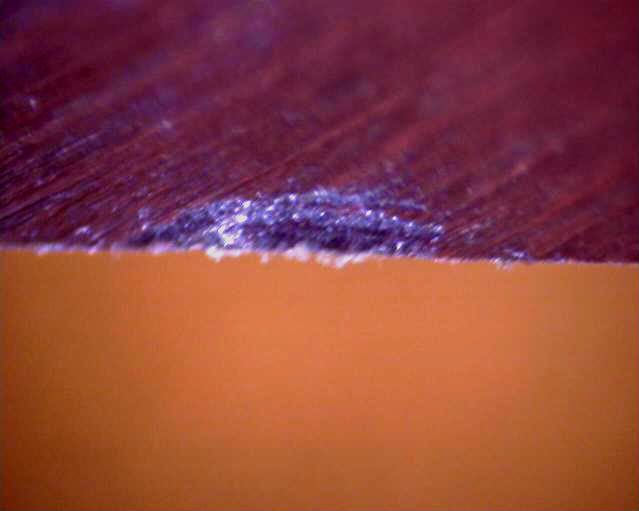
I'd love to see magnified views of the impact areas.
 
I'd love to see magnified views of the impact areas.


Ok :)

Scrapyard scrapper 5, intentional hit to a brick to create chip. Picture at 200x

PIC101-1.jpg


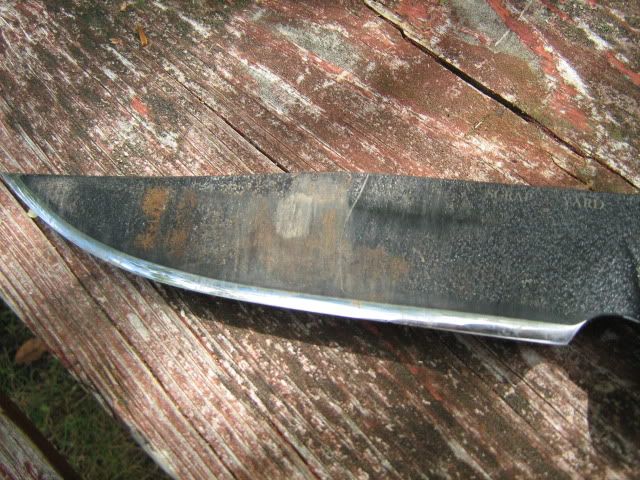
Scrapyard Regulator, Convexed edge (microbevel added after impact), In a full swing I hit a 2x4 on end to split for a fire. There was a metal, copper coated staple I did not see and the knife made direct contact. The swing completed through the 2x4 but I knew I hit something hard, upon inspection of the edge I noticed what I thought was a large chip. The metal staple was struck near the end and bent in the shape of the edge before being pulled away from the edge and dragged up the side of the blade. No, it did not cut the staple.

As you can see from this pic the metal did not chip but rolled up on the other side of the blade, also known as a deformation. This is what you want to happen if anything.

Picture1557.jpg


You can see about mid blade where the staple scraped into the coating
Picture1559.jpg
 
I know what this type of Filipino are called "Filipinos with CRAB MENTALITY":grumpy:

Just because I don't see any validity in that test? LOL.

You're not a mod here so let's discuss it without your panties getting all bunched up. In that local forum you were a mod so you pulled rank on me.

You just deleted everything else and put "go pinoy products".

I did not object to this test just because the tester was Filipino, but because I believed that it was nothing but a "test" of a thick edge vs. a thin edge of blades with similar hardness. This was my argument in that forum were you merely deleted everything.

Just because I do not think that the "test" proves which is a better blade, are you then trying to say that this is now a Filipino vs. US thread and you're calling me a traitor? :p

I am not anti Pinoy but I am anti "smoke and mirrors". As Jerry Busse commented in a post about edge on edge tests:


3.) Mostly it supports the premise that con men and magicians count on. . . . smoke and mirrors and misinformation.
 
Last edited:
I think he means that when the dent is that large, it isn't any better than a chip because of the amount of metal fatigue and sharpening work to fully restore the edge to good steel with uniform sharpness.
 
Hitting one piece of metal with unknown geometry and unknown hardness, with another unknown piece of metal, at an unknown speed, doesn't allow anything more than some bad guesses about relative hardness and strength, and maybe a very bad guess about toughness. Actually, I don't think you can make any worthwhile conclusions even if you know the geometry and hardness of the samples. It is really just "something to talk about" from a scientific perspective.
 
Its a failure mode, would you rather have a edge chip out or dent?

Interesting question. I guess that I would prefer a dent in a big chopper and a chip in a small utility. I'd rather have an edge roll in a chopper so that microcracks dont propogate vs. the necessary high hardness for edge retention in the utility.
 
Hitting one piece of metal with unknown geometry and unknown hardness, with another unknown piece of metal, at an unknown speed, doesn't allow anything more than some bad guesses about relative hardness and strength, and maybe a very bad guess about toughness. Actually, I don't think you can make any worthwhile conclusions even if you know the geometry and hardness of the samples. It is really just "something to talk about" from a scientific perspective.

I agree. Forums are for talking about stuff.
 
Back
Top