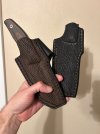
Lets see your CPK in Leather!

IMG_0134.webp
All right! Another leather question.

Setting aside taste — we’ll come back to it — is there a kinda sorta consensus on what leather works best for sheaths? Bear with me.

I know use and enjoyment are subjective. But if we put it in terms of wooden scales, there’s lots of room for taste, with intricate burls and spalted woods and flamed grains, etc etc. — but there’s a kinda sorta consensus that desert ironwood is difficult to top, for durability, rot resistance, stability, and so forth. Lots of other woods are excellent. Lots of others are beautiful.

Is there an equivalent in sheaths? An agreement that kangaroo or buffalo or shell cordovan or cow leather or *whatever* is tough to beat on objective qualities, even if there’s a much broader array of favorites?

(I’ve never seen a shell cordovan sheath, but I suspect it would be incredible.)
 
Last edited:
J Jack Lewis

Shell cordovan sheath I did awhile back.

IMG_5066.jpeg

Everyone has their likes and dislikes for what leather they use. If your asking cause your going make some sheaths. I’d start out by buying small pieces of different leathers. Get a feel for them and how you like them.

I personally use cow leather and exotic leathers for overlays or inlays
 
J Jack Lewis

Shell cordovan sheath I did awhile back.

View attachment 3090887

Everyone has their likes and dislikes for what leather they use. If your asking cause your going make some sheaths. I’d start out by buying small pieces of different leathers. Get a feel for them and how you like them.

I personally use cow leather and exotic leathers for overlays or inlays
Very cool — as I said, I’ve never seen that before. How did you find to work with? Does it mold well? I know shell costs a bit more, but I’m surprised more people don’t work with it, for sheer durability.
 
Thank you 🙂

It’s different to work with that’s for sure. It’s actually expensive I’d say , sections don’t come in larger pieces. And if you’re selective with your cut it will not yield as much. Great for wallets and such though.
Doesn’t mold easy takes a bit of work to get right. It’s usually thinner weight , so for a sheath or holster I feel it should be used as overlay. But it is some durable leather.
 
Thank you 🙂

It’s different to work with that’s for sure. It’s actually expensive I’d say , sections don’t come in larger pieces. And if you’re selective with your cut it will not yield as much. Great for wallets and such though.
Doesn’t mold easy takes a bit of work to get right. It’s usually thinner weight , so for a sheath or holster I feel it should be used as overlay. But it is some durable leather.
That it doesn’t mold easily, and tends to be thin, probably answers the question of why people don’t tend to use it. Not ideal qualities in a sheath.
 
Last edited:
View attachment 3090847
All right! Another leather question.

Setting aside taste — we’ll come back to it — is there a kinda sorta consensus on what leather works best for sheaths? Bear with me.

I know use and enjoyment are subjective. But if we put it in terms of wooden scales, there’s lots of room for taste, with intricate burls and spalted woods and flamed grains, etc etc. — but there’s a kinda sorta consensus that desert ironwood is difficult to top, for durability, rot resistance, stability, and so forth. Lots of other woods are excellent. Lots of others are beautiful.

Is there an equivalent in sheaths? An agreement that kangaroo or buffalo or shell cordovan or cow leather or *whatever* is tough to beat on objective qualities, even if there’s a much broader array of favorites?

(I’ve never seen a shell cordovan sheath, but I suspect it would be incredible.)
I've read kangaroo has the highest strength to weight ratio, but I don't think strength is really a concern unless you want to make a very lightweight sheath. A nice thick leather sheath shouldn't weigh much to begin with. So if strength is not an issue, perhaps abrasion resistance is more important? Shark leather should be the winner then.
 
I've read kangaroo has the highest strength to weight ratio, but I don't think strength is really a concern unless you want to make a very lightweight sheath. A nice thick leather sheath shouldn't weigh much to begin with. So if strength is not an issue, perhaps abrasion resistance is more important? Shark leather should be the winner then.

Agree with the Shark leather.

Disagree with J Jack Lewis ’ statement on desert ironwood. Like cocobolo and ebony, I feel it’s a fashion in the knife world, and that’s it. If you look at what other great woods are used in other areas, e.g., guitars, handgun grips, etc, that most knife makers don’t even consider, you’ll see what I mean.

Plus, I have some bog oak scales that held up > 7k years, don’t believe desert ironwood can beat that wrt longevity.
 
Last edited:
Agree with the Shark leather.

Disagree with J Jack Lewis ’ statement on desert ironwood. Like cocobolo and ebony, I feel it’s a fashion in the knife world, and that’s it. If you look at what other great woods are used in other areas, e.g., guitars, handgun grips, etc, you’ll see what I mean.

Plus, I have some bog oak scales that held up > 7k years, don’t believe desert ironwood can beat that :)
Yes, there are several species from Africa and especially Australia that exceed the density, hardness and durability of desert ironwood, but they are not nearly as easy to buy. And at the end of the day, you don't actually need better wood than that for knife scales.
 
Yes, there are several species from Africa and especially Australia that exceed the density, hardness and durability of desert ironwood, but they are not nearly as easy to buy. And at the end of the day, you don't actually need better wood than that for knife scales.

You don’t need the density, hardness and durability of desert ironwood either.

Gets kind of boring is my point :)
 
Interesting. I’m curious to hear more. Mpingo?
The Wood Database is a good resource for finding woods with specific properties. Here's a list of woods significantly harder than desert ironwood:


You'll see most of them are either commercially unavailable (most Australian hardwoods) or extremely rare and expensive (lignum vitae, ebony, snakewood). And the few remaining woods don't look as nice as desert ironwood.
 
Appreciation post for cpirtle cpirtle

Solid dedicated sheath maker for all of us CoCKs. Second to none quality and some of the best customer support I have ever came across with any business. Not to mention a 100% stand up dude who shares the same passions that we do. Just an uninitiated shout out for a much deserved member of our community!

IMG_2742.jpeg
 
Appreciation post for cpirtle cpirtle

Solid dedicated sheath maker for all of us CoCKs. Second to none quality and some of the best customer support I have ever came across with any business. Not to mention a 100% stand up dude who shares the same passions that we do. Just an uninitiated shout out for a much deserved member of our community!

View attachment 3091786
Thanks bro! 🫶
 
In my experience Elephant is more durable than shark. It’s hands down the most durable hide I’ve worked with or carried and used. I have a J frame pocket holster I made around 2008 that was in my pocket every day for at least 12 years and looks as good as the day I made it.

I’ve worked with shark fairly extensively and it’s an amazing hide, thin with great wear resistance. Shark hides come from the black tip shark and tanning them only came into existence as a way to use more of the animal than just cutting off its fins for soup. The black tip is in the process of being added to the endangered species list, which means all legal harvesting is coming to an end. Unless something changes what’s out there is what’s left and the little I have seen is going for scalper rates &/or pretty ratty.

I am doing some testing with horse and kangaroo currently, both reported to be very durable.

It’s important to know that no exotic leathers are tanned firm enough for safe use alone on a knife sheath. Most are intended for the garment or upholstery industry which is where 95% of leather ends up. Those of use who want to use it for sheaths have to back it up against more appropriate hides.

Bill - I’ve seen that Cordovan and was tempted, that sheath looks stunning, great work!!
 
In my experience Elephant is more durable than shark. It’s hands down the most durable hide I’ve worked with or carried and used. I have a J frame pocket holster I made around 2008 that was in my pocket every day for at least 12 years and looks as good as the day I made it.

I’ve worked with shark fairly extensively and it’s an amazing hide, thin with great wear resistance. Shark hides come from the black tip shark and tanning them only came into existence as a way to use more of the animal than just cutting off its fins for soup. The black tip is in the process of being added to the endangered species list, which means all legal harvesting is coming to an end. Unless something changes what’s out there is what’s left and the little I have seen is going for scalper rates &/or pretty ratty.

I am doing some testing with horse and kangaroo currently, both reported to be very durable.

It’s important to know that no exotic leathers are tanned firm enough for safe use alone on a knife sheath. Most are intended for the garment or upholstery industry which is where 95% of leather ends up. Those of use who want to use it for sheaths have to back it up against more appropriate hides.

Bill - I’ve seen that Cordovan and was tempted, that sheath looks stunning, great work!!

Thank you !!!! Truly means a lot to me coming from you 🙂🙂

I’ve worked with horse leather , but not for sheaths. Strong stuff.

Always love seeing your work, especially the overlay pieces. Always just Great work !!!!
 
It’s important to know that no exotic leathers are tanned firm enough for safe use alone on a knife sheath.
I’m ignorant of what qualifies as exotic. Kangaroo? You mentioned elephant hide — does it need a different backing?

For what it’s worth, I’ve dealt with kangaroo hide in other contexts, and it’s a unique leather in that it has no grain structure. It’s effectively crosshatched, which makes it unbeatable for strength and abrasion resistance. Its limiting factor, though, is its thinness.

And thanks for an educational post. I enjoyed that.
 
my homies ain't gonna have to wait TOO much longer now. Heavy lifting is done, fiddly finish work is left to do
aNmqKHG.jpg
 
Back
Top