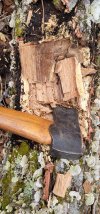
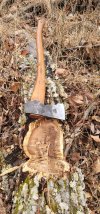
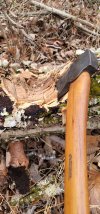
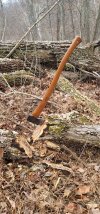
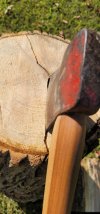
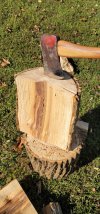
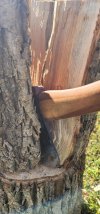
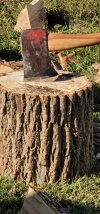
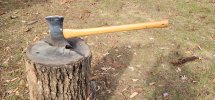
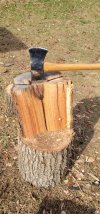
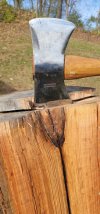
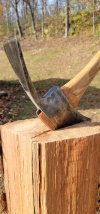
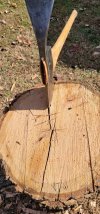
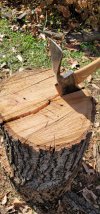
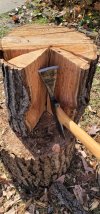
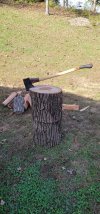
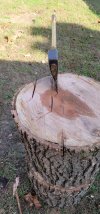
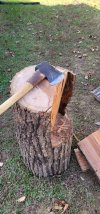
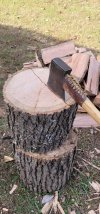
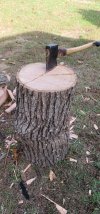
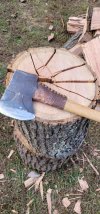
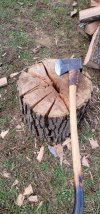
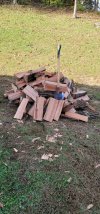
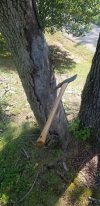
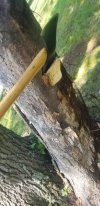
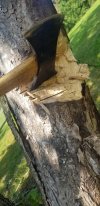
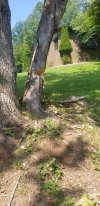
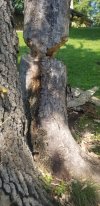
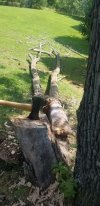
Lets use those axes for what they were ment for.

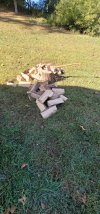
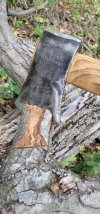
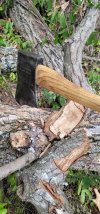
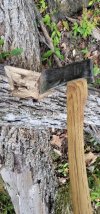
i went to make fire wood for my fire pit with an axe (2 kg slip fit french talabot on a 76 cm red oak haft) leaved the pile in the forest and came back with hand full of boletus
You know the drill, pics or it never happened! 😉
 
I fell, buck, and split about a cord every year with just an axe, and I use none of those things. Unlike splitting, you dont buck downwards, you stand next to or on the log and buck from either side. Even the "either side" thing is a generalization, I typically buck from each side but angled down a bit, so the top gets opend up for better access as you work further under the log. The downward angle fluctuates depending on the size of the log and how its lying, I fell all my wood selectively in thick timber... if portions of the log are suspended a bit above the ground when it lands, it makes it easyer to keep the axe out of the dirt but it also means I've got to chop out my notches with more of a downward angle to get through the bottom cleanly.

A bit of planning goes a long way towards keeping the log from hopping around too. I'll typically notch the log on one side all the way down before actually hacking off any rounds from the other, leaving the limbs on as long as possible. Often rather than go from end to end I'll shuffle through the various sections in conjunction with limb removal to best advantage, usually leaving a few big ones to keep it from rolling when I come at the other side. When you finally do take off the rounds I'll do the butt end first, since it takes lots of swings you want the rest of the log holding it still. Then the top, since its so light you also want it attached to a fair bit of log, then the middle, once again working around whatever limbs you've left attached to best advantage.

Hard to get a picture of it all since my axe cut wood ends up mixed in with all the stuff I cut with a power saw, but heres a face-cord-plus I hauled in, right now I've got about 3 more of these that are seasoning in the bush for the summer, and I'll haul them out with a big toboggan when it snows.

RIMG0076 by https://www.flickr.com/photos/153108294@N08/, on Flickr

Some nice white paper birch......That stuff is a pleasure to work with...Start to finish!!!! Some guys here need some of that birch bark in the puukko thread!!!😉
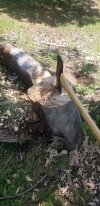
 
Some nice white paper birch......That stuff is a pleasure to work with...Start to finish!!!! Some guys here need some of that birch bark in the puukko thread!!!😉
Birch is the most efficiently burning wood that we have up here. Given the amount of effort that goes into axe bucking a cord of wood I pretty much only chop birch, though I'll harvest other species with the chain saw. The downside is you dont find it growing anywhere easy to get at, usually you're in for some tricky felling, as well as a bit of hauling. Though it sounds pretty oldschool, finding stands that are uphill of the road and using a big sled to skid the rounds out is actually the most effecient way of getting a truckload that I've found.

Most guys who burn lots of birch around here have some forestry connection and are taking it from log decks. Its a source of some pride that I'm one of a very few guys who heats a house on "honest birch" for most of the winter.
 
Last edited:
Birch is the most efficiently burning wood that we have up here. Given the amount of effort that goes into axe bucking a cord of wood I pretty much only chop birch, though I'll harvest other species with the chain saw. The downside is you dont find it growing anywhere easy to get at, usually you're in for some tricky felling, as well as a bit of hauling. Though it sounds pretty oldschool, finding stands that are uphill of the road and using a big sled to skid the rounds out is actually the most effecient way of getting a truckload that I've found.

Most guys who burn lots of birch around here have some forestry connection and are taking it from log decks. Its a source of some pride that I'm one of a very few guys who heats a house on "honest birch" for most of the winter.
That's great...I miss doing.......Enjoy it.👌
 
Hi everyone. Today I used axes! I felled some large poplars with a chainsaw, but I used axes for branches and small branches.

First, the biggest axe on the job site, a Sandvik 3 3/4 according to the stamp, but it seems lighter than the supposed 1.6 kg anounced. Anyway, a superb slicer for wood up to 5 inches thick, sometimes in one go! Firewood it was!

My Canadian axe,( Montreal pattern no brand) weighing 1.2 kg, was no slouch either, cutting wood sometimes as thick as with the other one.
The Sandvik has a homemade elm handle, a real pain to carve, the wood is so hard.

The other one has a crooked eye; I had to make a slightly twisted handle to compensate, but it broke recently. (Broken 3 handles in one week) I made a temporary one out of chestnut... also warped...
In short, a real pleasure to use when you want to quickly make kindling, pile it up nearby, and then make a heap of the branches you're not using...

yesterday i used a hatchet to cut kindling all day, up to an eigth of a cord, my elbow was sore...
 
The Wetterlings 32h in the first set of pics is an absolute beast. Anyone saying swedish axes won't perform in American hardwoods hasn't used the 32h

This is logical waynemanning74 waynemanning74 , as Hults Bruk States actual Swedish axe patterns root in North American ones

"Gunnar was born and raised at Hults Bruk and spent a lot of time visiting iron factories in England, Belgium, and the United States to learn about manufacturing. By the early 1900s, American axe models like the Yankee, Ohio, and Turpentine would replace nearly all of the traditional Swedish axes."

Source
 
yesterday i used my 2kg800 ( "talamont" + local smith brand ) french slip fit axe, on a 90cm haft
, home made in black locust (fast grown) , under an annoying rain, to help cut the fibers off the poplar i splitted with an hydraulic splitting machine. wood was green and full of nasty fibers that held wood together. had to aim precisely thru small slots to get rid of long fine strips of wood.
not easy with such a beast!
no lullaby needed!
 
This is logical waynemanning74 waynemanning74 , as Hults Bruk States actual Swedish axe patterns root in North American ones

"Gunnar was born and raised at Hults Bruk and spent a lot of time visiting iron factories in England, Belgium, and the United States to learn about manufacturing. By the early 1900s, American axe models like the Yankee, Ohio, and Turpentine would replace nearly all of the traditional Swedish axes."

Source
usefull info, thank you.
 
Thank you F flexo2 . Here you can find more interesting information, specially this one,

"The owner of Hults Bruk at the time, an ironmaster named Gunnar Ekelund, ventured to America. He brought back not only new production techniques, but also hickory handles and axe designs such as Montreal and Yankee patterns. With time these became some of our most popular and enduring axe models."

It’s always a pleasure to look at old catalogs. Take a look at the first two, there you can see which were the first Swedish/Scandinavian pattern axes and the huge transformation the range underwent in just 6 years. Just the years we are talking about.


You can also see this image in the 1890 catalog. They don’t mention it, but it’s evident that they also studied Spain and areas influenced by Spanish tradition.

De tumba SP.jpg

This image opens the door to discussing many uncommon aspects Starting with the almost forgotten Spain and the Spanish influence on the axe world; continuing with the likelihood of a convergent evolution of the high centerline; how slip fits with substantial square polls were actually produced; why European, especially Spanish and more specifically Basque axes have this characteristic toe; and the different ways each culture tends to name its tools (for example, the name ‘de tumba’ we see here refers neither to a pattern nor to a place).

Regards
 
The "de tumba" pattern is one of the most common Latin American patterns, both historically and at present, with the other most common being the "labor" and "media labor" styles.
 
Back
Top