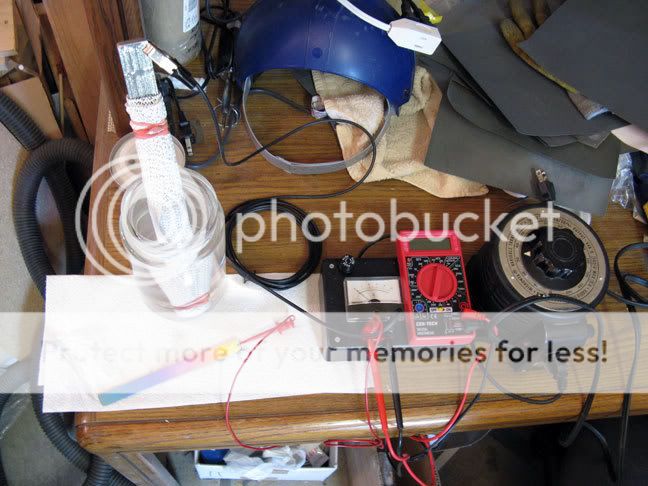
Looking for electro etch plans

Status
Not open for further replies.
I have been thinking of replacing my transformer with a variac. I need to keep an eye out on Ebay.
 
69 Knives -
The stencils are premade by Ernie from your design. He can help if all you need is straight text. You tape it to the blade and dab with the QTip.
 
DIY etcher is working like a champ, now to do some design and make some stencils.

Thanks to everyone that helped.
 
I put in the 24 volt trans from radio shack into my electro chem etcher.It burned the stencils real fast. I plugged it in to a light dimmer switch and can run it at 12 to 24 volts as needed.
16 volts seem to work fine using a touch 1,2,3 7-8 times
Try a dimmer switch on the Crawford/Warner model.
TJ
 
I've got it set for 12/24. I actually finished it over a week ago and verified voltage. Last night I actually tried it out on a piece of stainless, salt water, and a q-tip, could definitely tell the difference between the 2 voltages. 24 gives a nice sizzle.

How deep do you usually etch? Should you be able to feel the depth if you scrape with a fingernail?
 
What does everyone use for etching solvent? I just scored two etching machines off ebay for $80. Marking methods and Monode.

Eric
 
About one cup of water to one tablespoon of salt is all I use for etching. It's worked great on O-1, 440C, and CPM154. Careful about adding too much vinegar or you'll risk creating too acidic of a solution and discoloring your steel around the etch.

--nathan
 
4 oz vinegar 1 tblspn salt, warm it up in micro wave then get to work, dont hold on the stencil long. less than a second mulitple times and keep the q-tip wet to keep the stencil from burning up.
 
anybody have a picture of the Q tip method, how you hook it up ? I built the Crawford one and I seem to blow out the stencil on the first try, gonna try the 12 volt but can't picture the Qtip deal
thanks
Gary
 
If someone would please assist me, I have three questions. I don't know a whole lot about electronics, I just follow the instructions.
I built a machine similar to Mr. Warner's. The machine does a pretty decent job of anodizing. I never got around to adding a AC/DC switch to my project-box, but I need to do that soon so that I can do some etching.

1. While anodizing, it's difficult for me to control the voltage. I have to really finesse the thing to get and maintain a consistent voltage during anodizing. If I submerge my workpiece and try to go straight to the voltage I want, the voltage keeps climbing. It doesn't matter if my variac is set to something like 50 volts, the amp-meter will slowly climb over 160V. To finesse it, I start at 0V and then slowly turn the voltage up in steps. If I'm very careful about it, I can make the voltage stable.
Is there anything I can do to improve my machine so that it will maintain a stable voltage while anodizing?

2. Whenever I show my machine to people they always ask me how I am getting by without a capacitor. Everyone seems to think I need one. One person guessed that maybe the anodizing solution was acting as a capacitor. My question is, do I need a capacitor and if so what type and size would I get?

3. I have a 30AMP variac. Is there any reason that the higher amperage would be a problem for etching? Should I add some electrical component to limit the amperage? My machine has volt and amp-meters installed, so I could monitor those during etching.
 
Last edited:
I figured he must already have a rectifier....

He said he's anodizing already.

I toyed with putting a capacitor in mine for a while just to stabilize the thing, but decided it wasn't necessary.
 
Last edited:
Here are some pics

Anodizer-RUGUR.jpg


Edit - I had put up a techinal drawing of my anodizer and then thought that I may be being inconsiderate to Mr. Warner so I have removed it.
 
Last edited:
I saw your drawing before it went away.

Pretty sure you have the amp meter hooked up incorrectly.

Ammeters get wired in series, not parallel.

Don't know what kind of effect this would have on your process, but the meter reading wouldn't be accurate.

So, if I'm not mistaken, if you want to read your amps, you would hook the negative of your meter to the positive on your anodizer, then use the positive off the meter as your lead for the anode...
 
I will try setting up my volt meter they way you suggested. That really seems to make sense. I will try it tonight. It would be great if that fixed my run-away voltage issue.
Thanks for the help :)

It seems like I have been getting accurate measurements from my volt-meter even though it is set up in an odd way. The colors showed up at the voltages that I expected them to and with care I could use the volt-meter to get repeatable colors on multiple titanium work pieces.

I sent an email off about this. I'm trying to get an electrical engineer to review the design and suggest improvements. If I figure out anything interesting, I'll report it here.
 
Status
Not open for further replies.
Back
Top