"Made in Sheffield" 1830-1930, A golden age ?

WinMag775 WinMag775 Another fine example, and in the correct time period :thumbsup: Wonder if the colouration of the bolster (and similar with the one you showed on post 2993) is perhaps a result of a higher copper content in the German Silver bolster, as it was called ?

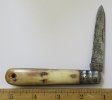
That's an interesting observation...I had bought this Brookes & Crookes a few years back, and at the time, I thought that the bolsters were brass. Turns out they are NS...
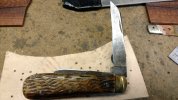
b&c1.jpg
 
That's an interesting observation...I had bought this Brookes & Crookes a few years back, and at the time, I thought that the bolsters were brass. Turns out they are NS...
View attachment 3147695
According to Wikipedia:

"Brass is an alloy of copper and zinc"....
...."Nickel Silver: "The usual formulation is 60% copper, 20% nickel and 20% zinc."


I've heard NS called "white brass" before.

Great old knife, by the way.
 
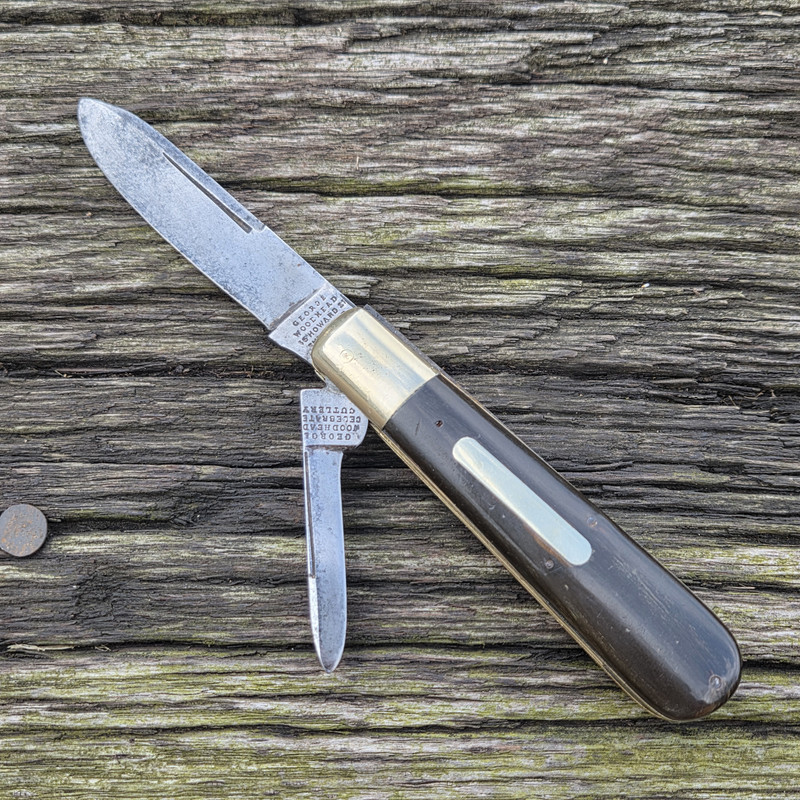
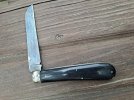
4 1/4" Bearhead Jack by George Woodhead, 36 Howard Street, Sheffield, c.1849–1876.
The bolsters and shield exhibit a golden hue, consistent with aged brass or similar non-ferrous metal. However, the bolsters appear to be of a dissimilar metal when viewed alongside the brass liners.

20260330-182628.jpg

WinMag775 WinMag775 Another fine example, and in the correct time period :thumbsup: Wonder if the colouration of the bolster (and similar with the one you showed on post 2993) is perhaps a result of a higher copper content in the German Silver bolster, as it was called ?

Congratulations Rob, another wonderful knife to add to your collection :cool:

That's nickel silver :) Howard Street runs from Sheffield train station up to the city centre, and had lots of cutlers and cutlery shops on or close to it. I have walked up or down the hill with a few members of this forum in the past :) :thumbsup:

That's an interesting observation...I had bought this Brookes & Crookes a few years back, and at the time, I thought that the bolsters were brass. Turns out they are NS...
View attachment 3147695

According to Wikipedia:

"Brass is an alloy of copper and zinc"....
...."Nickel Silver: "The usual formulation is 60% copper, 20% nickel and 20% zinc."


I've heard NS called "white brass" before.

Great old knife, by the way.

I believe it is nickel silver with higher Cu content than is typical. I once had a knife rehandled and it started as a shadow pattern and I wanted NS bolsters. When brand new the bolsters were bright silver color but in a short time they had a definite yellowish cast. If I polish them they go back to silver.
 
WinMag775 WinMag775 Another fine example, and in the correct time period :thumbsup: Wonder if the colouration of the bolster (and similar with the one you showed on post 2993) is perhaps a result of a higher copper content in the German Silver bolster.
That's nickel silver :) Howard Street runs from Sheffield train station up to the city centre, and had lots of cutlers and cutlery shops on or close to it. I have walked up or down the hill with a few members of this forum in the past :) :thumbsup:

That's an interesting observation...I had bought this Brookes & Crookes a few years back, and at the time, I thought that the bolsters were brass. Turns out they are NS...
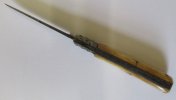
View attachment 3147695

According to Wikipedia:

"Brass is an alloy of copper and zinc"....
...."Nickel Silver: "The usual formulation is 60% copper, 20% nickel and 20% zinc."


I've heard NS called "white brass" before.

Great old knife, by the way.

I believe it is nickel silver with higher Cu content than is typical. I once had a knife rehandled and it started as a shadow pattern and I wanted NS bolsters. When brand new the bolsters were bright silver color but in a short time they had a definite yellowish cast. If I polish them they go back to silver.

Thank for the responses everyone, greatly appreciated!
 
As I understand it, the terms German silver and Nickel Silver are inter changeable, both are alloys having no silver content at all but being this mix of Copper/Zinc/Nickel 60-20-20. Alteration in this alloy proportion could lead to a yellowing effect when tarnished.

The term German Silver was popular in the c19th and early c20th knife catalogues to describe bolsters with a bright silver colour & to differentiate from iron bolsters. The material originated due to German chemists' prowess in the early c19th imitating a process originally from much earlier in China but using the then latest chemical and metallurgy advances. During the industrial expansion in Europe and N.America it was used for table knife handles, ornaments, inexpensive jewellery. pocket-knife bolsters etc. The term German Silver MAY have been replaced by Nickel Silver due to anti German sentiment/Teutonophobia in the Anglo-Saxon zone during World War One. Alternatively, gold and silversmiths may have grown tired of the unscrupulous peddling German Silver as silver proper coming from Germany, which it certainly was not. Silver content can vary between 800 (80%) to 958 95.8% (Britannia silver) or the more usual 925 (92.5%) Sterling silver. English silver has complex hallmarks and Continental silvers have their own purity marks. Hence Nickel Silver may have gained favour as a term to clearly distinguish an alloy containing zero silver.

Another interesting metal, or rather, technique is that of Old Sheffield Plate. This extraordinary skill involved fusing a thin sheet of pure silver over copper. Then beating/ rolling this to make ornaments such as vases, bowls, candlesticks, napkin rings etc. Thus saving money on costly pure silver sheet , this process took hold in the 1740s and became popular for about a century until the invention of electro plating silver onto baser metals such as Nickel Silver, thus EPNS - Electro Plated Nickel Silver was born, a chemical /electrical process much faster and less complex than making Old Sheffield Plate, nor did it bleed through after wear/shining so much- revealing a copper colour. There are still jewellery and accessory items made in rolled Gold I think which essentially borrows on this process as used on Old Sheffield Plate.

Who knows, perhaps rolled silver was used by some knife makers for bolsters, this may well lead to a more 'golden' effect in wear & tarnish?
 
Last edited:
Some very nice examples shown recently.

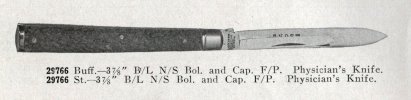
waynorth, Very cool Rodgers physician's knife and enclosed is a catalog illustration from 1927.
The small blade is shown open which partially covers the slightly different main blade etch as seen on your example.

Jack, Two nice examples in your Howarth and Haywood models. I've always liked Haywood's "Kettle" logo.

WinMag775, Two good Lockwood folders, but I especially like your Woodhead model.

rockman0, Very nice Allen pruner. I've become a big fan of pruner models over the years.

glennbad, Fine older Lamb Foot model and nice surprise to find out it has nickel silver bolsters.

Jack, Hard not to fall in love with triple rat tail bolsters as seen on your Francis Newton folder.

Rodgers Physicians Knife 1927 .jpg
 
Last edited:

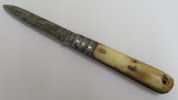
Ten different “Barnes” names are listed in Tweedale’s book. Among that group is Isaac Barnes who had a cutlery company from around 1833 to the 1870s. Shown is an elegant pearl handled folding lock back dirk marked “Isaac Barnes W (crown) R” on the blade tang. The “W (crown) R” marking dates this fine example from between 1830 to 1837. With a handle length of 4-1/2 inches, the pearl handles on both sides are made from two pieces each. That was a common practice and done to make the best use of smaller pieces of pearl. Beyond the beautiful pearl used, both sides are also etched with decorative designs which are hard to show in photographs. The blade has a typical dagger grind which meant this knife was made for self-protection rather than general usage. An exquisite knife that is nearing the two hundred year mark.

Sheffield Dirk Pearl Barnes (1200x902).jpg
 
Some very nice examples shown recently.

waynorth, Very cool Rodgers physician's knife and enclosed is a catalog illustration from 1927.
The small blade is shown open which partially covers the slightly different main blade etch as seen on your example.

Jack, Two nice examples in your Howarth and Haywood models. I've always liked Haywood's "Kettle" logo.

WinMag775, Two good Lockwood folders, but I especially like your Woodhead model.

rockman0, Very nice Allen pruner. I've become a big fan of pruner models over the years.

glennbad, Fine older Lamb Foot model and nice surprise to find out it has nickel silver bolsters.

Jack, Hard not to fall in love with triple rat tail bolsters as seen on your Francis Newton folder.

View attachment 3149640
Love these Catalog posts that you share with us Herder, I have a question when I receive the "knife" and I will post it, a very old Stag Timber Scriber by a name I haven't had a lot of luck with looking up - mind you it was a feeble attempt at it's best :)

Ten different “Barnes” names are listed in Tweedale’s book. Among that group is Isaac Barnes who had a cutlery company from around 1833 to the 1870s. Shown is an elegant pearl handled folding lock back dirk marked “Isaac Barnes W (crown) R” on the blade tang. The “W (crown) R” marking dates this fine example from between 1830 to 1837. With a handle length of 4-1/2 inches, the pearl handles on both sides are made from two pieces each. That was a common practice and done to make the best use of smaller pieces of pearl. Beyond the beautiful pearl used, both sides are also etched with decorative designs which are hard to show in photographs. The blade has a typical dagger grind which meant this knife was made for self-protection rather than general usage. An exquisite knife that is nearing the two hundred year mark.

View attachment 3149639
Wow! Now this is stunning- such fine condition for it's age Herder, What a beautiful knife!
Now I am not too sure if this is the knife I purchased at the Oregon show and left it on the table when we were all having a show and tell after thee show one night?? 🤣 😂
Pretty sure I saw this one Bob - nice score!
 
Some very nice examples shown recently.

waynorth, Very cool Rodgers physician's knife and enclosed is a catalog illustration from 1927.
The small blade is shown open which partially covers the slightly different main blade etch as seen on your example.


Jack, Two nice examples in your Howarth and Haywood models. I've always liked Haywood's "Kettle" logo.

WinMag775, Two good Lockwood folders, but I especially like your Woodhead model.

rockman0, Very nice Allen pruner. I've become a big fan of pruner models over the years.

glennbad, Fine older Lamb Foot model and nice surprise to find out it has nickel silver bolsters.

Jack, Hard not to fall in love with triple rat tail bolsters as seen on your Francis Newton folder.

View attachment 3149640
Thanks for digging up that Physician's catalog Picture, Neal!! I notice my knife does not have rattail bolsters and is only 3 1/4" long!!
Is there a smaller knife pictured nearby??
CC
 

Ten different “Barnes” names are listed in Tweedale’s book. Among that group is Isaac Barnes who had a cutlery company from around 1833 to the 1870s. Shown is an elegant pearl handled folding lock back dirk marked “Isaac Barnes W (crown) R” on the blade tang. The “W (crown) R” marking dates this fine example from between 1830 to 1837. With a handle length of 4-1/2 inches, the pearl handles on both sides are made from two pieces each. That was a common practice and done to make the best use of smaller pieces of pearl. Beyond the beautiful pearl used, both sides are also etched with decorative designs which are hard to show in photographs. The blade has a typical dagger grind which meant this knife was made for self-protection rather than general usage. An exquisite knife that is nearing the two hundred year mark.

View attachment 3149639
Lovely Dirk, Neal!!
 
Back
Top