MagnaMax hitting the market

T Twindog

If I’m reading this correctly, your issue is that you don’t believe ‘factory’ knives are heat treated properly. That’s a far cry from an alloy ‘shining’ at a specific hardness, especially because I’m willing to bet the blade at 63.5 would have tested for toughness just like most other Magnacut blades at 63.5.

It’s not the hardness.
 
T Twindog

If I’m reading this correctly, your issue is that you don’t believe ‘factory’ knives are heat treated properly. That’s a far cry from an alloy ‘shining’ at a specific hardness, especially because I’m willing to bet the blade at 63.5 would have tested for toughness just like most other Magnacut blades at 63.5.

It’s not the hardness.
Nope. I was pretty clear. When you go up in hardness, 60 Rc to 65 Rc, for example, you lose a lot of toughness for a small gain in edge retention. I'd rather have the greater toughness.

What I also said was that a high-end custom heat treat is going to be much better than large-batch heat treats during mass production. The better heat treat could make higher hardness levels more attractive.
 
Nope. I was pretty clear. When you go up in hardness, 60 Rc to 65 Rc, for example, you lose a lot of toughness for a small gain in edge retention. I'd rather have the greater toughness.

What I also said was that a high-end custom heat treat is going to be much better than large-batch heat treats during mass production. The better heat treat could make higher hardness levels more attractive.

I havent seen anyone running their magnacut at 65. Most say the sweet spot is 62-64, according to what i have read.

Are you saying that a custom 63-64 RC HT is better than a manufacturer like CRK or Hogues heat treat with the same RC? How does that work?
 
I havent seen anyone running their magnacut at 65. Most say the sweet spot is 62-64, according to what i have read.

Are you saying that a custom 63-64 RC HT is better than a manufacturer like CRK or Hogues heat treat with the same RC? How does that work?
It's a sliding scale. Larrin has the numbers posted. But as you go up in hardness from 60 Rc, you lose much more toughness than you gain in edge retention. A CRK blade at 60 Rc would be a lot tougher than one at 64 Rc. All I'm saying is that I'd rather have the toughness. For me, toughness is what makes MagnaCut special. If I wanted a high-wear steel, I would not choose MagnaCut. There are much more wear resistant steels available.

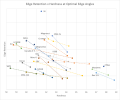
MagnaMax is going to be a really good high-wear steel, because it will have more toughness than most other such steels. So, looking at Larrin's website for MagnaMax, Max won't outcut S90V, but it will be very high in wear resistance and have a lot more toughness. I think M390 will be in trouble. It's used in a lot of high-end knives, but as you can see below, MagnaMax will out cut it by a lot and be much tougher (resistant to breaking, and chipping). I wish my Arius was MagnaMax and not M390.

MagnaMax-toughness-CATRA.png
 
Nope. I was pretty clear. When you go up in hardness, 60 Rc to 65 Rc, for example, you lose a lot of toughness for a small gain in edge retention. I'd rather have the greater toughness.

What I also said was that a high-end custom heat treat is going to be much better than large-batch heat treats during mass production. The better heat treat could make higher hardness levels more attractive.


You’re conflating fine edge stability with wear resistance, and that’s the point I’m making. If you want higher toughness because you believe it offers something, that’s on you, but the increase in strength at higher hardness while still maintaining remarkable toughness offers improvements in edge stability, and that’s why most are running it higher than 60rc. Not that a 12% increase in abrasive wear resistance is a small gain, but abrasive wear resistance is only one metric, and the example you present of ‘remarkable’ performance at 63.5rc demonstrates that it isn’t always the important one.
 
For me, heat treat quality is the "Achilles Heel" of modern general consumer-grade knives.

I will also state that the 'best' folding pocket knife steel is NOT the 'best' fixed blade steel.

At the moment, I am into Vanax Superclean for small fixed blades and normal "pocket" knives.
 
  • Like
Reactions: DMG
For me, heat treat quality is the "Achilles Heel" of modern general consumer-grade knives.

I will also state that the 'best' folding pocket knife steel is NOT the 'best' fixed blade steel.

At the moment, I am into Vanax Superclean for small fixed blades and normal "pocket" knives.
Vanax is one of the more difficult to heat treat knife steels, so ironically if it were used more it would likely exacerbate the issue you point out.
 
T Twindog

I don't think you answered this question in your reply above, unless I missed it:

Are you saying that a custom 63-64 RC HT is better than a manufacturer like CRK or Hogues heat treat with the same RC? How does that work?
 
  • Like
Reactions: DMG
It's a sliding scale. Larrin has the numbers posted. But as you go up in hardness from 60 Rc, you lose much more toughness than you gain in edge retention. A CRK blade at 60 Rc would be a lot tougher than one at 64 Rc. All I'm saying is that I'd rather have the toughness. For me, toughness is what makes MagnaCut special. If I wanted a high-wear steel, I would not choose MagnaCut. There are much more wear resistant steels available.

MagnaMax is going to be a really good high-wear steel, because it will have more toughness than most other such steels. So, looking at Larrin's website for MagnaMax, Max won't outcut S90V, but it will be very high in wear resistance and have a lot more toughness. I think M390 will be in trouble. It's used in a lot of high-end knives, but as you can see below, MagnaMax will out cut it by a lot and be much tougher (resistant to breaking, and chipping). I wish my Arius was MagnaMax and not M390.

MagnaMax-toughness-CATRA.png
It's almost like MagnaMax will be the steel that everyone seems to believe MagnaCut is.

I don't think most knife people even understand that Magnacut basically won't out-cut s30/35/45 yet somehow it's been adopted as a supersteel and the masses have swallowed it hook line and sinker.

It's not bad steel, but it won't out-cut the vast majority of steels we have already in average knives at the same thickness/geometry, so in factory folders primarily used for fine/easy cutting tasks what does it bring to the table? Seems like nothing.
 
It's almost like MagnaMax will be the steel that everyone seems to believe MagnaCut is.

I don't think most knife people even understand that Magnacut basically won't out-cut s30/35/45 yet somehow it's been adopted as a supersteel and the masses have swallowed it hook line and sinker.

It's not bad steel, but it won't out-cut the vast majority of steels we have already in average knives at the same thickness/geometry, so in factory folders primarily used for fine/easy cutting tasks what does it bring to the table? Seems like nothing.
And yet it was never promoted as such, to be fair. What some folks will think is not the fault of those who brought the steel to market to fill a particular niche.

If you read what Larrin has written from the beginning about his goals in formulating MagnaCut, maybe there would be less reason to be so dismissive.

(And to be honest, you can make the same argument about any steel which ups the ante from other "similar" stainless, carbon or tool steels.)
 
It's a sliding scale. Larrin has the numbers posted. But as you go up in hardness from 60 Rc, you lose much more toughness than you gain in edge retention. A CRK blade at 60 Rc would be a lot tougher than one at 64 Rc. All I'm saying is that I'd rather have the toughness. For me, toughness is what makes MagnaCut special. If I wanted a high-wear steel, I would not choose MagnaCut. There are much more wear resistant steels available.
The data show that Crucible Magnacut has a very good tradeoff in tougness when going from 60 to 63, which is why most knifemakers choose 62-63. Erasteel Magnacut looks even better. There's very little advantage to 60:

s1 (1).png

It's almost like MagnaMax will be the steel that everyone seems to believe MagnaCut is.

I don't think most knife people even understand that Magnacut basically won't out-cut s30/35/45 yet somehow it's been adopted as a supersteel and the masses have swallowed it hook line and sinker.

It's not bad steel, but it won't out-cut the vast majority of steels we have already in average knives at the same thickness/geometry, so in factory folders primarily used for fine/easy cutting tasks what does it bring to the table? Seems like nothing.

Magnacut also responds remarkably well to geometry optimization, it works well at any hardness if the correct edge angle is chosen. So yes, it will definitely outcut S30V (and most other steels) if you run it at edge angles that S30V can't handle.

s4.png
 
Last edited:
Vanax is one of the more difficult to heat treat knife steels, so ironically if it were used more it would likely exacerbate the issue you point out.

Yes, that is why I am pretty selective for that one. It will be a long time before I get one from the common mass production makers.

I have had a Benchmade knife, which is normally a very high-quality option with great quality control, in ATS-34, which was over-hardened, and its Tanto blade was brittle, and rust was a problem as well. A total mess of a Benchmace pocket knife.

This is where boutique makers and custom knifemakers have a real advantage over the mass produced knife options.
 
It's almost like MagnaMax will be the steel that everyone seems to believe MagnaCut is.

I don't think most knife people even understand that Magnacut basically won't out-cut s30/35/45 yet somehow it's been adopted as a supersteel and the masses have swallowed it hook line and sinker.

It's not bad steel, but it won't out-cut the vast majority of steels we have already in average knives at the same thickness/geometry, so in factory folders primarily used for fine/easy cutting tasks what does it bring to the table? Seems like nothing.

From a practical standpoint, the vast majority of knife buyers know so little about knife steels that you could sell them anything with a reasonable sales sheet of suggested sales points of a non-scientific nature. Those same people also will never use a knife enough doing knife'y things to see a difference as well.

They are more apt to care about lateral flex properties because they use them like mini-prybars ... 🤔 Maybe as a substitute screwdriver and cap lifter on their beer bottle. And other non-knife use cases. Add to this a price point that prevents a high-quality premium steel from being utilized to its fullest. This is why we see so many AUS-6/8 blades with 14C28N being the new 'darling' of this crowd of more affordable options.

And yes, I find 14C28N has its place in my rotation of knife options as well. Some days and in some places, using an >$300 folder just isn't a reasonable thing to do for many reasons, some of which have nothing to do with actually cutting something!
 
Last edited:
From a practical standpoint, the vast majority of knife buyers know so little about knife steels that you could sell them anything with a reasonable sales sheet of suggested sales points of a non-scientific nature. Those same people also will never use a knife enough doing knife'y things to see a difference as well.

They are more apt to care about lateral flex properties because they use them like mini-prybars ... 🤔 Maybe as a substitute screwdriver and cap lifter on their beer bottle. And other non-knife use cases. Add to this a price point that prevents a high-quality premium steel from being utilized to its fullest. This is why we see so many AUS=6/8 blades with the 14C28N being the new 'darling' of this crowd of options.

And yes, I find 14C28N has its place in my rotation of knife options as well. Some days and in some places, using an >$300 folder just isn't a reasonable thing to do for many reasons, some of which have nothing to do with actually cutting something!

I don't think anyone dissed 14C28N, did they?
It, Nitro V, AEB-L make Excellent knives. I don't think Any maker would argue that.
 
I don't think anyone dissed 14C28N, did they?
It, Nitro V, AEB-L make Excellent knives. I don't think Any maker would argue that.

Depends on where you look and who did the review. In the past, when I inquired about 14C28N, I got some pretty harsh negative comments with lots of recommendations for other steel options.

14C28N ain't perfect for all knives and all uses, but in my experience with how I use it and under my use conditions, I have found it to be a good option for me in general use pocketknives. Would I prefer M390 or something else? In some use cases, yes, but in most no. Edge holding, sharpening ease, etc., offer a good balance for me in general use cases in my life as it is today.

D2 will beat it on baling twine, for example, but 14C28N does a good enough job for me to be happy with it. If Victorinox offered 14C28N in their classic SAK, I'd be a happy man with a new Spartan!
 
Untitled by GaryWGraley, on Flickr

I remember when ATS-34 was all the rage ;)

I'll admit that all these options can and are somewhat confusing. What I do know is, when I sharpen a blade and the steel is heat treated to a fairly hard rockwell, I find it a lot easier to sharpen. While softer steels seem to waffle sometimes and that is frustrating to me.

BUT, I feel that it is important to keep pushing that envelope and experimenting with steel composition using past wins to help guide.

G2
 
Untitled by GaryWGraley, on Flickr

I remember when ATS-34 was all the rage ;)

I'll admit that all these options can and are somewhat confusing. What I do know is, when I sharpen a blade and the steel is heat treated to a fairly hard rockwell, I find it a lot easier to sharpen. While softer steels seem to waffle sometimes and that is frustrating to me.

BUT, I feel that it is important to keep pushing that envelope and experimenting with steel composition using past wins to help guide.

G2

I still need me some Talonite! 😉

s-l1200 (8).webp
 
Back
Top