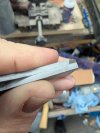
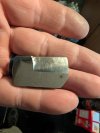
It might be worth it to set some expectations when working with this alloy. For many of you, working with high carbide volume, high wear resistance steels is old hat, and you likely won’t need to hear any of this. But for some of you, perhaps this is a new world, so here’s some considerations to keep in mind.
This is the first stainless steel with both the toughness and wear resistance of wear resistant tool steels like K390 and CPM-10v. I know you’ve likely heard that before, but it bears repeating. The carbides in this steel are likely harder than some of the abrasives you use. Once hardened, this alloy is going to be difficult to grind.
Oddly enough, this isn’t true at coarser grits.
A fresh coarse grit ceramic belt pulls this stuff off wonderfully. Remarkably. You can accomplish a great deal with a 60 grit belt like Norton Blaze or VSM XK885Y. Nonetheless, when the belt stops cutting, don’t try to eek more out of it. You’ll just generate heat. Expect to use more abrasives - it’s just part of the deal with wear resistant steel!
I grind all of this material at full thickness, post heat treat. It’s that easy to grind with coarse grit ceramic abrasives. This also allows for full contact of the blade with my quench plates, for a faster quench rate, and perhaps less distortion.
For myself, I don’t grind primary bevels beyond 240 grit - this coincides with the endpoint for my ceramic belts. I just don’t feel it’s necessary on a truly stainless steel, and I personally like the aesthetic of a clean machine satin finish. Many of you like to do hand satin finishes - have at it. For people that are familiar with materials like this, there’s not going to be any surprises, but if some of you think alloys like M390, S35vn, or even Magnacut are tough to do, you’re in for a very new experience with Magnamax. This is not to dissuade you from the effort - I think it’s important for everyone to follow their muse. Just understand that you might need to explore new abrasives and processes to get the look you’re after.
It responds readily to heat treat, and in my experience so far has been relatively free of distortion when using aluminum plate quenches. Don’t waste any time getting out of those plates and into cryo - that’s not another step, remember, it’s the continuation of the quench, and this alloy seems to be sensitive to delay. Get out of those plates and into the freezing cycle of your choice as quickly as you can, within reason. If you’re the type that likes to do ‘as-quenched’ hardness tests out of plates, I’d advise you to make separate coupons for this, as there’s likely going to be disparities between material that’s been delayed long enough to test and material that was processed quickly into cryo.
None of what I’m writing here is intended to discourage you from using this material. Quite the opposite! I’m merely trying to set expectations. It’s an expensive material, with some unusual properties. It’s these same properties that set it apart from nearly everything that’s come before it. If you do your part, it should offer performance in areas of this category of steels that make it a fantastic upgrade for many knife applications.
Good luck!