Making the buffer safer

Joined
Aug 13, 2002
Messages
5,703
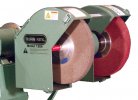
The terrible and tragic accident that cost Gordon Dempsey his life (see thread in Customs) made me realize that I really needed to build some kind of enclosure to make my buffer safer. Please note that I did not say “safe” since it is obvious that it never is. :( But we can at least try and minimize the chance of extreme injuries.

So here is my first attempt. I added plating in the hopes that if, God forbid, a part (or knife) caught in the wheel it would not be thrown back at me but hit the steel plating.


It is spring loaded in the back so I can adjust the height relative to the different size wheels I have.


Not too bad to take off to change wheels but still a bit of a hassle so I will need to tweak the design a bit.

Of course some of you surely have already done this in which case I would greatly appreciate pics or your input on this one, in case you see something that you think would not work.

Hopefully this will help a little to avoid such tragedies. :(

Once again my deepest condolences to Mr. Gordon's wife and family.
 
That looks totally unsafe to me. Sharp metal edges are dangerous-even in that position, and there are way too many sharp edges there.
It's silly how so many people are scared of buffers. They are no more dangerous than any other piece of shop equipment. Yes, accidents can happen, but staying alert is more important than any safety equipment.
Perhaps people are doing the typical "guy" thing and leaning into their buffers. That isn't the way to polish. Light pressure on the lower 1/3 of the wheel. Never present an edge or point to the rotating buff. Keep a firm grip on your work. Inspect you buffs for loose strings. Don't be afraid of a buffer, just respect it.
 
Bill, thanks for your input. Can you tell me how is this dangerous exactly (the mechanics of it) so I can improve it? I do respect the buffer but i still want some kind of fail safe. Respect goes a long way but can't insure 100% you won't make a mistake.
Thanks.
 
You have what appears to be a tray under the buffer. It has sharp vertical edges.
If your wheel were to actually catch something, it could pull it and your hand past 6:00 and UP into the front guard.
You can never insure 100% that you won't make a mistake. Just be careful and if you do make a mistake buffing, learn how to handle it. This only comes from experience.
My buffers have hoods made of cardboard, should something get loose, cardboard won't cut you.
BTW-I can tell a lot of thought and work went into your shield.
 
I wonder if a similar wooden enclosure might have less "sharp edges." I've taken to satin finishes on my blades so I'm not using it as much lately. I still use it on handles and when I do the blade is wrapped. I will probably wrap an additional layer of heavier leather around it now.
 
Patrice, Everyone has an opinion so here is mine: I do not think your guard will help protect you. I mean no insult and it is just my opinion. My only suggestion would be to remount your buffer frame all the way to the right on the edge of the workbench if you can. Get the wheel away from stuff that a knife might contact if it gets grabbed by the wheel. Usually when the wheel grabs a knife it throws it down and in front of your feet on the floor. I have put a paper sack full of paper scraps and shop towels to catch the blade if it happens so the blade isn't damaged and also to keep the blade from ricocheting off the floor and doing more damage. This has actually worked for me one time. (another time it missed the bag) . If I had the space I would put a long box full of clean shop cloth under and behind the buffer to catch them all. In my experience the wheel IS going to grab your blade every once in a while. That is why I stand with my feet well back from the grinder. I wear a leather shop apron when I use an angle grinder and I suppose that you might want to slip one on before using the buffer but I am more concerned about the blade nailing my foot which is much more likely. All I know for sure is that I need the buffer to make the kind of knives that I like. I think we are all stuck with the buffer so anything that will make them safer everyone should praise. Larry PS I loved your surface grinder project...nice machine!! LL
 
It's silly how so many people are scared of buffers. They are no more dangerous than any other piece of shop equipment. Yes, accidents can happen, but staying alert is more important than any safety equipment.

Yeah, but in addition to some very serious injuries, I can actually think of a couple people killed by buffers. I can't really think of any other innocuous little piece of shop equipment that actually kills people like that. People get cut and maimed by saws, and about everybody here has been hurt on a grinder, but the buffer isn't even used that much compared to other tools and it doesn't have a cutting edge like a saw, but it flat out f**ks people up. I'm a little scared of them.

Pat, it looks to me like you could get your hand pulled into a mess of sheet metal there, but I'll bet your guard would do a fine job of keeping a blade from getting launched at you. I've heard of a buffer picking something out of your hand and hitting you with it several times before you can blink and I'll bet your guards would work for that too.

I don't know how Mr. Dempsey got hurt. Perhaps he buffed on the top of the wheel, which is a big no no, and it caught up with him. But I buff on the lower 1/3rd of the wheel very carefully (100% sphincter pucker alert) with light pressure and I've still had it pick stuff out of my hand, swing it around the wheel and launch stuff at my head, and I wouldn't be surprised if something similar happened to Gordon. And I expect that some guards like you have here would be useful.
 
Think more along these lines

newm1200.jpg
 
My lesson was in gunsmithing school .Polishing the cylinder of a revolver the wheel caught the cylinder from my hand and threw it to the floor. I thought I'd have to do some work for scratches but I had some major work to open up two collapsed chambers !! With that force I paid close attention to the buffing !!!

AVigil has a simple effective way to do it !
 
How might such an accident happen where the blade actually hits you in the torso? I'm assuming it depends on the height the buffer is mounted at, or where on the wheel the blade is being held? I only ask because I have very little experience with an open wheel buffer. I use a buffing wheel on my regular bench grinder at the moment, but it's mounted on a fairly low bench. I have part collected to build a buffer, but Id also like to make it as safe as possible.

Patrice, how does this guard work? could the blade still not be thrown towards you, maybe I'm not picturing it right. thanks
 
Patrice, I like your design. Most of the buffing set-ups I have seen in 'full' time makers shops is a Baldor 3/4hp motor with extended shafts mounted on a pedestal base. No type of protection at all. When I took a class from a nationally known maker, I watched him put his full weight behind pressing the blade into the buff. A recipe for disaster. He related the story about how he was polishing a blade and the buffer grabbed it. He ended up with the blade stuck in his thigh. Gee, I wonder why...

Your design will deflect a blade when the buff grabs it. Your blade may suffer some damage, but you should be safe. If I were to offer a suggestion, it would be to extend the front of the guard to the bottom of the buffing wheel. It should be long enough to accommodate the biggest buff you will use.

Something much more important is to learn to use the proper technique when using a buffer. The position of the blade in relation to the wheel when polishing (using the front lower quadrant of buff only), and using the proper pressure when pressing the blade to the buff. Always polish with the blade edge down. Be especially careful when you get to the tip.
 
A very sad accident - I'd missed that thread

Well, my first buffer was a 1hp, 3450 RPM motor. While it would really buff, it also had the power to really grab and throw a blade if you got one bit careless. Then I would use the buffer to really "cut" metal at times with a coarse rouge. Now, I have changed to a 1725 RPM, 1/4 hop motor and find it has all the power needed to put a nice finish on a blade, "IF" you do the proper sandpaper work first. Low RPM and low power seems to make buffer MUCH safer. Of course, the buffer can still grab a blade if careless, but it is thrown with MUCH less power from a 1/4hp, 1725RPM than from a 1hp, 3450 RPM motor - provided same diameter wheel.

Ken H>
 
Farriers use buffer and expander wheel with belts. I have seen guards on the grinder wheels and those same guards could be used for the buffer side. Cheap easy and would likely solve your issue.

Look at a Baldor bg 12
 
Last edited:
Mr. Dempseys accident has me wondering if it wouldn't be wise to wear a long chain mail shirt when buffing blades.
 
Patrice, I think your guard is safe enough and would probably prevent knives and parts from being thrown back. I see two issues though; first is accessibility of the wheel. Your guard prevents being able to come at the wheel at much of an angle and would certainly prevent me from being able to get in and buff out finger notches and such. The other issue is the bench below. A buffer needs to be mounted in free air so anything that is taken away from the user has a place to go. I will also mention that I think it is possible that if a part gets caught and the wheel brings it around to hit your guard, it is possible that it could get pinned in there and eventually hurled out. I personally think smart and safe technique is the best way to go.

Bob
 
Thanks guys, all good points. This is exactly what I wanted, a discussion to come up with the safest option for a fail safe.
Let me make a few drawings so we can continue while making sure we are talking about the same thing.
And I see now what you mean about the bench it is mounted on, I was so concentrated on the shield itself that I never saw the potential danger there.:o I need a pedestal mount.

Philip, I did plan on making an apron with chainmail chest protection like you said.
 
Patrice Lemée;14112269 said:
The terrible and tragic accident that cost Gordon Dempsey his life (see thread in Customs) made me realize that I really needed to build some kind of enclosure to make my buffer safer. Please note that I did not say “safe” since it is obvious that it never is. :( But we can at least try and minimize the chance of extreme injuries.

So here is my first attempt. I added plating in the hopes that if, God forbid, a part (or knife) caught in the wheel it would not be thrown back at me but hit the steel plating.


It is spring loaded in the back so I can adjust the height relative to the different size wheels I have.


Not too bad to take off to change wheels but still a bit of a hassle so I will need to tweak the design a bit.

Of course some of you surely have already done this in which case I would greatly appreciate pics or your input on this one, in case you see something that you think would not work.

Hopefully this will help a little to avoid such tragedies. :(

Once again my deepest condolences to Mr. Gordon's wife and family.

i agree with the many sharp edges around the grinder base. You obviously have spent some time on this mod but look at this video

https://m.youtube.com/watch?v=tA42j-sAuxM

And you will see the guards that farriers uses with buffers that they have attached an expander wheel on. I think these guards can be used on either side of the buffer. I think the fact that farriers use these is a strong endorsement that they work.

What about just using a buffer wheel in a grinder wheel housing? I guess that implies that one started with a grinder and then took off the guard to attach.
 
Here is a pic of my buffing setup.


The 'hoods' have built in lexan shields that come down in front of the wheel. Lots of light. I also wear a HEAVY leather apron and don't push to hard. I let the buff and compound do the work.
 
Patrice good on ya for the concern about buffers and the safety they require.
i like many have been hit by a blade/handle that was torn out of my hand. i was lucky only to be beat up a bit by it but i started looking at how i could solve 2 problems at once. i came up with a "Shield" you could mount to the motor that goes around the wheel . round like the wheel with the back 1/2 closed in so i could hook a vacuum up to it and keep the crud out of my face ,and make it so if the item grabs it goes down hopefully not back into me.
what is nice is you mount this to the workbench not the machine and you can still change the wheels out if needed.
 
Chain mail is for protection from slicing. Having a blade thrown at you tip first is going to slip through the links and you'll still be stabbed. You need a solid plate armor to protect from piercing. Chain mail on your arms will be useful for cuts, but you'll still get a nasty bruise if you are hit with a knife thrown at you.
 
Back
Top