
-
The BladeForums.com 2024 Traditional Knife is available! Price is $250 ea (shipped within CONUS).
Order here: https://www.bladeforums.com/help/2024-traditional/
You are using an out of date browser. It may not display this or other websites correctly.
You should upgrade or use an alternative browser.
You should upgrade or use an alternative browser.
Making the buffer safer
- Thread starter Patrice Lemée
- Start date

Bill DeShivs
Knifemaker / Craftsman / Service Provider
- Joined
- Jun 6, 2000
- Messages
- 12,892


My buffer hoods. My buffers are all bench-mounted. They are more for catching/routing debris than protection from flying objects, but they won't cut you!
I would think a board with a slot cut for the wheel, and installed from the rear might offer simple protection. It would cover the rear half of the wheel and offer some degree of debris protection also.
Chain mail is for protection from slicing. Having a blade thrown at you tip first is going to slip through the links and you'll still be stabbed. You need a solid plate armor to protect from piercing. Chain mail on your arms will be useful for cuts, but you'll still get a nasty bruise if you are hit with a knife thrown at you.
Matters how big the links are, no? I would say it wouldn't pass through your average chain mail since most blades are greater than 1/4" wide.
Bill DeShivs
Knifemaker / Craftsman / Service Provider
- Joined
- Jun 6, 2000
- Messages
- 12,892
Chain mail? Are you guys serious??

Nathan the Machinist
KnifeMaker / Machinist / Evil Genius
Moderator
Knifemaker / Craftsman / Service Provider
- Joined
- Feb 13, 2007
- Messages
- 19,191
Chain mail? Are you guys serious??
Yeah man, some of this shit can get sketchy Bill. Historically speaking, cutlers didn't live to be my age, or anywhere near your age.
I have a polycarbonate apron I wear when I'm not sure. I'm responsible to a wife, two kids and a mortgage...
Edit: Had Gordon been wearing some sort of protection he might have survived his mishap. If someone wants to wear chainmail, more power to them...
Last edited:
- Joined
- Jan 3, 2007
- Messages
- 302
Greetings,
I rarely buff any knife these days. When I have to do a polished blade, the blade is always screwed to a 2"x2" by 16" piece of wood. Once a blade is screwed down on to the wood, most anyone can hold it aggressively into a buffer. If it ever got away from you, there is very little chance it hurting you. It is a must practice in my shop.
I never buff any blade(s) with the handle or bolster already on. I do buff handles, but that is by hand with the blade already wrapped up, etc.
Dennis
I rarely buff any knife these days. When I have to do a polished blade, the blade is always screwed to a 2"x2" by 16" piece of wood. Once a blade is screwed down on to the wood, most anyone can hold it aggressively into a buffer. If it ever got away from you, there is very little chance it hurting you. It is a must practice in my shop.
I never buff any blade(s) with the handle or bolster already on. I do buff handles, but that is by hand with the blade already wrapped up, etc.
Dennis
Last edited:
"
Great recommendations. A few extra moments time to increase the chances that you leave the shop safely.
Greetings,
I rarely buff any knife these days. When I have to do a polished blade, the blade is always screwed to a 2"x2" by 16" piece of wood. Once a blade is screwed down on to the wood, most anyone can hold it aggressively into a buffer. If it ever got away from you, there is very little chance it hurting you. It is a must practice in my shop.
I never buff any blade(s) with the handle or bolster already on. I do buff handles, but that is by hand with the blade already wrapped up, etc.
Dennis
Great recommendations. A few extra moments time to increase the chances that you leave the shop safely.
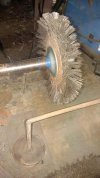
It's been a long time since I've had a piece get away while brushing or buffing, but this is part of my insurance package. A simple L bolted to the bench top. (the photo is taken from the back side)
No, it's not going to definitively prevent an accident, but it will slow it down in most cases.
My other hard and fast rule is to never stand directly in front of the wheel.

- Joined
- Aug 13, 2002
- Messages
- 5,703
Ok first issue is moving the buffer to more of a "pedestal" type location. Might not be the easiest to do as you can imagine when you see this pic of the buffer location. 

Larry: I will look into some kind of trapping underneath like you suggested. PS: Glad you like the surface grinder project.
Nathan: Hadn't thought about my hand being pulled in but I never heard that happening, well not compared to the part being pulled in. Of course that doesn't mean it can't so I'll add this to my list of things to address.
Avigil: These look great but I was trying to come up with a simpler solution, something homemade that the average Joe could do and not so complicated that it keeps getting pushed back on the ToDo list for lack of time.
Smithy: I had the guard extending further down at first but I shortened it thinking that too long and the blade, instead of passing underneath, might bounce off it and back at me. Makes sense?
Ken: The plan is to eventually get a motor for this that I can hook up to the VFD. I agree with you that less speed is a little less scary. But even if slowed down to 1725 or less, there is still enough speed there to hurl a part at you with a lot of force. I think the main advantage of less speed would be a little less sphincter tension. (See Nathan's post)
PT Doc: The flat shield was just simpler to make than the wrap around cover you pictured. Also, I made it wider, I would be afraid that the open side on the one in your picture would make it so that the blade could still make it around missing the shield. Also, the stock wheel housings are usually too small, well in this size grinder anyway.
Ranger Bob: I did not think of that but I could surely move it back a bit to get better access to the wheel and still get the same level of protection
Smithy: Thanks for the pic. I wonder if Lexan be enough to stop a blade thrown back at you? If so, I could incorporate it into my design somehow.
Pinoy: I'd love to see a pic of your setup.
alohadave: Chainmail is more effective at protection from slicing than piercing but depending on the guage of the wire used, it would still, combined with the heavy leather apron, offer some level of protection. And if that is not enough, I have some stainless riveted rings I have been wanting to use for some time.
Tim37a: That sounds like a very good idea for some applications but sadly not all of my buffing needs.
Bill: Thanks for the pics. That looks like it works great for keeping the dust/debris at bay. Some kind of cut-off board was what I started with but I thought that I needed to to add the flaps that come down the front so that the part could not sneak back at me from under the board. Makes sense? PS: Was there some kind of tornado in your shop? Cause I never seen your bench so clean.
I hope I got to all of your suggestions guys, if I missed some I am sorry. So next step is to:

1) Move the buffer so that there is no obstruction underneath
2) Move the plates (A) as far as they'll go (motor shaft) to give better access, while keeping the (B) plate on top of the wheel so there is no or very little gap there.
3) Have some kind of trapping underneath. C
Only thing I am not sure how to address is Nathan's concern about getting your hand pulled in there. But I guess there is really no way to prevent that without sacrificing the thrown piece protection. Anyone had this happen to them?
I greatly appreciate all your help and words of support.

Larry: I will look into some kind of trapping underneath like you suggested. PS: Glad you like the surface grinder project.
Nathan: Hadn't thought about my hand being pulled in but I never heard that happening, well not compared to the part being pulled in. Of course that doesn't mean it can't so I'll add this to my list of things to address.
Avigil: These look great but I was trying to come up with a simpler solution, something homemade that the average Joe could do and not so complicated that it keeps getting pushed back on the ToDo list for lack of time.
Smithy: I had the guard extending further down at first but I shortened it thinking that too long and the blade, instead of passing underneath, might bounce off it and back at me. Makes sense?
Ken: The plan is to eventually get a motor for this that I can hook up to the VFD. I agree with you that less speed is a little less scary. But even if slowed down to 1725 or less, there is still enough speed there to hurl a part at you with a lot of force. I think the main advantage of less speed would be a little less sphincter tension.
(See Nathan's post)PT Doc: The flat shield was just simpler to make than the wrap around cover you pictured. Also, I made it wider, I would be afraid that the open side on the one in your picture would make it so that the blade could still make it around missing the shield. Also, the stock wheel housings are usually too small, well in this size grinder anyway.
Ranger Bob: I did not think of that but I could surely move it back a bit to get better access to the wheel and still get the same level of protection
Smithy: Thanks for the pic. I wonder if Lexan be enough to stop a blade thrown back at you? If so, I could incorporate it into my design somehow.
Pinoy: I'd love to see a pic of your setup.
alohadave: Chainmail is more effective at protection from slicing than piercing but depending on the guage of the wire used, it would still, combined with the heavy leather apron, offer some level of protection. And if that is not enough, I have some stainless riveted rings I have been wanting to use for some time.
Tim37a: That sounds like a very good idea for some applications but sadly not all of my buffing needs.
Bill: Thanks for the pics. That looks like it works great for keeping the dust/debris at bay. Some kind of cut-off board was what I started with but I thought that I needed to to add the flaps that come down the front so that the part could not sneak back at me from under the board. Makes sense? PS: Was there some kind of tornado in your shop? Cause I never seen your bench so clean.
I hope I got to all of your suggestions guys, if I missed some I am sorry. So next step is to:

1) Move the buffer so that there is no obstruction underneath
2) Move the plates (A) as far as they'll go (motor shaft) to give better access, while keeping the (B) plate on top of the wheel so there is no or very little gap there.
3) Have some kind of trapping underneath. C
Only thing I am not sure how to address is Nathan's concern about getting your hand pulled in there. But I guess there is really no way to prevent that without sacrificing the thrown piece protection. Anyone had this happen to them?
I greatly appreciate all your help and words of support.

- Joined
- Dec 5, 2013
- Messages
- 1,180
Wouldn't your guard be just as effective if you mounted it just to the rear of the buffers shaft? Seems it would be much easier to work with and still prevent anything being thrown.
Bob
Bob

- Joined
- Dec 6, 2004
- Messages
- 6,212
for steel i use buffing belts on my KMG i have grey white and green loaded belts the "buffer" i have is a 1/3 1700rpm that i keep a loose buff with white and its for final handles buffing.
took a tip from the wood lathe guys and i stand out of the "line of fire"
also if you are buffing scratches out likly you are washing out your grind lines also
i had a straight razor ripped out of my hands a few years back but since i buff over the top it was just shot accross the garage. after that i changed some of my setup
took a tip from the wood lathe guys and i stand out of the "line of fire"
also if you are buffing scratches out likly you are washing out your grind lines also
i had a straight razor ripped out of my hands a few years back but since i buff over the top it was just shot accross the garage. after that i changed some of my setup

- Joined
- Nov 20, 2008
- Messages
- 10,188
Greetings,
I rarely buff any knife these days. When I have to do a polished blade, the blade is always screwed to a 2"x2" by 16" piece of wood. Once a blade is screwed down on to the wood, most anyone can hold it aggressively into a buffer. If it ever got away from you, there is very little chance it hurting you. It is a must practice in my shop.
I never buff any blade(s) with the handle or bolster already on. I do buff handles, but that is by hand with the blade already wrapped up, etc.
Dennis
Of all the recommendations thus far, yours is the simplest, and probably, the safest. The blade will not go anywhere if it's attached to a 16" piece of wood, even it the buffer did grab the blade. No way it could be hurled.
Last edited:

- Joined
- Mar 25, 2012
- Messages
- 9,287
I read somewhere about someone wearing a plywood apron while buffing.
Thank you , Patrice for posting this. While I think I practice safe techniques while buffing ( something I do very little of) it is good to have a reminder of the dangers.
Thanks all who posted suggestions.
Thank you , Patrice for posting this. While I think I practice safe techniques while buffing ( something I do very little of) it is good to have a reminder of the dangers.
Thanks all who posted suggestions.
- Joined
- Jan 2, 2006
- Messages
- 564
Howabout running the buffer backwards, away from you and buffing on the top
of the wheel? If a blade gets caught, it will go away from the operator, not towards.
I have my paper wheels running this way and feel it is much safer.
Bill
of the wheel? If a blade gets caught, it will go away from the operator, not towards.
I have my paper wheels running this way and feel it is much safer.
Bill
Bill DeShivs
Knifemaker / Craftsman / Service Provider
- Joined
- Jun 6, 2000
- Messages
- 12,892
Never run a buffer backwards. Many years of use have shown the proper way to do most things.
When a buiffer does catch something, it is generally thrown down or to the rear. Running one backwards puts you right in the "line of fire."
When a buiffer does catch something, it is generally thrown down or to the rear. Running one backwards puts you right in the "line of fire."
- Joined
- Jan 2, 2006
- Messages
- 564
Bill, I'm not sure I understand. If the wheel is running "to the rear" and you buff
away from yourself if the workpiece catches it will be pulled away from you not towards, and
propelled into the wall, not at you or your feet.
away from yourself if the workpiece catches it will be pulled away from you not towards, and
propelled into the wall, not at you or your feet.
- Joined
- Nov 20, 2008
- Messages
- 10,188
Bill, I'm not sure I understand. If the wheel is running "to the rear" and you buff
away from yourself if the workpiece catches it will be pulled away from you not towards, and
propelled into the wall, not at you or your feet.
It seems to me if the buffer is running normally, and the blade catches, the blade may spin around and come at you from the bottom of the buffer, reverse the spin, and the blade could still come at you, only this time from the top of the buffer, over the wheel. Am I wrong here?

- Joined
- Nov 27, 2013
- Messages
- 1,626
Howabout running the buffer backwards, away from you and buffing on the top
of the wheel? If a blade gets caught, it will go away from the operator, not towards.
I have my paper wheels running this way and feel it is much safer.
Bill
Paper wheels are different from a buffing wheel IMO. A paper wheel isn't going to "catch" a blade and spin it all the way around and fling it into you. At least thats the way I understand it.

- Joined
- Sep 6, 2014
- Messages
- 5,188
I made a Lexan shield 24"x12"x3/8" to fit in front of my buffing machine attached to the base with 2 pieces of angle aluminum it takes a bit getting used to but worth the added safety in the long run.A blade could get thrown into a leg or a stomach but not your chest or your face I also have a full length 8-10 oz leather apron I also wear while buffing.But I like the 16" piece of wood attached to the knife blade also.Here is a photo of my shop made buffer I made this along with a lot of other machines so don't laugh when you see it.


I'd like to hear comments on the reverse running wheel, but to my mind, with the blade on "top" of wheel, it would be thrown rearward, BUT - not sure how well you can see the blade for buffing with it on top. "IF" the blade were held in front of wheel with it running reverse and it grabbed, - just throw right into you.
Ken H>
Ken H>