Most balanced (toughness/wear resistance) steel?

Just to remind everyone here, all favorite steels 3V, cru wear, infi so on mentioned here are basically high carbon steels containing small amount of other alloys. That being said, Carbon which also the main substance to form diamond, is the most important element. That's why giant company like Hitachi Is willing to invest so much funds on making white steel. However, they eventually aware that it is too costly to forge knife out of pure carbon steel, so they add a little bit of other alloy to white steel, then blue is thus come out. Modern world require lower cost and high efficient manufacturing, cutlery company focus more on marginal profit than ultimate high quality stuffs.
Are you guys enlightened?
 
https://www.alphaknifesupply.com/Pictures/Info/Steel/CPM3V-DS.pdf

CPM 3V is a new tool steel made by the Crucible Particle
Metallurgy process, designed to provide maximum resistance
to breakage and chipping in a highly wear-resistant steel.
CPM 3V offers impact toughness greater than A2, D2,
Cru-Wear or CPM M4, approaching the levels of S7 and
other shock resistant grades, while providing excellent
wear resistance, high hardness and thermal stability for
coatings. Intended to be used at HRC 58-60 CPM 3V
can replace high alloy tool steels in wear applications
where chronic tool breakage and chipping problems are
encountered.
 
I don't know. I think I am some where in between with this.
It seems I keep remembering YouTubes that apply so I’m going to keep posting them.
Worth watching both all the way through. They are from different periods in his work.
He's not BSing about not asking too many questions. I have heard from Shokunin of other crafts that you are expected to learn by osmosis, almost out of the corner of your eye without being caught at it while you are doing grunt work for the master. Still . . . the people I heard this from actually knew their stuff and by practicing what they wrote I was able to prove to myself that they were actually right on. I feel lucky I had their writing and not to have gone through what they had.


Just to remind everyone here, all favorite steels 3V, cru wear, infi so on mentioned here are basically high carbon steels containing small amount of other alloys. That being said, Carbon which also the main substance to form diamond, is the most important element. That's why giant company like Hitachi Is willing to invest so much funds on making white steel. However, they eventually aware that it is too costly to forge knife out of pure carbon steel, so they add a little bit of other alloy to white steel, then blue is thus come out. Modern world require lower cost and high efficient manufacturing, cutlery company focus more on marginal profit than ultimate high quality stuffs.
Are you guys enlightened?
Show the testing and stats and I will then consider being enlightened. Nothing against White...just wanting to see some kind of result based data vs other modern steals.
 
I agree with carter's view. He had made millions of knives and he knew anything about forging.
In short, less is always more.
 
Last edited:
I agree with carter's view. He had made millions of knives and he knew anything about forging.
In short, less is always more.

Please be careful of your words there.
". . . He had made millions of knives "
not accurate. Thousands of knives.

he knew anything about forging
sounds like you are saying he made thousands of knives before he knew anything about forging.
I think he said he knew a great deal about forging but not as much as he possibly could learn and so he kept working over the years to learn even more.
 
I dunno about white steel but it's certainly not bad.

http://www.inthewoodshop.com/ToolReviews/FourChiselSteelsCompared.html

Would need some data and testing to show its edge retention and toughness in comparison to these other steels

In chisels it didn't fair as good as 3v or m4 so you need to provide proof of your claim of white steel being better.
http://www.inthewoodshop.com/ToolReviews/ChiselBladeTesting-5Steels.html

http://www.inthewoodshop.com/ToolReviews/ChiselParing.html


Looks like he knows what he is doing and the testing is very interesting and appreciated.

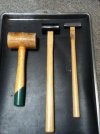
I do question his attention to detail. I would never lay my chisel hammer down on the work like that. I remember once looking at my work and seeing these little marks and dings that I sear were not there because I had planed the surface smooth.

The more I worked the more of these appeared. I finally traced it to my hammer marking up the surface every time I put it down. Now I set the hammer, and most tools I take to the bench on a rubber mat or tray. In addition the tray makes it fast to get the tools out of the way when I need to move the work.

IMG_2193.JPG

PS: OOOOHhhhhh that explains it ! That's Derek in Australia. I know him (through the internet). The Australians work wood that is a whole different world than the one you and I live in. More like a mixture of concrete and metal. Hard to cut or make smooth . . . chips out and is just super hard.

He said
There were relatively good performances from 3V and M4, and superlative performances from Koyamaichi laminated white steel.

YuuuuuP. We don't agree on everything but he's a good guy.
 
Last edited:
To be honest I don't know if forging these steels would gain anything in the steel. I thought it was already delivered optimally to be heat treated for the best performance.

I could be wrong though.

Someone who didn't know what they were doing could obviously make things worse.

The steel should be “Rolled sheet or flat bar to near finished dimension, and length direction parallel to the rolling direction. When you have the blade in this orientation the inclusions have less effect as they are oriented in the rolling direction. If cut in transverse direction the toughness and strength can be significantly lower.”, according to Fredrik Haakonsen. So if you respect this rule and buy high quality steel, no blacksmith by forging can turn your piece of steel better than it already is, from the Mill. Pm and ESR steels can also be affected by rolling direction of the steel sheet, but not so much as ingot ones. You can read my conversation with mr Haakonsen here:

https://edgematters.uk/thread/3348-...ostID=159988&highlight=metallurgen#post159988
 
Just to remind everyone here, all favorite steels 3V, cru wear, infi so on mentioned here are basically high carbon steels containing small amount of other alloys. That being said, Carbon which also the main substance to form diamond, is the most important element. That's why giant company like Hitachi Is willing to invest so much funds on making white steel. However, they eventually aware that it is too costly to forge knife out of pure carbon steel, so they add a little bit of other alloy to white steel, then blue is thus come out. Modern world require lower cost and high efficient manufacturing, cutlery company focus more on marginal profit than ultimate high quality stuffs.
Are you guys enlightened?

The vanadium carbides found in many modern steel alloys are so hard and contribute to wear resistance. Even tiny ammounts of vanadium as low as 0.1 % while not enough to form vanadium carbides is enough to improve the steel's grain structure.

This idea that a steel made from just carbon and iron is superior is plainly false. If it was true that it was superior everyone would be using it.

Also did you even watch the video by Murray Carter? At all points during the video he is listing instances where Aogami (blue steel) would be better option. He even says right in the second video at 2:40 seconds that blue steel is better than white steel in edge retention.

Please watch what you post before you cite information that proves you wrong.
 
Would M4 hypothetically be a good choice for a small 4 5 inch fixed blade that would have to baton if needed ( i would never need to just saying hypothetically!)

CPM M4 is supposed to be quite tough, especially with a good heat treat. I have a 5" bushcraft/camp knife from hardedge knives on the forum and it's been doing well but I haven't beaten the heck out of it as the maker recommended against hard batoning as he ran the hardness high. I've done some chopping with it, what chopping you can do with a 5" knife, and the edge has been holding up really well so far.

He added an acid etch to limit corrosion and it seems to be working so far but I haven't left it wet much and it stays out of the pocket so I don't sweat on it like the other knives I carry on romps through the thicket.
LhSY2jWl.jpg
 
Yeah dude, I always get my master to forge my blade inside an active volcano. Not alot of smiths know this but if you forge the blade facing magnetic north it will help align the grain structure to lead to a better steel.

That is why it is so important a master forges your sword. An amature will not know these things.

(In all seriousness white steel is nice, but not at all what I would pick if I had to rank a good balance between edge holding and toughness each at as high levels as possible. M4 comes to mind. 3v comes to mind too depending on what task you are doing with the knife. Does anyone know if m4 is still standard at blade sports competition?)

M4 is still used a lot in Bladesports, but 4V is coming more into play among a lot of the cutters.
Scott
 
Interesting Carter videoes on Blue and White.

Ive long been a fan of blue steel and in extension white steel.

Have a friction folder custom project using white steel underway, when and if a couple of knifemaking friends have the time.

Post #61 "Are we enlightned?"

Ohh, you defo need to meet Gaston.
 
Last edited:
Just to remind everyone here, all favorite steels 3V, cru wear, infi so on mentioned here are basically high carbon steels containing small amount of other alloys. That being said, Carbon which also the main substance to form diamond, is the most important element. That's why giant company like Hitachi Is willing to invest so much funds on making white steel. However, they eventually aware that it is too costly to forge knife out of pure carbon steel, so they add a little bit of other alloy to white steel, then blue is thus come out. Modern world require lower cost and high efficient manufacturing, cutlery company focus more on marginal profit than ultimate high quality stuffs.
Are you guys enlightened?

This is by far the most ridiculous steel theory I have ever heard LULZ so you are saying that pure carbon is the absolutely best and alloy steel are invented because pure carbon steel is too costly to made? ROFL ...
 
I know m4 or cpm s110 stays sharp for a long time, but do you know how hard to restore the edge after they get dull?
If edg-retention is the only factor to define a good knife, then why don't you just use diamond knife to cut. This is a very straight forward answer.
IMOP, a well balanced knife should be sharp and easy to sharpen by human'hand, not by machine. I have sharpened so many knives in s30V, M390
M4. I have to gring off so many metals from the blade to get it as sharp as possible every time i re-sharpen these super steel blades. In the long run,
i worry that these blades would have nothing left for me to grind. Is that what you define as durability?
 
I didn't say Carter is the best Forging master, but he had a clear observation and open minded thought after his many years of apprenticeship under a master.
 
I didn't say Carter is the best Forging master, but he had a clear observation and open minded thought after his many years of apprenticeship under a master.

you are incorrect that pure white steel is best because it is a pure carbon forged steel. The reason why is because simple carbon steels have very poor wear resistance. Alloying elements add wear resistance to steel. Even low allow steels like S7 will have more wear resistance and be much tougher than your white steel. Also forging by a master was once the way to get high quality steel because making many layers of steel by folding is how they would make a steel uniform throughout. Todays steel manufacturing and heat treating of more complex alloy steels more than compensates for that. As for which steel is best, well that is all a matter of opinion. To me the maker/manufacturer/heat treater are more important than just which steel is used.
 
Yeah dude, I always get my master to forge my blade inside an active volcano. Not alot of smiths know this but if you forge the blade facing magnetic north it will help align the grain structure to lead to a better steel.

That is why it is so important a master forges your sword. An amature will not know these things.

(In all seriousness white steel is nice, but not at all what I would pick if I had to rank a good balance between edge holding and toughness each at as high levels as possible. M4 comes to mind. 3v comes to mind too depending on what task you are doing with the knife. Does anyone know if m4 is still standard at blade sports competition?)
A voice of reason!
 
I appreciate Cobalt's opinion. And forgive me about words in the aforesaid thread. I think nobody has the authority to make a conclusion here.
I would like to read some articles written by a true master bladesmith here. So please join our discussion here if you have in-depth experience of forging knife.
 
Back
Top