My 1st Knife is Done! ....Now I Have Some Questions.

Status
Not open for further replies.
Joined
Jun 13, 2013
Messages
948
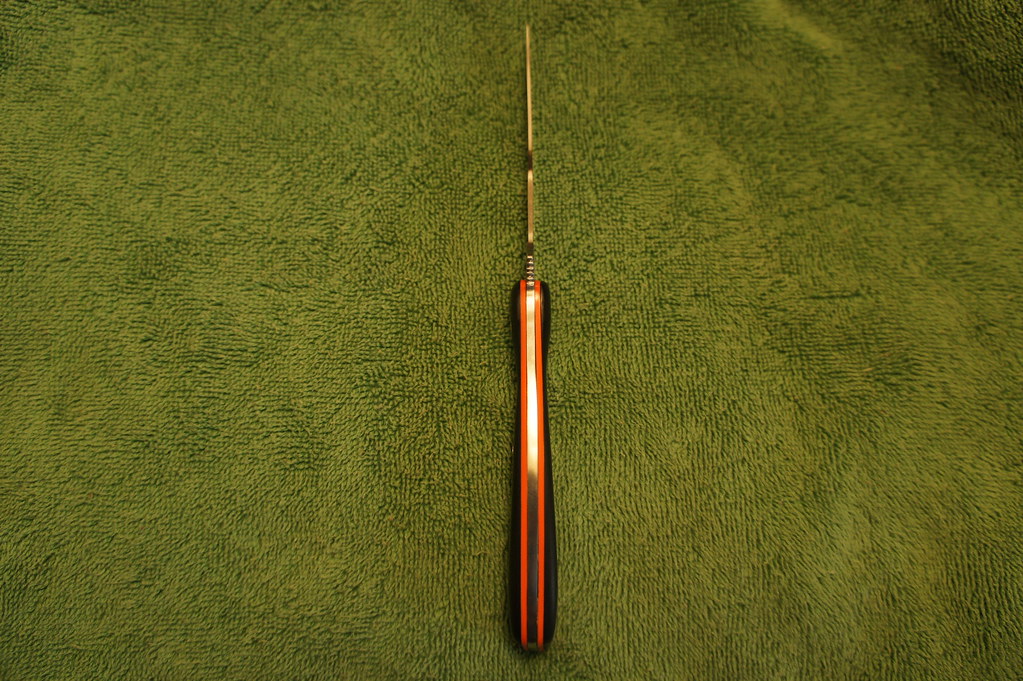
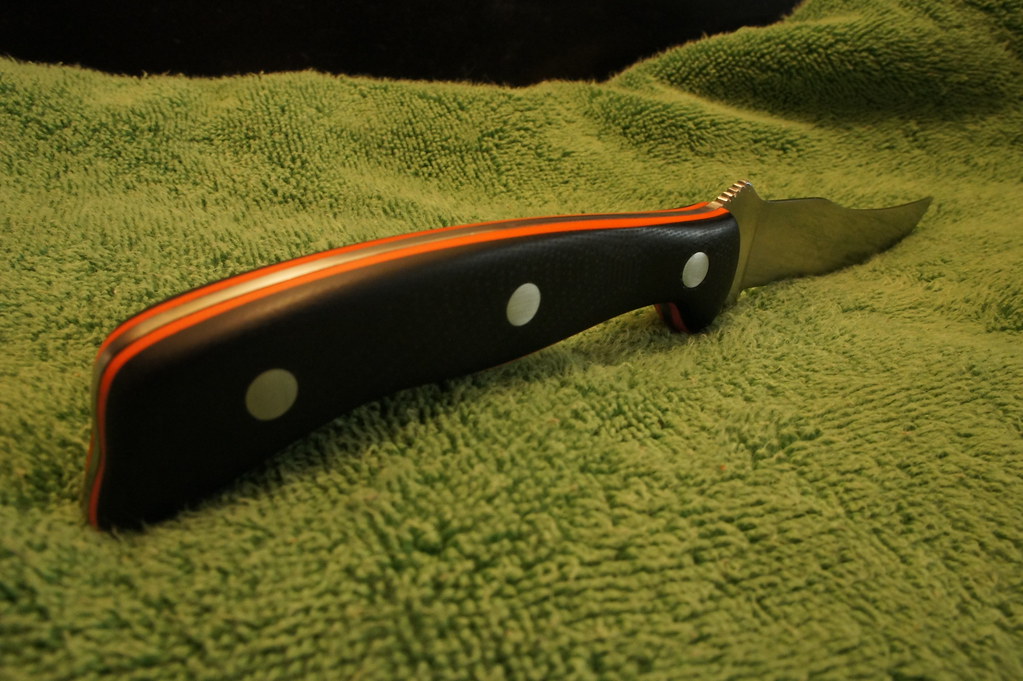
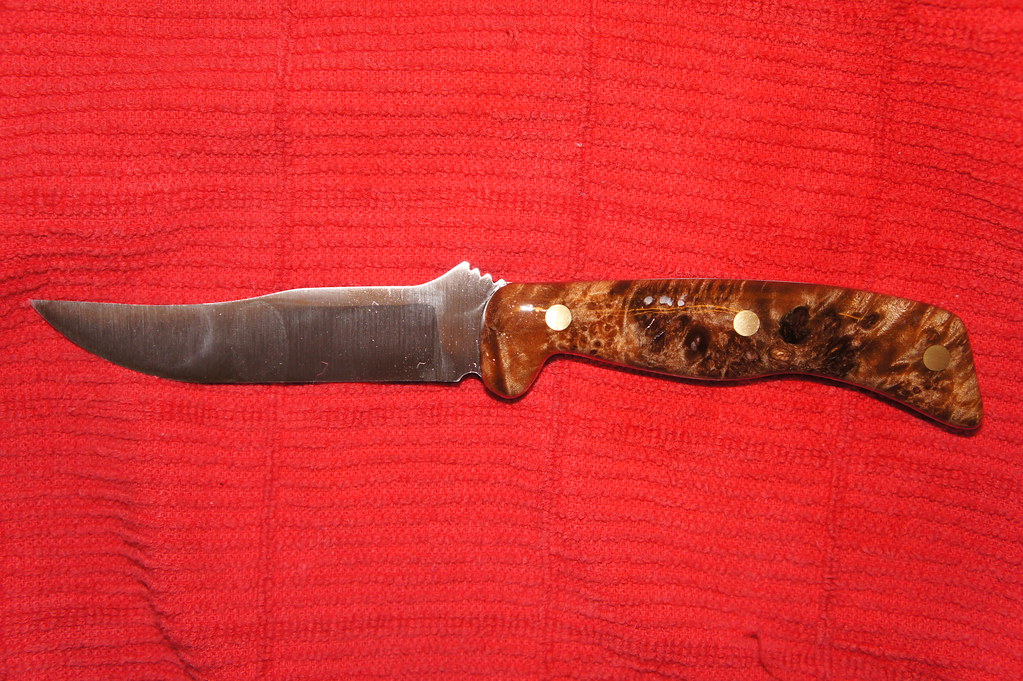
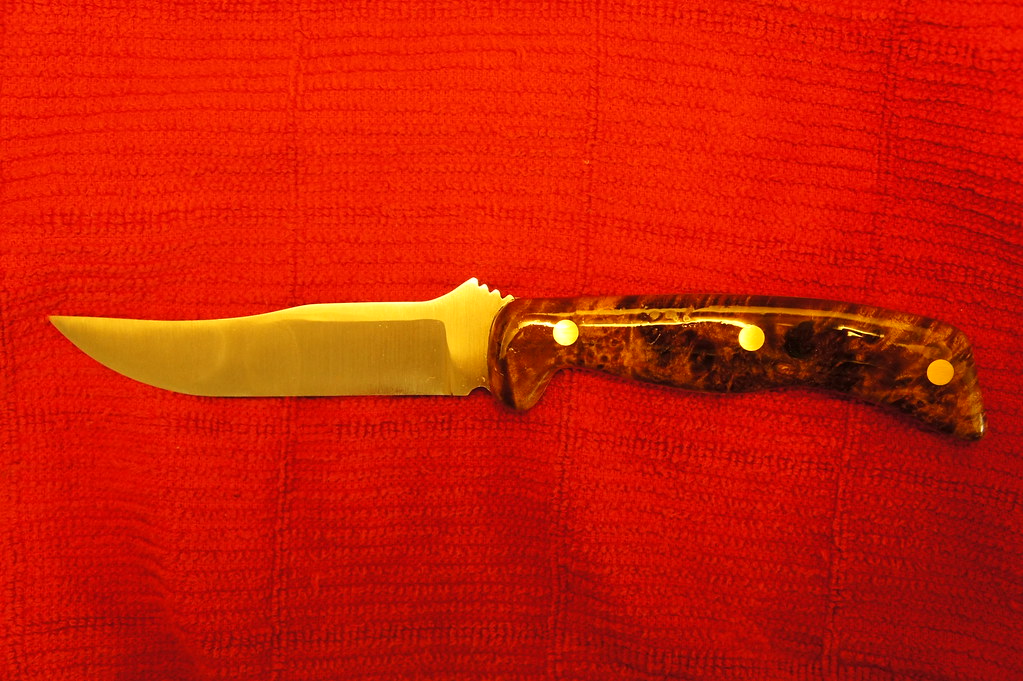
I heat treated my knife yesterday and finished it off today. Granted, this was the test knife. I almost threw it away because I messed up the grind and didnt want a FFG....also the blade isn't as tall as I wanted because...well, I messed up the grind....aaand I also made the bowie blade cut out way bigger than I intended. The 2nd version of this knife is a half grind and I didn't start withering away at the edge.

Anway, now that my first knife is done, I have a question, what grit belt do you typically use for doing your primary bevel grinds? I only had a 80 and 120 belt. 120 looked like ok, I gguess but something was still off...maybe it was just me doing crappy grinds. With the knife below, I ended up mirror polishing in it and not liking it so I took it back down to 600 grit.

...Alright, now I want to show off my knife :D (ignore the terrible grind please). I tried using a jig and I ended up doing better on the second knife free handing. My jig I made sucks for my grinder. btw, I made this in my apartment!
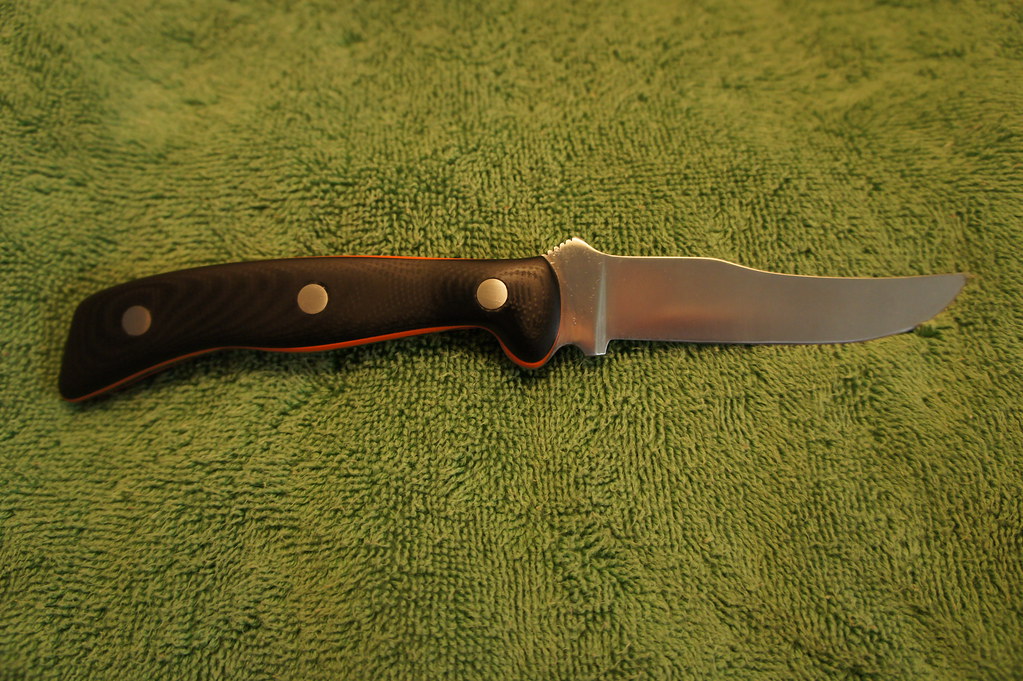
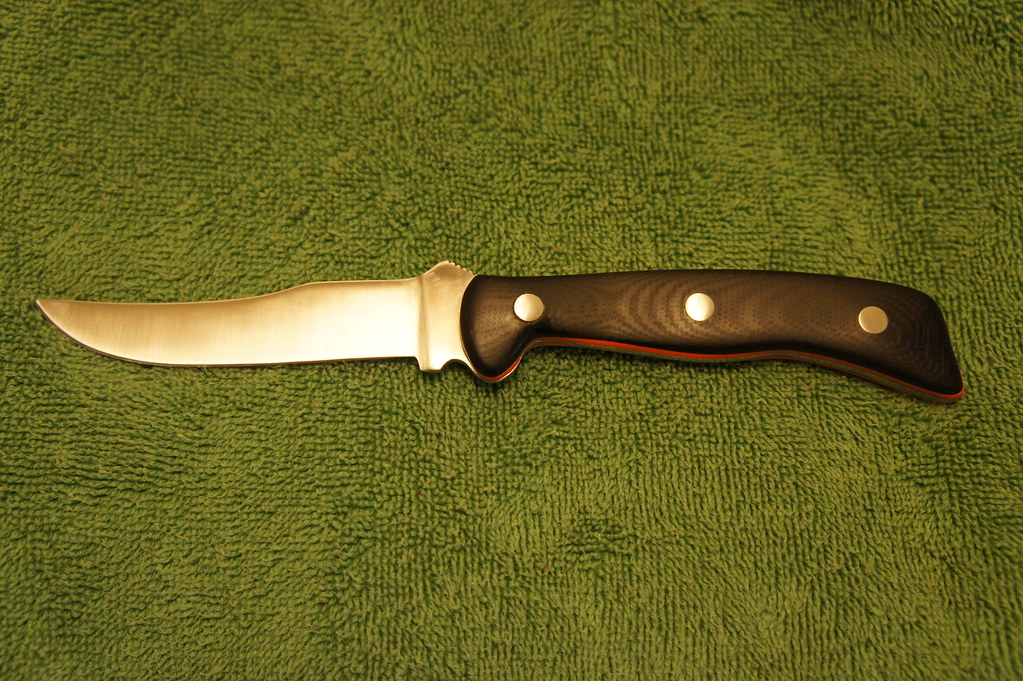
12077790465_f263628bfe_b.jpg


12078118583_e7c03aa487_b.jpg


12078201354_d4de86d64f_b.jpg


12078204844_4f6a4c6445_b.jpg
 
Looks good. You have identified and pointed out the areas that need attention on the next knife, thus making it a successful build. Period.

It looks great for a first, heck, much better than my first FEW looked. As for what grit to cut your primary bevel, do you mean roughing them in? For that, it comes as you develop feel. You don't want to go deeper than will be taken off by the next grit, and the next grit, and so forth. So starting, I would suggest going a bit higher in grit which will cut slower, but won't goof as quick. I usually rough out my bevels with 60. Plenty fast, and I know how far I can go before stepping up.

Overall proportions look good. Nice thin stock. Spacers and scales look good with good pin placement. And yes, a bit taller blade, and take care to expose the whole blade from tip to ricasso so it can be used on a flat surface unless there is some need for a blade-stopping mechanism... I hope all that makes sense. Trying not to be too stuck on nomenclature.

Overall really nice. Glad you didn't chuck it in the dust bin!
 
Looks good. You have identified and pointed out the areas that need attention on the next knife, thus making it a successful build. Period.

It looks great for a first, heck, much better than my first FEW looked. As for what grit to cut your primary bevel, do you mean roughing them in? For that, it comes as you develop feel. You don't want to go deeper than will be taken off by the next grit, and the next grit, and so forth. So starting, I would suggest going a bit higher in grit which will cut slower, but won't goof as quick. I usually rough out my bevels with 60. Plenty fast, and I know how far I can go before stepping up.

Overall proportions look good. Nice thin stock. Spacers and scales look good with good pin placement. And yes, a bit taller blade, and take care to expose the whole blade from tip to ricasso so it can be used on a flat surface unless there is some need for a blade-stopping mechanism... I hope all that makes sense. Trying not to be too stuck on nomenclature.

Overall really nice. Glad you didn't chuck it in the dust bin!

Thanks for the helpful feedback and encouragemenn. I actually was more concerned about common finishing grits for bevels. Also, I have been debating all day whether to take that bottom....uh...stuff?...off the blade at the ricasso. I'm afraid that the knife will look even funnier (more disproportioned blade location and size, relative to the handle). But I never thought of it as being something that got in the way while cutting. I may take it off now.
 
WIth my recent knives (im a total newbie), Ive learned on here that final sanding on bevels is just easier hand sanding. There is a vid on here somewhere that will change your approach. Ill try to find it. It really changed how I finish my bladed and Im very happy with my progress. Thanks in advance to the maker if I find the link
 
I like it. Looks like pin fitment could be a little better on the forward most pin, but it's a solid effort. Love the liners and g10(?).

Now go rub it in your nay-sayer friends faces (not literally!). :p
 
Ah. Finishing...

Well, that just depends on intended purpose and overall aesthetics. Highly polished is gorgeous, but fragile. Every little lint scratch looks like the grand canyon. 400-600 pretty purposeful and durable as long as its uniform. I usually polish to 2500 then etch to what looks like a sandblasted finish. Or, there is stonewashing which I do some of as well for users. (I don't really make shelf sitters... Love em, just don't make em.) Almost any finish, even 120-220 as long as it is smooth and uniform looks great and is durable. Nathan the Machinist is a forum member here who does a lot of mono-direction hilt-to-tip finishing in low grits. If you look at his stuff, it just says 'clean.' Look through the custom knife gallery. Most makers put what grit they finished out to, and if they didn't, they will probably answer a PM. I tend to pull a similar knife out of my stash and see what it seems to have worn to. Like a camp knife for instance. If a few years has left it with a 400ish grit finish, I may shoot to something similar on a new blade just to kind of keep it uniform. Does that make any sense?

As for the ricasso/bevel/edge area of that one, I say leave it. You would kill some visual balance by taking it off, and it looks fine as is.

-Eric
 
Sorry I almost forgot, strong work for a newbie, very strong. I love that liner work and associated scale look. Very nice.
 
Well, thanks for the advice and the unexpected compliments. You guys are very forgiving to a beginner. The material is G10.....it's all over my bedroom. :grumpy: Yes I know it's bad for you. My containment method failed pretty terribly but it was too cold out to shape the G10 outside.

Too late Eric, I did some quick photoshopping with MSpaint and I decided to take off the bottom near the ricasso. Shouldn't have done it. I'm getting used to the proportions now, but it's starting to look more and more like an extreme steak knife with a thumb ramp and jimping. But that's ok. When it goes dull I can just put some force into it when cutting my steak, thanks to the thumb ramp. lol Now I have a good kitchen weapon though.

As far as grinds go, I was looking at my minigrip and it looks to be a pretty coarse grit grind and looks great, but I don't think I am anywhere close to being able to make a grind look good at that kind of coarse grit yet. I think you need to be pretty perfect with what you do under those circumstances.

Other guy: thanks for the video (18mins!?!?!). It's getting late but I will take a look at it tomorrow.

As far as the pin placement goes, somebody has a good eye. You have to look close though. The weird thing is, that first pin (closest to the blade) was the first hole I drilled and I immediately drove the pin in. There was no error correcting/drilling done?!?!

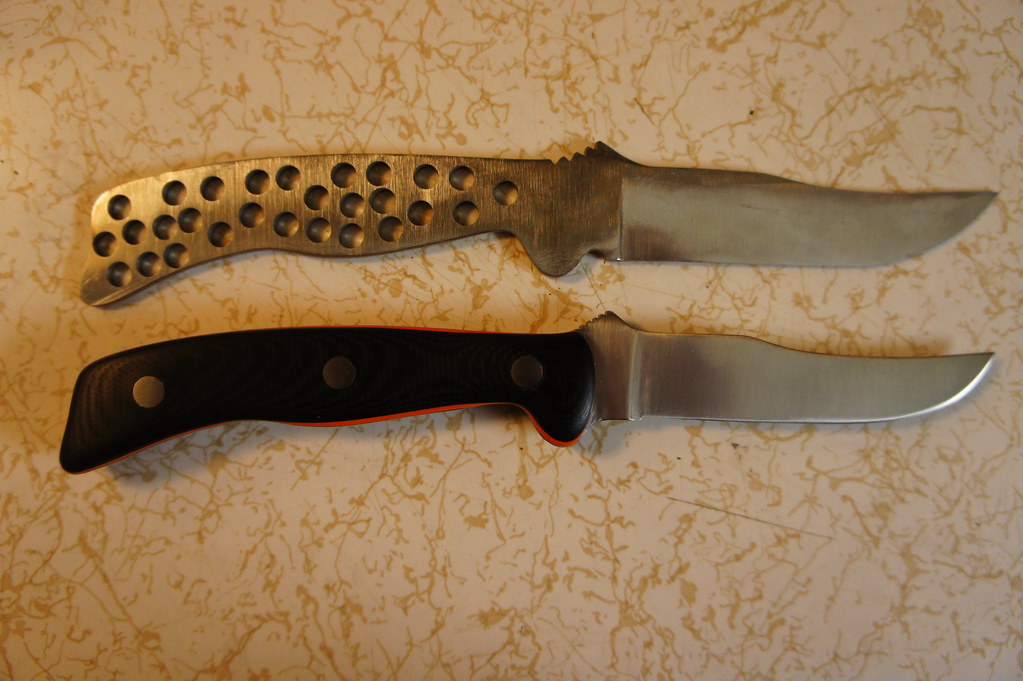
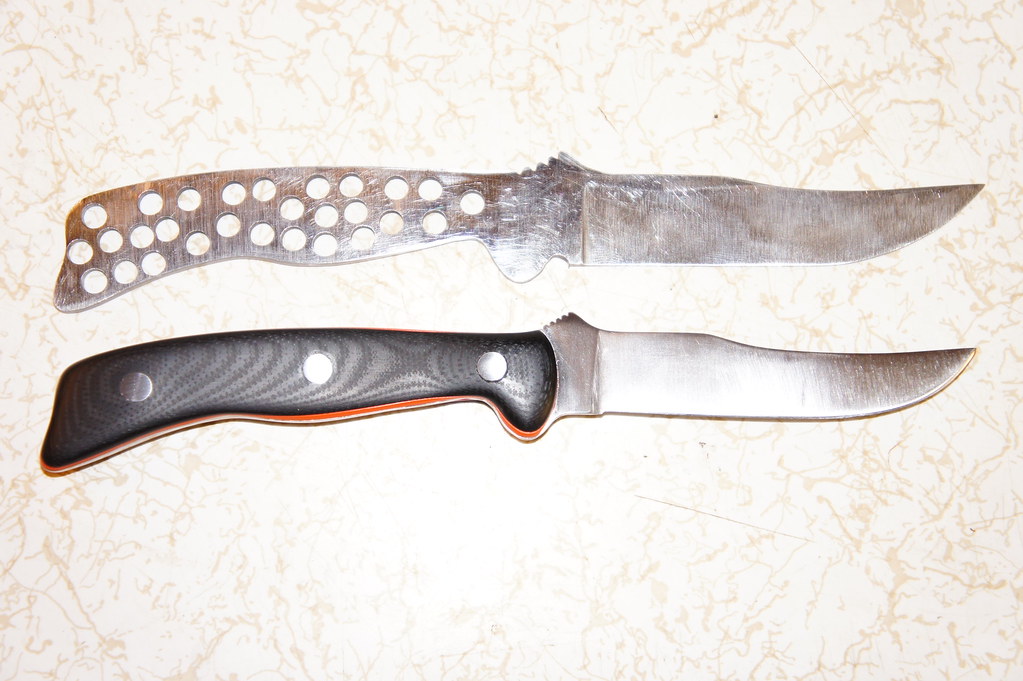
Below is a photo of the knife after I took out the stuff near the ricasso at the bottom. The knife above is my 2nd one. ...yet to be heat treated. Currently the grind is with a dull 120grit belt. ...the more I look at my next knife to do, I'm going to have to be extremely careful not to grind into the hole directly on the rear of the knife. I may have to get creative.

Taking off the stock by the ricasso looks even worse when sitting next to its yet to be finished counterpart.
12079958465_63bf9c8b9a_b.jpg


So you can see the grind difference, I guess.
12080266143_13ab05e0ab_b.jpg
 
Last edited:
Very nicely done! That knife is definitely better than my first 5, likely even my first 10.

Just a newbie myself, but here are a couple observations as I see them. The pin issue Strig pointed out would be resolved by moving the front pin slightly forward. Try to avoid the narrower areas of the handle with your pins. It helps avoid splitting, especially for peened pins and it looks better. Personally, I would have left the front finger grove less pronounced, by making it a more gradual arc off the quillon. Also, I think your pins are too big for how "short" the handle is. But maybe that is because I am used to using smaller pins. :foot: Finally, the grinding will get better with time. Just keep making more and doing whatever it takes to keep yourself interested.

Overall, very good first knife.
Chris
 
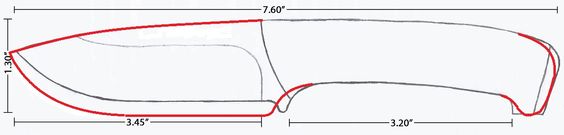
Yes, the front of the grip index finger area transition to the blade through the ricasso looks a bit awkward. A thicker (top to bottom) blade profile placing the edge as basically the lowest point on the knife would be more visually appealing. It sort of looks like a folder instead of a fixed blade...

This is another members sketch that I drew over a bit, but I think it gives a good idea of handle/blade proportion to stop the steak knife look. A steak knife looks like it does because we cut with the tip. In this sketch, the edge is 100% usable.

9229802e8397e142f16f49e52ee42120.jpg


And Nick's finish sanding video is excellent. And should be in the stickies if its not already...

-Eric
 
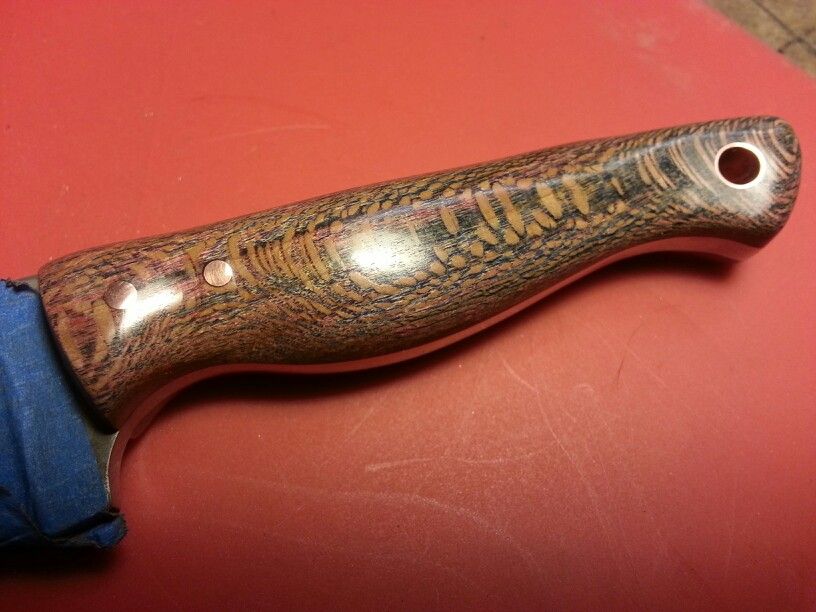
Ok. So just to reiterate, the black and orange knife was my intended first knife but it was messed up from the begining due to the terrible bevel grind. Today, (two days later) I finished my second knife. It is what I intended the first knife to be. I also got the hang of doing the final grind by hand on my cheap Craftsman 1x42 with a pretty worn 120 grit belt. I just wanted to show off what I INTENDED to make with the first knife. I believe the akwardness is gone in the knife...at least in my opinion. I haven't ever seen a knife like what i did. So maybe there isn't a rule book for what i did. This was months in planning but only took a total of three different days to get from bar stock to final product. It's amazing how after starting my first knife I thought making a knife would always take forever, but once you know the process, it gets a lot easier.


In regards to this knife below, I have a question. I have researched how to make stabilized maple (like my knife below) pop/shine. I only went to 600 grit sand paper and am not going any higher. My thumbs are raw. In the pics it is only shiny because it is coated in wet boiled linseed oil. I refinished my maple top work bench with BLO and furniture paste wax and the finish was amazing (albeit, temporary).

So, my question is, how will this go if I decide to paste wax this knife? I can keep the wax off the exposed blade in front of the knife, but I am curious if the wax is going to build up and look funny on the tang and brass pins.

FYI - The pins and tang is sanded to 600 grit and there is of course a visible fine grain.

Here is the final product (besides the wood finish being completed)
12109892515_de6f9dbbf6_b.jpg


12110553836_a11a9e6bf7_b.jpg


Thanks, for all the help!
 
Last edited:
Well, I used BLO and furniture paste wax (yes i am impatient and didn't let the BLO do all it can do). It doesn't look very shiny. It doesn't bother me a ton, but since I have already gone to 600 grit I am thinking of taking a buffer to it with some polishes but I am concerned that this knife will look funny with a polished tang and a coarsely ground blade. Does anyone want to share an opinion on that idea of whether or not it will look odd?
 
This is stabilized wood taken to 1500 and buffed with jeweler's rouge. No wax. Stabilized wood pretty much works like any plastic/resin product...

I mount handles after finishing the blade and handles seperately. Otherwise, with a little care you can polish out and go back with sandpaper lightly on a small stick and give the tang a matching unidirectional finish..
ea55e2dd2d610ffef07dd47179c54045.jpg
 
Yes, the front of the grip index finger area transition to the blade through the ricasso looks a bit awkward. A thicker (top to bottom) blade profile placing the edge as basically the lowest point on the knife would be more visually appealing. It sort of looks like a folder instead of a fixed blade...

This is another members sketch that I drew over a bit, but I think it gives a good idea of handle/blade proportion to stop the steak knife look. A steak knife looks like it does because we cut with the tip. In this sketch, the edge is 100% usable.

9229802e8397e142f16f49e52ee42120.jpg


And Nick's finish sanding video is excellent. And should be in the stickies if its not already...

-Eric

that's my favorite blade shape. your right it is 100% usable. others look good but this one performs.
 
You polish before putting the scales on? How do u accurately shape the scales to the shape of the tang
 
I will only give a few pieces of advice on this knife....

Make the next one without that dorsal fin on it (I would grind it off this one if it was mine). Just curve the handle into the spine. It does not need that bump...and it looks terrible.

Getting rid of the nub of metal at the ricasso was a good thing.

Your deep and angular indent at the index finger looks uncomfortable, and looks odd with the otherwise very nice handle flow. Try a less deep and more curved indent, rounding back into the palm swell ( like the handle Lucyknives showed).
 
I will only give a few pieces of advice on this knife....

Make the next one without that dorsal fin on it (I would grind it off this one if it was mine). Just curve the handle into the spine. It does not need that bump...and it looks terrible.

Getting rid of the nub of metal at the ricasso was a good thing.

Your deep and angular indent at the index finger looks uncomfortable, and looks odd with the otherwise very nice handle flow. Try a less deep and more curved indent, rounding back into the palm swell ( like the handle Lucyknives showed).

lol. Now you are talking about knife style. I guess I should explain this knife and what I am doing as a knife maker and a person in general.

I love the way the knife looks. I had this drawn up about 6 months ago. It doesn't look right to you because you haven't seen anything like it. I don't want to make knives that I can buy in the store. I wanted to make something unique and beautiful. I gave the knife a "busy" look with lots of curves and such in a small/slim profile but also with an aggressive forward lunging feel. The top of the knife looks like it has all been stretched forward. That is why the thumb ramp is not symmetrical. I like how it looks and the knife feels comfortable. Way more comfortable than a lot of other really expensive knives.

The "detent" choil at the bottom of the knife by the ricasso is not angular. It is rounded and very smooth. Your hand touches no sharp edges. How large and round do you think my finger is?? The radius of a finger is incredibly small.

I like the "dorsal fin" aka, thumb ramp. I specifically wanted a knife with this. A Bark River Bravo has one. So do some other fixed blades and a large percentage of folders. Never the less, if I put it there, I must have wanted it. It wasn't by accident. It adds character AND a ton of functionality. (The US military specifically requested the thumb ramp on the bravo one.)

I have a lot of other things to improve upon. Like I said before, the first knife I posted above was my first ever grind and was supposed to look like the 2nd knife (it wood handles are on it). There was no intention to have the akward up/down blade positioning relative to the handle on the first knife. It was just messed up from the beginning and became a test knife. As far as the second knife, it sounds like we have different tastes. You'll never be able to convince me that something is wrong with this knife design.

You should think outside of the box more. Our sense of style is very different. I can only imagine that your knives are extremely ugly and boring. Just wait until you one day see my fixed blade I will make with a pocket clip. I'm going to blow your mind. :D
 
Last edited:
You polish before putting the scales on? How do u accurately shape the scales to the shape of the tang

I drill my pins dead nuts to size. Then I use some very slightly undersize aluminum or brass pin stock because it works down quickly. When everything is shaped, polished and done I knock the pins out and finish the blade to whatever grit or etch I choose. I can then bring everything back together for glue up. I leave the scales just a little proud around the pins so I can work it down flush, give it a light tap to swell em out just ever so lightly and polish it back up with the permanent pins.

I also use a lot of hidden pins. On my knives, there are probably 2:1 hidden pins to visible ones. For hidden pins I also drill dead to size and depth, use thread stock and undercut or keyway the holes prior to glue up. Probably overkill, but why not.

It takes a little practice, a good drill press and pinning as you drill to make sure nothing moves.
 
lol. Now you are talking about knife style. I guess I should explain this knife and what I am doing as a knife maker and a person in general.

I love the way the knife looks. I had this drawn up about 6 months ago. It doesn't look right to you because you haven't seen anything like it. I don't want to make knives that I can buy in the store. I wanted to make something unique and beautiful. I gave the knife a "busy" look with lots of curves and such in a small/slim profile but also with an aggressive forward lunging feel. The top of the knife looks like it has all been stretched forward. That is why the thumb ramp is not symmetrical. I like how it looks and the knife feels comfortable. Way more comfortable than a lot of other really expensive knives.

The "detent" choil at the bottom of the knife by the ricasso is not angular. It is rounded and very smooth. Your hand touches no sharp edges. How large and round do you think my finger is?? The radius of a finger is incredibly small.

I like the "dorsal fin" aka, thumb ramp. I specifically wanted a knife with this. A Bark River Bravo has one. So do some other fixed blades and a large percentage of folders. Never the less, if I put it there, I must have wanted it. It wasn't by accident. It adds character AND a ton of functionality. (The US military specifically requested the thumb ramp on the bravo one.)

I have a lot of other things to improve upon. Like I said before, the first knife I posted above was my first ever grind and was supposed to look like the 2nd knife (it wood handles are on it). There was no intention to have the akward up/down blade positioning relative to the handle on the first knife. It was just messed up from the beginning and became a test knife. As far as the second knife, it sounds like we have different tastes. You'll never be able to convince me that something is wrong with this knife design.

You should think outside of the box more. Our sense of style is very different. I can only imagine that your knives are extremely ugly and boring. Just wait until you one day see my fixed blade I will make with a pocket clip. I'm going to blow your mind. :D

OK, I won't argue with your experience. You have made two knives in a few days, and I have made two thousand knives in fifty years, and seen and handled over ten thousand....what would I have learned doing that.
Just for the record, if you knew my work, you would not say that I don't think outside the box. And I have never had anyone say a single knife I made was ugly or boring.

To paraphrase another maker...."It is OK to think outside the box, but first you have to know what the box is."
 
Status
Not open for further replies.
Back
Top