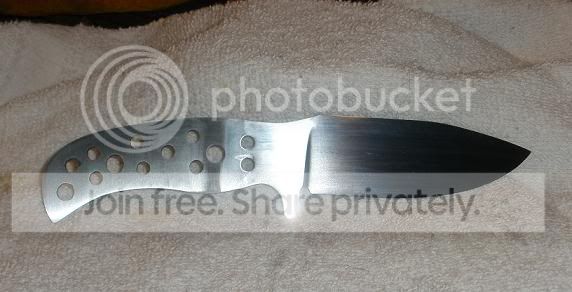
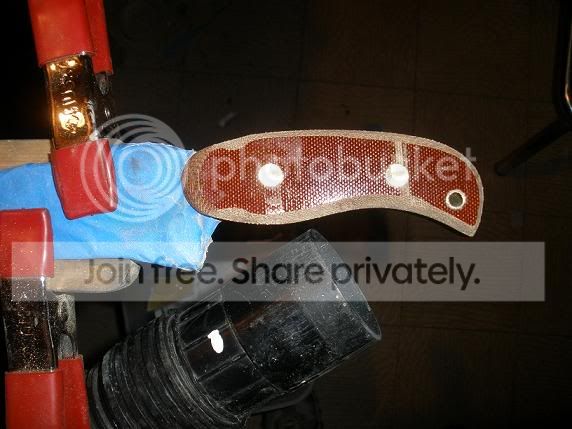
My first knife design. Critiques and Comments welcome

My only concern with the gorilla glue is the fact that it does foam up. I'd really hate to look at the knife the next day and see the glue oozed out all over my knife.

I'd prefer something very slow curing, like a 24 hour epoxy. The slowest curing ones are usually the strongest from what I can gather.
 
Matt,
If the handle is still being installed with Corby blots, the glue is not really any more than a sealant. Gorilla Glue should work fine. I use T-88 24 hour curing epoxy, but any 1 hour epoxy from Home Depot will work fine.

When setting the Corby bolts, only tighten then snug. You don't need to torque them down like lug nuts.

Remember to plug the thong tube with tissue paper before gluing it in place ( this keeps the glue out of the tube). Also, make sure you install it at the same time you glue the handles on.

Sand down the front of the handles with them off the knife, and give that area a buff with pink or white compound if you have a small buffer ( a 4" muslin buff on a cheap grinder will work....just be careful). The material I sent will buff nicely once it is sanded to 400.
The easiest and best way is to temporarily bolt the scales together with the Corby bolts, and finish the front where it will be over the blade. That will keep everything even. Once the handles are installed, you can tape the blade up heavily, cut/file off the excess bolt metal, and sand/file/grind the handle to the final shape and finish. If using a grinder, go slow and avoid getting the handle hot, or it may scorch. The same goes for buffing, go slow and be careful. If hand sanding,wear a filter mask and clean up all the dust with a vacuum. If you are using a grinder, wear a respirator. Clean up the dust well in either case.

For those just joining this thread, photos of the blade and handle are on page 4,post #78.

Final thought:
When you glue up the handle scales, it is best to tape the blade up to about one inch from the handles. Then after everything is bolted down, wipe off the excess glue on the ricasso area.Be sure to wipe any glue off the pre-polished handle fronts,too. Use some solvent, sparingly, if needed. Come back just after the glue sets up ( check the glue cup for when it gels) and clean this area with the solvent for the glue again, as some glue may seep out during cure. Depending on the glue used, the solvent will most likely be acetone of vinegar.
Set the knife aside to let the glue cure for at least 24 hours before starting the handle sanding.

Stacy

 
Well I'm doing the handle all by hand I don't want to go and make matters any worse than I have so far with power tools. I don't have a buffer so it'll all be done by hand. I don't need any special files to work on the handle then? The same ones I used to shape the blade will also work fine on the handle area then I'm guessing...
 
Alright here is a pic, somehow I lost the pic of the other side and I'm too lazy to try and take another decent pic of it. For some reason my "satin" finish doesn't seem to be as satiny as a lot of the finishes I see. This was taken to 800 grit with Mobil 1 and it's awful shiny if you ask me. It looks more like a finish with some sanding marks in it than a satin finish :confused:. When I look at it I can see my reflection pretty clearly in the damn thing...Aren't you not supposed to be able to do what with a satin finish?
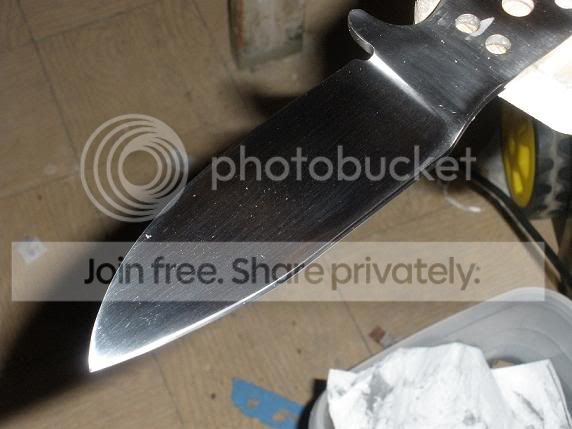
800finish.jpg
 
I like getting scotchbright pads from the local auto parts store. They make a nice satin finish.
 
Fletch, here's one finished to 600 grit if I remember correctly:

IMG_0249.jpg


So, yeah, you can see your reflection in a hand finished satin. :D A machine finished satin, tumbled, or sand blasted are more "true" satins.
Glad to see it getting close to handles. I use WD40 for a solvent when cleaning up glue at the front of the scale, and it works really well. Spray a small amount on a paper town, and wipe off the excess glue. Move to a clean area of paper and repeat until you've got the excess cleaned up. I check it again in a few minutes, and then several more times to make sure it's all good. Nothing causes more pain than screwing up a great hand finish on the ricasso because you're trying to remove cured glue.

--nathan
 
I had #5 sanded to 600 then buffed shiny. I thought it looked too shiny for satin so I buffed it shiny. I didn't like the shiny because it would get scuffed way too easy(bad material, different thread). I sanded back to 400 and love the satin finish. Although, I also considered a cheap sand-blaster to do the same.

BTW: All the holes in the handle, are they all for pins or just to reduce weight?
 
BTW: All the holes in the handle, are they all for pins or just to reduce weight?

Only 3 serve a purpose. 2 for the Corby rivets and 1 for the lanyard tube. Rest are for weight reduction. Page 4 post 78 like Stacy mentioned shows that it looks like with the handles on.

Oh good news I showed the knife to my father recently with the handle material and he asked "what is that material called?" I said "Micarta. Then he said I have a big piece of that stuff..... SCORE!!

I really have to get faster at making these things too. I have handle material coming out of my ears, between the wood I've bought, some paper Micarta from a member here, G11, and something else I picked up at the ECCKS this weekend I can probably make 100 knives. What I need to focus on now is more sandpaper (a lot apparently the way I do things) and things like Corbys.... I have a few rods of brass I grabbed while out a while back too. I've apparently caught some kind of material hording sickness.
 
Last edited:
Matt, Blade looks good.

Same files will work fine. Same sandpaper,too.

Using sanding strips ( roll abrasive or cut 12" long strips) you can "shoe-shine" sand the handles after the initial shaping. This yields a smoother curved surface.

Tape the blade with three layers of tape. The clamp may cut through only one layer, and slips with files and coarse paper can be brutal on a 400 grit finish. A good trick is to put a piece of thin wood, or something like Kydex, over the blade before clamping it on your work board.

I would avoid using WD-40 and other oil based things on Micarta and any handle material that might absorb it.

Stacy
 
Stacy, I'm curious as to why you'd say WD40 is a bad choice. I've used it on micarta and several wood types, and I've had no issues. I know that's a poor excuse. Kinda like saying I haven't ever tripped and fallen, so I must be just fine. I was using alcohol, and another maker tipped me on to WD40. I like it much better, but if there's a reason I shouldn't be using it, I'd like to know. I haven't had trouble with finish (I shape after glue-up) or with failure of the epoxy bond. Thanks.

--nathan
 
Okay I went out and got the slowest setting epoxy I could find at the Depot. It's Loctite Marine Epoxy, it has a 50 minute set time and says it's fully cured at 24 hours. Says it works on metal, glass, ceramic, most plastics, any kind of pipe you can think of (PVC, Brass, copper, galvanized) so I guess it should work. Most of the other epoxies I found were all in the 5-6 minute range, I was torn between that and gorilla epoxy but that was a 5 minute set time.

If anyone knows any bad points about this stuff please let me know and I'll return it before I open it. Scales should be ready to go on in the next few days. I got most of the ricasso area cleaned up last night, I'll do a once over on everything in the next day or two. Then get the front of the scales filed down and from there they should be ready to go on.
 
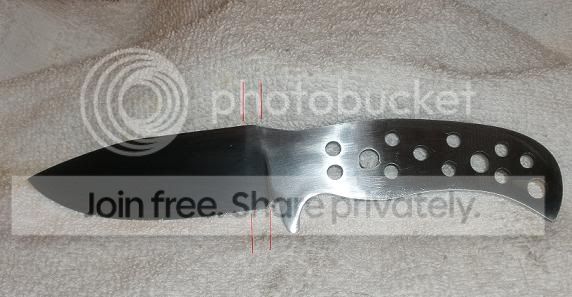
Alright I think I'm just about there on the finish. The only thing I'm a little unsure of (both what it is and how to get rid of it)... Is marked in red on the top pic. It looks like I've mentioned before a 2" grind line right where the plunge is. Not sure how it got there because I did a tip to tang rub on this and just touched it up to make sure it all flows from the blade to the ricasso area... And it was all with a 1/4" piece of square stock. Since they were done separately I wanted to have the finish look as uniform as possible. There is still a little oil on it I'm sure which makes some spots look a little smudgy. Not sure what the best thing is to get all the Mobil 1 off the blade before I put the scales on.

Satin2.jpg


Satin1.jpg
 
Good call on the brake cleaner, I degreased the blade today and spent a little time on the handle. Mostly just the area that will sit on the ricasso I tapered it down and buffed up the front edges to 1200 rather than try and do that when it's against the metal. I'm planning on doing the handle with a taper towards the tip then widening in the middle of the grip and taper again towards the butt. So it'd be thin, wide, thin is the current plan.

I think I'm just about ready to glue the scales on in the very near future. I'm assuming the epoxy I have is okay for the job so the plan is to monkey with the ricasso part of the grip a little more until I like it. Then wipe the handle on the blade down with rubbing alcohol (even though it's got a good couple shots with brake cleaner). Then glue everything on, either tonight or at the latest tomorrow.
 
Sounds good! My project is coming slowly. I've pretty much given up on the 1x30 for now--I can't grind flat with it--I keep getting dips. So, I'm going at it with a file. It's coming, but the 1/4" stock takes a while to hog off.

I'm afraid I may have thinned the edge too much for heat treat, but I don't want to be filing on it forever after heat treat either. This really is a learning experience!
 
Well you shouldn't be filing after the HT it's all sanding. If you think the edge is going to be too thin you can always just sand the edge down a bit and make it wider. Remember you're going to lose a little thickness after you sand too, you're likely going to go up to at least 400 before the HT so account for that. And yes this whole first knife thing is a massive learning experience.
 
Yeah I have 4 other ones that have to be taken up to 400 grit then HT. Plus another one I started forging that is still in it's infancy stages. I kept myself pretty busy when I was waiting to get the blank back and while it was out for HT. So while it's my first knife I managed to get 5 other ones going at the same time. What I need to to is start drawing up more :D
 
And so it begins......

Knife022.jpg


Everything was glued up a few nights ago. Cut the rivets and tube off last night and did a little filing. Tonight I basically took all the excess material off the edges (not sure if that's considered profiling). Also did basically what you see on both sides. The more indented areas near the ricasso are roughly where the handle will start to get thicker. Never really did this before so I'm flying strictly by feel here.
 
Back
Top