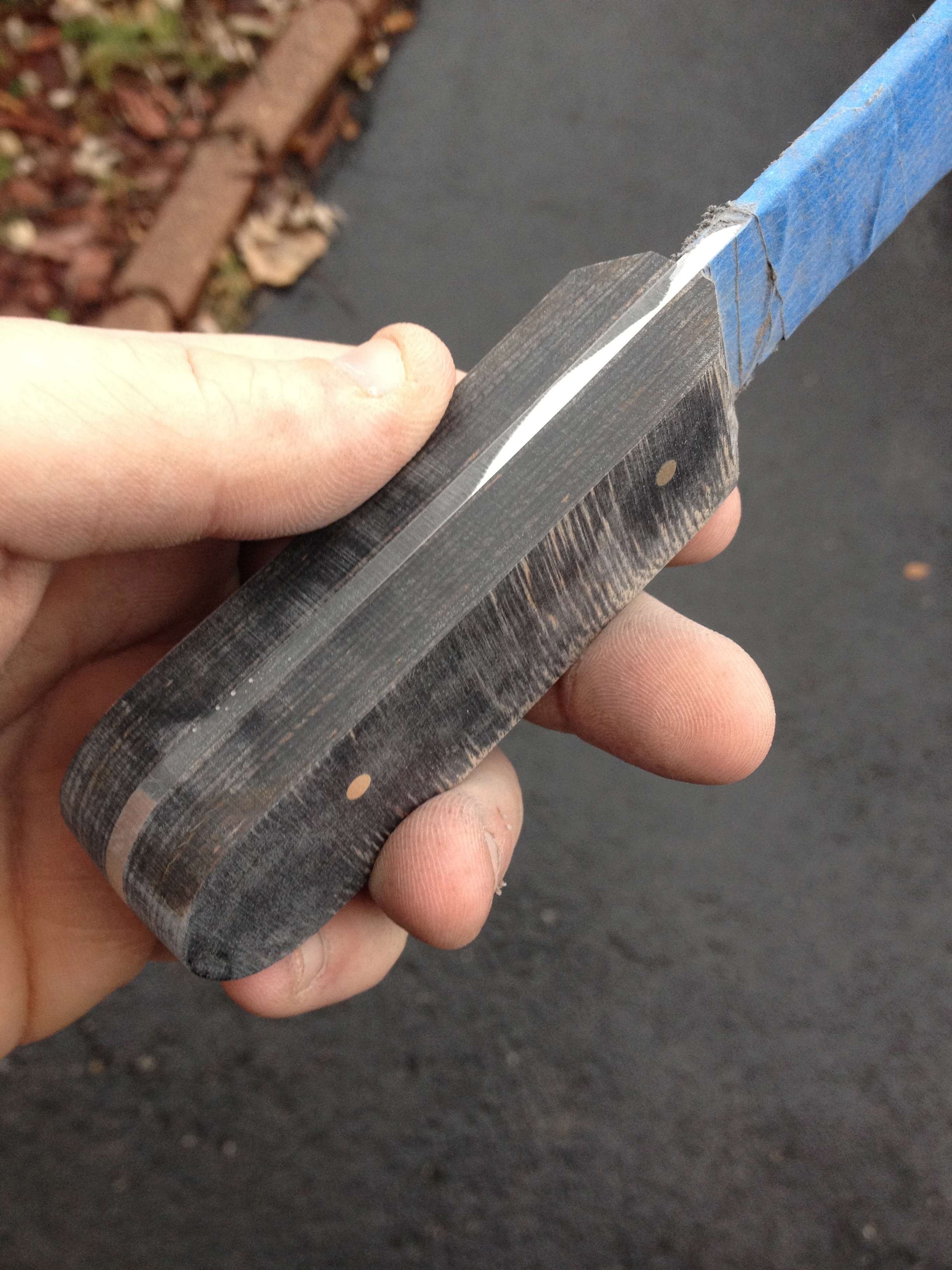
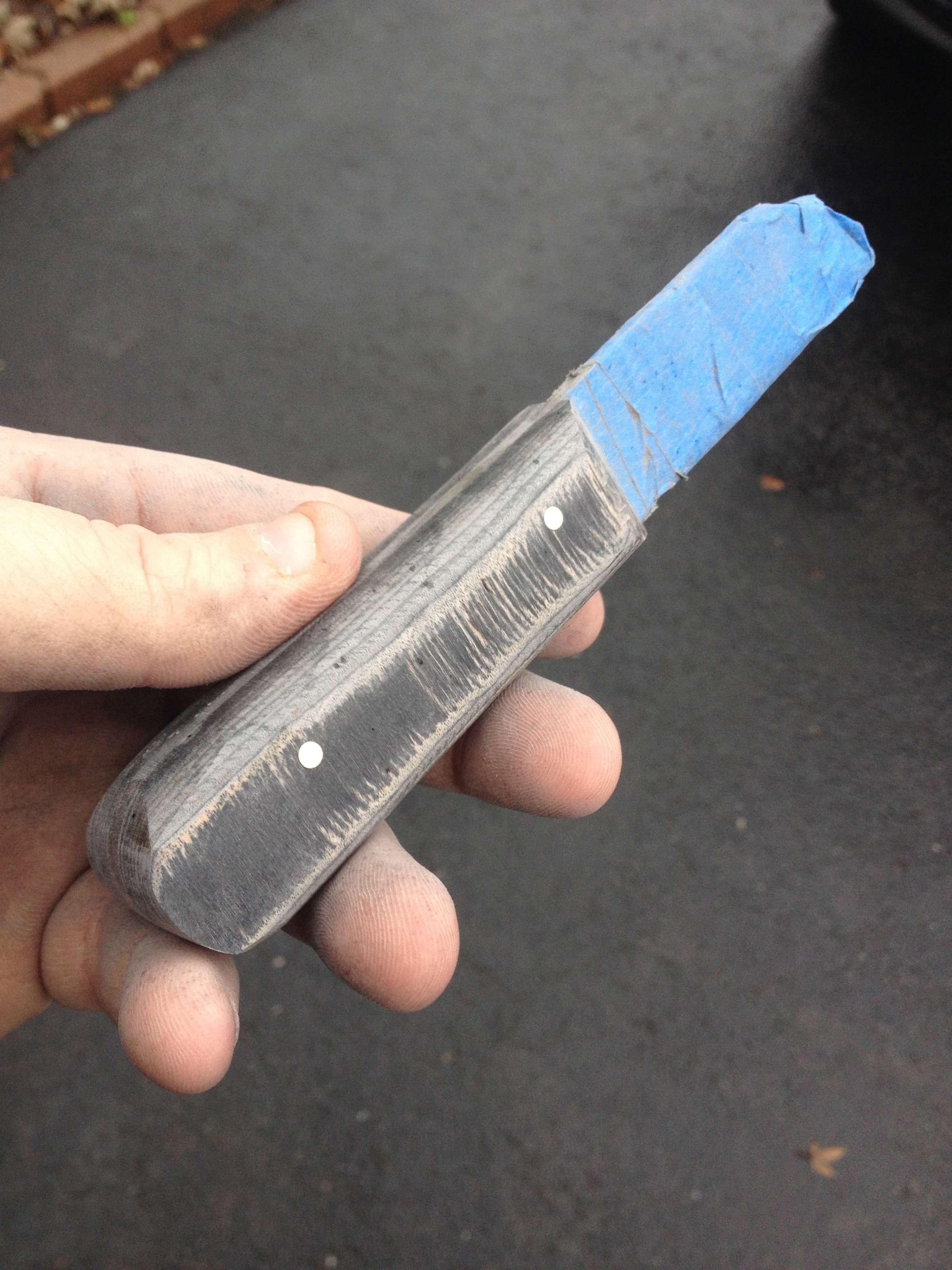
My First Knife WIP

What that knife suffers from is called BHS.....Blocky Handle Syndrome. You need to round that handle up a lot. Taper it toward the bottom as you make it rounder, making it egg shaped in cross-section.
 
What that knife suffers from is called BHS.....Blocky Handle Syndrome. You need to round that handle up a lot. Taper it toward the bottom as you make it rounder, making it egg shaped in cross-section.

Thanks Stacy, any thoughts on the blade not getting razor sharp?
 
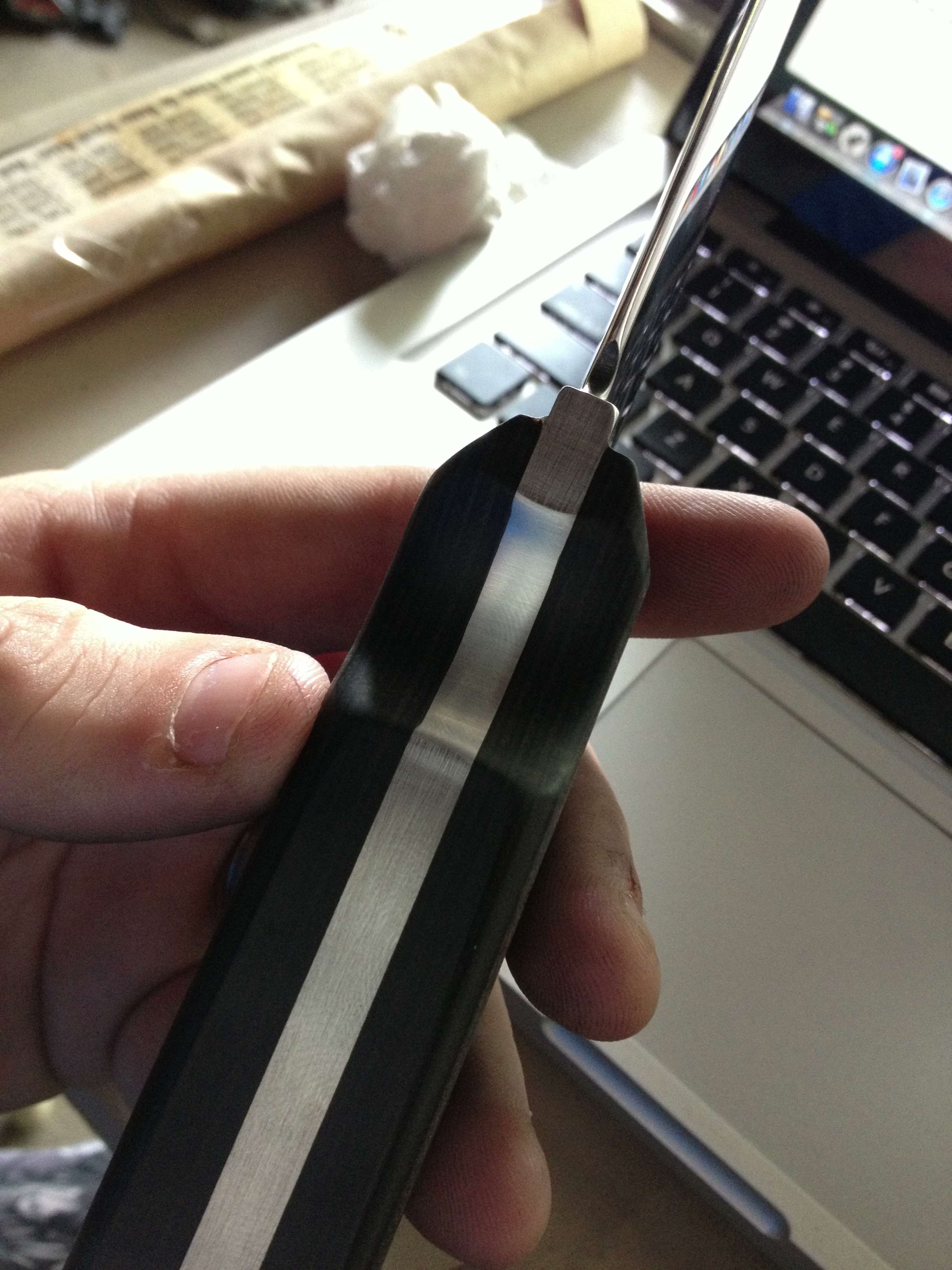
Quick Update: I sanded down the epoxy in the finger guard, I have higher standards than that (momentary lapse of laziness).


nl8u.jpg
 
If you haven't sharpened a convex edge before, are you sure you're trying to sharpen at the final angle? You run a lower grit paper on your polished edge as you would sharpen and then see where you scratched it with a magnifying glass to find out if you need to adjust your angle.
 
If you haven't sharpened a convex edge before, are you sure you're trying to sharpen at the final angle? You run a lower grit paper on your polished edge as you would sharpen and then see where you scratched it with a magnifying glass to find out if you need to adjust your angle.

I will give this a go later tonight, thanks Chuxwan!
 
Are you pulling or pushing when you sharpen? Think spreading butter, not shaving off the paper. In other words from spine to edge not edge to spine for your direction. And make sure its not too spongy of a material you are using. Too soft will wreck it. Needs to be fairly firm. Mouse pads are great...
 
Are you pulling or pushing when you sharpen? Think spreading butter, not shaving off the paper. In other words from spine to edge not edge to spine for your direction. And make sure its not too spongy of a material you are using. Too soft will wreck it. Needs to be fairly firm. Mouse pads are great...

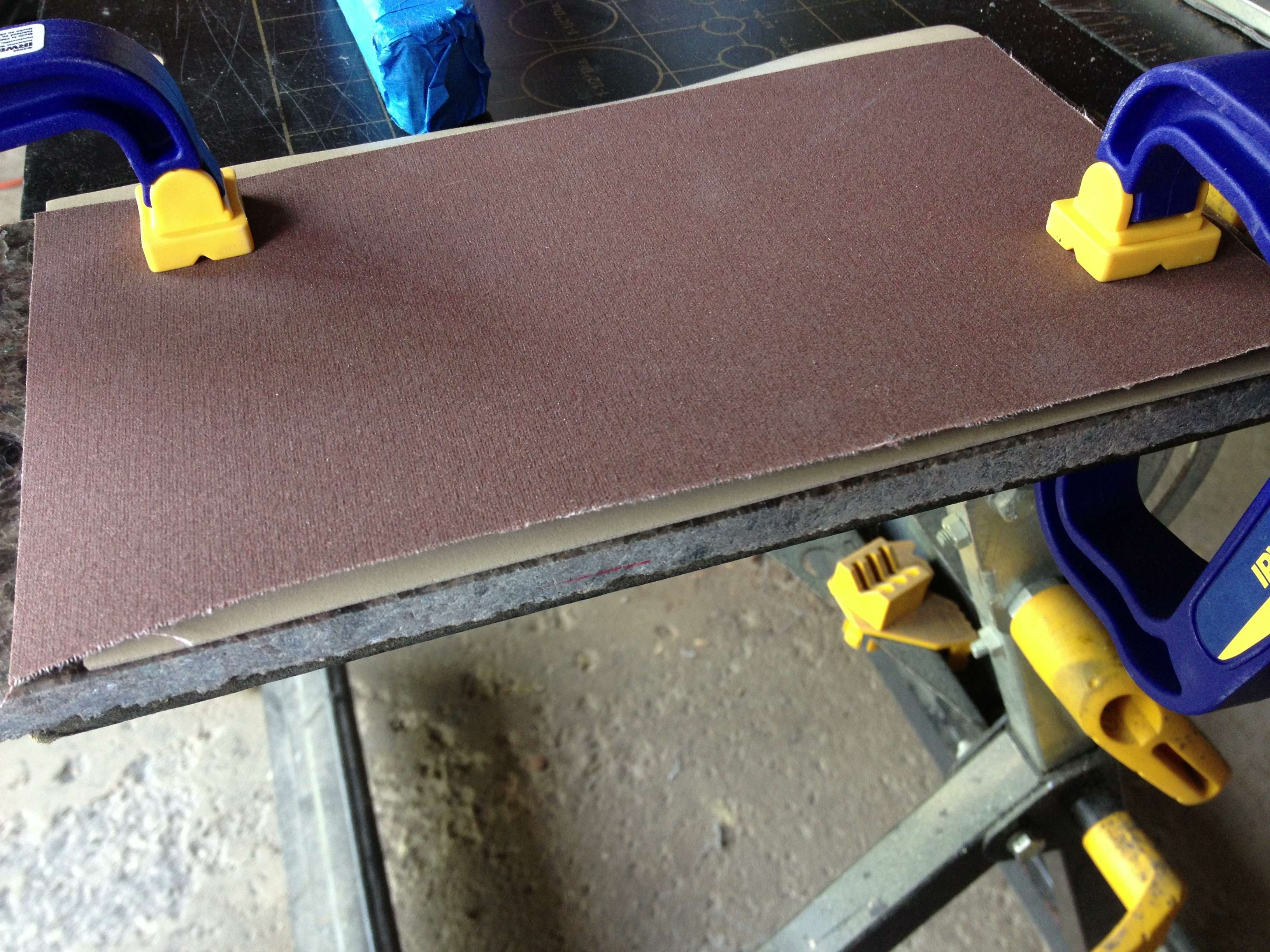
Here's my sanding station...
y9vl.jpg


I was moving in both directions while sharpening so I will try moving the blade edge to spine only, thanks!
 
I still can't seem to get the edge razor sharp. Odd because I have no problem doing this on my kitchen knives, however convex edges are new to me. I am guessing due to the thickness immediately behind the edge that this knife is acting more like a wedge/axe. It actually works ok on branches and wood but any sort of delicate/fine use doesn't exist. Would this be an accurate assumption? You'll have to forgive my ignorance as I have never worked with a blade this thick before.


P.S. I am using Rhynowet Redline sandpaper starting with 400 grit and moving all the way up to 2000 grit. I know my technique is a bit off because I keep dulling the the curve of the tip. The flats should be a no brainer and they definitely have that grippy feeling of a sharpened edge but it will not shave hair off my arm.
Thanks,

Pete
 
I suspect your edge is very obtuse (90*) because of thick-behind-the-edge and partially rounded edge from edge-trailing strokes on sand paper with soft backing. Sugget re-bevel with 180, progress to 320/400 w/d on hard-backing. Then sharpen it on your waterstone 1K, then strop to clean up and perhaps a micro-convex-bevel.

Also I found a camera macro shot through a loupe at the edge reveal a lot of details.
 
I suspect your edge is very obtuse (90*) because of thick-behind-the-edge and partially rounded edge from edge-trailing strokes on sand paper with soft backing. Sugget re-bevel with 180, progress to 320/400 w/d on hard-backing. Then sharpen it on your waterstone 1K, then strop to clean up and perhaps a micro-convex-bevel.

Also I found a camera macro shot through a loupe at the edge reveal a lot of details.

I do quite a few convex edges and discovered they work best if the area of the blade behind the final edge is thin enough that it is basically an extension of that edge. In other words, instead of being a defineable edge between the bevel and sharoened edge like a flat ground blade, it is really more of a smooth tightening of the radius away from the sharpening angle. Keep in mind the bevel behind the edge has to move cleanly through the material that was just cut so the thinner overall the better...
A convex bevel and edge combo is hard to get to a hair popping edge but can be done. They prefer to be a little more brutish. My advice is if it is cutting what it is intended to cut, and does a good job of it, it doesn't matter if it will shave hair. And I was meaning go spine to edge with your sharpening strokes not edge to spine. Once it starts to get really 'bitey' strop it clean.
It has really turned out to be a cool knife. Just stay patient and it will get where you want it to be.
 
I do quite a few convex edges and discovered they work best if the area of the blade behind the final edge is thin enough that it is basically an extension of that edge. In other words, instead of being a defineable edge between the bevel and sharoened edge like a flat ground blade, it is really more of a smooth tightening of the radius away from the sharpening angle. Keep in mind the bevel behind the edge has to move cleanly through the material that was just cut so the thinner overall the better...
A convex bevel and edge combo is hard to get to a hair popping edge but can be done. They prefer to be a little more brutish. My advice is if it is cutting what it is intended to cut, and does a good job of it, it doesn't matter if it will shave hair. And I was meaning go spine to edge with your sharpening strokes not edge to spine. Once it starts to get really 'bitey' strop it clean.
It has really turned out to be a cool knife. Just stay patient and it will get where you want it to be.

I think you are refering to the "Moran"edge,also called the "appleseed"edge.Iget those by accident sometimes ,and sometimes on purpose.
 
I'll point out where your problem is.....your edge. Go back and put one on the blade.

Where most folks go wrong with a Moran edge, or the Japanese version - hamaguri, AKA the apple seed edge - is they somehow think it doesn't starting out close to a full flat grind. It isn't a grind made by sloppy grinding/sanding because you don't want to do all the work needed to get it straight and flat. The only difference is that you leave a bit more meat on the edge, and when doing the final grits, curve the bevel down to the edge instead of making a secondary bevel. If you just round over the edge , it will be far too thick and won't cut worth beans. If you taper the curve down into the edge, it will have strength as well as superb cutting ability. All that is necessary to get this type of edge is a softer backing block. There are ones made in hard rubber, or some folks use a layer of canvas on a block of pine. These slightly curve the surface toward the edge. DO NOT MAKE CURVED STROKES in an arc when sanding (unless you want a round edge that won't cut). For the final sharpening and higher grit sanding a mouse pad will work, but use care not to round over the edge. I find a tight belt on the slack portion does very well in getting a hair shaving hamaguri edge. These also need very little stropping. The Rotary Platen from Beaumont is superb for attaining this edge.

For a hair popping and thin slicing edge, a full flat grind can't be beat. But, if you want an edge that will survive use in the field a little longer, the Moran edge is tougher and cuts nearly as well.

To get your mind around this grind, draw a narrow "V". That is the edge. Now curve the "V" up to meet the spine. That is the convex part.....the edge is still almost the same.
Scroll down to the GRINDS part of this link for a good comparison:
http://www.spyderco.com/edge-u-cation/knifeanatomy.php

 
I agree with Stacy here. I just found this out the hard way. I had my brother's bowie hand sanded to 2000grit, and couldn't get a proper edge on it, without adding a 3/16" scandi grind at the edge. I went back to the grinder, and re ground the blade. I am only back to 400g, but it takes an edge really easily. Hardened O1 at probable r61/62 is a pain to grind and sand.
 
Thanks to everyone Bluntcut, Lucy, Eric, Stacy and Willie. I really appreciate the feedback about the edge or lack there of currently on the blade. The blade is O1 hardened to 59R/C. Since all I have are files, sandpaper and whetstones I will try thinning the blade out and putting an actual edge on it.

I gifted the blade to my Father last night and he was so happy he teared up. He couldn't believe the amount of hours I had spent to create the knife for him and it really touched him. This was definitely the best Father's Day gift I had ever given him. I will take it back home with me and thin it until I can put a proper edge on it and then ship it back to him.

Thanks again guys,

Pete
 
Here's an update, I finally found the time/energy to get back into working on my second knife.

Well after quite a few months off from making knives I decided I had better finish the other knife I had started on back in April. This one will be a Christmas present for my Dad and I have tested its' cutting ability and she does quite well. The idea of this knife is to be an awesome box opener/utility knife for odd jobs around the house. Unlike the previous finished knife, this one is 100% functional. The blade was about 85% finished, what was missing was the handle and the final sanding/sharpening in order to be complete.

I mixed up some epoxy yesterday and mounted the scales and today I spent time with my new Harbor Freight 1x30 grinder working on the handle. Wow, talk about a total time saver in terms of the 1x30 grinder. I've regained my interest in knife making now since it won't take me 30 hours to make a handle by hand. Here's a few WIP pictures that tell a small portion of the story.

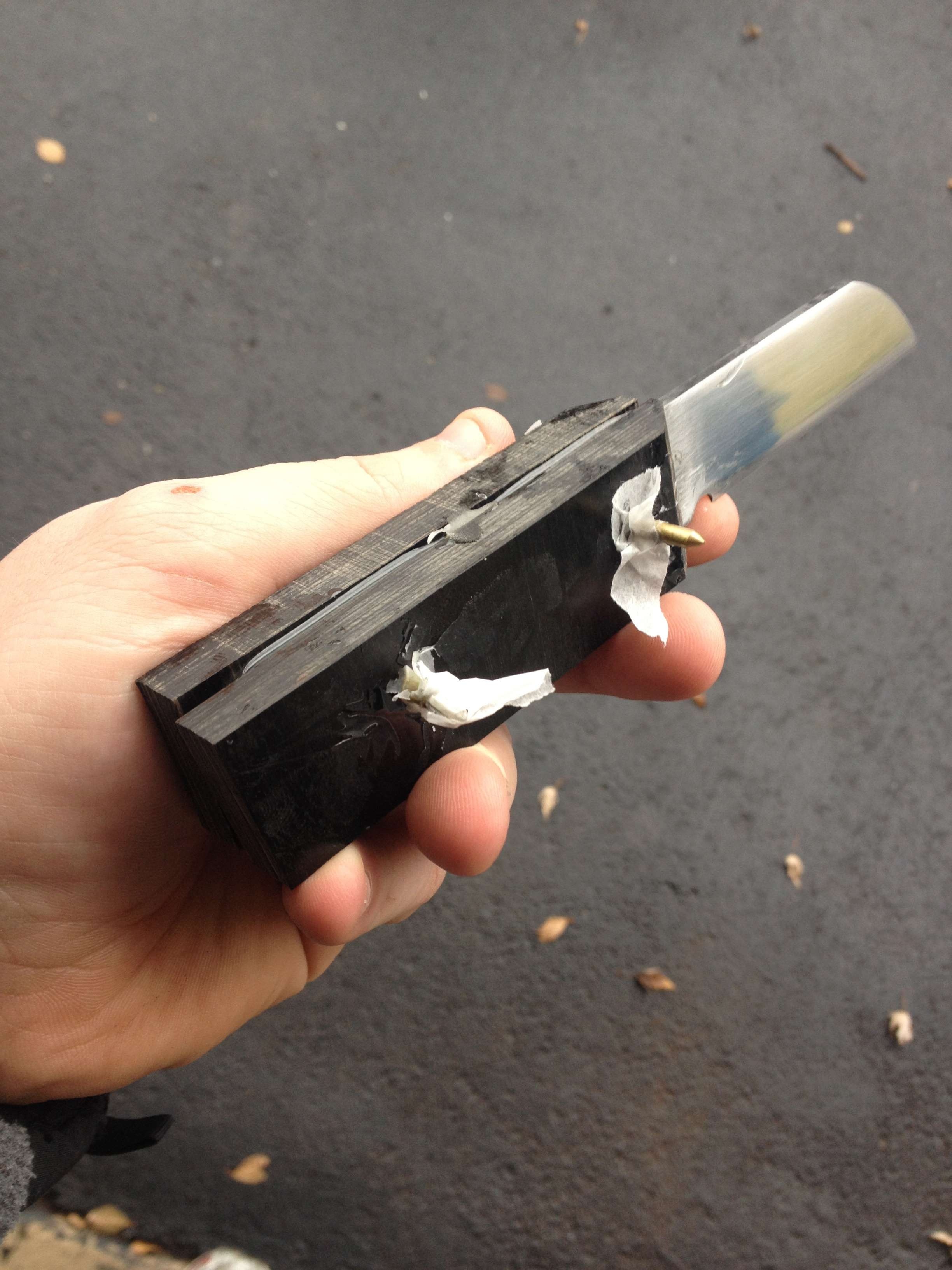
Scales ready for sanding
jndc.jpg


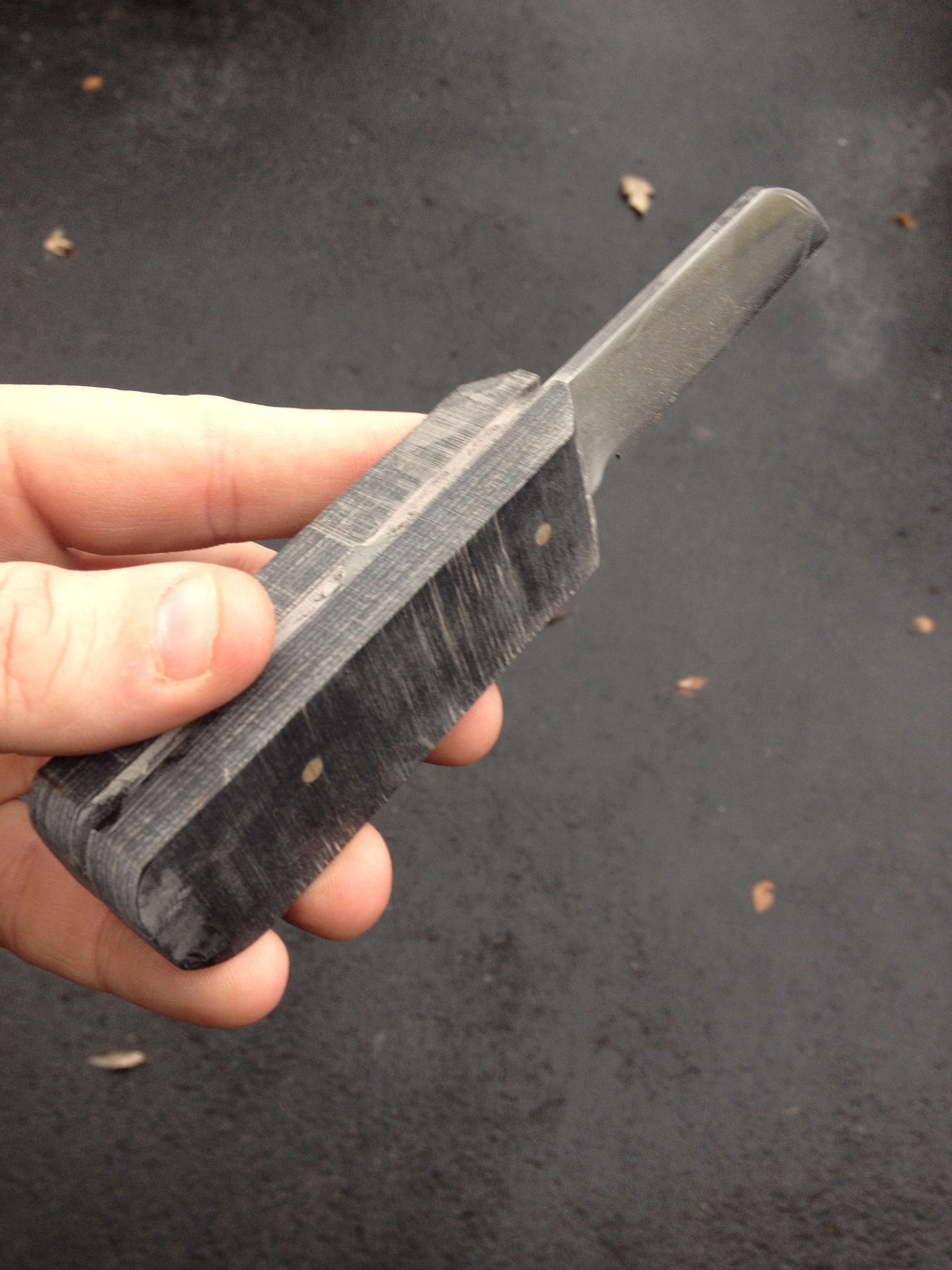
Initial sanding (very square and the butt of the scales are not even with the tang)
bs5e.jpg


Scales are now flush with the butt (sounds kinda dirty) but still a very square handle
meqn.jpg


Finished with the 1x30, rounded the edges with the next step being hand sanding. Handle feels nice in the hand and 100x more comfortable than my first knife's handle.
o6x6.jpg


P.S. This dymondwood sure is ugly ;)
 
Pete just a tip to consider. Before you mount your scales finish the front of them to completion. This way when you're working on shaping them and sanding them you won't have to worry about scratching up the ricasso or possibly the blade when you're finishing it. Something Stacy points out a lot and did with me on my first knife. That handle is still to blocky imo. Think of the handle like a woman... smooth curves and feels good in your hand ;) If it were me I'd round the top and bottom so it was curved like a "D".
 
Last edited:
I like to get the scales close to the edge of the tang (all the way around), then do the majority of shaping with them taped together. I've read that some people use a tiny bit of super glue to hold them together.

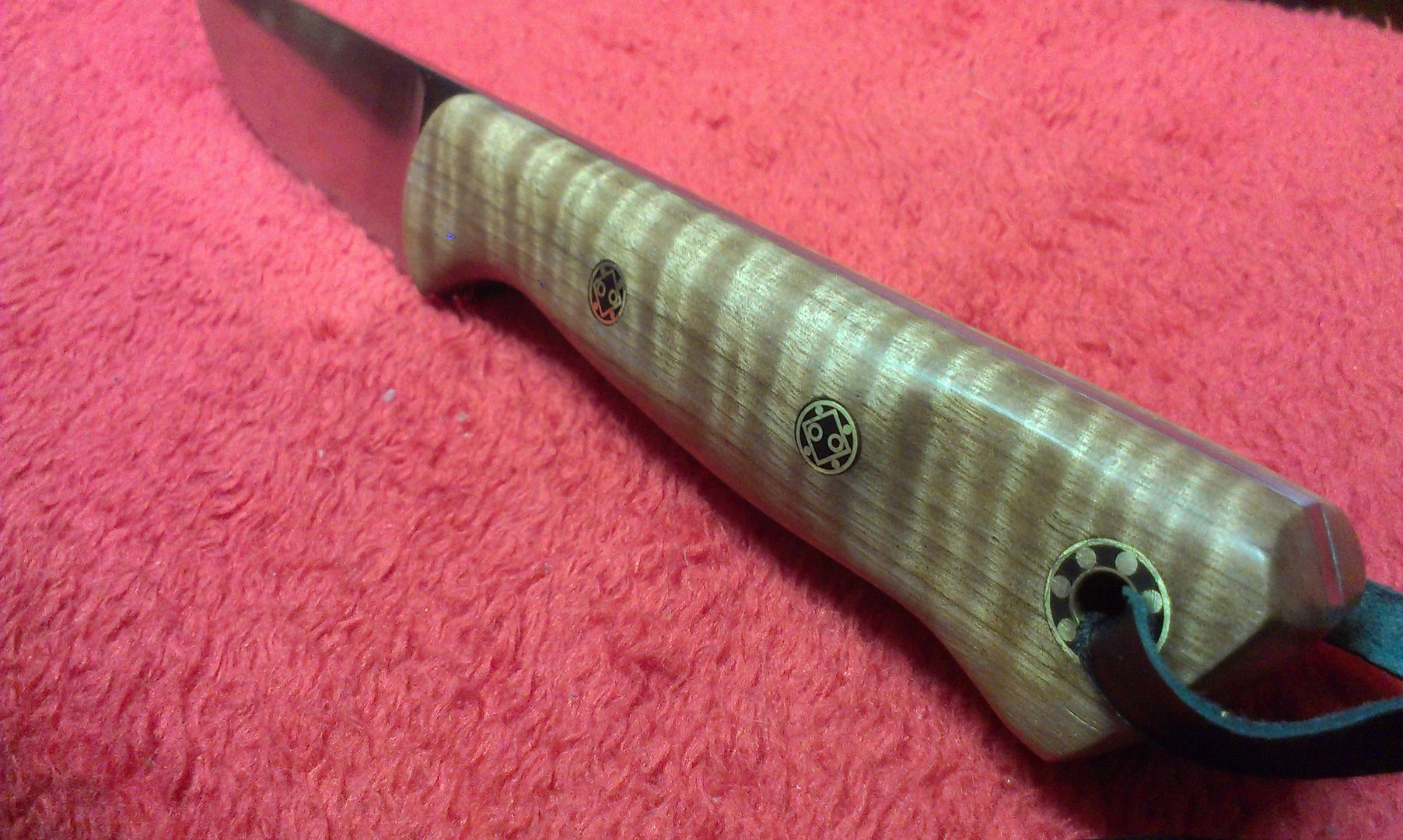
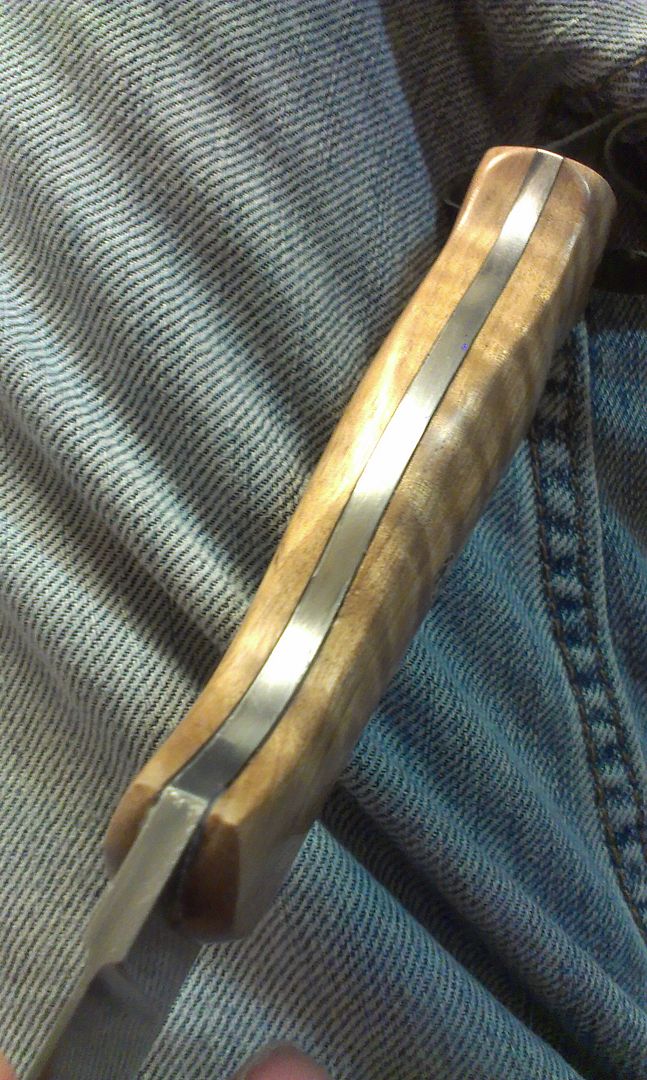
What I learned from my last set was that I had always made my scales too thick. Look at a lot of custom knives, doing so gave me a lot of inspiration. I chose a "coke bottle" shape for my last set.

I will make a lot of improvements on my next set, but these are pretty comfortable.

IMAG1534_zpsefe42da0.jpg


IMAG1538_zpsb54932b0.jpg


Shoe shining with a 1" by 10"(or so) piece of sandpaper while the scales are clamped down helped immensely.
 
Thanks guys, you are absolutely right on all accounts. I did shape the front of the handle while the scales were off the knife but now I realize I should have done more.
 
Back
Top