Noob's Second "First Knife"

Especially with 3 holes, I make the holes in the tang at least 0.005" oversized. Then I make snug fitting holes in the handle material. The extra wiggle room is helpful during glue up when you're trying to get everything to line up and slide in.
 
Especially with 3 holes, I make the holes in the tang at least 0.005" oversized. Then I make snug fitting holes in the handle material. The extra wiggle room is helpful during glue up when you're trying to get everything to line up and slide in.
That’s a good idea
 
Use quench plates for when you take it out of the oven. Clamp the foil packet between them. (Even two pieces of 1/2" mild steel with a brick on them will help prevent warping.)

No need to try and cool faster by blowing air between the plates. Just clamp flat and let cool for a couple minutes. Then you can take the blade out of the foil, cool it off with water, and put it in the freezer.

I highly recommend a dry-ice bath. A gallon of cheap denatured alcohol from the hardware store and a three or so pounds of dry ice from the grocery store or welding supply will make a -100°F bath. Use any long pan or a small cooler to hold it. When you add the DI to the pan of alcohol, it will foam up like crazy .. then settle down to a nice boil (which it actually is - Carbon Dioxide and alcohol boils at -100°F).
Five minutes in the barth is more than long enough for the blade to reach Mf ... then warm it up to room temp and pop in the oven.
When done with the bath and it stops bubbling (several hours), pour it back into the can for re-use. It is still perfectly good. I leave the cap a tad loose for a day and shake the can before tightening it up to release any retained CO2.


I place multiple foil paclets in the oven and do as many as 10 blades from one DI bath.
As long as the blades are the same thickness and roughly the same size you can put two blades in each packet. Lay them side by side, not stacked.
 
I heated treated it this morning. It's currently in the freezer...

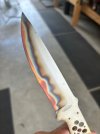
The coloration on this one is different than my first one. The first one had a lot of color to it, this one does not. Does this mean anything?

ap6J81Hh.png


F9PHOI6h.jpeg


b7zReMch.jpeg


Thanks,
Darren
 
The colors on a HTed blade in a foil packet are normally surface oxidation. Less is better, but a rainbow of colors is common. If there is a hole in the packet or bad fold that area may show extreme oxidation and color. Yours looks fine.
 
I made a plunge line jig today. Tomorrow I’m going to try to grind my first bevels. Any tips? I’m all ears.
 
Don't be disappointed if you don't get the results you want if this is your first blade grind. take your time, step back from the grinder if things go south and do the best you can!
 
Me being the ever cautious person I am, Before I did my first bevel grind on the 2X72 I took a paint stick, then a couple of scrap metal strips to practice grinding on. One BIG thing was doing what's called the "water fall" method of grinding length wise on the belt. Take a look at this short video for an idea of what it's all about:

Here's a 5 minute video showing the building of a simple angle iron "waterfall" platen. Does a better job of explaining the use:

The really work - after finish grinding lengthwise hand sanding is greatly reduced. He doesn't mention the type of belt, but use only J-flex type belts with a waterfall platen.

I just found this video and it's more like what I have using a small wheel with platen set at an angle. This video is 25 minutes long and should have been <10. I did glue a graphite strip on top of platen to reduce friction for cooler running.
 
Last edited:
I have started grinding my first "first knife." Switching back and forth from my dominant hand to my non-dominant hand took some getting used to. I made my first bevel on both sides, leaving 0.040" of edge thickness. Now I'm going to put on the plunge jig and taper the blade and make it full flat from here. This is all with my 36 belt.

2e9KYi3h.jpeg


4sD7duLh.jpeg


9cRQTZeh.jpeg
 
That's a VERY impressive first bevel - my first (or 5th) bevel didn't look that straight 'n even. good work! Now take it on up to a FFG.
 
Here's where I ended up today. Definitely some mistakes were made... I still have to round over the finger choil and do some more clean up. Hopefully I can polish this thing up enough that it's passable. Learned a lot today. I had to do all this freehand since my vevor grinder doesn't have a big enough table to use a jig. I'm going to have to make another table for it sometime.

2JZIbwph.jpeg


9QXwJF2h.jpeg


XRslHCqh.jpeg


QXK2cAWh.jpeg
 
That is going to make a nice knife - one you can hang the tag on "first knife" and be very proud of. What grit belt is the final grinding of blade in photo?
 
Really nice job.

I like your clean K-tip. Ha looks like a perfect curvature, too.
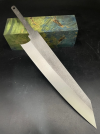
You should make a kiritsuke mate for it. Make it the same basic size, but with the entire spine line tapering toward the K-tip. The tip height should be about 65% to 75% the heel height. Your FFG will be fine. While I don't use a bird's head butt on such knives, make the handles the same for the set.

Not my knife, but a photo of kiritsuke.
1781458300137.png
 
Last edited:
Really nice job.

I like your clean K-tip. Ha looks like a perfect curvature, too.
You should make a kiritsuke mate for it. Make it the same basic size, but with the entire spine line tapering toward the K-tip. The tip height should be about 65% to 75% the heel height. Your FFG will be fine. While I don't use a bird's head butt on such knives, make the handles the same for the set.

Not my knife, but a photo of kiritsuke.
View attachment 3207544
Thanks! I actually did taper the spine as best I could. It’s hard to tell in the photo but it’s tapered. But it’s not very uniform. I’ll try it a different way on my next one. I’m currently working on the handle scales for this one. We’ll see how that goes.
 
Last edited by a moderator:
Back
Top