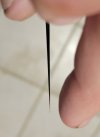
Noob's Second "First Knife"

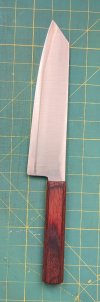
Got the handle epoxied on. It's bubinga. The pins are 1/4" brass rod. I have done a lot of woodworking in my day, so I've got a garage full of random woods. I have a ton of bubinga sitting around so I figured I'd use it on my first knife.

I'm not super happy with how I did the front of the handles. The knife has a lot of sharp corners, so I carried that theme over, but I think I could have done it better. Honestly, I just wanted to get the handles on so I could get some practice doing that and working on the wood.

There's still a lot of shaping to do on the handle. I'm not going to leave it blocky like this. I'm going for a more delicate look, so I'll be removing a ton of this wood. I figure I can make as many mistakes as I want on this knife so I won't make them on my next.

I'm going to finish the bubinga with some tru-oil I had sitting around. I did a test piece with it and it looks really good.

I can't decide how much of this handle I want to do with my belt grinder vs how much I want to do with my dremel. I may be breaking out the dremel sooner rather than later...

mF4bLNyh.jpeg


i9rvVE2h.jpeg


EYt0cLjh.jpeg


k58Pfa7h.jpeg
 
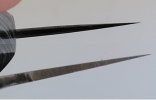
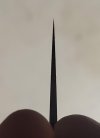
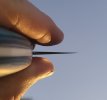
I spent a little time with the belt grinder. That's enough for tonight. Next I'll do some touchup with a dremel, then hand sand to get rid of any lumps or bumps, then tru-oil, then straighten the cutting edge, then sharpen, then I'm done! I'm pretty happy with it for the first knife I've ever made.

voXJhDwh.jpeg


d7Bz0x9h.jpeg


eXe26kBh.jpeg


8HHnMJph.jpeg
 
I spent a little time with the belt grinder. That's enough for tonight. Next I'll do some touchup with a dremel, then hand sand to get rid of any lumps or bumps, then tru-oil, then straighten the cutting edge, then sharpen, then I'm done! I'm pretty happy with it for the first knife I've ever made.

voXJhDwh.jpeg


d7Bz0x9h.jpeg


eXe26kBh.jpeg


8HHnMJph.jpeg
Great job👌👌👌
 
Your thickness tapers are fine. I mean taper in height. If the blade is 2" wide at the choil, make it 1.25" to 1.5" wide at the K-tip. That is the distinctive shape of kiritsuke.
Thus may be a better image of the blade height taper.

1781519490250.png
 
I just saw the handle shots. Bubinga is pretty wood, and a great kitchen knife handle. It is often called African Rosewood.

That triangular handle end isn't a great idea. The end of a handle is best either straight or curved. Any tip or point on a wooden handle is a point where the wood can chip off. This is a common thing on new makers knives, especially when they carry a thin portion down the choil.

Yours will probably be OK as far as chipping, but may get in the way with sharpening as it extends past the edge line. On the next knife, make te end a curve from the top to the bottom and see if it looks and works better.
 
I just saw the handle shots. Bubinga is pretty wood, and a great kitchen knife handle. It is often called African Rosewood.

That triangular handle end isn't a great idea. The end of a handle is best either straight or curved. Any tip or point on a wooden handle is a point where the wood can chip off. This is a common thing on new makers knives, especially when they carry a thin portion down the choil.

Yours will probably be OK as far as chipping, but may get in the way with sharpening as it extends past the edge line. On the next knife, make te end a curve from the top to the bottom and see if it looks and works better.
I see what you mean now. You’re right, I can see those are two problems with this design.

I already have the next one heat treated - the one with the better pin holes. It does have a similar lack of height taper, but I’m going to go ahead and finish it just so I can get the practice of grinding. Maybe I can do that one cleaner. And I’ll do a different handle design. Also, I’m going to try to do a convex grind rather than a full flat so I can get better food release. So those are my goals for knife #2.

Darren
 
While convex is simpler, FFG is far better cutting for a kitchen knife. Food release is rarely an issue. The next slice pushes the last one off if needed.
I slice vegetables for oriental and European dishes with a small kiritsuke every night. I don't have a convex kitchen knife as far as I recall.
 
What do you guys think about an S grind? I could get a convex platen and do that to these knives pretty easy I would think.

Thank you for all of your help with this!

Darren
 
Like Stacy, I don't care for them, mainly the look of the compound or "S" grind. I much prefer a full flat with very thin edge geometry. Often I will come off the grinder with a 60 grit finish, and then go to stones and sharpen the knife at a VERY low edge angle, say 5° per side. I then go back to the grinder and refine the finish with 120-220-400 belts, and knock off the edge shoulder, so you end up with a sort of tear drop shape (just ever so slightly convex). Once the blade has been hand sanded (and you have to be really careful with that apex!), I will go back to a fine stone, raise the angle just a tad, maybe 10° per side, and add what is now essentially a micro bevel at ~3000 grit. Makes for a wicked slicing edge, and the "behind the edge" really won't need thinning for a VERY long time...if ever. Just something I do quite often, it's totally not necessary.
 
Thank you guys, I really appreciate your advice as I have literally zero experience with this.

Stuart Davenport Knives Stuart Davenport Knives brings up something - do I need to hand sand anything? I see videos of people doing it, but I’m pretty happy with the finish as it is. I went up to 120 on my Norton blaze belts and then I went to my three surface finishing belts in different colors. I’m pretty happy with the way it looks. Is hand sanding just for looks or is it a necessary step I’m missing?

Thanks,
Darren
 
For a general use or utility blade you do not need to hand sand unless that is the desired finish. On many of my blades I go to either 220 or 400 and use a surface conditioning belt for a matte/brushed finish. I like the blue belt's finish best. I have not seen any reason to use the Scotch-Brite belts in succession. Pick your desired surface finish, prepare the blade surface by sanding, and use the belt you need. (See info below.)
That is still dependent on having a FLAT and reasonably scratch free bevel. If the bevels are uneven or prior sanding is not properly done, the brush finish will not look clean and show the imperfections under it.

That is why I often use stones on a long knife to get the bevels absolutely flat. Vertical grinding on a waterfall platen also leaves the blade ready for the Scotch-Brite belt.

On damascus blades and high end slicers a brush finish will not work. Taking the blade to over 1000 grit by hand sanding is required.

So, let's talk Scotch-Brite and other surface conditioning belts.
Scotch-Brite and other surface conditioning belts are not a way to avoid proper sanding of a blade. They are an additional step to leave a desired surface finish. If the surface is wavy or deeply scratched, that will still show when the surface belt is used.


The normal 3-M color code from coarse to fine is Brown-Maroon-Blue-Grey. Depending on who makes other belts, colors may vary. You often find a green belt from some suppliers that is roughly between the maroon and blue.

Brown - The prime use is to clean a surface of rust or paint and leave a coarse to medium scratch finish. These tasks are what I use to remove rust from old blade blanks and check for deep pits.

Maroon - This leaves a nicer scratch finish than the brown. I use it for light surface cleaning of rust and paint as well as preparing axe heads for painting., The finish is often nice enough to leave the axe head with just a brushed finish.. Maroon leaves an even heavy brush finish. This belt only needs a 120 or 220 grit finish before use.

Blue (or green) - This belt is for leaving an even light brush finish. That works well on daily use knives that would have a shiny fine finished scuffed up quickly. Most daily use kitchen knives, hunters, and EDC knives look good with this finish. A 220 grit to 400 grit belt will prepare the blade for this belt.

Grey - The fine grey belt leaves a satin finish. It is hard to get it to look good unless the sanding before the belt is very good. I use these to restore a knife that had a polished surface that has become scuffed up or scratched. It requires a good 400 grit finish before using this belt. Hand sanding at 400 is best before this belt.

I have tried the yellow and white belts. They are not really of use for knifemakers.
 
For a general use or utility blade you do not need to hand sand unless that is the desired finish. On many of my blades I go to either 220 or 400 and use a surface conditioning belt for a matte/brushed finish. I like the blue belt's finish best. I have not seen any reason to use the Scotch-Brite belts in succession. Pick your desired surface finish, prepare the blade surface by sanding, and use the belt you need. (See info below.)
That is still dependent on having a FLAT and reasonably scratch free bevel. If the bevels are uneven or prior sanding is not properly done, the brush finish will not look clean and show the imperfections under it.

That is why I often use stones on a long knife to get the bevels absolutely flat. Vertical grinding on a waterfall platen also leaves the blade ready for the Scotch-Brite belt.

On damascus blades and high end slicers a brush finish will not work. Taking the blade to over 1000 grit by hand sanding is required.

So, let's talk Scotch-Brite and other surface conditioning belts.
Scotch-Brite and other surface conditioning belts are not a way to avoid proper sanding of a blade. They are an additional step to leave a desired surface finish. If the surface is wavy or deeply scratched, that will still show when the surface belt is used.


The normal 3-M color code from coarse to fine is Brown-Maroon-Blue-Grey. Depending on who makes other belts, colors may vary. You often find a green belt from some suppliers that is roughly between the maroon and blue.

Brown - The prime use is to clean a surface of rust or paint and leave a coarse to medium scratch finish. These tasks are what I use to remove rust from old blade blanks and check for deep pits.

Maroon - This leaves a nicer scratch finish than the brown. I use it for light surface cleaning of rust and paint as well as preparing axe heads for painting., The finish is often nice enough to leave the axe head with just a brushed finish.. Maroon leaves an even heavy brush finish. This belt only needs a 120 or 220 grit finish before use.

Blue (or green) - This belt is for leaving an even light brush finish. That works well on daily use knives that would have a shiny fine finished scuffed up quickly. Most daily use kitchen knives, hunters, and EDC knives look good with this finish. A 220 grit to 400 grit belt will prepare the blade for this belt.

Grey - The fine grey belt leaves a satin finish. It is hard to get it to look good unless the sanding before the belt is very good. I use these to restore a knife that had a polished surface that has become scuffed up or scratched. It requires a good 400 grit finish before using this belt. Hand sanding at 400 is best before this belt.

I have tried the yellow and white belts. They are not really of use for knifemakers.
Thank you! I've got a lot to learn...

Darren
 
I like a convex grind on my kitchen knives, but I have a LOT of experience with Japanese knives with convex grinds and S grinds. I use a 36" radius platen for the shallow hollow around 3/4 of the blade height on S grinds and then use some S2-32 Rock Hard felt from McMaster Carr to get a gently convex the lower 1/4th of the blade basically. The felt has a little give to it, so it gives a very gentle convex, but lets you get stupid thin down at the edge. F3 felt has a little too much give for a kitchen knife, but does well with outdoor knives and a convex grind. The plunges are a pain and it's easy to round them out too much with a soft platen, so keep that in mind!

The S Grind lightens the blade a little, but is a PITA to get a nice finish on. You can go full convex, too with the felt and skip the S grind. 3/32" blade stock, do a full flat grind until around .015-.02" behind the edge, then switch to the felt platen and work your way back up the grits from 120 on up. You will be thinning the spine out a bit more due to the felt having some give to it and basically regrinding almost all of the blade face. I put the belt in reverse at slow speed and grind edge up with the belt going up the platen and watch the edge thickness. The felt will give slightly and allow you to get a nice convex grind. Some thick leather will do the same and others take a piece from a scotchbrite belt and attach leather to it and use that as a soft platen. This gives a little convexing to the sides of the blade which help with food release, even if you just do the lower third or half of the blade. I try to get it as thin behind the edge and up the blade as I can. Pops has some felt backed belts that have a slight give to them that leave a nice satin belt finish and can give a very slight convexing, too.

With a full flat grind, some foods will stick and others will not, and your final blade finish will effect it, too! Stuff like Potatoes can really stick hard to a blade, but do better on a polished finish so the next piece can push them off. I prefer a slight convex over a full flat grind because I hate having to push stuff off of the side of the blade that is stuck hard! Even a convex on the area just above the edge can help with food release, but I go super thin with my convex edges, almost a zero edge and then a micro bevel!

S grind choil on my Magnacut gyuto. I start the hollow just in front of the choil so I have more steel to round out there for comfort, so it's not visible in the choil picture. On this blade, it's .040" thick where the convex and concave meet, so the area that is hollowed out is a bit thinner than that!
mcc handle.jpg
magnacut choil S.jpg

You can see the shallow hollow on the side of the blade here:
20240422_185605.jpg

You can see the hollow vs the convex grind here on this one when I was working on it. It's similar to a Takeda kitchen knife where there is a large hollow on each side and then convexing to the edge.
PXL_20241122_165404645~2.jpg

Top is my Shigeki Tanaka Sekiso Blue #2 knife showing off a gently convex all the way up the blade. This blade performs very well through a variety of foods and not much sticks on the blade at all! It's a thicker spine around 1/8" or so, too. The knife on the bottom is a 80CRV2 knife I made for a guy who wanted a heavier, all convex blade.
sk3.jpg

Another choil shot of the 80CRV2 blade. My convex is more gentle than the Tanaka, which kinda starts mostly halfway down the blade.
8c2.jpg

Kitchen knife grinds are a lot of fun to play with and see what you like! S Grinds are a pain, but sometimes worth it. Full convex also works really nicely, especially with thinner steel to start!

3/32" full convex Nitro V:
NV 205 Choil.jpg

Very thin White #1 Funayuki choil!
Funy1 choil.jpg

And a chonkier S30V blade with .140" thick spine and a full convex:
tbcs.jpg
 
And some other full convex grinds on thicker blades:
H choil.jpg

Kitch Choil.jpg

Going down super thin behind the edge needs a steel that is hard and tough to support that! Nitro V, AEB-L, 14C28N (62-63 HRC for these steels) and Magnacut do really well with that thin edge. But you gotta go slow, be very carefull of how hot that edge is getting!!
 
Back
Top