Octagon handles history thread

A chapter in axe history everyone is interested in. A thread specifically for this type of handle with photos of original old examples and period literature scans.

So far 36% of those posting have actually said something about the stated subject of the thread instead of talking about their favorite subject, themselves, or something unrelated. No surprise at all, but maybe a record high for this forum, thank-you and congratulations. I have just "unwatched" my own thread.
 
Last edited:
Just joined. Found this thread doing a Google search on axe handles.
Just saying hi.
I tried posting a photo of the octagon axe I have using two different image hosting services but neither worked.
Try posting pics to Imgur then use the URL's they provide to post them here.
 
A chapter in axe history everyone is interested in. A thread specifically for this type of handle with photos of original old examples and period literature scans.

I was introduced to octagon cross-section handles a few decades ago when I picked up an old double-bit the widow of it's original owner had stuck between wall joists at a garage sale. In the following years of picking up many dozens of axes and hatchets only locally and in "the wild", I found that old examples of octagon-handled axes were very scarce compared to the common oval cross-section handles. My guess is that getting the octagon shape into the handle requires more expense and may not be something that can be mass-produced with common handle lathes and manufacturing methods post WWII, so they died out along with cheap labor in the baby-boom era.

The most common octagon handles back in the "old days" around and before WWII are the straight handles usually put onto double-bit axes;


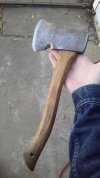
Although I have found "S" form handles with an octagon shape such as on this 1930s Craftsman hatchet, so both straight and "S" form handles were known and existed in the old days.;


My hope is to add some old literature scans and more photos of original examples in the near future.

I just got into Blacksmithing and rehanging axes and old hammers scrounged from flea markets and I have to say that I fell in love with the octagonal handle shape so I started fashioning my handles with flats for easy indexing.
 

ca 1910
9HRuPOI.jpeg

tl6brIs.jpeg


RILr1eI.jpeg


YVet3Zp.jpeg


pMaux0G.jpeg


qRxG0mh.jpeg


Bob
 
This Hartwell Grey Gorge actually rides in my tool bucket. It's not doing it any good, but I love the suction grip haft.
I remember these hafts from my youth because they were pretty common on ball pen hammers.


Anyone know who made Hartwell's hammers and axes?
 
These are probably my oldest surviving octagon hafts, late 1800's early 1900's perhaps.

Both of these are Y&P in light and medium. The haft on the light appears to have been whitewashed, badly twisted at this point.

It's worth noting that the haft on medium is notably thicker than on the light, they didn't miss a trick back then and today manufactures are making rigging axes with no nail notch.

The octagon continues down lower on the light so just the very grip is oval.

I wonder if these were made octagon on a belt sander just like they are today?


Anyone know who made Hartwell's hammers and axes?


Bob
 
Many generations of my Appalachian ancestors were proud axe men too. They mainly cut white oak tie cuts that were snaked out of the woods to the chipyard with mules to be hewed and sold for outside income. Hewing ties was mainly a wintertime job. The other source of income was from riving white oak 'baccer sticks that were always in demand and used for harvesting and housing burley crops to cure. Every farm had a 'baccer crop, but most farms didn't have white oak timber to make the sticks so they were always in demand and made and sold by the thousands.

An axe was an everyday essential tool on the farm year round. Most of the old outbuildings and barns around here were built with pine poles either notched log cabin style, or pole barn style with each bent pole set on flat rocks for footings, and more pine poles for rafters. About the only sawn lumber was the girts, purlins and boxing. One of my earliest memories of an axe was as a toddler watching my grandmother chop ear corn into wafers at the corncrib to feed the milk cow when she milked her. That was the very day I caught the bug..

But anyhow..
As a young boy, I remember watching many axe handles being made and scraped smooth by my grandfather and other older neighbors. As a young teenager I decided to try my hand at handle making and immediately ran into the age old problem of grain orientation that I had never even given a thought before. I had never heard grain direction ever mentioned by anyone ever, but there it was, plain as day staring me right in the eyes.. I couldn't even begin making the handle that I had put so much thought into without knowing how to orient that darn grain. I thought for a moment about how to resolve my problem and then decided to Google it. That didn't work because the internet hadn't been invented.. I thought about it again and decided that I would mail order An Axe to Grind and read it to see if there were recommendations on grain orientation but quickly realized it hadn't been written yet..

So, I decided to do the next best thing and run out the road to my elderly neighbor's saddle shop and ask him about grain orientation because I had seen him make several axe handles by his shop fireplace over the years while telling logging stories from his younger years. When I got there, he was stuffing the raised quilted top for a Eugene Minihan spring tree saddle he had completely rebuilt from the tree up. I watched him work on that saddle top for a few minutes before the old gentleman raised his head and asked me what I had on my mind. I told him that I had run into a problem that I thought he could answer. I told him that I was fixing to start making a double bit axe handle but realized that I didn't know which way to turn the grain. He then leaned over and spit in the cruddy cuspidor before walking over to the corner of the shop and grabbed his old Flint Edge DB and said just like this whist pointing to its eye, the grain has to run horizontal across the eye like this or otherwise it'll most likely warp and won't give you the chip popping snap. I've never looked back!
I can see how horizontal grain could be an advantage if the haft were made from riven wood that followed the grain and you were making straight hafts for double bit axes. But like Old Axeman I've seen too many broken hafts caused by runout on sawn hafts.

So if I'm selecting a sawn haft at the hardware store I'm more likely to look for vertical grain, especially for a curved haft single bit.

An exception I make is for Pulaskis. There I'll look for continuous grain at 30° to 45°. That narrow Pulaski eye too often results in breaking vertical grain hafts with very minimal prying on the handle.
 
This handle I think was octagonalized by hand with a spoke shave or something
If you look you can see a lot of deep grooves that look like what you get when wood is just peeled off.
Also the bit looks like it was sharpened by somebody who knew what they were doing.
I'm betting this hatchet was originally owned by somebody who used it for a living.
20251103_134816.jpg

I don't know what else would explain it.

I think this Craftsman is from the late 40's ?
 
I can see how horizontal grain could be an advantage if the haft were made from riven wood that followed the grain and you were making straight hafts for double bit axes. But like Old Axeman I've seen too many broken hafts caused by runout on sawn hafts.

So if I'm selecting a sawn haft at the hardware store I'm more likely to look for vertical grain, especially for a curved haft single bit.

An exception I make is for Pulaskis. There I'll look for continuous grain at 30° to 45°. That narrow Pulaski eye too often results in breaking vertical grain hafts with very minimal prying on the handle.
Runout from sawn blanks is the devil everyone blames on horizontal grain. I've put my handmade horizontal grain handles through real workouts over the years with absolutely zero issues and I have 100% confidence in horizontal grain orientation and prefer it too vertically oriented. If I were dropped into the wilderness and had to depend on one axe for my life that axe would be on a horizontal handle made by me of course from riven and air dried material.

Another thing, and I have posted before is the old premium axes made back in the early to mid 1900's when axe makers were at the very top of their game, and axemen were demanding of their axes. That's when every axe maker wanted to dominate the market with the highest quality, most durable and most advanced product they could manufacture. I have several old single bits made during the period of what I consider the golden era of axes- 1900- 1950 from various makers that are on original horizontal grain handles. This brings me too why would those companies back in the day even consider damaging their reputation by offering a premium line of axes hafted with horizontal grain handles if that grain orientation was inferior?

Okay, one might ask if horizontal grain is so great, why was it not used exclusively back in the day? Well, back then only white hickory or sapwood was used in handle making as heartwood was considered inferior and it takes a huge tree to get sapwood thick enough to make a full sized horizontal grain handle. With what I have witnessed and understand, I would surmise that back in the day a stave that was thick enough was made into a horizontal handle, and all others were made into vertical grained handles. Like said, inferior sawn blanks and runout are the devil.
 
I actually agree with what quinton just said, the only difference is I would (and did) when in the wilderness take a vertical grain, made by me of course from riven and air dried shagbark hickory.

But there is a second devil besides sawn blanks with runout, a haft with mixed sapwood and heartwood. I have seen almost as many broken hafts with mixed as I have seen with runout.
 
Grain orientation for axe handles is an interesting topic. When this thread was started I looked at a lot of advertising information concerning axe handles. I have posted several catalog snips dating from the first half of the twentieth century in this thread. Besides looking for octagon offerings for handles, I was also curious if grain orientation was mentioned as part of the marketing.

Post #67 above shows that circa 1931 Hartwell Brothers promoted vertical grain for longer life. This was the most explicit reference to grain orientation for production axe handles I was able to find. I did not find horizontal specifically mentioned. If anyone has information regarding marketing for horizontal grain axe handles, please post.


Bob
 
Grain orientation for axe handles is an interesting topic. When this thread was started I looked at a lot of advertising information concerning axe handles. I have posted several catalog snips dating from the first half of the twentieth century in this thread. Besides looking for octagon offerings for handles, I was also curious if grain orientation was mentioned as part of the marketing.

Post #67 above shows that circa 1931 Hartwell Brothers promoted vertical grain for longer life. This was the most explicit reference to grain orientation for production axe handles I was able to find. I did not find horizontal specifically mentioned. If anyone has information regarding marketing for horizontal grain axe handles, please post.


Bob
I have often wondered why grain orientation wasn't ever mentioned in vintage ads as well because of the big deal that has been made of it in the internet age. In my circle of old timers who were axe people, and sadly have been gone for some time now, all said horizontal grain was best when making a handle. I am in the Appalachians and am now thinking it may have been a regional thing. I've made and used handles with both grain orientations but always very much prefer swinging horizontal grain in a full sized axe.
 
Back
Top