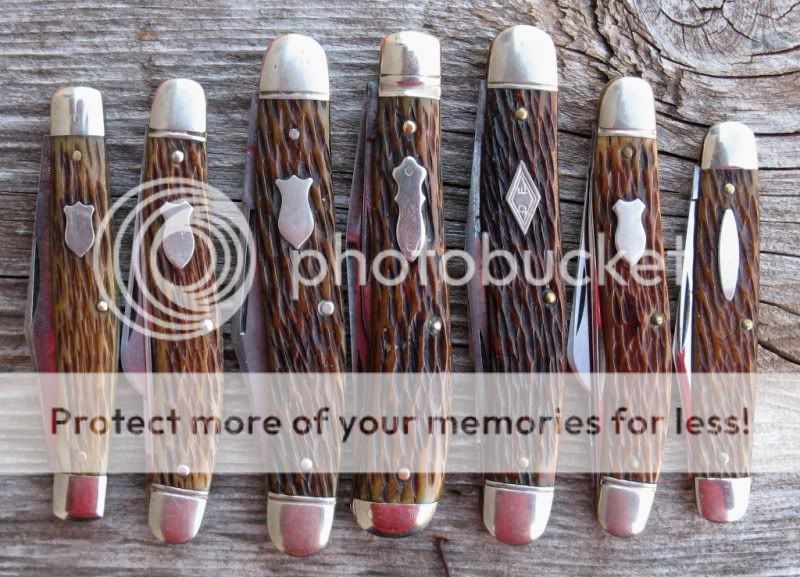
Oiling old bone?

Ken, Thank you for your informative post. There's no need to hide. LOL! I've used dyes as a tool only and I haven't studied their chemistry but it was my understanding that the dyes are are chosen based on their affinity for the substrate (bone, in this case). Whatever you're doing in your workshop certainly has produced some beautiful knives.
 
I've thought for some time before responding to this thread. If there is a way to reliably dye bone
without first infusing some form of oil into it I'd like to know about it. I think its safe to say I've dyed
hundreds of sets of scales in 5-8 years and unless the bone contains enough animal fat (or some form
of oil) the bone won't even accept the dye (oil based dye). Not to say there aren't different methods.
I'm talking about thru & thru solid color that stays there, not exactly an easter egg dip of water or
alcohol based dyes. Instead of running to hide- I'll continue with my methods.
Ken.

Thanks Ken.

With the oil-based dyes you've used, have you seen anything (oil/solvent/lube-related) that will alter/fade the color, or otherwise damage it, once it's in the bone? Or anything that damages the bone itself (softening/cracking/etc.)?
 
David, I'm thinking that the affinity of the dye is perhaps a major factor. What do you think?

I'm not sure if this is the best example, but.... here are images of bone stained with hematoxylin and eosin, a routine histological stain. A histology reference says that "Eosin is an acid aniline dye. It will bind to and stain basic structures (or negatively charged structures), such as cationic amino groups on proteins." I'm still looking for a reference on oil based dyes. ...I hope this doesn't start a wave of pink knives. ;)

F3.large.jpg
 
The two oils,- albeit thin ones that I've had the most success with as a base are Xylene, and gasoline, I guess some would
call them solvents. Once we get to lemon oil or mineral oil the color just starts to become
richer and more full looking. I'd stay away from the faster thinners MEK, Acetone, Lacquer thinner, and possibly
toulene. So most of the stuff that people put on their knives won't hurt the bone other than a possible color
shade or so darker. The base is done with heat and vacuum.
Ken.
 
Ken, From your description, the process of dying bone for knife handles has some similarity to the the process for staining bone for microscopy.
 
David, I'm thinking that the affinity of the dye is perhaps a major factor. What do you think?

I think that makes a lot of sense. After reading Ken's comments regarding the oil-based dyes he uses, the thought went through my mind, 'Whatever pigment is in there, must really cling to the bone, whether the oil base itself does or not.' I think this is true of solvent-based dyes (like alcohol or whatever); the solvent is the delivery medium, which allows the dye to penetrate into the bone, and the pigment gets deposited wherever the solvent can reach. Solvent evaporates away (I assume) and the pigment holds on tight to the substrate (the bone).
 
The two oils,- albeit thin ones that I've had the most success with as a base are Xylene, and gasoline, I guess some would
call them solvents. Once we get to lemon oil or mineral oil the color just starts to become
richer and more full looking. I'd stay away from the faster thinners MEK, Acetone, Lacquer thinner, and possibly
toulene. So most of the stuff that people put on their knives won't hurt the bone other than a possible color
shade or so darker. The base is done with heat and vacuum.
Ken.

That's a lot more specific than so much of everything else I've read here, on the topic. Really narrows it down.

Much thanks again, Ken. :thumbup:
 
Wow. And I was worried this might be too simple and obvious a question to ask!
 
Wow. And I was worried this might be too simple and obvious a question to ask!

This is a good thing. I love 'simple and obvious' questions like this, because they can often evolve into so much more. Always makes me think about things I'd never even considered before. :)
 
When I asked in the maintenance forum about why folks use lemon oil for stag, here is the best response I got:


Also on Ivory and mineral oil debating the concept of preserving Ivory's natural oil:

Ivory is a tusk which is similar to a tooth dentine material but like fingernails and hair benefit from prevention from drying out. The best, safest way to do this is to use mineral oil which does not harm the stag, ivory, dentine, horn material. It keeps it from cracking and falling apart just like proper care for leather. Unlike most other solvents, mineral oil isn't considered to be a solvent but a light oil. It also is not harmful to someone ingesting it.
 
Ken, Thanks for the MSDS. I don't know how cobalt and chromium interact with bone at the molecular level but I'll see if I can find a reference.
 
I was curious about the chemicals listed in Ken's photo of the MSDS info for the dyes he uses. A little Googling, and this is what I found for each, as to their use in the 'witches brew' of the dye. Looks like industrial solvents across the board, with the last ingredient as the only coloring agent:

Diethylene Glycol Monomethyl Ether (industrial solvent)
Dipropylene Glycol Monoethyl Ether (industrial solvent)
Propylene Glycol Methyl Ether (industrial solvent)
Ethanol (solvent; a.k.a., "grain alcohol")
Isopropanol (solvent; a.k.a., isopropyl alcohol, rubbing alcohol)
Xylene (industrial solvent; used in ink; slows drying in paints & varnishes)
Ethyl Benzene (industrial solvent; also a contaminant in xylene)
Ethyl Acetate (solvent; also used to decaffeinate coffee beans)
Cobalt and Chromium Complex (pigment)

With this mix, seems it takes a heck of a chemical combo to make the color 'stick' for good. Strong stuff. After all that, I'd really hope that simple, plain ol' mineral oil shouldn't be able to faze the color, or the bone, at all.
 
Last edited:
The chance of someone accidentally dropping their knife in a similar solvent concoction and forgetting about it for a few days is pretty slim. :p
 
This was fun! I also have a 50gal drum from aircraft fuel deicer that says on the label
Diethylene Glycol Monomethyl Ether so whatever kind of industrial solvent it is, I'm pretty
sure its used for that too!
Ken.
 
Well, this is a very interesting debate. All I can add is personal experience, and of course, this may be at odds with others' .

Four or five years ago I kept hearing of people giving their knives a mineral-oil bath, right long soaking etc. You don't hear so much of that now...I tried it with a CASE Bonestag 6.5 knife and it absolutely wrecked (or another word beginning with another letter..)it! Colour changed into a horrid grey mush, don't know why. A barehead stag knife I had fared no better, it soaked into the pores at the end of the knife and it has become certainly softer in texture in an unpleasant way. Appearance too.

I also noticed increased brass-bleed/verdigris from the liners, this may impact as well. Then I heard what Shivs and Levine were writing about mineral oil baths and I felt my experiences bore out their warnings, they have considerable expertise too. Now it's a wipe down with Lemon oil or wax polish. Actually, just using he knives and handling them improves the appearance, simple but true.

Thanks, Will
 
I've used Formby's Lemon Oil for a few years, after seeing a recommendation here in the forum. This group has been oiled a few times, and I think it keeps the bone looking nice. Sometimes old jigged bone has developed dry spots down in the jigging grooves, and it seems to keep it from showing quite as much. I like the shine it puts on the scales too.

peach_f-1.jpg
 
Beautiful peach seed.

I did some digging and came to the conclusion that we need to recruit a materials scientist, preferably with a specialty in dyes. ;) My guess is that some dyes have an affinity for bone and another possibility is that some dyes may form highly insoluble deposits under the conditions of heat and pressure that are used to color bone knife handles.
 
Back
Top