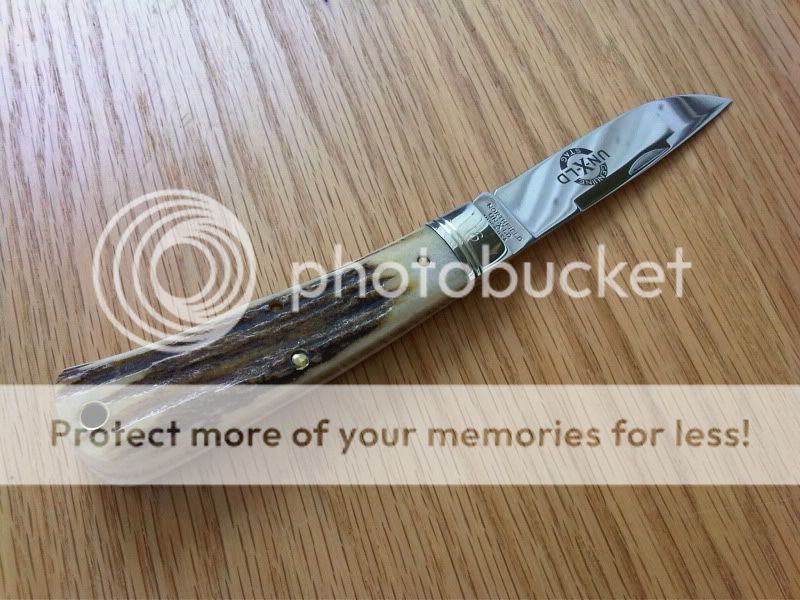
Oiling old bone?

Interesting thread. I've only a couple things I can add from personal experience.

As to leeching the dye from bone handles I have only one experience with that. I cut some lemons with a Queen knife equipped with red handles with dark black dye in the indents of the jigging. It took most of the black off in the time the lemon juice ran down my hands and onto the handles till I finished up with the lemons. A minute or two at most. Long term I cannot speak to it aside from the fact that I know my EDC carry knives that have a lot of time on them (only a couple have spent years and years in my pocket) do change color and get darker and I don't oil the handles... it just kind of happened.

The second thing I'll add is that maybe some of the skittishness comes from what happens to old guns that have been slathered in gun oil. The wood adjacent to the steel portions of many old guns has soaked up gun oil which tends to color it black and swell it up. Many times this results in cracking at the edges. You can find this pretty easily if you take a gander at some old firearms that have been used a lot. I've seen some of these gunstocks refinished and it takes a lot of work with a hot air gun to try and sweat it out. Even then it is a chancy thing that only works to a certain extent.

Will
 
David, I'm thinking that the affinity of the dye is perhaps a major factor. What do you think?

I'm not sure if this is the best example, but.... here are images of bone stained with hematoxylin and eosin, a routine histological stain. A histology reference says that "Eosin is an acid aniline dye. It will bind to and stain basic structures (or negatively charged structures), such as cationic amino groups on proteins." I'm still looking for a reference on oil based dyes. ...I hope this doesn't start a wave of pink knives. ;)

F3.large.jpg

Analine dye is not lightfast. It fades rather quickly, especially with exposure to sunlight. Which is a concern for durable items like knives that are intended to last generations. It is much easier to get a pretty color on bone with analine dye than is with other methods. The problem is that the color won't last. I strongly suspect that companies like Rough Rider use simple analine (fabric-type) dye to color their scales. I suspect Case does too on some of their more brightly-colored offerings, like the key-lime bone, which does not seem to hold its color very well.
 
Will,

I was under the impression that Bill is more in the know then most about this topic. That's why I took his word for it.

Kevin
 
Andy, I hadn't considered lightfastness. For the application in the photo, this isn't a problem. The bone is dehydrated in an alcohol series, cleared in xylene and embedded in a resin.

Lightfasness might be an important issue for people who display their knives (I don't). I have seen displayed knives that were faded on side.

Years ago, I had a Frost trapper that bled dye all over the place after I rinsed it with regular hand soap and water. It ruined a shirt and pair of pants and I'm still holding a grudge but I haven't heard of similar experiences so I may have gotten a bad one. I haven't had any problems with Rough Riders or more expensive knives.
 
I still suspect, when we hear anecdotal accounts of issues with oiling bone or stag, we're often hearing about a huge variety of 'oil' being used, in spite of many just referring to it as 'mineral oil'. In the broadest definition of the term, 'mineral oil' simply means any oil that was extracted from the earth ('mined', in other words; hence the 'mineral' association). That includes literally all petro-chemically formulated versions of 'oil'. There's an almost infinite variety of formulations, for automotive uses, for guns, furniture and so many other things. So many of them include additives (solvents, detergents, surfactants, scent, etc.), aside from the basic oil itself. And even basic 'mineral oil' is refined to varying degrees, depending upon it's targeted use. The 'food safe' or 'laxative' variety is considered to be the purest, for good reason. The 'lesser' grades might still contain traces of petro-chemical solvents that haven't been refined out of the mix. The little bit of solvents, many of which are pretty nasty stuff, are the biggest troublemakers, as I see it. Solvents are designed to thin whatever product they're used in, and allow it to penetrate more deeply. That's sort of a double-whammy of trouble, for materials not resistant to them.

I have seen many of the old, greenish stag-handled knives on the 'bay, and elsewhere, and often wondered what specific formulation of oil was used on them. The large popularity of 3-in-1 oil, over decades, has me somewhat suspicious. I know it's got a slight green tint to it, as seen if applied to a white paper towel. I stopped using it on my knives, when I saw this. As popular as the stuff has been, I wouldn't be surprised if it has accounted for some of the 'green stag' knives I've seen over the years. Back in the '70s and earlier, 3-in-1 was about as universal as could be. It was used for virtually everything around the house, garage and workshop. Coincidentally, most of the 'green stag' knives I've seen are about the same vintage ('70s and earlier). This is all 100% speculative, on my part. But it crosses my mind, every time this topic is discussed.
 
After reading thru a bit of this esp. the parts about fat and oil soluble dyes some of the results I'm
having make sense. Just wish I had more of a capacity to fully understand what I'm reading, if I did
that book would be very quickly ordered.
Ken.
 
Ken, I read a little bit and it's interesting stuff but not my area of expertise. From what I can understand, the dye you use is very stable.

David and Campbell, Does the stag turn green on all steel knives or just on knives with brass liners? I had assumed (perhaps incorrectly) that it was verdigris from the liners that sometimes gives bone and stag a greenish hue.
 
How about neutral shoe polish/wax? Has anyone tried that? Yesterday, I was given an old German fixed blade with stag or antler scales and they are very dry.
 
Ken, I read a little bit and it's interesting stuff but not my area of expertise. From what I can understand, the dye you use is very stable.

David and Campbell, Does the stag turn green on all steel knives or just on knives with brass liners? I had assumed (perhaps incorrectly) that it was verdigris from the liners that sometimes gives bone and stag a greenish hue.

I've seen some knives with the brass-related verdigris, but at least among those, it only appears near the pins. In fact, I have a 1970 Case stag Peanut in my pocket now, with just a hint of green tinge around the brass anchor pin for the spring. I'd think something would have to be seriously wrong, if the brass liners or pins were altering the color of the entire stag covers. In those cases, I'd bet something else was a major contributor (such as the oil type being used on the scales).

Verdigris forms from an acidic condition, like acids in tanning chemicals for leather sheaths, reacting with the copper in the brass alloy. Depending on the oil used, it may have some acidic content in it. That's the advantage of using the 'food grade' or 'laxative' type mineral oil. It's chemically inert, so it can't react with anything (which is why it's safe for human consumption).
 
Since verdigris was used in paint and I've seen traces of it on the liners after removing the handles on an old worn out knife, I always assumed that was the reason for the greenish color. I don't have any 3-in-1 but I wonder what is in it that makes it green...

Switching subjects back to bone dyes, according to BRL most of the commercially jigged bone was dyed brown usually with potassium permanganate.

Until recently, most commercial jigged bone was dyed brown (usually with potassium permanganate) in an effort to make it resemble stag bark. Indeed its usual name in the trade was 'stag,' as opposed to 'genuine stag,' i.e. the real thing. Other times it was called 'bone stag.'

After WWII Case began to dye its bone dark red. I don't know why, but I suspect it was a way of making their knives visually distinctive to help sales and brand recognition -- and it did have that effect. Case had earlier begun dyeing its genuine stag orange, which it still does now. Collectors now call Case's earlier brown bone 'green'. And no, I don't know why. Maybe because it is not red.

Meanwhile Robeson began to dye its bone a lighter 'strawberry' red.

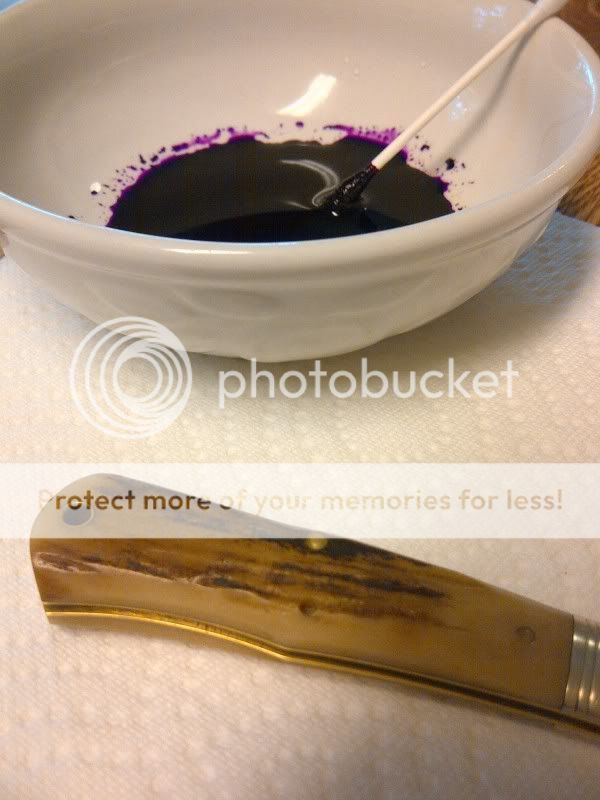
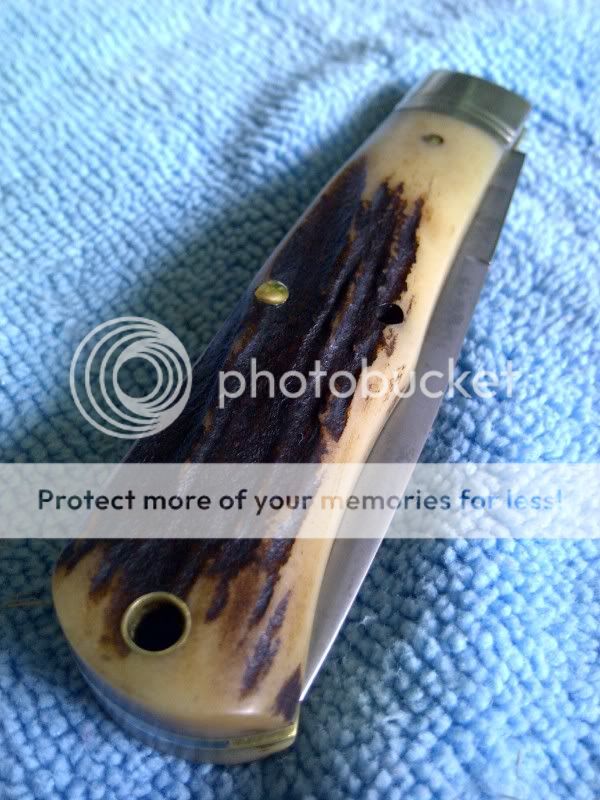
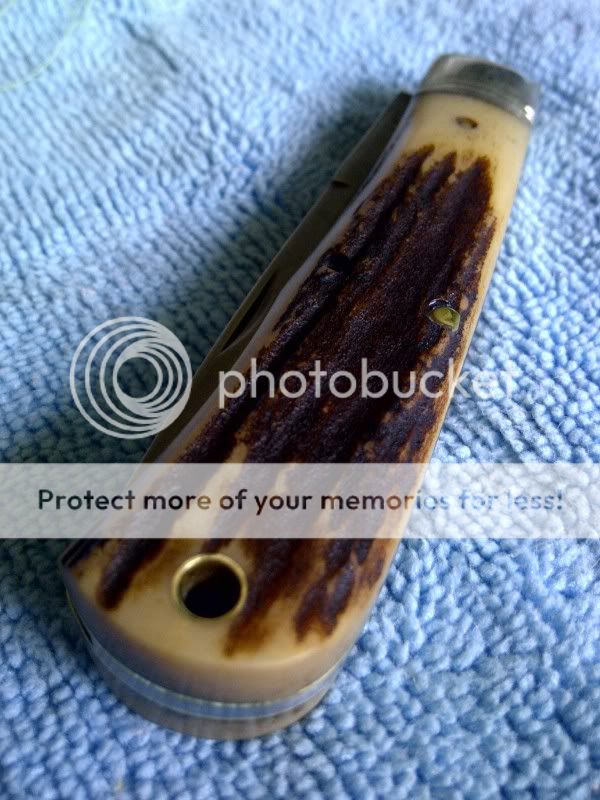
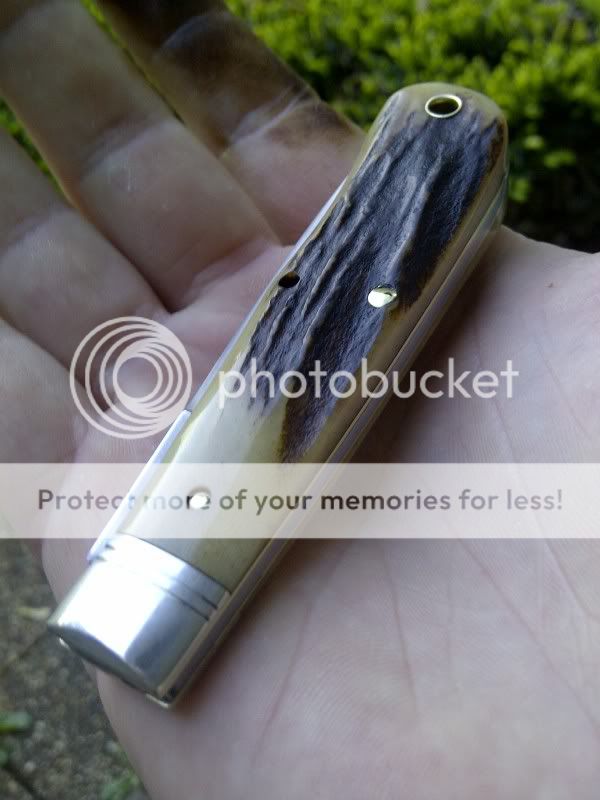
Queen had its Winterbottom Bone highlighted with a dark purple, probably by using a more concentrated solution of potassium permanganate, which is in fact purple.

'Rough black' is the modern collector name for jet black imitation jigged bone (i.e. imitation imitation stag). I can't tell you when it was first used, but I know that Imperial used it on the sailor knives it made for the US Navy in World War I (1917-1918). It was more widely used in the 1920s, and became very common in the Depression years of the 1930s, especially on the lowest price 'assortment knives.'

Starting in the late teens, Landers Frary & Clark used a version that was made of black celluloid molded to look like genuine stag, rather than like bone stag, and they called it 'Perfected Stag,' despite its tendency to burst into flames, and its unattractive appearance.

Most rough black was celluloid, which was both inflammable and prone to shrinkage. In World War II, the US gov't would not buy any celluloid handled knives, for safety reasons, so most of the GI pocketknives were handled in brown jigged bone (this bone was imported from Argentina, since all U.S. bone then was used as a raw material in the chemical industry, for munitions, fertilizer, and plastics. The president of Rogers Bone Co. told me that the free-range Argentine cattle had denser bone that made better handles (only the 'shin' bones were used for handles).

Other GI knives, such as the TL29s and the lifeboat knives, had wood handles. Beginning in 1944, most GI utility knives had Monel metal handles (a nickel alloy), although the bone handles continued in production til war's end.

The only rough black handles used on GI knives in WWII were on the Geo. Schrade paratrooper knives -- and these handles are not celluloid.

I think it is funny that some current makers are dyeing genuine bone black. I suppose you could call it imitation imitation imitation stag. I suspect they do this because they don't know the real story, plus black is an easy and safe color to obtain (working with potassium permanganate to get brown or purple can be hazardous), plus black is the 'in' fashion handle color right now.

This is the same sort of blind copying by which some makers copy worn out or damaged antique knives, warts and all. And other makers create carefully measured copies of fake bowies or fake military knives, something that never fails to amuse me.

On my links page is a link to an article I wrote on the history of the two leading bone handle mfr's in the U.S. (Rogers and Winterbottom). There are also 3 links to very informative pages on the history and composition of plastics, posted by the Plastics Museum in Italy.

BRL...

------------------
http://pweb.netcom.com/~brlevine/links.htm
 
In a recent thread in the Maint forum, it was pointed out that 3-in-1 was a mixture of oil, corrosion inhibitor (no idea what this is made of), and a little bit of citronella oil as a scent, which seems kind of odd to me. I've seen some mention on the web, that citronella oil is slightly yellow in color. The greenish tint might come from the mix of those three. The MSDS for 3-in-1 lists the ingredients as:

'Severely Hydrotreated Heavy Naphthenic Oil', 97%
'Naphtha, petroleum', < 2%
'Non-hazardous ingredients' (also called 'Proprietary Additive' in another section of the MSDS), < 3%

Naphtha is a pretty strong solvent, BTW.
 
Last edited:
David, I am sorry to disagree with you, but Naphtha is about as mild as solvents get. For most substances it is no more aggressive than rubbing alcohol. Ketones (Acetone, MEK, etc.) , aromatics (Xylene, toluene, etc), or even most esters are considered much stronger solvents. The paint thinner (mineral spirits) you buy at the paint store can be roughly categorized as "Naphtha", as can lighter fluid.
 
I know the Naphtha in lighter fluid has left a nice burning sensation on my leg/hip, when it leaked from a lighter in my pocket. Sometimes left some rash or other skin irritation behind. Isopropyl never did that to me.

It's also used in wasp-killing spray (drops them instantly), and is especially nasty if it blows back in the face.

As always, what's 'strong' or 'mild' is relative to the application, and the dilution. Here''s a quote from a Wiki article on the subject:

"It is a broad term covering among the lightest and most volatile fractions of the liquid hydrocarbons in petroleum.

http://en.wikipedia.org/wiki/Naphtha
 
Last edited:
I was ogling the latest work in progress in the Erickson Retrospective and I saw an interesting example of oil changing the color of stag.

Sweet thanks Ken!

Here is the before. Almost all the dark had worn off and the rest had turned real yellow from honing oil:

SU1HLTIwMTIwNDIzLTAxMDE1LmpwZw.jpg


Here is both sides after I had buffed it once and sanded for about 30 minutes.

SU1HLTIwMTIwNDIzLTAxMDE2LmpwZw.jpg


SU1HLTIwMTIwNDIzLTAxMDE3LmpwZw.jpg


I had to sand all the high spots very carefully. I wanted to/and tried to darken the highs/polished areas but it wasn't turning out well for me. So I had to sand it off.

In doing that I actually made it overall much nicer! The end result which is perfectly matched side to side is here below:

SU1HLTIwMTIwNDIzLTAxMDE4LmpwZw.jpg


The parts of the stag that I buffed on my 10" wheel are like glass! Not something you may always want but I really like it.

Anyhow, that stuff really is corrosive so thanks for the warning. I am excited so I hope I'm not going on to much, but its you that I have to thanks. So this is my way of showing it.

Ken, you make this look terribly easy and it surely is not.

Respectufully,

Kevin

http://www.bladeforums.com/forums/s...nives-A-Retrospective?p=10778388#post10778388

Cool post, Kevin! I hope you don't mind me sharing it here.
 
Last edited:
Jake, here is for comparison's sake:

Brand new:

IMG03904-20110830-1550.jpg


The only oil that knife ever saw was either from my hands or from the honing oil. The honing oil is yellow, so I guess it makes sense. Either way, I only got it on the handle when it would slowly run down the spring and onto my hand. It wasn't like it got a bath or soaked. Now I wipe the blade of oil often when I sharpen. Even with minimal oil it still happens if I don't.

I don't really like the yellowing, but thats just me. As you can see it went deep because when I sanded down the stag, I also sanded down the boltsers and liners and backspring to stay flush. I took off plenty of the surface to prove there was deep penetration and staining.

Anyhow, that was my bad run in with oil and stag :)
 
Thanks for the before photo! That's even better!

From what I've read previously on this forum, the dark color is mostly from the preservation of the stag with potassium permanganate. Also, the old jigged bone was dyed brown mostly with potassium permanganate. I think this fits well with Bernard's and Bill's recommendations regarding not incubating bone in oil because it could affect the color.

Btw, I like the look of the stag both mellowed and restored.
 
Jake,

I think so but I have one thought to add. When I was playing with refinishing I did a couple tests. I tried to buff off the new dark areas and it wouldn't (at least not easily). I also messed with metal polish and oils just because sometimes I use an old polishing cloth that can have both on it when I polish the blade. Neither affected the new finish so I'm not sure what to think entirely.

Food for thought :)

Kevin

ETA, thanks Jake for the good words on the stag :)
 
I think it means that yours and Ken's method of staining stag is much better than the methods used to preserve it. I suspect dyed bone was subjected to a bigger dose of KMNO4 but could still lose some color.
 
Back
Top