Only Sharp Knives Are Interesting- the Sharpening Thread

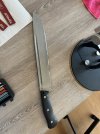
To sharpen my only CPK knife a BFK in Tweaked D3V (I only own 3 knives besides a few steak knives and Caphalon knives in the kitchen drawer), what would you say about the following 2 options at the bottom:

(Context: My goal is to have a way to sharpen the best way possible without relying on a sharpening system at home and in the event I don't have access to a stropping compound. This would be like a bug out situation or supply chain issues (compound is out of stock). Sorry in advance if I don't use the right terminology. No one in my family taught me about knives so I'm trying to learn on my own so I can pass the skills of knife handling/usage on to my 5 children. I could imagine in this situation, keeping a knife sharp is important and am wondering if I can use extra fine diamond or ceramic as a substitute for leather strop loaded with compound. Instead of stockpiling CPKs to avoid learning how to sharpen, as I don't have the budget for that, would any of you who are experienced give your approval on either (or neither) of these 2 portable guided sharpeners below? I understand the ultimate goal would be to achieve freehand proficiency. I also plan to practice on a Cold Steel Finn Bear I recently picked up on sale on Amazon, so that i don't mess up my BFK. Thank you in advance for your advice)

1. https://wickededgeusa.com/products/venture-pro-portable-knife-sharpener
2. https://www.sharpeningsupplies.com/...-with-ee-e-f-c-in-case?variant=48626849153326
I’ve tried the 2nd kit (always been a fan of the DMT Diafold sharpeners). If you need the help holding a more consistent edge angle, it’ll do.

And if/when you get better with freehand sharpening, then you can toss the attachments and just use the Diafolds.

I have on old Diafold Fine that’s over 30 years old (and still works great). Then when they released the Duo (dual sided), I got the Coarse/Fine. That’s what I usually pack (really light and compact).
 
Oh, so you guys sharpen knives here?

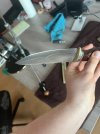
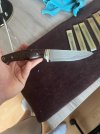
I sharpened a knife made from 15V steel.

Actually, I ground this knife myself to a zero edge, so at 19 DPS the cutting edge looks like it's not even there.

The steel is slightly harder than 65 HRC, but the most interesting part is that it's a laminate: 15V core clad in stainless steel.

I sharpened it in multiple stages, carefully avoiding over-refining or "glazing" the carbides present in the steel.

There's a specific technique required to properly sharpen tools made from this type of steel.

This is because you need an extremely aggressive diamond abrasive that can also polish the cutting edge at the same time.


I use a specific trick: when I finish with a 1-micron stone, I then switch to an abrasive-resistant belt that I glue onto a glass blank and apply diamond paste to it. This way, I avoid glazing or over-polishing the carbides, and the knife becomes incredibly sharp and aggressive.

Additionally, since the edge is essentially ground to zero (zero edge), to preserve this geometry and not lose that thinness, I essentially never sharpen with anything coarser than 1000 grit, because the knife is extremely thin behind the edge.


7.jpg8.jpg

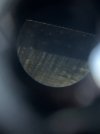
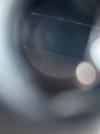
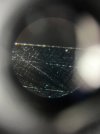
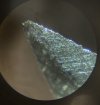
I'm always curious about how the steel looks after being processed with different abrasives. I take these photos for myself, to better understand how to sharpen different steels and knives in the future. So, here are just some shots from the sharpening process.

1000 grit

1.jpg

1500 grit
microscopy photos are not really good :rolleyes:

2.jpg

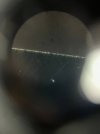
Essentially, grit values aren't that significant here anymore, so I'll just refer to them in microns.

This is 6 microns.


3.jpg

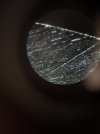
There is 3 microns

5.jpg

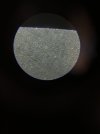
1 micron and abrasive belt
(It's essentially like Scotch tape onto which I apply diamond abrasive paste)
The microscopy photos aren't very good because of overexposure issues specifically with my phone's camera...!

But essentially, the cutting edge has no burr at all and is polished to a mirror finish.

6.jpg


You know, looking at sharpening under a microscope is quite a dangerous thing.


All of a sudden, you think you're sharpening knives amazingly well and everything's great—then you get even the simplest microscope and you're shocked, absolutely shocked.


You realize just how many factors affect edge retention, initial sharpness, the sharpness that remains after use, and everything else.

And result video!

 
I've been really tempted to buy one of these KMFS Vantaedge sharpeners just to play with it. They have a pivoting head design that is supposed to maintain the same edge angle even through the belly and out to the tip, clamp position theoretically doesn't matter. They handle up to a 9.5" blade without changing the clamp, so pretty good capacity and the build quality appears to be top notch. Just not a lot of info out there on them.
During checkout on KMFS site I stopped short of paying after viewing payment types accepted

Later next morning received email from the company, an invoice in USD $333 + $15 shipping
.
Sure wish there's a distributor on our side of the hemisphere. Really hate giving my CC info to unknown sources in CZK
 
During checkout on KMFS site I stopped short of paying after viewing payment types accepted

Later next morning received email from the company, an invoice in USD $333 + $15 shipping
.
Sure wish there's a distributor on our side of the hemisphere. Really hate giving my CC info to unknown sources in CZK
I grabbed one before Christmas for $219 a complete kit, yesterday the multi angle 11-29 degrees for $118 arrived - USA vendor
Still playing with it - get the hoverspring for $11 - it also comes with travel stops for the stone holder
 
I grabbed one before Christmas for $219 a complete kit, yesterday the multi angle 11-29 degrees for $118 arrived - USA vendor
Still playing with it - get the hoverspring for $11 - it also comes with travel stops for the stone holder
Can you please pm me the vendor contact info, or post it here if not violating rules..

At that price does it appear worth the money, made in Czech or Taiwan?
 
325 grit (50/40 microns) is sharper than 5000 grit (3/2 microns).

At least in the classical understanding, 5000 grit can be sharper in an ideal situation.
But when we try to cut non-homogeneous materials that are either softer or, on the contrary, harder, the result turns out to be such that 325 grit (50/40 microns) is significantly sharper. Some people will say that this is a kind of micro-saw, while 5000 grit at 3/2 microns is a truly polished and even edge.

In reality, the difference lies only in how you sharpen and what movements you use when the cutting edge contacts the abrasive. Because finishing and refining strokes can be done on 325 grit as well, and even on coarser abrasives, producing a more or less even edge. At the same time, it will be sharper in real-world tasks, and according to my observations, it somehow holds its sharpness better.

What I mean is: try finishing in the 300–600 grit range, using the same finishing movements that you normally use on abrasives designed for polishing. I tested this on diamonds and CBN (elbor), and the result was the same.

Essentially, after polishing to unrealistically high grit values, I ended up working with literally one abrasive, at most two. And you know, it turns out that the knife not only stays sharp longer, but also cuts much more aggressively.

Here are the microscopy results.

325 grit 50/40

Yes, the cutting edge, when viewed under a microscope at this level of magnification, may look not as aesthetically pleasing and not polished.

At the same time, it is just as even.

5040325.jpg

5000 grit 3/2
The cutting edge looks significantly more polished, but in essence this even slightly reduces its aggressiveness.
500032.jpg

5000 grit 3/2 result


325 grit 50/40 result
I know that, in essence, when you look at microscopy at around ×500 magnification and closer, the edge structure appears to be something like a micro-micro saw. But in practice, and in real working conditions, it is actually sharper and more durable.

This is because a perfectly polished cutting edge, at least in theory, is subjected to higher stress. That is why I eventually came to sharpening in the 300–650 grit range, sometimes slightly higher.

A polished cutting edge ultimately holds up worse.

Some people will say that this mainly works on steels around 60–64 HRC, and that on harder steels polishing holds better and the edge becomes more durable. But that is not the case.

Even steels with a hardness of 66–70 HRC retain sharpness better at 20/14 or 14/10 microns (1000–2000 grit).

 
Let me tell you something interesting — and you can try it for yourselves.

Most of you guys sharpen your knives using diamond abrasives.
And I used to do that too — and still do sometimes.

But do you know that CBN is actually better for this?

Diamond is significantly harder, and because of that it tends to tear into your steel more aggressively and leaves deeper scratches () on it. And do you know why?
In essence, diamond abrasives were originally developed mainly for glass, ceramics, and similar materials.

The steel in your knives isn’t nearly as hard as diamond, so diamond abrasives behave less stably on it — they rip the edge more, while the abrasive grains themselves break down into finer fractions.

When it comes to knife sharpening, CBN is really your bro — it’s much more stable, much more controllable, and interacts with your steel way better.

And you know what?
It leaves far less deep parasitic scratches.

And do you know what a deep parasitic scratch really is?
It’s basically small areas of stress concentration along your cutting edge.

CBN is better — noticeably better.

40/28 Diamond abrasive
IMG_7724.jpeg

40/28 CBN abrasive

IMG_7932.jpeg

In general, the difference, say, in microns—yes, it’s not some dramatic effect that you could notice with the naked eye.
By the way, trust me, all the differences further down in microns and grits have roughly the same scale—extremely tiny, only really visible under a microscope.
Yes, the difference is indeed microscopic, essentially existing in parasitic risks and those few microns.

But have you ever thought about how much steel and sharpening quality you actually save over the lifetime of, say, 100 sharpenings of your favorite knife?

In reality, the more often you sharpen and re-profile your knife, the more the benefit of using CBN grows almost geometrically. Because you get much greater edge stability, much cleaner cutting edge, and as a result—far fewer stresses and micro-chips when you look at it at 250–450× magnification.

In fact, even over just 20–30 sharpenings, you end up saving several times more of your precious knife steel.

And the most interesting part: you literally need only one stone.

Something like 50/40 (around 325 grit)
or 40/28 (roughly 400–550 grit range).

The sharpness you get from CBN (Elbor) at these values is roughly equivalent to 20/14 or 14/10 on a diamond stone (i.e. ~1000–1500 grit).

Yet the stability and cleanliness of the cutting edge are dramatically better.
 
Last edited:
Let me tell you something interesting — and you can try it for yourselves.

Most of you guys sharpen your knives using diamond abrasives.
And I used to do that too — and still do sometimes.

But do you know that CBN is actually better for this?

Diamond is significantly harder, and because of that it tends to tear into your steel more aggressively and leaves deeper scratches () on it. And do you know why?
In essence, diamond abrasives were originally developed mainly for glass, ceramics, and similar materials.

The steel in your knives isn’t nearly as hard as diamond, so diamond abrasives behave less stably on it — they rip the edge more, while the abrasive grains themselves break down into finer fractions.

When it comes to knife sharpening, CBN is really your bro — it’s much more stable, much more controllable, and interacts with your steel way better.

And you know what?
It leaves far less deep parasitic scratches.

And do you know what a deep parasitic scratch really is?
It’s basically small areas of stress concentration along your cutting edge.

CBN is better — noticeably better.

40/28 Diamond abrasive
View attachment 3100387

40/28 CBN abrasive

View attachment 3100388

In general, the difference, say, in microns—yes, it’s not some dramatic effect that you could notice with the naked eye.
By the way, trust me, all the differences further down in microns and grits have roughly the same scale—extremely tiny, only really visible under a microscope.
Yes, the difference is indeed microscopic, essentially existing in parasitic risks and those few microns.

But have you ever thought about how much steel and sharpening quality you actually save over the lifetime of, say, 100 sharpenings of your favorite knife?

In reality, the more often you sharpen and re-profile your knife, the more the benefit of using CBN grows almost geometrically. Because you get much greater edge stability, much cleaner cutting edge, and as a result—far fewer stresses and micro-chips when you look at it at 250–450× magnification.

In fact, even over just 20–30 sharpenings, you end up saving several times more of your precious knife steel.

And the most interesting part: you literally need only one stone.

Something like 50/40 (around 325 grit)
or 40/28 (roughly 400–550 grit range).

The sharpness you get from CBN (Elbor) at these values is roughly equivalent to 20/14 or 14/10 on a diamond stone (i.e. ~1000–1500 grit).

Yet the stability and cleanliness of the cutting edge are dramatically better.

Very cool!

Wished you lived closer to run side by side results against each other!
 
Very good information.

There's another level to this as well regarding CBN stones. I've been purchasing mine from Alex at UKSG Sharpening Stones directly from Ukraine.

The Silver grade CBN are very aggressive and remove material very quickly but also prone to tear out carbides, just like diamond stones. They're particularly good for fixing badly damaged edges and re-profiling. While the KDTU CBN Hybrid are slower and more gentle (and cheaper) and best to use for finishing the edge before stropping.

I have metal matrix CBN as well, but they have proven too hard and difficult to use, at least in the smaller micron. I'll probably need to grind them on glass with a diamond slurry to get them to work, while the other two mentioned above are good to go without any special pre-treatment.

For my kitchen knives and relatively softer steels, I use Naniwa Chosera stones. It's not always necessary to use the hardest or most advanced stones. Sometimes the softer ones do as well or better.

For those that like the Spyderco Sharpmaker, those two ceramics (brown - medium, and white - fine) along with a white extra-fine, are also available as a mounted 1" X 6" for use on a guided system.
 
In reality, no matter how many CBN and diamond stones I have, I’ve generally noticed that they all benefit from being lapped/opened up on glass with silicon carbide.

Because each one has a certain degree of “baking” or whatever you want to call it.

So I lap/open up literally all my abrasives that contain diamond or CBN — whether they’re hybrid, metal-bond, or rubber/resin-bond types.

Like, if you open them up on some powder first, and then finish/refine them using your own slurry with some hypoallergenic soap, the abrasive becomes so even and perfectly opened that it literally sticks to the glass.

In short, all manufacturers slightly lie when they say their stones are always “ready to go” 😅

Nothing beats glass + silicon carbide, followed by your own slurry.
 
Last edited:
And there's this specific trick I do to make the abrasive work cleaner when you're already aiming for a decently good surface—even on something coarse like 100/80, 50/40, 40/28, or 28/20.

Just try using the same kind of motions and sharpening technique as if you were working on very high, finishing grits.

Work the abrasive gently and make those light, finishing passes.

Over time and through testing, I've actually become pretty disappointed with polishing the cutting edge itself.

For some reason, most steels give the best results right around 40/28, 28/20, or 20/14.

Anything finer—moving into true polishing territory—seems to somehow stress/load the edge, and while the cut might feel cleaner initially, the primary sharpness drops off very quickly.

And that's exactly where "working sharpness" or "edge-on-the-decline sharpness" (meaning residual/remaining sharpness) shines much higher.

Say, if you sharpen to the same 28/20 (roughly around 650 grit), but here CBN really wins out—because it leaves your edge much cleaner and without those micro-stresses
 
I've experienced similar cutting results from stopping at 14/10 vs going to full polish and stropping to remove the burr.

I worked with a couple of other guys setting up and running a book bindery in Brooklyn in 1974. We would take the guillotine knives (1/2"+ thick steel slabs) to a shop for sharpening. They bolted them in a special grinding rig that used very coarse fast spinning stones with water soluble oil coolant. They were ground single side but were ridiculously sharp and able to cut through a 2" stack of cover stock with ease, and there were obvious grinding marks on the blades.

The light touch on final strokes and consistency have worked well for me too over the years.

Regarding the lapping of stones, you're probably right. Not only does it "open them up" but more importantly (at least for me), it flattens them out so there's even contact. Almost every stone I've purchased has some degree of cupping or bow to it. Easy enough to check with a precision machined straight edge.

From my recent use of the Silver CBN & KDTU Hybrid CBN, they really do cut very well right out of the box and they seem to improve with each sharpening, essentially lapping while sharpening. At least that's my own experience. YMMV.

I should say that I don't use a microscope, nor am I a metallurgist. My experiences are purely subjective, so take it with a grain of salt as your milage may vary. I'm just adding to the conversation, nothing more.

Regarding polished edges, several of my carry knives do have them because that's what I like, though I do strop with coarser diamond for more bite. It really is just a matter of personal taste and not what's necessarily most efficient or effective.

Since I come home every day to my equipment, I can afford to touch up the edges any time I like.

Those fixed blades that travel with me for true SHTF scenarios or when I travel out of the country, do have coarser edges. However, at my age, the worst thing that I expect to happen would probably be not having a bathroom facility when I need one, and how long the edge of my knife lasts would definitely not come into play in those situations. 😆
 
Back
Top