Please help me with a tapered tang

This is how the blade looked before I foolishly decided to go on my tapered tang adventure:

9qXTto.jpg


I didn't plan to do a tapered tang at first, I just tried to get the damn tang flat so there would be no gaps. I tried this with a granite surface and sandpaper glued to it and it wasn't working (note that I used this method on another blade just recently and it worked) so I said to myself: might as well try a tapered tang...

Also note that I managed to make a full tang knife just recently (my second handle, not my first blade that I made) that I managed to get a handle on that did not have any gaps....I just could not replicate well enough what I did there:
ENWZ1y.jpg

OtM5XY.jpg

qUGeWX.jpg


What it really comes down to is this: I've messed up blades before, plenty so...but really bugges me that I had a good thing going, I had a nice grind, a nice satin and then I screwed it up because I was too dumb to take care of such a fundamental thing like making everything flat beforehand.

Thank you for your encouraging words and advice nonetheless, I'll try to salvage what I can...try to put a handle on it and gift it to someone who will beat the crap out of it.

Edit: also I'll try to upload a picture of what the messed up knife looks now. Also really sorry to hear about your broken arming sword JTknives JTknives , seems like you had a good blade there

Also regarding the grinder: I have a 2x72 variable speed grinder. The tool is adequate in my opinion, the problem was only my skillset
 
Last edited:
if you attempt it again, try doing the tang right after you profile the blade. that way if you mess it up, you will not waste the time you put into doing the bevels and the rest of the knife.
 
Yes, I sure as hell won't be making that mistake ever again.

Edit: Also regarding why it took me so long. That is simple: I am not the best at grinding, I am not the best at hand sanding, but I tried to put the best effort I could into the blade and spent a lot of time correcting mistakes and getting everything symmetrical.
 
Last edited:
I just find it way easier to control with the blade up and butt down. Hitting the scribed line is just a question of grind and check. Doing it like Adam described with a 45 first makes it very quick to check. And then I'm watching how high the grind goes towards the ricasso as much or more than the butt, since I want both sides to meet in the same place.

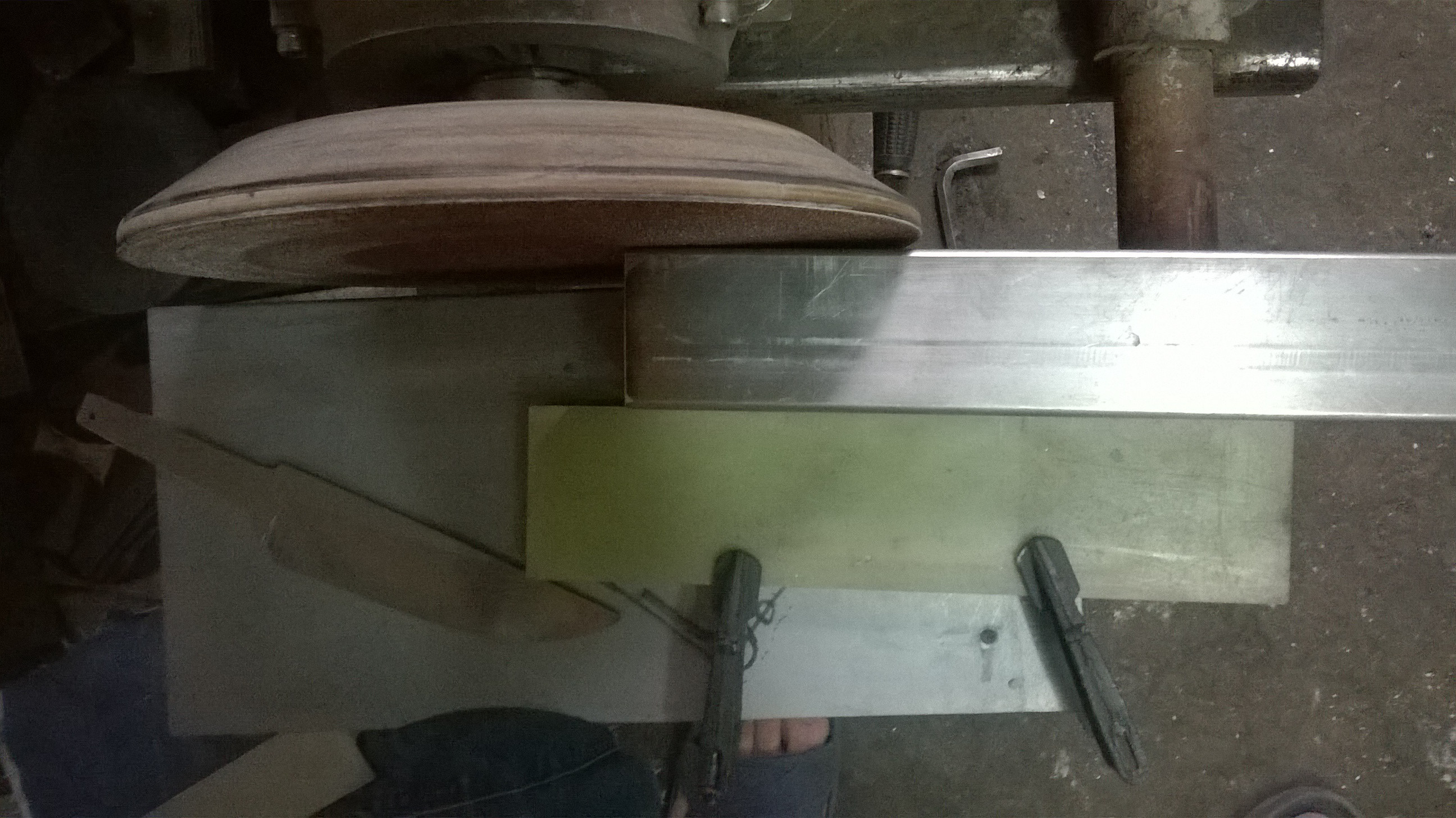
Why do you guys complicate such a simple thing? Every honor of yours craftsmanship , but........................This is how I would taper tang if I decide to do that . You can do this on 2x72 Belt sander , but I think it is more easy on disc sander ......

Set rest plate on 90 degree to belt , calculate the angle , attach some piece as guide for jig on rest plate , scribe two line on tang , fasten the blade on jig and grind that taper ? 100/100 repeatable and 110/100 accuracy !
My English is not very good and I think this picture will explain better .....

5Aq0pnm.jpg
 
You'd be surprised how fast and easy it is to freehand.
Its like grinding bevels. At first a jig is a lot faster and easier, but if you take the time to really master freehand grinding, freehand will be faster.
Guys like Bob Engnath could completely rough grind a knife just in the time it would take to attach a blade to the jig. Obviously he wasn't exactly the average knifemaker, but I'd be willing to bet a lot of makers could taper tangs faster freehand than with a jig or fixture
 
I move my grind up from the butt. Scribe my lines and work from there and push it higher and higher. This way I can stop when I have reached where I want to be. To me a jig is just to ridged. Knife making is a art and takes skill, so many people are trying to remove the skill part of it. We work hard to learn the needed skills. I'm not saying jigs are cheating I'm just saying spend more time learning and less time trying to get around learning.
 
wanna see something funny?

here is what it looks like now:

6GDQiq.jpg


8ajzgG.jpg


now remember this is what it looked like:

9qXTto.jpg


just fkin awsome.

And my dust collection burned down today, even though it is build to handle sparks from grinding. If you'll excuse me, I'm gonna punch a wall.
 
none of your pictures are showing. But remember my adage, "if at first you don't succeed (at tapering a tang) you can now try out doing a hidden tang"
 
Did I miss something?

Why did you go so far on the taper?

You could have stop right at the plunge and then blended the 2 areas together.
 
i see the pics. someone earlier suggested he taper up to the front of the bolsters, and he went a bit farther by accident i think. i do it like loveless, taper stops before the guard so the guard has a flat spot to rest on. natlek, how does that jig work ? are you getting perfect ( to the eye anyways) results with no gaps ?
 
While that sucks, you can still save it. I would hit the flats on a disc sander to bring them back to the plunge, touch up the bevel and plunge and then blend it like Adam said.
 
Its not like I intended to let the taper go that far. I just screwed up, horribly.

I've now given up on the piece, I'm done investing any more time in a horribly failed project than I already have.

I'd be ashamed to even gift it so someone, so I will keep it as a token to always remind me what a moron I've been in this build and never make such mistakes again.

Regarding the dust collection: I am in contact with the manufacturer of the dust collection unit and will have a technician over in a couple of days who will take a look at it and hopefully tells me what caused it.
 
Its not like I intended to let the taper go that far. I just screwed up, horribly.

I've now given up on the piece, I'm done investing any more time in a horribly failed project than I already have.

I'd be ashamed to even gift it so someone, so I will keep it as a token to always remind me what a moron I've been in this build and never make such mistakes again.

Regarding the dust collection: I am in contact with the manufacturer of the dust collection unit and will have a technician over in a couple of days who will take a look at it and hopefully tells me what caused it.

One of the most important things in knife making is learning how to correct your mistakes or like I tell my wife , there are no mistakes there is only a new design .
You will make mistakes again , if you cannot handle it , quit now .
 
mail it to me at PO Box 249 , Seaview , Washington , 98644 . I'll make a new knife of it .
 
I think it could be fixed and look quite presentable. Surface grind the sides of the blade. It will be slightly thinner, no big deal. Maybe go to a little finer grit so you have a little more control without it hogging off so much material.

Did you shorten the blade as well?
 
Back
Top