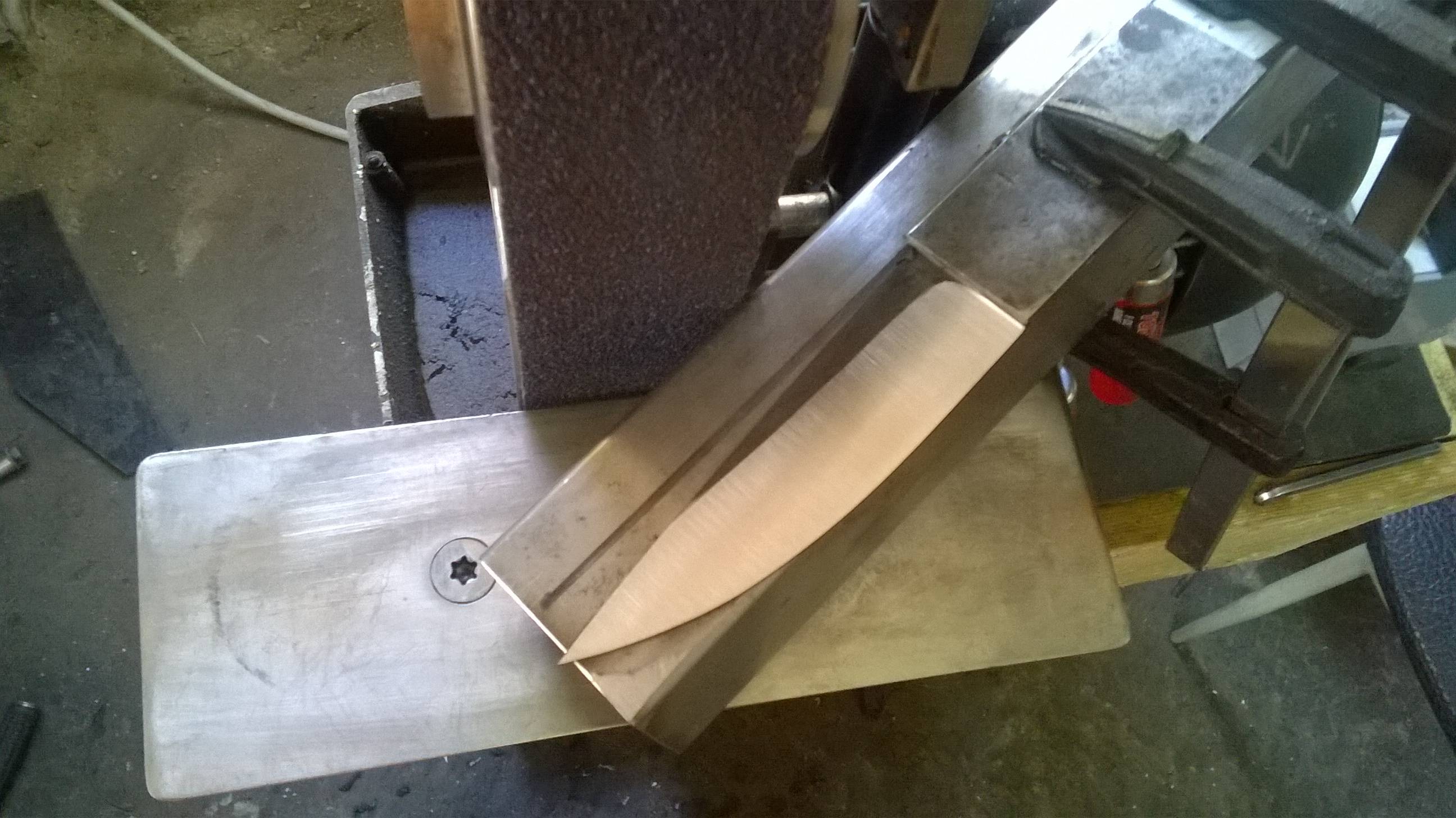
Please help me with a tapered tang

One of the most important things in knife making is learning how to correct your mistakes or like I tell my wife , there are no mistakes there is only a new design .
You will make mistakes again , if you cannot handle it , quit now .

not your place to judge if, when or under what circumstances I quit. Also yes, in my opinion there is a certan point where it is not worth to put any more time into a piece when I could use my time and energy better on a new project.

Also thank you for your kind offer to send you the knife, but I honestly do not care what you can or could still do with the knife, that's not the point.

Edit: for clarification: I did not shorten the blade, it just seems like that because the picture was taken at an unfortunate angle.
 
I move my grind up from the butt. Scribe my lines and work from there and push it higher and higher. This way I can stop when I have reached where I want to be. To me a jig is just to ridged. Knife making is a art and takes skill, so many people are trying to remove the skill part of it. We work hard to learn the needed skills. I'm not saying jigs are cheating I'm just saying spend more time learning and less time trying to get around learning.
Words of someone who build new machine every month :)Why you build forge press ? I know that you have skill to do that with hammer :D Look , why I would spend my time learning something that need very very long time ....here we call that ... experience .Experience don t come in a day ..... Ten minutes ago I grind this up with jig and all that on 6400 SFPM and 40 grit ceramic belt , take minute . How many vaste steel and time I will lost till I get there freehand ? .Jig is so simple , grind too , make feel good :thumbsup:
HvJBqvc.jpg
 
Where not taking the time to learn freehand becomes an issue is on more complicated blades. For things like that a jig works great.
But what if you wanted to make a recurve hollow grind with a sweeping plunge line? I'm not aware of any jig that could do that
 
Took these pics as I was working on this today. Tapering is the last thing I do before sending it off to heat treat, may blade is completely finished prior to tapering. To protect the finish I use several wraps of masking tape. The layers of tape offer protection against damaging the blade should you present it badly to the platen. Also the tape offers remarkable resistance to the grinding belt creating a little more control as you move the taper up.

As already explained by everyone, a hollow grind down the guts of your tang removes metal quickly and makes the actual tapering easier. Once the hollow is established I find it easier to start the taper by holding the blade at right angles to the platen. Once I have it started I present the tang to the platen with the tip up. The magnets that have been mentioned are a must have.

The bulk of the tapering is done with 50 grit and I finish with a few passes of 100. Final hand clean up starts at 320 Rhino and then on to finer grits. Another point to remember is the more you taper the less likely you are to shoot to far forward.

Hope the pics help you in future projects, Peter.


https://www.flickr.com/photos/152637387@N03/36800826632/in/dateposted-public/
 
I did not say jigs are bad, I can see a use for them. But I really enjoy gaining experience and learning to do things by hand. I guess with me a blade is just a chunk of steel till it gets the bevels and that's when it transforms into a knife. You would not use a jig to birth your child lol. Any way I am proud that I can grab a chunk of steel and step up to the grinder and grind my bevels. I have put a lot of time into gaining this experance. But I'm not doing it to pay bills I'm doing it becaus I enjoy it.
 
I agree with the others that you could still salvage that knife.

When I have screwed up knives in the past, I have had the exact same feelings as you. I just wanted to forget about it and move on to something else. I think that can be healthy for certain personalities (like me).

I've put a blade like that under the bench and came back to it a year or so later once my skills had progressed, and once the disappointment of screwing it up had worn off.
 
I did not say jigs are bad, I can see a use for them. But I really enjoy gaining experience and learning to do things by hand. I guess with me a blade is just a chunk of steel till it gets the bevels and that's when it transforms into a knife. You would not use a jig to birth your child lol. Any way I am proud that I can grab a chunk of steel and step up to the grinder and grind my bevels. I have put a lot of time into gaining this experance. But I'm not doing it to pay bills I'm doing it becaus I enjoy it.
Well ,if I tried one more time to grind free hand most likely I would have destroyed this blank :) How do you grind free hand thin steel in the name of God ???? This blank is 1.5mm 1.2519 hardened steel and it is too flexible for me to grind freehand . No that I know to grind free hand , but on thicker steel i can grind close and then with the jig to make small correction so I do not throw it in the waste basket all that previous effort .
It's easy to see on the picture what is free hand and what is grind with jig :) But I like challenges, I will learn that too ,the left side is a problem, right side I can do even now on thicker steel .....:mad:
XSQPpdp.jpg
 
Not to stir the pot, but while jigs are without a doubt limited I would also say that skill level can be/is VERY limiting at times. For those that may disagree, please try freehand grinding a uniform bevel with a one inch wheel. :D
Photo of my work for reference, I use jigs whenever it makes sense to. My goal is to knock the socks off my customers, how I go about doing so means much less to me.

36584944240_f1edb90e22_k.jpg
 
As Josh, in my opinion has some of the most impressive grinds I've seen and consistent as all get out, I defer to him on jigs. I don't use one, but that's mostly because I have found them distracting in the past. But there are certain operations I would like to do with more consistency. End product is the goal.
 
Most of my free hand grinding is flat grinds or on an 8" wheel. If I was going with a smaller wheel then yes I can see using a jig as it can get rather squirrelly. Maybe I need to try jigs more, I just never considered them when grinding. But I'm all for more consistency. But I still think free hand grinding is a valuable skill worth putting in the time to learn.
 
Back
Top