AOE4 said:
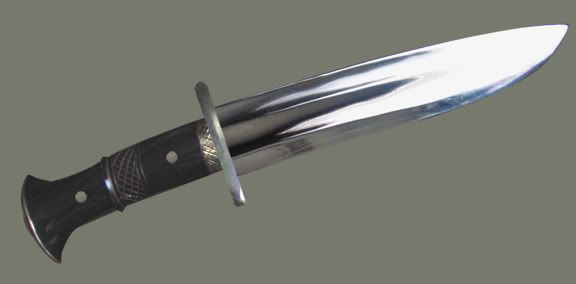
I love the blade and the guard on these protypes...but would prefer the handles be flatter (not so rounded)...
In my opinion, flat slab type grips give you a better "feel" for where the edge is. I'd avoid adding finger notches (like on the "Bura fighter" that was recently shown) because these notches are unlikely to comfortably fit everyone's fingers.
Bill, at 15" this knife is potentially as much a fighter as a great outdoor/camp knife. Most people will use it as a camp knife and I doubt it it will be much used in real knife fights.
I agree that a more oval crossection of the handle would be beneficial. However a small ring in the position where it is right now would be an added bonus: for chopping and for a distinct Nepali/Himalayan feature.
I found that even a tall, protruding ring can be comfortable on a khukuri handle, if
A) the edge of the ring is rounded (not sharp);
B) the position of the ring is closer to the buttcap, allowing for a generous front portion of the handle;
C) there is still enough length left for the butt flare (i.e. the whole handle is longer than on the traditional Nepali khukuries); and
D) the crosection of the handle is oval (flatter) rather than round, both in the front (pre-ring) and in the rear (flare) sections.
What I like about the HI khukuri handles is, that one frequently can find longer handles with these design features, which make these handles usable in several, slightly different grip positions and one can adjust the perfect grip according to the size of his/her hand and the task intended (light vs. heavy chopping vs. whittling type cuts).
From the around 20 khuks I purchased from HI, some had less comfortable handles, and all of those had round and/or short front pre-ring handle sections and sometimes sharp ring edges.
The sharp edges can be particularly annoying on the harder horn handles.
I have an otherwise spectacular horn Bura BAS (from my very first purchase), where the round front section and the initially sharp ring edge made it very uncomfortable to grip. I rounded down the edges, but the round front section still makes it less comfortable to hold than my other khuks with oval handles (many of them made by Bura).
I remember Yvsa repeatedly pleading for oval crossections in the khuk handles, and I completely agree with him and AOE4 on this issue. I think a proper handle crossection is as important for a user knife as the proper heat treatment of the blade. The Nepali kami tradition got it right: the oval crossection of the older khuks is superior to the round, or flat, or fingergrooved handle designs seen on so many modern large western knives, the latter created with the main purpose to sell them to armchair warriors and mall ninjas, or to collectors who never use them. Flat, round or fingergrooved handles can be very useful on small, specialized knives, but are rarely good for large user knives.
As for ommitting the ring and making a completely smooth handle, what is the point to make just another typical American Bowie? There are several Bowie designs in production already in the HI line.
On the other hand, if there is a high demand for this, why not?
I however think this knife design should retain both the chitlangi handles and the fantastic double fullers, as Lefthandblack designed it.:thumbup:
This makes it a uniquely Himalayan Import knife with the exciting and exotic combination of both the best of Nepali bladesmithing and the American Bowie traditions, combining them into a new harmony.
I think the Chitlangi handle features, if properly executed, make this design very useful for both a heavy duty camp knife and a unique collector/display item. In both cases the Nepali handle design is superior IMHO to a plain, smooth handle.
Both Lefthandblack's design and Kumar's execution are pure knife-poetry.
:thumbup: :thumbup: :thumbup: