Putting the final edge on

Joined
Sep 21, 2013
Messages
1,574
First finished knife. Have another just glued up as well.

This one is 1084 with paper micarta.

2i0actj.jpg


Looked at the stickies a bit but no dice. What skill should I pursue for putting a final edge on?

Thanks!
 
A steady hand and diamond sharpeners. I like my DMT's but a cheaper set will work as well.
20degrees per side will make a good edge

driehoek.jpg
 
One small problem you will have is that you placed the handle rather far forward on the blade, leaving no ricasso. That will require angling the knife a bit to avoid damaging the front of the handle when sharpening. Not a big problem, but one to consider when sharpening.

Talk a look at this knife a fellow members here just finished. It is very similar to yours, but has a ricasso. You can see how sharpening will be easier on such a knife.
http://www.bladeforums.com/forums/showthread.php/1199863-First-Tapered-Tang

A tip on sharpening a mirror polished blade is to have everything clean and ready . Wash your hands several times. Tape up everything on the blade that you won't be sharpening. Clean off the sharpening swarf with as little hard wiping as possible. Realize that the blade will show marks from almost any contact with dust, dirt, grit, etc. Just cleaning it up after sharpening and removing the tape will likely leave tiny swirls and lines.....be prepared for the angst of this, as it is inevitable on a blade that is highly polished.
 
The DMTs look nice. What grit should I get? Can I get away with 2 grits and get 1 Duo stone?

I'm ok with the blade getting scuffed. I think I'm getting over the new maker fascination with mirror polish. I even thought about just straight pulling some 800 or 1200 on this little guy.

I have to order some more rhynowet and I'm going to order a conditioning belt as well for satin finishing.

http://www.supergrit.com/products/products_belts-misc.asp

Medium or fine? Anyone use one of these belts from supergrit?
 
Last edited:
sometimes I don't wipe off swarf or sanding dust/gritt, I hold it under a running tab to wash it off and not scratch.

Sharpening is removing material, so in theory you can get away with using just one gritt size. You'll have either a very coarse edge or spend a rediulously long time sharpening.

When going for the DMT I sugest black-blue and red-green (that is 220-325 and 600-1200)
You can save time by starting with a 120 gray one and can go finer with (water)stones but those two diafolds will get the job done well.
Don't forget to strop! That is the finishing touch and makes the blade *sharp*
 
If you have a final edge that just needs sharpened consider asking in the Maintenance forum. Really should be called the Sharpening & Maintenance forum. All the crazy sharpening gurus hang there.

I like the Edge Pro if you are not well versed in stone sharpening, but I do prefer the stones or belt. One thing about the guided sharpeners, they will reveal any discrepancy in thickness across the length of the apex. You can get away with a little more on stones because you won't usually get the precision by hand if that makes sense.

Get it close and it'll be a matter of a few strokes on a stone. I prefer 30° and less, but with 1084 you *may* get chipping or rolling at the apex depending on the hrc and end user. 40° (as suggested) with a slightly toothy edge may be more practical. For that I like 400 grit followed by a good stropping.
 
I use my file jig set at 20° with wood backed sandpaper from 220 to 2000. Then I use a sharpmaker.
 
Would I be a sinner in the eyes of an angry god if I suggested a 1x30 bench grinder with fine belts and a leather belt to finish? I know you can get a blade sharper by other means but knives are tools that require maintenance and spending hours getting the perfect edge on them only to dull them on the first use seems like a waste of time.

I'll make exceptions for Japanese cooking knives though.

-Sandow
 
You only set the edge once, after that you maintain it (or restore it)
I believe the people that say that a grinder produces to much heat at the very thinnest party of the edge.
That is why I use handsharpeners.
Roman Landes even states that using a diamond plate (or stone?) dry lets friction build up way to much heat at the very edge.
 
There was a published work (llandis?) from Germany that studied the heat generated at the apex from a belt grinder, or maybe another means, but the idea was the same. Apparently the temps reached were very high, high enough to destroy the ht. I'll look for it. That said, I've used a 1x30 to sharpen for a number of years and have been happy with the results, and I insist on a sharp knife. I think if you have the ability to make a knife, you have the ability to sharpen it on a grinder. Be very light handed, keep it cool and consider finishing on a strop.
 
I dug up what he (Roman Landes) said cause I was curious:

"I had a book dedicated to general grinding methods, in this book i found a test application.
A normal steel block apx. 2"x2"x4" that had a large number of highly sensitive thermocouples integrated in the surface.
The block was slit dry by hand over a 1000grit grinding paper.
The peak temps measured, walked up to 2000°C for split seconds in the very surface (some microns)."

This sounds like you can't avoid altering the temper with anything other than a whetstone. The thing I'd ask from this is does it even matter? Tempering is time and temperature depended and we are talking about very brief temperature spikes.

-Sandow
 
Tempering is time and temperature depended and we are talking about very brief temperature spikes.

-Sandow

EXACTLY. Time AND temperature dependent. 400 degrees for an hour might lower hardness to x, but 800 degrees for ten seconds could achieve the same effect or more. That's the point Roman was making. There's no question it has an effect.

2000 degrees Celsius for a micro-second is still a shitload of energy!!!!! You can guarantee that the microstructure has been embrittled at that point.
 
Learn from the Japs .Those beautiful delicate hamons can ony be achieved by sharpening by hand !! Power tools destroy the microstruture . By hand , wet ,is the best way worth the bit of time it takes.When I started out in life I found I could smear the matrix of a hardened tool steel on a wet polishing wheel !! Be gentle and don't use worn out abrasive paper .
 
I don't suppose anyone has seem either SEM studies or microhardness testing data on edge sharpening? I've heard of studies done on wet stones showing that they actually work harden the material on the surface but I was never able to find them. I don't doubt that there is an effect, I'm more interested in if that effect makes a functional difference.

Mete, don't the japanese use large stone wheels and water for a good deal of the final shaping? If it really makes a difference to avoid surface heating then the solution is a technological one. Misting system or a similar solution perhaps?

-Sandow
 
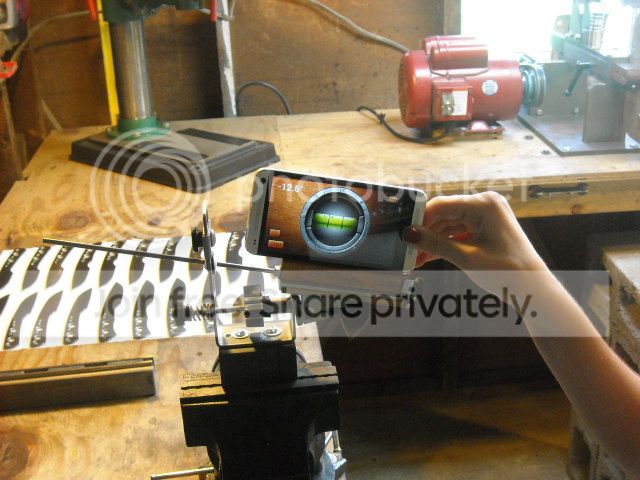
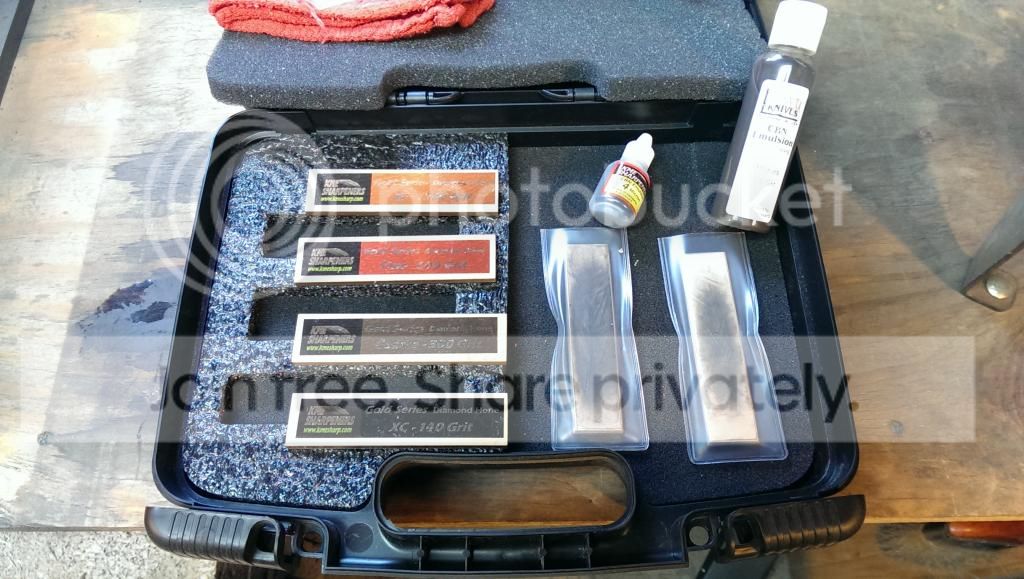
I've gotten away from using the grinder to sharpen my knives with. It's just too easy for me to botch it up and I only have the 3 speed control. I've been using the KME diamond system on the last half-dozen knives and I'm really pleased with the results. Minimal effort with a high degree of accuracy. The knife doesn't need to be removed from the clamp when switching sides because the fixture allows the knife to rotate over. I work my way through the 4 diamond stones and finish off with 8 and 4 micron CBN emulsions on kangaroo leather strops. I attached the clamping fixture to a small piece of angle iron so I could use it in conjunction with my bench vise for stability. It puts an accurate, very sharp edge on my knives every time. I chucked up a blank in the photos to illustrate.

KME007.jpg

IMAG0205.jpg
 
I use a 1x42, then go to a final sharpening by hand. Never once have had an issue with an edge that wasn't abuse induced. I think the study that everyone freaked out about was a big fat red herring. I'd put my edges against anyone that wet sands theirs. Whole lotta wumpa lumpa fluff worry, but not any real world effects.
 
I've gotten away from using the grinder to sharpen my knives with. It's just too easy for me to botch it up and I only have the 3 speed control. I've been using the KME diamond system on the last half-dozen knives and I'm really pleased with the results. Minimal effort with a high degree of accuracy. The knife doesn't need to be removed from the clamp when switching sides because the fixture allows the knife to rotate over. I work my way through the 4 diamond stones and finish off with 8 and 4 micron CBN emulsions on kangaroo leather strops. I attached the clamping fixture to a small piece of angle iron so I could use it in conjunction with my bench vise for stability. It puts an accurate, very sharp edge on my knives every time. I chucked up a blank in the photos to illustrate.

KME007.jpg

IMAG0205.jpg

Adam, nice post, I like your fingernail polish in the pic of the phone showing the angle. :) What app is that?
 
That's my daughter's hand Fish, not mine :p. The app is called iHandy Level Free. I use it quite a bit in the shop since I don't have an angle cube yet. It works well and is pretty accurate when verified with a square. You can zero out at any angle and it also has a hold feature as well. Since the KME system is basically infinitely adjustable for edge geometry and I like to use a 25 degree inclusive bevel on most of my knives, the app helps me find exactly 12.5 or so degrees. I chuck up a couple of blanks and use my phone to verify that the fixture is locking in at 0 degrees first and then pick my angle from there. I then lock the fixture at that setting and I know precisely what edge geometry I'm applying.
 
Back
Top