
-
The BladeForums.com 2024 Traditional Knife is available! Price is $250 ea (shipped within CONUS).
Order here: https://www.bladeforums.com/help/2024-traditional/
You are using an out of date browser. It may not display this or other websites correctly.
You should upgrade or use an alternative browser.
You should upgrade or use an alternative browser.
question about handle making
- Thread starter jblyttle
- Start date
I'm starting to think that I'm better off asking a local firewood service to sell me a roughly 3'x8" log. I can split it, throw it into the basement and play with it in the spring. Either. If I want to practice reshaping, I also have some decent cut offs that I can try to turn in hatchet handles. Just an idea.
Splitting a large diameter log is definitely the way to go! Getting hold of such a thing fresh and uncut is going to be a chore and so is trying to split it. There will be considerable weight to a 3 foot diameter chunk of 'green' timber as well.
- Joined
- Apr 15, 2014
- Messages
- 655
that sounds like a good idea to call up a local firewood place and ask for a big hickory log. I think I'm gonna try that soon.
that sounds like a good idea to call up a local firewood place and ask for a big hickory log. I think I'm gonna try that soon.
This is what I was just about to recommend. I was able to score a couple nice hickory logs that I could do some 30+ inch hafts and several 20in or so larger splits.
I wish I had a picture but some of the hickory has a birds eye pattern in the grain. They are shorter splits that should look really neat on a hatchet.
Don't forget tree services, esp. For green stuff. Not many folks have hickory in their yards, but there are a lot of ashes coming down due to emerald ash borer, and it shouldn't be that hard to find usable lengths. I'm working right now on a wooden maul for use with froe,etc., it came from a big limb that fell at the edge of the woods. I expected it would be useless wood and too far gone, but as I was chopping it to cord length to get it out of way, found several sound sections. If you are nice to a tree guy, it wouldn't be hard to get 4' rounds. A friend of mine lives in the city and got a couple of ricks of ash for firewood when the house a few yards down had a big ash cut.

- Joined
- Sep 3, 2014
- Messages
- 3,741
Don't forget tree services, esp. For green stuff. Not many folks have hickory in their yards, but there are a lot of ashes coming down due to emerald ash borer, and it shouldn't be that hard to find usable lengths. I'm working right now on a wooden maul for use with froe,etc., it came from a big limb that fell at the edge of the woods. I expected it would be useless wood and too far gone, but as I was chopping it to cord length to get it out of way, found several sound sections. If you are nice to a tree guy, it wouldn't be hard to get 4' rounds. A friend of mine lives in the city and got a couple of ricks of ash for firewood when the house a few yards down had a big ash cut.
Great recommendation. I knew this, but you knew enough to say it. Hickory is the "go to", but ash is always a great alternative. I have three BIG trees on my property, but they are healthy. Once in a while a limb will fall, but nothing big enough. There should be a PSA in this forum that says ash is great for handles. I think that it is a close second to hickory in it's physical properties, but I also think that it is superior for rot resistance.
- Joined
- Sep 3, 2014
- Messages
- 3,741
The bottle is strictly for medicinal purposes. When I left 50 behind my joints just require more lube, kind of like the tin man.
Yeah, me too. I'm only 42, I need it for mental health!

- Joined
- Aug 2, 2014
- Messages
- 746
If you're not that experienced in making handles you might want to just try using branches or saplings. They will work even for felling axes, but are more than enough for smaller axes. Hickory isn't required.
One problem with dry wood is that it can be quite hard on your cutting edges, and also tends towards splitting.
One problem with dry wood is that it can be quite hard on your cutting edges, and also tends towards splitting.
If you're not that experienced in making handles you might want to just try using branches or saplings. They will work even for felling axes, but are more than enough for smaller axes. Hickory isn't required.
One problem with dry wood is that it can be quite hard on your cutting edges, and also tends towards splitting.
Excellent suggestion! Try explaining the "grain orientation" though
 ! You can even find good curves with no runout with a little looking, if desired.
PS. I'm convinced that this was the most typical way to make tool handles through much of history.
Last edited:
Square_peg
Gold Member
- Joined
- Feb 1, 2012
- Messages
- 13,879
There should be a PSA in this forum that says ash is great for handles. I think that it is a close second to hickory in it's physical properties, but I also think that it is superior for rot resistance.
Both ash and hickory have poor rot resistance. The best handle materials for rot resistance are black locust and osage orange.
http://www.fpl.fs.fed.us/documnts/fplrn/fplrn153.pdf
Black locust also has better mechanical properties than Ash, i.e. - Mod. of rupture, Mod. of elasticity.
http://www.fpl.fs.fed.us/documnts/fplgtr/fplgtr190/chapter_05.pdf
- Joined
- Aug 28, 2010
- Messages
- 5,431
If using tree limbs (instead of a piece of the trunk) for handles, be aware that "reaction wood" can tend to warp.
Both ash and hickory have poor rot resistance. The best handle materials for rot resistance are black locust and osage orange.
http://www.fpl.fs.fed.us/documnts/fplrn/fplrn153.pdf
Black locust also has better mechanical properties than Ash, i.e. - Mod. of rupture, Mod. of elasticity.
http://www.fpl.fs.fed.us/documnts/fplgtr/fplgtr190/chapter_05.pdf
Yep, Black locust is great for fence posts, but driveing staples in it is not so easy. Not sure how it stacks up in rot resistance to Juniper or Cedar, I just havn't been around that long.
I got a purpleheart slab from the lumberyard awhile back that was a full 2" thick for some handle experiments. I had to poke around and pick one with grain that would work but the slab size was not a problem. As I recall they also had hickory and other hardwoods in similar sized slabs as well.
http://www.bladeforums.com/forums/showthread.php/1173516-Purpleheart-handle-(pic-heavy)
http://www.bladeforums.com/forums/showthread.php/1173516-Purpleheart-handle-(pic-heavy)
Last edited:
- Joined
- Sep 3, 2014
- Messages
- 3,741
Very nice. This thread has reminded me, that we tend to get too locked into "rules", and the "right way", and "the way it should be". I think that we can all agree the there is a best choice for longer handles and heavy use, but that we should relax a bit and be open to many other choices when the situation allows. Anecdotal evidence tells us that heartwood and "incorrect grain pattern" is fine. As long as you don't ask your hatchet to be a splitting maul, many other choices will work just great. I have a few 3'x2"x2" sections of oak, a ton of cut off old hickory handles, and lots of cut down maple and another unidentified hardwood from my yard in 6" diameter sections. Between that and the odd piece of hickory firewood, I have limitless options for experimentation for hatchet, house axe and hammer handles. I would love a piece of Osage Orange or Black Locust to play with, but we all probably have many more good choices than we typically think about. I also just like the idea of making a tool handle from a tree growing nearby anyway. There is something right about that.
JB,
Sorry we are not closer- I have 6 40-46" logs in the woods drying since last Spring- straight healthy hickory too large to get arms around. I could use help rolling them out and splitting into staves
If get back to the farm and get them out, I will let you know how it goes and maybe send you one to play with.
Bill
Sorry we are not closer- I have 6 40-46" logs in the woods drying since last Spring- straight healthy hickory too large to get arms around. I could use help rolling them out and splitting into staves
If get back to the farm and get them out, I will let you know how it goes and maybe send you one to play with.
Bill
- Joined
- Aug 2, 2014
- Messages
- 746
Very nice. This thread has reminded me, that we tend to get too locked into "rules", and the "right way", and "the way it should be". I think that we can all agree the there is a best choice for longer handles and heavy use, but that we should relax a bit and be open to many other choices when the situation allows. Anecdotal evidence tells us that heartwood and "incorrect grain pattern" is fine. As long as you don't ask your hatchet to be a splitting maul, many other choices will work just great. I have a few 3'x2"x2" sections of oak, a ton of cut off old hickory handles, and lots of cut down maple and another unidentified hardwood from my yard in 6" diameter sections. Between that and the odd piece of hickory firewood, I have limitless options for experimentation for hatchet, house axe and hammer handles. I would love a piece of Osage Orange or Black Locust to play with, but we all probably have many more good choices than we typically think about. I also just like the idea of making a tool handle from a tree growing nearby anyway. There is something right about that.
After using birch handles going back to hickory feels like using a jackhammer. I think hickory is considered the best because for most of the past century axes have only been used by common folk for splitting. It's really durable while retaining some of the other qualities useful in axe handles.
Mostly I think it is considered the best because of the immense damage required to break a handle, which would prevent upset customers returning with broken axes (for most people the axe became a disposable item, as you can see with all the poor treatment on vintage handles, wedges, and mushroomed heads). It is possible that lumber companies also wanted to save money on replacement handles and only bought hickory for workers to save money.
In terms of weight/mobility, balance, flexibility, spring, and general use for extended periods without your arms getting torn to pieces, hickory falls behind ash and far behind birch. Of course if you miss a lot you probably want a hickory handle. But after going to birch I would never go back to hickory. For anything over two inches in diameter it just shocks you with every hit. Still useful for limbing and splitting axes where force transfer is much less, but if you're going to be falling trees I'd leave the hickory behind.
That kind of contradicts what I said before. I just mean you would do well to consider other handle options if you're confident in your aim. There's no need for hickory in hatchets, and for working axes hickory is beat out on everything apart from durability. It's a tradeoff for what you need in an axe.
Also you learn a lot by making your own handle with minimal materials. Mine is rough but it works and I learned a lot while making it - also gaining confidence that I can make a handle in the woods if I have to. Whatever you decide it will be a great project and will help you learn about axes.
- Joined
- Sep 3, 2014
- Messages
- 3,741
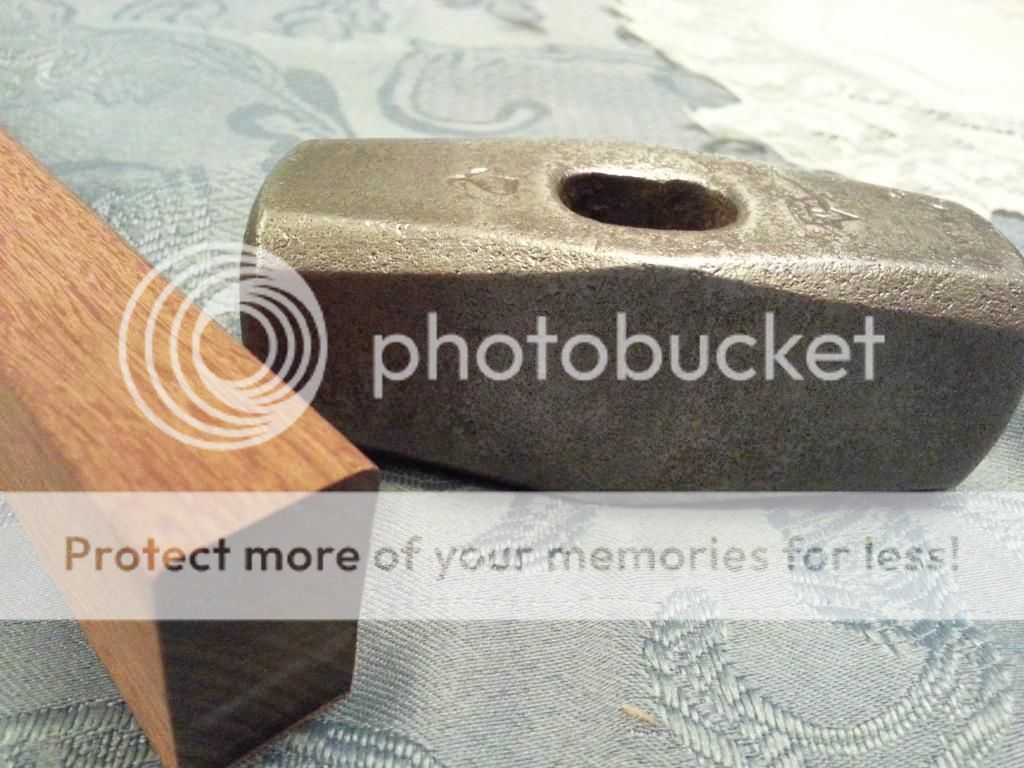
Here it goes. I'm going to hang this 2lb Iron City hammer head. I have a bunch of wood that was given to me. It was called "ironwood" and is a decking material. I know that there are several woods called ironwood, I do not know the actual species here. If anyone knows an "ironwood" that is a common decking choice, let us know the species. It is heavy and dense, noticeably heavier than mahogany of the same size. I don't know it's properties, but I have been using small pieces of it for wedges and it turns VERY dark with oiling. I'm thinking that 11 inches will be just right. I will post when done, let's see how this goes.

Square_peg
Gold Member
- Joined
- Feb 1, 2012
- Messages
- 13,879
Probably lignum vitae.
Here it goes. I'm going to hang this 2lb Iron City hammer head. I have a bunch of wood that was given to me. It was called "ironwood" and is a decking material. I know that there are several woods called ironwood, I do not know the actual species here. If anyone knows an "ironwood" that is a common decking choice, let us know the species. It is heavy and dense, noticeably heavier than mahogany of the same size. I don't know it's properties, but I have been using small pieces of it for wedges and it turns VERY dark with oiling. I'm thinking that 11 inches will be just right. I will post when done, let's see how this goes.
Pics arent showing up for me, but if it's used as decking material and referred to as ironwood then what you have is ipe. Ipe is sometimes
called "Brazilian Ironwood," but don't call it ironwood because it's just too confusing. There are probably over 30 species that some folks somewhere
would call ironwood. Ipe makes an interesting axe handle, might not be the greatest wedge material because of it's oily properties. Definitely lather it
up with wood glue before slamming a wedge in.
- Joined
- Sep 3, 2014
- Messages
- 3,741
You nailed it, it's ipe. After looking that up, it's all over the web as decking, and it's a visual match. After reading some of the properties, no wonder I had a tough time with the saw. Apparently it's one of the toughest, hardest, strongest, densest, most rot resistant woods known. I guess it sinks in water. And it looks nice. Probably perfect for short handles. The piece shown is half of a board that I cut, I have some 2x2 but it's mostly 1x4 in lengths from 3-4' up to 8'. I have maybe 100' of it, and more of mahogany boards of the same type. I like the contrast of a dark wedge, maybe that will work better.