
-
The BladeForums.com 2024 Traditional Knife is available! Price is $250 ea (shipped within CONUS).
Order here: https://www.bladeforums.com/help/2024-traditional/
You are using an out of date browser. It may not display this or other websites correctly.
You should upgrade or use an alternative browser.
You should upgrade or use an alternative browser.
Random Thought Thread
- Thread starter Nathan the Machinist
- Start date

- Joined
- Aug 21, 2014
- Messages
- 23,118
What season it isI was wondering last night while falling asleep - what's the real world difference between a goober and a gomer?

- Joined
- Nov 25, 2024
- Messages
- 328
I'll never under the allure of Minecraft no matter how many times I see it. But I'm old and played too much Nintendo.
Fair enough! I can't really play it anymore because I played it too much when I was younger and just don't have the time to dedicate to it now
- Joined
- Nov 25, 2024
- Messages
- 328
I was wondering last night while falling asleep - what's the real world difference between a goober and a gomer?
Honestly I feel like this has the potential for a very constructive and nuanced discussion
- Joined
- Aug 21, 2014
- Messages
- 23,118
Dammit75000!!!!!
- Joined
- Aug 21, 2014
- Messages
- 23,118
Spelling?I was wondering last night while falling asleep - what's the real world difference between a goober and a gomer?

Moorik
Platinum Member
- Joined
- Jan 17, 2025
- Messages
- 1,326
Either I’ve been spoiled by custom heat-treated steels, or the factory heat treatment of mass-market blades is just plain awful?
Lately I’ve sharpened more than a dozen folding and fixed knives with various steels — sometimes even supposedly “pure cutting steels” like ZDP-189, Cowry-Y, M398, Cromax, S125V, M390, RWL-34.
And none of the above hold an edge — not even close — compared to any literally standard steel that’s been heat-treated more or less competently, not even excellently or perfectly…
Lately I’ve sharpened more than a dozen folding and fixed knives with various steels — sometimes even supposedly “pure cutting steels” like ZDP-189, Cowry-Y, M398, Cromax, S125V, M390, RWL-34.
And none of the above hold an edge — not even close — compared to any literally standard steel that’s been heat-treated more or less competently, not even excellently or perfectly…

- Joined
- Sep 4, 2011
- Messages
- 12,582
A lot will get burnt edges also , and it can take time to sharpen that outEither I’ve been spoiled by custom heat-treated steels, or the factory heat treatment of mass-market blades is just plain awful?
Lately I’ve sharpened more than a dozen folding and fixed knives with various steels — sometimes even supposedly “pure cutting steels” like ZDP-189, Cowry-Y, M398, Cromax, S125V, M390, RWL-34.
And none of the above hold an edge — not even close — compared to any literally standard steel that’s been heat-treated more or less competently, not even excellently or perfectly…
Moorik
Platinum Member
- Joined
- Jan 17, 2025
- Messages
- 1,326
It doesn’t help at all. I tried everything, even removing the excess steel along the edges.A lot will get burnt edges also , and it can take time to sharpen that out
I’m not even talking about the fact that very often, judging by the feel, the hardness is clearly lower than what is claimed.
I can’t check it on a hardness tester.
However, during sharpening I can often tell—both under a microscope and by the tactile feedback—when there is an obvious lack of hardness or something else is off.
On top of that, most of these steels don’t really take fine abrasives at all.
Something like 40/28 (300–500 grit) already seems to be too fine for them, as if it’s excessive.


Boattale
Gold Member
- Joined
- Nov 27, 2019
- Messages
- 2,753
Depends on the maker. The good guys are still good. I.E. Spyderco, Buck, BM.... you know who they are.Either I’ve been spoiled by custom heat-treated steels, or the factory heat treatment of mass-market blades is just plain awful?
Lately I’ve sharpened more than a dozen folding and fixed knives with various steels — sometimes even supposedly “pure cutting steels” like ZDP-189, Cowry-Y, M398, Cromax, S125V, M390, RWL-34.
And none of the above hold an edge — not even close — compared to any literally standard steel that’s been heat-treated more or less competently, not even excellently or perfectly…
- Joined
- Sep 4, 2011
- Messages
- 12,582
It doesn’t help at all. I tried everything, even removing the excess steel along the edges.
I’m not even talking about the fact that very often, judging by the feel, the hardness is clearly lower than what is claimed.
I can’t check it on a hardness tester.
However, during sharpening I can often tell—both under a microscope and by the tactile feedback—when there is an obvious lack of hardness or something else is off.
On top of that, most of these steels don’t really take fine abrasives at all.
Something like 40/28 (300–500 grit) already seems to be too fine for them, as if it’s excessive.
Maybe ask the manufacturer?
I currently only have 1 of the steels you mentioned (m390) and don't have issues with edge holding
Boattale
Gold Member
- Joined
- Nov 27, 2019
- Messages
- 2,753
Resistance is futile.Don't know how long I can hold out but I'm proud of myself because I've resisted the impulse to buy 3 knives today.
Moorik
Platinum Member
- Joined
- Jan 17, 2025
- Messages
- 1,326
From my experience, M390 is exactly the steel that most often has problems with edge retention—roughly with about 90% of manufacturers.Maybe ask the manufacturer?
I currently only have 1 of the steels you mentioned (m390) and don't have issues with edge holding
It’s rare to come across truly good heat treatment on M390.
By the way, I’d put factory Magnacut in the same category.
And again, is the edge retention really that good?
Like, after cutting 40–50 pounds of meat, does it still cut paper?
Edit:
I’m not blaming the steel itself, I’m blaming the heat treatment.
I tested a custom Magnacut on rope, and it cut just as much as a good S90V.

SharpBits
Gold Member
- Joined
- Apr 26, 2002
- Messages
- 8,946
Many manufacturers will run their steels lower than optimal to prevent complaints about broken blades and chipping. To be honest, the average users (not aficionados) will never notice the hardness, but will notice a broken blade.It doesn’t help at all. I tried everything, even removing the excess steel along the edges.
I’m not even talking about the fact that very often, judging by the feel, the hardness is clearly lower than what is claimed.
I can’t check it on a hardness tester.
However, during sharpening I can often tell—both under a microscope and by the tactile feedback—when there is an obvious lack of hardness or something else is off.
On top of that, most of these steels don’t really take fine abrasives at all.
Something like 40/28 (300–500 grit) already seems to be too fine for them, as if it’s excessive.
- Joined
- Nov 25, 2024
- Messages
- 328
It doesn’t help at all. I tried everything, even removing the excess steel along the edges.
I’m not even talking about the fact that very often, judging by the feel, the hardness is clearly lower than what is claimed.
I can’t check it on a hardness tester.
However, during sharpening I can often tell—both under a microscope and by the tactile feedback—when there is an obvious lack of hardness or something else is off.
On top of that, most of these steels don’t really take fine abrasives at all.
Something like 40/28 (300–500 grit) already seems to be too fine for them, as if it’s excessive.
Production companies often heat treat too soft. They also frequently do this thing called lying. It's quite unfortunate.
- Joined
- Aug 21, 2014
- Messages
- 23,118
Time for ..... something I dunno I'm at a loss

ferider
Platinum Member
- Joined
- Jun 20, 2018
- Messages
- 16,724
I tested a custom Magnacut on rope, and it cut just as much as a good S90V.
Not so good, the S90V then (or different geometry?) - try Spyderco S90V.
Heat treat is one thing. The other thing I (now) watch out for is that a maker grinds wet.
Moorik
Platinum Member
- Joined
- Jan 17, 2025
- Messages
- 1,326
To be honest, the edge retention values in tests like CATRA may not always reflect real-world edge holding in everyday tasks.Not so good, the S90V then (or different geometry?) - try Spyderco S90V.
View attachment 3067968
Heat treat is one thing. The other thing I (now) watch out for is that a maker grinds wet.
What do we actually cut in daily life?
Cardboard, meat, vegetables, wood, fruits, occasionally fabric, plastic film, or some kind of plastic.
In addition, heat treatment, in my opinion, plays an absolutely crucial role.
When comparing one steel to another, what matters is the quality and the focus of the heat treatment for those specific steels.
If one steel is heat-treated purely for maximum edge retention, while another is optimized for a versatile EDC context, the results will differ significantly.
In some situations, edge retention and the ability to sharpen/polish the cutting edge to a very fine grit are important.
The question isn’t just about hardness, because if the steel is too hard, the edge can chip or crumble.
Interestingly, as far as I understand, in CATRA tests a steel can still show higher scores even if it’s frankly too brittle/hard.
I’ve noticed that steels which hold an edge well while also being tough are often not extremely hard.
I personally have a record-holding knife in CPM 15V that outcuts even the best Rex 121 blades, and its hardness is 65 HRC.
At the same time, as far as I know, Spyderco’s 15V can reach 66–67 HRC.
Moorik
Platinum Member
- Joined
- Jan 17, 2025
- Messages
- 1,326
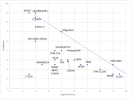
What I mean is that on charts showing steel toughness versus edge retention, in the context of edge retention specifically, many steels can effectively be shifted to the right—towards better edge retention.
That's why I try not to rely too heavily on those charts.
Because the steel itself doesn't deliver an absolutely fixed result as indicated in the test.
The same heat treatment can produce different characteristics depending on various variables.
That's why I try not to rely too heavily on those charts.
Because the steel itself doesn't deliver an absolutely fixed result as indicated in the test.
The same heat treatment can produce different characteristics depending on various variables.