
-
The BladeForums.com 2024 Traditional Knife is available! Price is $250 ea (shipped within CONUS).
Order here: https://www.bladeforums.com/help/2024-traditional/
You are using an out of date browser. It may not display this or other websites correctly.
You should upgrade or use an alternative browser.
You should upgrade or use an alternative browser.
Random Thought Thread
- Thread starter Nathan the Machinist
- Start date


Nathan the Machinist
KnifeMaker / Machinist / Evil Genius
Moderator
Knifemaker / Craftsman / Service Provider
- Joined
- Feb 13, 2007
- Messages
- 19,520
There is a lot of confusion amongst not only knife enthusiasts, but also the knife industry in general, about the difference between abrasive wear resistance and edge retention.
Abrasive wear resistance is a component of edge retention. Depending on the application, it can be just as important as edge stability.
It is easily measured and quantified.
But, wear resistance is only part of the story. It is a property that knife manufacturers like to talk about because it is baked into the steel and it is relatively straightforward to quantify. It is an important component to edge retention. However edge retention is what we're actually all after.
Equating wear resistance to edge retention is incorrect, but also very common.
Edge retention is the ability to retain an edge. (Duh). It is a factor of all of the aspects affecting edge loss that includes abrasive wear. It is not so easily quantified. In my personal experience, it is impossible to ascribe a numerical value to it but instead, it is kind of more like a mohs hardness test where one thing can scratch another. It's comparative in nature. Test samples are run through known media, attempting to utilize reproducible cutting techniques that reflect real use, alongside known samples as controls, and then compared under bright light and magnification to determine which alloy and which heat treat held up the best.
Abrasive wear resistance is a component of edge retention. Depending on the application, it can be just as important as edge stability.
It is easily measured and quantified.
But, wear resistance is only part of the story. It is a property that knife manufacturers like to talk about because it is baked into the steel and it is relatively straightforward to quantify. It is an important component to edge retention. However edge retention is what we're actually all after.
Equating wear resistance to edge retention is incorrect, but also very common.
Edge retention is the ability to retain an edge. (Duh). It is a factor of all of the aspects affecting edge loss that includes abrasive wear. It is not so easily quantified. In my personal experience, it is impossible to ascribe a numerical value to it but instead, it is kind of more like a mohs hardness test where one thing can scratch another. It's comparative in nature. Test samples are run through known media, attempting to utilize reproducible cutting techniques that reflect real use, alongside known samples as controls, and then compared under bright light and magnification to determine which alloy and which heat treat held up the best.

- Joined
- Nov 25, 2024
- Messages
- 328
To be honest, the edge retention values in tests like CATRA may not always reflect real-world edge holding in everyday tasks.
What do we actually cut in daily life?
Cardboard, meat, vegetables, wood, fruits, occasionally fabric, plastic film, or some kind of plastic.
In addition, heat treatment, in my opinion, plays an absolutely crucial role.
When comparing one steel to another, what matters is the quality and the focus of the heat treatment for those specific steels.
If one steel is heat-treated purely for maximum edge retention, while another is optimized for a versatile EDC context, the results will differ significantly.
In some situations, edge retention and the ability to sharpen/polish the cutting edge to a very fine grit are important.
The question isn’t just about hardness, because if the steel is too hard, the edge can chip or crumble.
Interestingly, as far as I understand, in CATRA tests a steel can still show higher scores even if it’s frankly too brittle/hard.
I’ve noticed that steels which hold an edge well while also being tough are often not extremely hard.
I personally have a record-holding knife in CPM 15V that outcuts even the best Rex 121 blades, and its hardness is 65 HRC.
At the same time, as far as I know, Spyderco’s 15V can reach 66–67 HRC.
And then there's the difference between abrasive vs non-abrasive edge wear and how that factors in

sgt1372
Platinum Member
- Joined
- Oct 16, 2018
- Messages
- 8,978
This is one of the knives that I was thinking about buying today.
The listing has been up for 18 hours which is ages for a CPK knife listing.
Someone hurry up & buy it before I can't resist it anymore.
---------------------------------------
That's a relief. It's sold!!!
Sold Thread 'Shiv 2.0'
New/unused Shiv 2.0 with unbuffed black canvas micarta and purple TI hardware. Kydex sheath. $800 shipped, Paypal only. Will ship USPS Priority. Thanks for looking.
- 420isaac
- Replies: 1
- Forum: Carothers Performance Knives For Sale
The listing has been up for 18 hours which is ages for a CPK knife listing.
Someone hurry up & buy it before I can't resist it anymore.
---------------------------------------
That's a relief. It's sold!!!
Last edited:

- Joined
- Sep 4, 2011
- Messages
- 12,582
BUY IT!!!!This is one of the knives that I was thinking about buying today.
Sold Thread 'Shiv 2.0'
New/unused Shiv 2.0 with unbuffed black canvas micarta and purple TI hardware. Kydex sheath. $800 shipped, Paypal only. Will ship USPS Priority. Thanks for looking.
- 420isaac
- Replies: 1
- Forum: Carothers Performance Knives For Sale
The listing has been up for 18 hours which is ages for a CPK knife listing.
Someone hurry up & buy it before I can't resist it anymore.

Moorik
Platinum Member
- Joined
- Jan 17, 2025
- Messages
- 1,326
After all, when I talk about edge retention, it probably depends on the definition—I might have used the wrong phrase. Let me clarify:
For me, edge retention and keeping sharpness aren’t necessarily the same concept.
I have a little experience with sharpening and using microscopy during and after sharpening, to see how the cutting edge of knives made from different steels behaves after some use.
Everything I was talking about regarding those steels—from mass-market factory producers—fits this context:
I sharpen a knife, give it back to its owner, or just test it a little myself, and then I look under the microscope to understand how the steel behaves and what it looks like.
For me—or at least what I meant by “edge retention”—is this:
I take the knife and cut meat, some cardboard, and carefully plane some wood, and I can even controllably strike the antler of a young deer (they’re harder, as you know).
And the steels I was talking about, under the microscope, after what I consider relatively light use, tend to crumble, lose integrity, and don’t stay smooth, unlike, for example, some others.
This is what the cutting edge of SDFK looks like after this kind of stress. It stays straight and uniform.
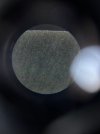
And this is what the microscopy of some factory steel looks like—I don’t remember exactly which one, but I do remember it was a fairly expensive knife from a well-known brand!

The load was more or less the same—let’s say light.
The blade in the second microscopy photo still remains sharp, thanks to the carbides, but it holds its geometry terribly.
This is more or less what I meant.
And it’s not so much about the steel’s toughness…
Cutting meat, planing wood, slicing a couple of pieces of cardboard, a light tap on an antler—just like a gentle knock.
And this is how a huge number of “premium” steels behave, even from major manufacturers.
They don’t hold their sharpness even from slicing an orange or a kiwi…
It’s hardly an abrasive material!
For me, edge retention and keeping sharpness aren’t necessarily the same concept.
I have a little experience with sharpening and using microscopy during and after sharpening, to see how the cutting edge of knives made from different steels behaves after some use.
Everything I was talking about regarding those steels—from mass-market factory producers—fits this context:
I sharpen a knife, give it back to its owner, or just test it a little myself, and then I look under the microscope to understand how the steel behaves and what it looks like.
For me—or at least what I meant by “edge retention”—is this:
I take the knife and cut meat, some cardboard, and carefully plane some wood, and I can even controllably strike the antler of a young deer (they’re harder, as you know).
And the steels I was talking about, under the microscope, after what I consider relatively light use, tend to crumble, lose integrity, and don’t stay smooth, unlike, for example, some others.
This is what the cutting edge of SDFK looks like after this kind of stress. It stays straight and uniform.
And this is what the microscopy of some factory steel looks like—I don’t remember exactly which one, but I do remember it was a fairly expensive knife from a well-known brand!
The load was more or less the same—let’s say light.
The blade in the second microscopy photo still remains sharp, thanks to the carbides, but it holds its geometry terribly.
This is more or less what I meant.
And it’s not so much about the steel’s toughness…
Cutting meat, planing wood, slicing a couple of pieces of cardboard, a light tap on an antler—just like a gentle knock.
And this is how a huge number of “premium” steels behave, even from major manufacturers.
They don’t hold their sharpness even from slicing an orange or a kiwi…
It’s hardly an abrasive material!

- Joined
- May 1, 2010
- Messages
- 5,506
I haven't had an issue with edge retention either from ZT, Benchmade, Spyderco or any other manufacturer that uses M390/20CV steel.Maybe ask the manufacturer?
I currently only have 1 of the steels you mentioned (m390) and don't have issues with edge holding
But I also usually sharpen/reprofile the knife after trying the factory edge for a few weeks.
Moorik
Platinum Member
- Joined
- Jan 17, 2025
- Messages
- 1,326
Well, the microscope creates huge problemsI haven't had an issue with edge retention either from ZT, Benchmade, Spyderco or any other manufacturer that uses M390/20CV steel.
But I also usually sharpen/reprofile the knife after trying the factory edge for a few weeks.

Because with it, you can spot flaws.
This is S45VN, from planing wood and contact with fairly soft bone in meat.
By the way, I just grabbed one of my folding knives right now and took these photos.
20 degrees per side.
The BTE (edge bevel) behind the cutting edge is quite large, since the bevel is about twice as wide as on my other knives.



The fact that I have no problems with this steel doesn't mean that, upon close inspection, I won't see dents/chips from using the knife—which are quite normal for it

P.S
The essence of the cutting edge geometry, if we consider sharpening under ideal conditions, is already lost!

0721
Gold Member
- Joined
- Jul 21, 2025
- Messages
- 279
You better hurryThis is one of the knives that I was thinking about buying today.
Sold Thread 'Shiv 2.0'
New/unused Shiv 2.0 with unbuffed black canvas micarta and purple TI hardware. Kydex sheath. $800 shipped, Paypal only. Will ship USPS Priority. Thanks for looking.
- 420isaac
- Replies: 1
- Forum: Carothers Performance Knives For Sale
The listing has been up for 18 hours which is ages for a CPK knife listing.
Someone hurry up & buy it before I can't resist it anymore.

- Joined
- May 1, 2010
- Messages
- 5,506
I use a Wicked Edge for sharpening and have looked under a microscope. It sounds like you're using your knives differently than me.Well, the microscope creates huge problems
Because with it, you can spot flaws.
This is S45VN, from planing wood and contact with fairly soft bone in meat.
By the way, I just grabbed one of my folding knives right now and took these photos.
20 degrees per side.
The BTE (edge bevel) behind the cutting edge is quite large, since the bevel is about twice as wide as on my other knives.
The fact that I have no problems with this steel doesn't mean that, upon close inspection, I won't see dents/chips from using the knife—which are quite normal for it
P.S
The essence of the cutting edge geometry, if we consider sharpening under ideal conditions, is already lost!
Moorik
Platinum Member
- Joined
- Jan 17, 2025
- Messages
- 1,326
- Joined
- May 1, 2010
- Messages
- 5,506
I always wanted a Robotech Cyclone.Man I wish I had some T-51 power armor

- Joined
- Dec 10, 2020
- Messages
- 431
lol, I do in the summer, but when its -20C here, its not as criticalThe other thing I (now) watch out for is that a maker grinds wet.
- Joined
- Dec 10, 2020
- Messages
- 431
0721
Gold Member
- Joined
- Jul 21, 2025
- Messages
- 279
Guyver Armor here!Man I wish I had some T-51 power armor

- Joined
- Jul 7, 2011
- Messages
- 6,196
Future Biff was rather prescientThat's what I was wondering to. Back to the Future II was really wrong about where our technology would be.