Share your titanium secrets with me...Please.

Bob, you're going the wrong way mate, run em as fast as you can. Think like its on a dremel or angle grinder!

Ok, thanks. I'll have to run into town tomorrow and find some more discs. Seems I'm doing everything backwards on this project. I just realized yesterday that the very first holes I should have put in my side plates was the blind holes for the stop pin. I'm learning a lot though so it's all going to be worth it.

Bob
 
I'm not going to write this one off as a throw away but, there are certainly quite a few things that I know I can improve on the next one. Overall though...I'm pretty happy with the style and feel in-hand. I'm learning so much doing this knife and I'm really enjoying the technical and problem solving aspect of this build. I still need to blend the spine of the blade into the stop pin area of the case, fit a pocket clip of some sort, install the detent ball and machine some kind of pattern into the slabs for texture/visual interest. I also have a couple counterbores that need to be made deeper.

I've also determined that I need to thin the blade about .010" per side so I'm going to put it back on the SG today. Apparently .005" of shim per side is not enough. In Bob Terzuola's book he says the detent ball needs to have .015-.025" stick-out to work properly so I'm going to shoot for the minimum.

I also learned that the quick-lock Dremel discs are not the ones to use for cutting the lockbar. I set everything up in the mill and cut my slot but the disc wandered and the slot was not straight. I think it is the spring loaded mounting of the quick-lock mechanism that allowed that to happen. I was already concerned that my lockbar wouldn't have enough meat and the wandering disc made it even narrower.

Bob

Untitled by Ranger_Bob, on Flickr

Untitled by Ranger_Bob, on Flickr
 
Looking good Bob I like it so far can't wait to see it finished. I'm no where close to using ti yet but learning a bunch from everyone in this thread.
Justin
 
Edit: Sorry I mis read the post but maybe the below info will help somebody in the future.

Looks great bro I really like the flow of the curves.You done good on you first attempt at a folder in my opinion. Really Im not sure I would mess with any major changes in the flow of spine. From the pictures it look about right to me.
As for you lock bar being a little short. You should be able to stretch it a bit by peening the rear area of the lock bar. You can do this with a small punch and ball peen hammer making a line of punch/peened divots in the ti. along the width of the bar. It may take some force to get that thicker ti to move but it will work well.
FYI If not the best at explaining things like this but I hope you get the idea. If not maybe some one who as done this can explain the process better the I. LOL

Brett
 
Last edited:
Looks real good Bob except for the thickness of the lock bar which already mentioned. Finish it off and see how it works. Obviously you did your homework on the relationship between the pivot and lock obtaining nearly perpendicular force down the lockbar. You won't be able (on future models) to move the long cutout more to the midline because of the washers so I guess you'll have to remove less material in the forward finger groove.

I wouldn't sweat it too much about the blind hole. Are you planning on press fitting the stop pin?

Mark
 
Looks great bro I really like the flow of the curves.You done good on you first attempt at a folder in my opinion. Really Im not sure I would mess with any major changes in the flow of spine. From the pictures it look about right to me.
As for you lock bar being a little short. You should be able to stretch it a bit by peening the rear area of the lock bar. You can do this with a small punch and ball peen hammer making a line of punch/peened divots in the ti. along the width of the bar. It may take some force to get that thicker ti to move but it will work well. I would do this peening on the side of liner facing out as your scale as that scale will cover the peening. If you did it on the other side when looking in to the knife you would see it and thats not good.
FYI If not the best at explaining things like this but I hope you get the idea. If not maybe some one who as done this can explain the process better the I. LOL

Brett

I understand what you're saying and it is a very useful bit of information that I will certainly keep in mind but, actually my blade locks up nice and tight. I am just not liking that the lockbar is so thin. I really don't think it affects anything other than aesthetics.

Bob
 
Great advice ^


(EDIT NOTE - posted at the same time as above pics... looking great!)

looking good! random thoughts... on pics in post #13

1. move pivot forward

2. move pivot down a bit (after step one and two make sure you have washer clearance)

3. it will flip faster if you move the stop pin forward of the pivot... (11 o'clock compared to the 1 o'clock it is now)

4. I'm just mentioning this... washers should be silky smooth and work well if everything is nice and parallel/centered. I get way more friction from my ceramic detent ball and use PB washers.

5. I second the longer lock bar

6. make a bunch! :D

Hey Daniel, I don't know if you'll get this, but can you explain how the pivot/flipper geometry affects flipping? Made my first flipper and it barely flips, but I don't really understand how the relationships with the geometry affect things.
 
Bob, You did not say which thin Dremel wheels you used. It might be obvious to a lot of knife makers but some do not know that Dremel makes thin cutting wheels that are labeled reinforced fiberglass as well as the standard cutting wheels. These particular wheels out last the others 5 to 1. They are more expensive but they work so well that they are well worth the price. These work well for me if I run them as fast as my Dremel tool will run and seem to be more controllable at a high speed. Larry
 
Last edited:
As a note for the future, it is far better to use a chisel shaped like a cold chisel type but with a more rounded end if you want to extend the locking leaf. Frank.
 
Looks real good Bob except for the thickness of the lock bar which already mentioned. Finish it off and see how it works. Obviously you did your homework on the relationship between the pivot and lock obtaining nearly perpendicular force down the lockbar. You won't be able (on future models) to move the long cutout more to the midline because of the washers so I guess you'll have to remove less material in the forward finger groove.

I wouldn't sweat it too much about the blind hole. Are you planning on press fitting the stop pin?

Mark

Thanks for the compliments and all the help everyone. I've had so much fun working on this knife that I've already started working on other folder designs. I will continue to refine this design as well since I feel it has some potential to be a really good knife with a few tweaks.

Mark, I did not intend the stop pin to be a true press fit but, the bores do fit as a tight hand press. I made them on the mill with a 3/16" carbide endmill. The stop pin is a hardened stainless 3/16" dowel pin. I originally tried using off-the-shelf 1/4" length but found that the chamfered ends on dowel pins reduced the accuracy of the fit. I ended up getting longer pins and hand fitting by grinding off the chamfered ends. For the way this knife is designed, it makes a lot more sense to bore the stop pin holes before any through holes. That way I can insert a short setup pin and clamp the two sides together to drill all the other holes and end up with perfect alignment. Just one of many lessons learned from making this knife.

Bob
 
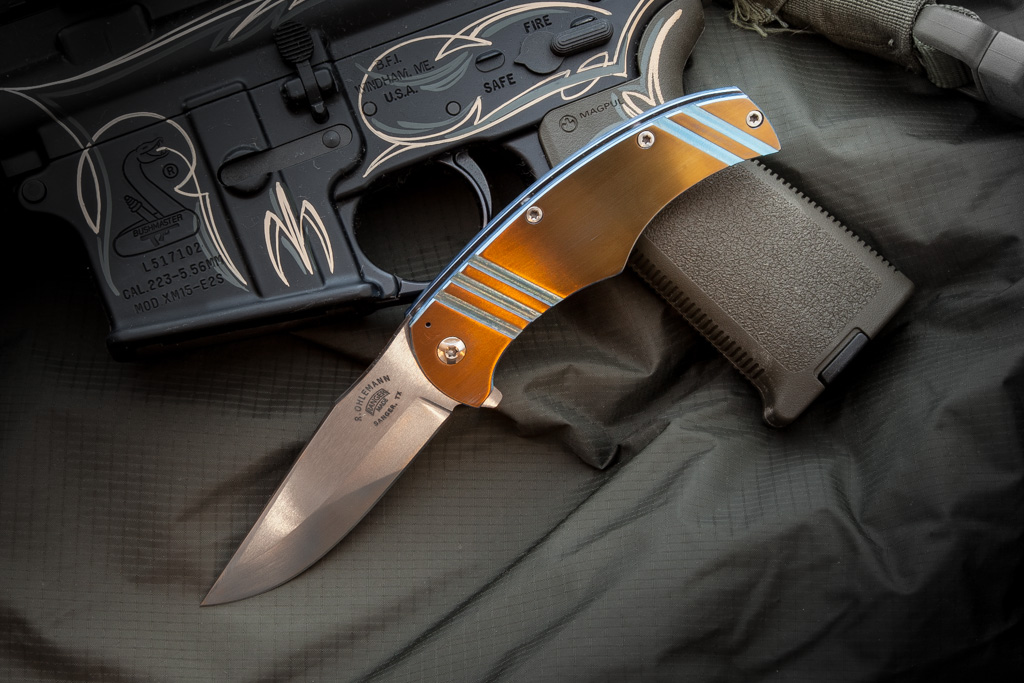
So I came back to this thread to ask some more questions and realized I never posted a pic of the finished knife. So here it is...

IMG_3969 by Ranger_Bob, on Flickr

Now, on to new questions about titanium. Dark gray finish; I've seen it on several knives but I have no idea how it is being achieved. Anyone have a technique they want to share? Carbidizing the lockbar? Apparently it can be done using the power supply that I bought for anodizing. Would love for someone to shed a little light on this technique. Thanks for all the help guys. I'm getting close to finishing my second folder, a linerlock, and much of what I've learned from this thread has been applied.

Bob
 
Looking great Bob! Good question about the dark ti. I know others have used Oxiclean to darken but I only had a knock-off brand lying around when I tried it and it darkened a little but rubbed off too easily. Maybe Chuck Gedraitis will chime in because his finish is awesome.

Mark
 
Fire questions. Sodium Chloride or common table salt melts when put on metal fires , sealing the metal from air. Sand also seals the metal from air though I doubt you get much melting ??
When you do sweep up machinings and grindings what do you do with them ? The rules have been to mix with sand at a certain ratio .Do you ? What other fire fighting proceedures do you use ?
 
Bob, I am still hoping you get the answer to your last questions because I'm interested in some of them too.

As far as the carbidizing goes, I hadn't heard you could use an anodizer to carbidize but I suppose all the right power supplies are essentially the same. I have a dedicated anodizer (Hunter Carbitron 300) and, if the reverse is true, i would love to be able to anodize with it. I tried in the past with no luck but I was just connecting wires and crossing fingers.
 
I'm not a maker by any means but I'm sure iv read that darkening titanium can be done with hot water and that oxi clean powder. If I remember correctly heat up tater to boiling dump a bunch of oxi clean into it mix it up and submerge the part you want to darken. Hopefully someone chimes in that knows the specifics.
 
It's a great looking folder, Bob! Considering what you have done on this one being your first, I will certainly be looking to see any future ones you make !
I have never done the "gray" finish to give you a reply on that. Frank
 
Last edited:
Back
Top