Solder vs. Epoxy for pinned SS bolster

I wasn't aware that this would be a problem. I'll make sure that chamfer the insides of the liners. Regarding the Loctite 324, I a trying it out now. I'll admit that if this works as well as advertised it is far easier than soldering but I glued my bolsters to my liners last Friday and waited an hour, they seemed solid, but when I was fitting the scales one came loose. I reglued and let them sit over the weekend and yesterday after I partially shaped the bolsters one came loose again. I was grinding bare handed and dunking in water, I didn't think that I was letting them get that hot. I clean all parts with alcohol before I assemble them. Any idea what I am doing wrong?
 
Natlek's image pointed out something new makers often do. They make the hole through the tank a snug fit for the pin. If you don't put a good chamfer on the bottom of the bolster holes as in his drawing, the bolster may lift up off the tang as you peen the rivets. This is due to the pin expanding a bit at the tang and the excess metal pushing up on the bolster from the bottom. The harder you hammer the worse it gets.

cG1ipeF.png
A very good point - thank you Natlek for the drawing and Stacy for re-enforcing the idea. I'd never seen anybody mention putting a chamfer at bottom of hole, GREAT idea.

Question: Would this chamfer be good on the inside of slipjoint liner at each place the pins are to be peened?
 
Follow up on my last post. Perhaps I am not using enough primer. I used the brush that came in the bottle, brushed a very thin layer on my stainless. I cam see the primer on the surface but it appears to dry in a couple of seconds.
 
Follow up on my last post. Perhaps I am not using enough primer. I used the brush that came in the bottle, brushed a very thin layer on my stainless. I cam see the primer on the surface but it appears to dry in a couple of seconds.

Use the spray, I found using the brush did not seem to work as well.

Use a very thin amount of adhesive, generous primer and let that primer dry for good results
 
It works just like a solid pin does. You deform the solid pin when peening, you deform a mosaic when peening. You clean up the bolster from peening by grinding with a solid pin, you clean up the mosaic pin and bolster by grinding. When done and clean the mosaic pin face is still a half a hair to a hair larger than the original stock, just like a solid pin. Remember the holes are tapered, the pin has to fill the hole by deforming.
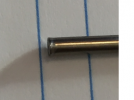
Folks - I had a chance to day to try Horsewright's approach to peening mosaic pins. Used a 3/4" thick piece of walnut (NOT a real knife!), and 1/8" diameter pin (stainless) (and corresponding hole in wood), with hole slightly reamed out on both sides. Mixed results. One side seemed to peen ok:
upload_2019-10-26_12-30-2.png

the other .... well not so good:
upload_2019-10-26_12-30-31.png

Obviously, the second side was sticking out further than the first side (a product of movement during peening, not intentional), but still a good chunk of the bend occurred inside the wood, damaging the hole itself ... but clearly the structure of the pin was damaged internally. the internal "look" of the first side looked good. A couple observations: compared to brass pins, these were hard to get deformed - possibly brass mosaic pins would work better for peening??? A guess it that to get this to work, you would need to place the pins, grind down to a very short exposed length (0.05" or 1 mm or so???), and then be very gentle in the peening, expecting less broadening than you might expect in brass?

(aside: after seeing this, I decided to just glue a mosaic pin in to place on a blade I am working on. fit was really tight ... so I had to "tap" it through the hole with a hammer. Once I verified I could get it through the hole, tried to remove by hand (would not budge), then tried pliers (still would not budge!!!). Well darn. I was left trying what I posit above: ground down to very low protrusion, then peened both sides (very gently - the hole had not been tapered). At the least - the pin is so firmly jammed in there that it will not move. Hopefully, the peening worked just a little bit - enough to keep it in place. If somewhere down the line it moves ... well I will figure out how to remove it at that time :-) )
 
Peening mosaic pins :) Come on , it is silly ...thin wall tube , epoxy and you will PINNED them ??? Malo sutra .....Yeah right :D
 
Peening mosaic pins :) Come on , it is silly ...thin wall tube , epoxy and you will PINNED them ??? Malo sutra .....Yeah right
I tried it on a dummy piece of wood. In previous posts Horsewright clearly said the "common wisdom" that Mosaic's can not be peened is not correct - so I wanted to give it a try. One side did peen ok .... which means it can be done (not that I doubted you Dave!) - but clearly you need to be - careful. Or maybe it really only works on bolsters with the stronger material supporting the pins?
 
Are you serious ? When we peen pins we EXPAND material , right ? Now , you try to expand thin waled tube , equally in all direction ? And what about epoxy inside and other metal , it will expand to ??
 
Are you serious ? When we peen pins we EXPAND material , right ? Now , you try to expand thin waled tube , equally in all direction ? And what about epoxy inside and other metal , it will expand to ??
I know ... I had the same reaction as you. However, Horsewright maintains that it works for him ... so again, I wanted to try it. Look earlier on in this thread for Horsewright's description of what he does. You yourself posted to this thread in the general area where he discusses this....
 
It works for him ................ is what he says .Explain to me how that can work ?
To peen pins like this :eek:
9bgca82.jpg
 
Or maybe it really only works on bolsters with the stronger material supporting the pins?
Wasn't where Dave was peening mosaic pins in the bolster area using metal bolsters? The metal would give LOTS more support than the walnut wood.
 
I'm sure he is not peening the hell out of them. Plus like Ken said he is peening them in metal bolsters which is probably way different
 
When you peen pins, you don't beat the hell out of them. The example shown was much too long and hit entirely too hard.
I peen dozens of pins each week. I use a 2 oz. hammer for 98% of my work.
The real question here is why in the world anyone would USE mosaic pins?? I did that stuff in 1976.
 
When you peen pins, you don't beat the hell out of them. The example shown was much too long and hit entirely too hard.
I peen dozens of pins each week. I use a 2 oz. hammer for 98% of my work.
The real question here is why in the world anyone would USE mosaic pins?? I did that stuff in 1976.

Chicks dig it grandpa :D
 
When you peen pins, you don't beat the hell out of them. The example shown was much too long and hit entirely too hard.
I peen dozens of pins each week. I use a 2 oz. hammer for 98% of my work..
Yeah - i WAS tapping lightly, but got no material movement at all (again, maybe because it was stainless?),;then, since this was just an experiment, tried a little harder, then again a little harder, just to see what would happn. The pin was not really all that long: it bent INSIDE the wood! Again, this was just an experiment...
 
Back
Top