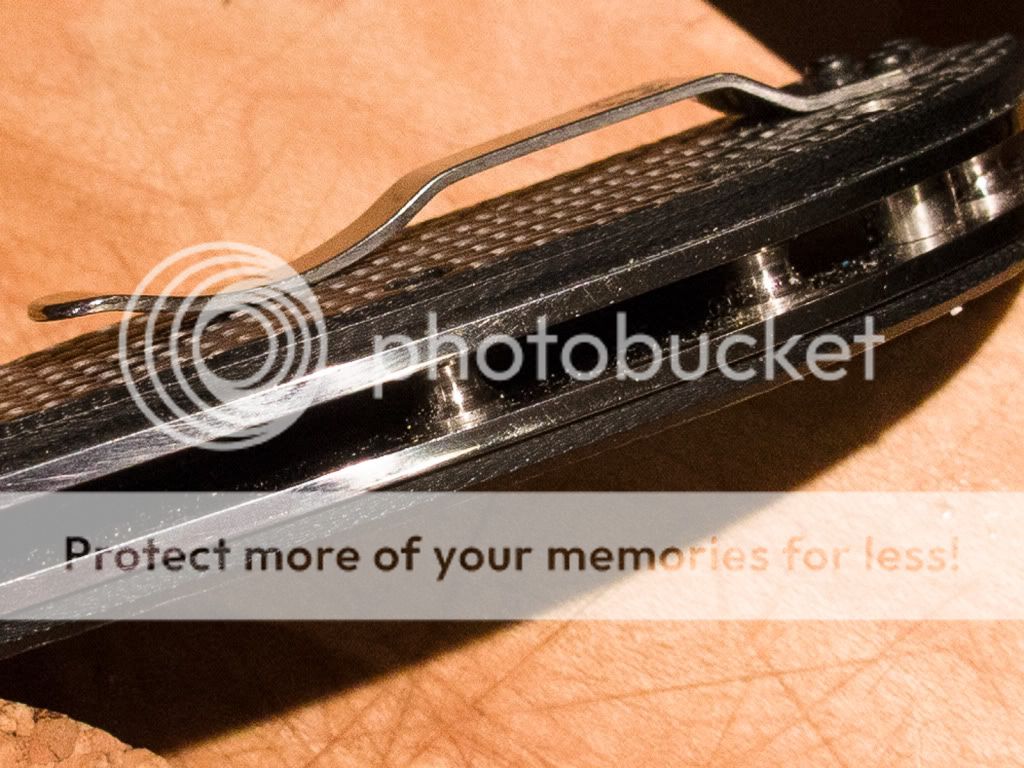
I love it how nobody in here is a composites engineer, and everyone seems to think they're right. Lets clear a few things up:
First and foremost my Gayle Bradley is clearly just a layer of carbon on top of G10. I can't speak for all models out of Taichung, but all models out of Taichung I have seen posted here also are predominantly G10 with simply a top layer of carbon fiber.
Is it as strong as carbon fiber throughout? Well if you look at it from the more limited engineering definition, strength in this case would be defined as tensile and compressive strength, and thats a no. Additionally you have to look at production processes. A composite thats been bonded as a sheet (remember this is made of layers of quite literally fiberglass/carbon fiber cloth which are combined with resin and generally cured under pressure and controlled temperature) has very different structural properties from a sheet which has been bonded separately after curing. If you look at composites failures they occur, almost without exception, along lamination lines. Bonding a thin layer of carbon fiber to the top of a, hopefully, carefully finished layer of G10 simply will not be as strong. Even if you do everything perfectly, you inevitably come up against the fact that you're creating a slightly thicker resin layer which will be the weakest link. Long story short, from a technical standpoint its not as strong, and the picture posted by 5.56 is a clear demonstration of exactly that. There are two other things to consider here though. G10, generally speaking, has a higher toughness than carbon fiber. This is because glass fibers, again there is some complexity I'm glossing over but "all else being equal," have a greater elongation prior to failure than carbon fiber. This makes G10 better able to tolerate abuse eg as a knife scale. Anyone who has abused their carbon blades has probably noticed the carbon has a higher propensity to chip than their G10 ones.

There is something else too: knife scales, particularly in knives with liners, is essentially a non-load bearing application. If you think that four screws, most of which are toward the edge of your liner and countersunk most of the way through your composite, are making your knife hugely stronger you are in for a big surprise. If knife strength were an issue the composites would be bonded directly to the metal, not just slapped on with a few tiny little screws which also grossly violate the fibers. Its almost purely aesthetic, and if you want a cute little demonstration of that you can always substitute your G10 for paper or cloth micarta and realize the knife is functionally unaffected.
As to whether or not its "cheating" for spyderco to sell something calling it carbon fiber when in fact its carbon fiber and G10..... that ultimately is up to you. You could very easily argue that, since you hadn't noticed this for years, it really can't be argued that it affects you. At the same time you could argue that it was dishonest, which lets face it at the end of the day you were told it was carbon and it turns out to be carbon and glass. Structural issues aside, this could become a factor if for example you wanted to "tuff thumbz" your Gayle Bradley by filing those Anso style grooves into it. What a bitter surprise you'd have when you discovered that you not only violated your warranty, but that there was no carbon fiber under there. So you can argue both ways. I myself find I'm sitting on the fence here because while I'd not discovered the problem yet, it is technically an inferior product marketed and sold as its superior relative. Quite frankly I'd have been happier had it been either all carbon, laid up as a single unit, or all G10. That join between the carbon and g10 is what bugs me.