Surface Grinder Electrical Problems (RESOLVED)

Okay, I'll get a VFD when I get the money and hook her up. I already cut off the ring connectors when I tried wiring the SPC up directly to the motor so I'll be using fresh leads this time.
For all of those who have helped me out on this, Thank you! I cannot express my appreciation you guys taking time to help me out on this.
When I get it working, I'll try to remember to post a video of it taking a few passes ;)
 
Hey dude, I have a Phase-O-Matic, 1-3 hp. model I'd be happy to loan you until you get the dough for that VFD, if you like. I could put it in a flat rate box and ship to you... I know how it is, new machine and can't run it yet- I get antsy.

If you fry that box too, well I wasn't using it anyway.
 
First off- Holy Crap Salem, I completely missed you offer! I apologize for not picking up on it and your generosity is much appreciated :thumbup: I completely agree though, over the past three months having this "over sized paper weight" sitting there in an unusable state (well, It works really well for holding your screwdrivers and profiled knife blanks, so I guess it wasn't completely useless :D ) really bugged me and I was super antsy to get it running. Boy, the day that VFD came in the mail, I couldn't pay attention in school because all I could think about was getting it hooked up and spinning some wheels! This brings me to my second point- I got my VFD and she is all hooked up. She purrs like a freaking kitten. I'm not getting the finish I want from it right now, But I attribute that to relatively course wheels and lack of experience. I have never really run one of these before prior to the three hours I spent on it after school today so I don't really know how to interpret the results. For that, I have pictures and a video-
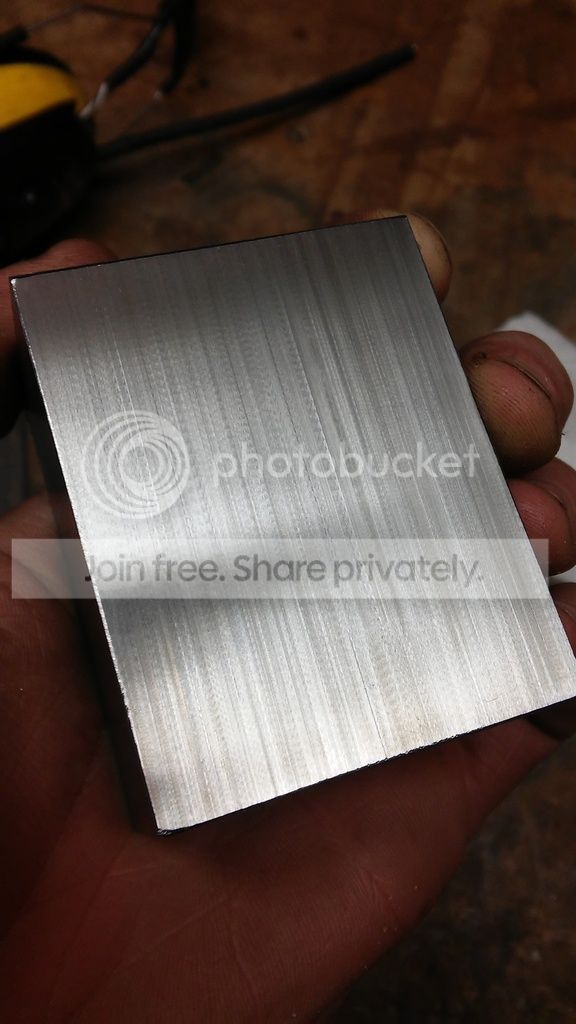


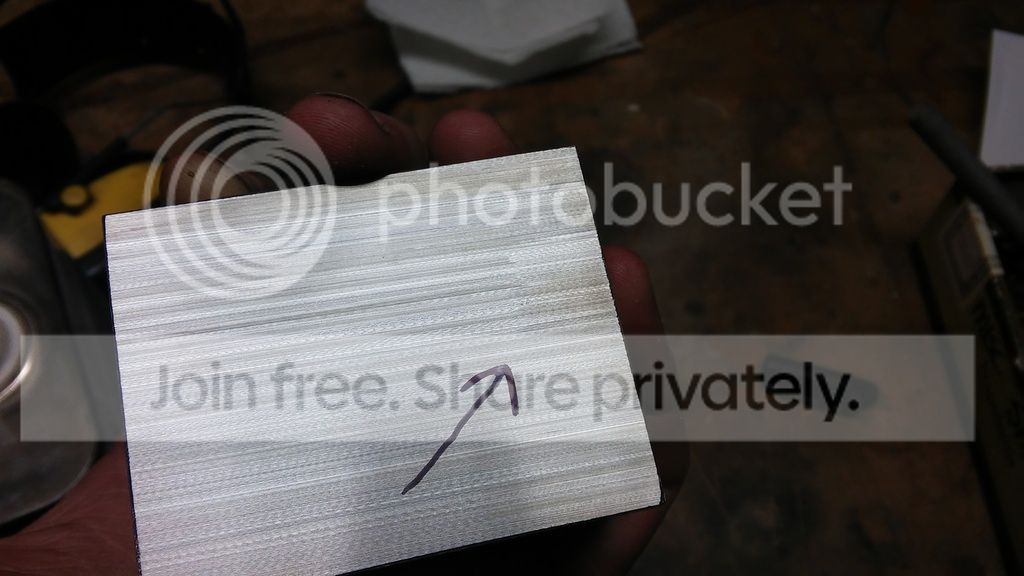
Here, you can see a light variation in the finish. I'm not entirely sure what this is from...

[video=youtube;verrHs_9rSI]https://www.youtube.com/watch?v=verrHs_9rSI[/video]
(let me know if the video doesn't work- I'm not 100% sure I did it right...)
For the finish I got in the pictures, I used an A60 stone- about 1/2" thick- And dressed it prior to doing a roughing pass. When I got a consistent cut all around the piece, I dressed it again and proceed to take a series of very light passes. I'm not entirely sure how deep the finishing passes were, but they must have been a thousandth or less. The VFD is set to 60 Hz, the maximum frequency and I believe that is running at3450 rpm if I'm reading the data plate on the motor correctly.

So all in all, the electrical issue of not being able to turn the freaking thing on is resolved, but I'm still figuring out how to get a consistent finish all around. Any advice on how to get more consistant finishes would be greatly appreciated, as well as critiquues to my "process" as it is.
-Tanner

 
Last edited:
I saw you post the video on IG earlier but didn't have time to watch.

You didn't start your grind in the middle of the block .001 deep did you? You start with the wheel off of the block, get the table oscillating back and forth, then crossfeed into the block a short distance for each table oscillation, or with a very slow continuous cross feed.

You said you dressed the wheel, how much did you take off the wheel? How fast did you travel the crossfeed during the dress?

Your grinding finish appears to me that the wheel was a little loaded and getting hot in the grind, with too much cross feed per pass. If you were oscillating the table in one direction and then the other without cross feeding in for each movement, and you got that much spark and sound in both directions, that's evidence it's not cutting completely and is actually pushing the grinding wheel up slightly.
 
I started off with the wheel to the right of the block, but not touching. for the first pass, I had the entire wheel in contact with the block with the exception of maybe a 1/16th overhang-maybe less. I fed it into the block at a consistent speed (moving left), then backed out (to the right) without moving the crossfeed. In other words, I let the wheel go over the block twice for every movement of the crossfeed.

When I dressed the wheel, I must have taken off 1/32 or so off. I moved the diamond really close to the wheel, moved the crossfeed forward and back, and repeated until I made contact with the wheel. I did this until I could feel and hear the diamond remove material the whole way through. It is dificult to regulate the amount being removed because the wheel for the x-axis is very touchy and very little movement of the wheel will result in a fairly large movement of the table. In retrospect, I probably could have just used the z- axis adjustment to really fine tune it. When I moved the crossfeed, I tried to take it slow and steady, though my definition of slow may differ from yours... I did notice there seemed to always be three peaks on the wheel after dressing. I can't recall it being noticeable on the wheel itself, but it did leave a pattern on the block in the first few passes. It evened out after the first few passes.

On my finishing passes, I believe you are hitting the nail on the head with having to much crossfeed per pass. When I was first trying this out, I was advancing the crossfeed about 1/16" each pass, but on these finish passes, I believe I went almost the full width of the wheel (1/2"). That may be contributing factor #1. When you say "If you were oscillating the table in one direction and then the other without cross feeding in for each movement", I'm assuming you mean I should have been advancing the crossfeed on the return pass as well? So for every movement on the x- axis, I advance the crossfeed?

Thanks for the insight!
-Tanner
 
Let's call the table oscillation "X" axis and crossfeed "y."

To dress the wheel, the dresser should be secured to the magnet and then indexed via the X until it's under the wheel to the left of center. This way if something happens it will be pushed into free space by the wheel and not pulled under, which could result in an exploding wheel.

With the X in this position, it should be locked. Lock handles are in different locations on different machines.

Then position the Y so the dresser is directly under the wheel and like you said feed into it with Z slowly until you hear it tough off.

Now move the Y so the wheel won't touch the dresser and then feed Z down .001 to .002". Feed Y one pass across the wheel. Do Z again and repeat.

Note the surface of the wheel before and after your first dressing pass. Regardless of the color of the wheel, properly dressed portions of the surface will be lighter in color than undressed. You're done dressing when that color is uniform across the face.

I'm concerned a little about the numbers you throw out there. Talking about a 1/32 of an inch in regard to surface grinding is off like if you were to say you adjust the tool arm of your 2x72 in feet.

Don't put yourself left of center in regard to the wheel. Dresser should be left of center. Engage the work piece with the X axis in motion. Carefully note how far you're setting Z moves. Dress at most .005 at a pass and that's a heavy dressing pass. It's hard to say how much Z to feed first a grinding pass without knowing the setup a little better but without coolant you will likely be limited to .001 or so. After each X move index the Y .030 to start and raise or lower that value based on how it's cutting.

If I have time on Friday I will make a surface grinding how to video so you can get a visual for speeds and what I described here.
 
Man, that is great! Congrats on getting it running well, and those FM50 drives are good stuff!

Thanks Salem :) So far so good with the FM50- it hasn't let out the smoke monster, so that's good in my book!

Kuraki- A video would be awesome. Like I said, I have no real experience with this so something visual to reference would be a huge help. Thanks for the offer! In the mean time, I'll continue to work at this block and put some of your suggestions into practice. When I said i took off 1/32", I meant off the wheel- not the steel. When I dressed the wheel, I made sure to keep the dresser to the left of the wheel. That was something my machining class teacher at the tech center was very clear about! I am still trying to figure out the graduations, but I'm fairly confident I was only taking off a half a thousandths each pass. -Tanner
 
Good. I just want you to be safe. I don't consider surface grinders the most dangerous piece of equipment in a machine shop, but they pose some significant risks that tend to be either "oops won't do that again" or catastrophic in nature with little in between and little warning leading up to it.
 
Yeah, I can see a few areas and situations where a screw up or a minor lapse in attention could lead to a long string of curse words. Using damaged wheels being the main one that comes to mind. I understand and used the ring test to test the wheels. I have hurt myself on the grinder already, though not where I would have expected. When loosening the wheel, the spanner wrench slipped and I scraped my knuckle on the edge of an A46 wheel. Ouch. I also caught my thumbnail on a knob on one the opposite side of the crossfeed wheel. I have no idea how in the hell ththe happened, but I certainly wasn't imagining it because part of my thumbnail is currently blue :eek: Won't do that again...hopefully.
 
I'm concerned a little about the numbers you throw out there. Talking about a 1/32 of an inch in regard to surface grinding is off like if you were to say you adjust the tool arm of your 2x72 in feet.

That's gold right there! Yeah man, you gotta start thinking in "thou" when you own a surface grinder, if not before... 1/32 being around 30 thou, that's a HUGE amount in surface grinding for a single pass or even a few passes with a stone!
 
Haha.

Did you balance the wheel before mounting?

By wheel, do you mean the arbor? Not sure how I would go about balancing the wheel, but my machine shop teacher just gave me a brand new arbor with three set screws for adjusting the balance. Pretty nice dude if you ask me :eek:

That's gold right there! Yeah man, you gotta start thinking in "thou" when you own a surface grinder, if not before... 1/32 being around 30 thou, that's a HUGE amount in surface grinding for a single pass or even a few passes with a stone!
I took maybe 1/32" off the wheel, not the block. I think I would have stalled the motor had I tried that! I think I was taking off a half a thousandths each pass.
 
You mount the wheel on the arbor and then balance it on two rails with the three sliding weights.
 
Glad to hear you finally got up and running!

[video]https://youtu.be/VIUeZoGn-gU[/video]
There's a good "home brew" balancer you can make pretty easily.

If you convert to belts, you won't need one. ;)

Understand that when you're grinding, you're only using a very small portion or "leading edge" of the wheel at any given time. This is how you can grind a piece that's wider than the wheel without having to down feed somewhere in the middle to compensate for wheel wear. Don't start in the middle of the piece, or even the middle of the wheel for grinding, but start on the corner/edge of the wheel. As you traverse across the piece, the contact point of the wheel will eventually move from one side/corner of the wheel to the other, if that makes sense.

Intuition might suggest that you if you have a 1/2 wide wheel that you just dressed, you should set it close to 1/2" inside the starting edge of the work piece in order to maximize your wheel and cut down on passes (or in other words, grind using the whole width of the wheel). You want to start where only the leading edge is contacting the piece though, probably no more than what your step over is set at.

Hopefully I'm explaining that right. Somebody please correct me if I'm mis-speaking. I'm far from an expert.
 
That makes a lot of sense. I have been trying to figure out how the wear of the wheel doesn't effect the tolerances for a while now and that explains it perfectly. So perhaps one turn of the crossfeed wheel per pass? That equates to about .100".

Thanks for the tip/video. I think I'll make on of those balancing jigs. I may have a couple old planer blades laying around somewhere that I could re purpose.

I was thinking about converting to belts, but I think for now, wheels will work fine. I have enough projects that need to be finished and modifying my surface grinder is not at the top of that list yet :o I do understand the benefits of using a belt though and the conversion seems simple enough. It may be worth the effort in the future. I would like to better understand the mechanics and nuances of using a wheel before I go and make changes just because I would rather know how to use a surface grinder with a wheel and never have to use that skill than to be on the job and need to use a surface grinder with a wheel, but not know how to use it. It also seems to be a bit of a dying art, seeing as everything nowadays is going CNC. Bummer :(.
 
Surface grinding is alive and well in toolrooms everywhere. Very few have gone to CNC. Any that do a good amount have gone to machines with simple logic controllers that can be set up to do automated down feed. The Okamotos I used to grind on, you would set mechanical stops for the table feed, then tell it how many thousandths to drop per pass, how many passes, and walk away. With a CBN wheel you really could walk away and come back a couple hours later and have .050" ground off.

But a lot of chores done for tooling on a surface grinder actually require you to be there, like using a radius dresser to grind a form punch or a spindex to grind pin geometry.

The biggest impact to surface grinding has been EDM. The tolerances and finishes they can produce today are so good that sometimes it's a better proposition than grinding, even at $150/hr burden rate or whatever they charge these days.
 
Oh wow, I had no idea they were such an important machine still. Thanks for setting me straight :eek:

I didn't get much time to screw around in the shop last night because of homework, but I did sneak out there long enough to try it out with slower feed rates, smaller depth of cuts, and only advancing the crossfeed .05 every pass. I still have those small ridges you can see in the other picture, but they are much more uniform and they appear to be finer. Ialso tried using the Z-Axis to dress the wheel and it worked much better.
 
As I recently experienced myself with a contact wheel and abrasive belts, you do want to wait until the machine has warmed up before you dress your stone. I know there are a couple of different ways to dress a stone as well, from a "fine" dress, to a quick and "rough" dress. A little bit of coolant may also make a difference, as may a different type of stone. There are about as types of stones as there are materials to cut with them, and they each behave in their own way I suppose. That's part of the reason I went to belts. Takes just a small amount of the guess work out.

Lastly, if you want to see your best finish, you probably want to try sparking out on the piece, or IOW, stop moving the grinding wheel down, but keep going over the piece until there aren't anymore sparks coming off the work.
 
Back
Top