Survival Blades - Big or Little

Joined
Apr 30, 2003
Messages
53
I know this is a on-going debate but lets see some of your favorite Survival type of knives. I'm looking to purchase another blade to add to my collection. What should I get? A smaller 3-5" blade, or a 6" or bigger? I already own several blades, moras, mears, becker7, and a couple swiss armys. I could spent around $300. I would love to see some photos

What is the best Survival Knife ?
 
From http://www.equipped.com/devices5.htm :

"There are few areas with regard to survival knives that elicit as much controversy as the length of the blade. Advocates of larger knives think that those who champion smaller blades, such as myself, are out of their minds. Likewise, the reverse is often true. For me, the deciding points are that a smaller blade is easier for the inexperienced user to work with and less dangerous in inexperienced hands, weighs less, a critical matter for pilots and many others, and is more versatile for the myriad of basic chores associated with a typical survival situation.

Those areas in which a larger knife excels, such as chopping branches and wood, are adequately handled by other means without the liabilities the large blade carries with it, in my opinion.

For experienced outdoorsmen, this controversy is entirely academic. They will have found what works best for them and have the experience to use it competently, small blade or large. Often, the choice is to simply carry two knives, each sized and optimized for its particular tasks. When you have to rely on a single blade which could end up being used by almost anyone, it pays to be conservative.

This leads to my recommendation that a survival knife should have a blade at least four inches long, but no longer than six inches, or there about. Many experienced woodsmen carry a knife about 4 inches long, give or take a little, for general purpose work (many also carry a second bigger knife, but the small knife is what is used for most chores). A survival knife can stand to be a bit longer, but not too much longer. You simply do not need an enormous blade for any job you will likely be faced with in the wilds. A little brain power will more than make up for any extra inches, without the problems inherent in trying to use a knife which is too damn big, especially for the inexperienced.

Now, if you're flying over the tropics, you would also want a machete or large bolo. This is really the only environment where such a large blade is an absolute necessary. However, this should be carried in addition to a basic survival knife."
 
What is the best survival knife?

IMO, the best survival knife is the one that you have on you if/when the time comes. Of course, in an urban environment, a fixed blade would probably be frowned upon, thus a large folder would/could serve well in its' stead. I carry a Spyderco Manix for EDC which I'm sure could serve well in a survival role if need be.

attachment.php
 
Anything over 4 inches but under 10 inches I have no use for.

A 12 inch Ontario machete with a Victorinox soldier in a pocket will cover it all, as will a Swedish Mora and a small hatchet.

The 6-8 inch knives are too small for effective chopping and too big for fish and small game. You'd be surprised to find out how fast you can butcher a deer with a 12 inch Ontario. Look at the people in places like the South American rain forests, Indonisia, Africa, and Nepal and what they use. The machete, Panga, Golock, Parang, Kukri, bolo are there for a reason.

I worked with a guy from El Salvadore and got to know him well and became friends. A couple of us used to go fishing after work and he came into our circle and started to fish with us. He had two knives, a small Colonial barlow pocket knife and a 12 inch little machete. Man, you never saw someone get more use out of something. He'd cut forked sticks for fishing pole rests, turn over old logs and dig up bait, behead and clean fish. He'd cut open the fish with the machete like it was a bagle and scrape out the guts. He used that machete for everything!

Made a believer out of me. These days I carry a sak and a 12 inch machete.
 
Sounds like you already have the knives you need.... but who's to say what "Need" is? ;)

My "always with me in the woods" blades are:
SAK Trailmaster
Custom 3.5" Dozier fixed blade

For Hunting:
SAK Trailmaster
Dozker K2

For "WAY in the deep woods:"
SAK Trailmaster
One of the above Doziers, depending on the purpose of my trip
Dozier Wilderness (usually) or Becker BK7 (rarely); again, depending on the purpose of my trip

I personally don't chop with a knife but I'll baton with one as required. Chopping for me is handled by a GB Mini Hatchet, but in a pinch I can make do with either my SAK or the fork of a tree used as a fulcrum. I also sometimes carry a Wyoming Saw, and it chops pretty good in its own right. ;)

I keep a Busse Basic 9 in my truck, and among other things in the pouch is yet another SAK Trailmaster.... that combo is for when I'm in my truck and things just all go to hell.

There are good arguments for both big and small knives, which is why I carry both... but for me, a 7" blade is as big a knife as I like to carry.
 
When I am in the jungle I will carry a machette. I have destroyed machettes on hard wood in the past with ease, its the wrong type of blade for northern climates.

As far as survival goes it is subjective what size of blade. Some feel a small Mora is fine and some like a 10 inch chopper. To put it mildly this is a LOADED topic as people are pretty passionate about their blades.

I will break down my thoughts by starting with what and why and where.

I am of the larger blade is better for survival purposes camp because it is a more utilitarian piece of gear. A shorter than 7-9 inch blade is fine for cutting and thats about it. For survival purposes you will have the need to chop trees or limbs greater than an inch in diameter. Unlike others I find a 7.5 inch blade about perfect for chopping smaller trees and isn't too big to be a pain to carry.

Many of us carry a saw and yes it is faster to saw a 3 inch tree with a saw but when limbing the tree of branches a longer blade more than makes up for the saws speed cutting the trunk.

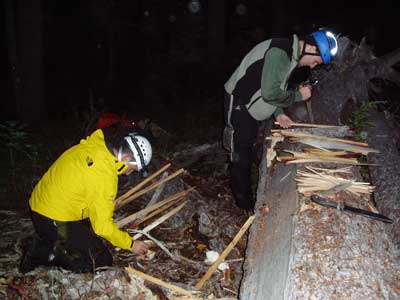
Splitting firewood to get at the dry center is a pretty important skill in very wet weather and does make a big difference in getting a good fire going. A saw cannot do this in any way. A saw blade cannot cut anything that requires a sharp edge either. A short blade cannot be pounded through thick logs.

It is this one exercise that separates cheap knives from good ones and makes longer blades the choice for me.

Yes, you can combine a smaller blade with a saw and do ok but you will never do this splitting action with that saw blade combo. Anything short of a hatchet and this is not possible, unless you have a good 7-9 inch blade. A hatchet also weighs a lot more than one large blade and is less utilitarian. As far as folders are concerned, they ARE NOT meant to be beat on and thus not a true survival blade in the truest sense of the term. There is not a folder in the world that can take this punishment and nor should it, they are not designed for it.

If you never plan on being in terrible weather when the woods are 2 weeks soaked with rain then forgo the large blade. If not then splitting is THE ONLY way to find dry wood that could make a life and death difference. It is this demo that sells my students on the virtues of large blades if for no other reason.

Do I carry a 7 inch blade backpacking?
No as I am mostly on trails and carry a shelter etc... A lower exposure to risk.

Do I carry a large blade when a situation is unknown and my exposure to higher risk and nasty situations is great?
Damn right!

ratweiler.jpg


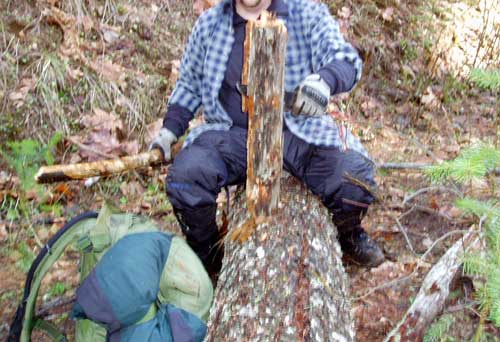
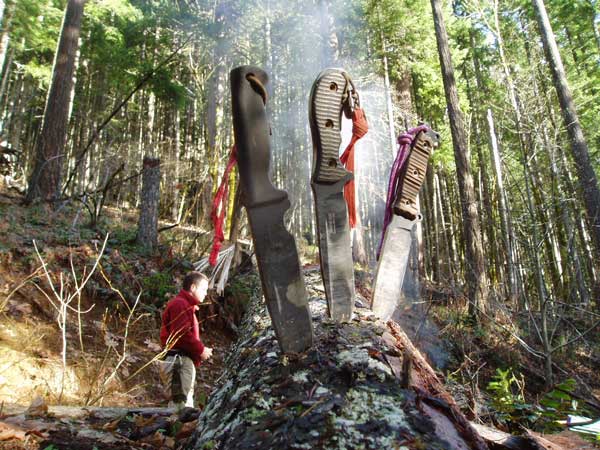
SOme Busse products in proper use.
TroySplit.jpg

3knives.jpg

RWtest3.jpg

FirePrep.jpg


Large blades are prefered if you have experienced their utility.

In conclusion I will say for many a large blade is overkill unless you believe you may be in the right situation or have need to split wood for fire,which in my opinion is very likely. There is no hard and fast answer you must make your own choices as to what you want to carry and what needs you have to cover off with good tools.

If I had $300 to spend it would for sure be a Busse product probably used and 7+inches in length, they can't be beat for quality.

My 2 cents.

Skam

 
For just a squeensy bit over $300 you could probably get a set of three Gene Ingram knives, with two, four, and six inch blades.
 
What is the best Survival Knife?
IMO, the best survival knife is the one that you have on you if/when the time comes.
This leads to my recommendation that a survival knife should have a blade at least four inches long, but no longer than six inches, or there about.
Doug Ritter's RSK Mk I is a Griiptilian folder with a less than 4" blade (3.44").

My opinion is that first you need to define survival. Very few folks walk around every day with a 10"-12" fixed blade. Most knife knuts carry a folder, some a large folder, a few carry small fixed blades. I have yet to see anyone who EDC's a large fixed blade. Survival is come as you are. Some folks pack all their camping gear with lots of freeze-dried food, a back-packing stove, a one man tent and a collection of blades, and go on a "survival trip" :barf:

I do not consider my Fehrman Final Judgement to be a survival knife. I'd love to have it with me if a survival event happened, but it would probably be somewhere else with the rest of my "wilderness gear". The knife I will have on me is a Benchmade 941, my EDC folder. If my backpack is nearby there will be a second folder (RSK Mini-Mk I) along with an UK4AAeLED flashlight, GPS and whistle in the rear compartment. There will even be a small kit in the bottom of the bag which has a signal mirror and fire starting stuff. But that big blade won't be there.

I consider those big "survival knives" to be more properly "wilderness knives." You take them with you when you intentionally go into the wilderness. It's a tool for planned wilderness camping; don't pretend you'll have it for unintended (pop quiz) survival camping. For those times you find yourself in the wilderness when you didn't really plan on staying over, any knife you have is a survival knife. If I knew enough to take my Fehrman FJ because of a planned survival situation, I'd change my plans. Oh, you mean hiking in to go camping, sure let's take the big blade.

Then again, maybe folks really do go around 24/365 with a 10" blade readily available -- naah, not in this century.
 
This is like a blade forums Zen parable. Instead of 'If a tree falls in the forest, does anyone hear it?' we have 'what's the best survival blade?' - the point is not to answer the question but to use it to focus the mind :)

I'm of the 'the one you have with you' pursuasion. To answer this question properly I need to differentiate between the normal time I spend in the bush, which is just low impact camping/fishing and a true survival situation. For the former, 99% of my needs are taken care of with any knife - large locking SAK, Leatherman, Folder, fixed - whatever. I've used a RAT7/Leatherman Wave combo for ages - but honeslty could probably do without the RAT. I just like having it along. I've also done a few 3-4 day trips with my Spyderco military as the only knife.

For a true survival situation I would like a large blade 7"+- just because it gives a few more options with shelter etc
 
Ming65 said:
I'm of the 'the one you have with you' pursuasion.

For a true survival situation I would like a large blade 7"+- just because it gives a few more options with shelter etc

Apparently not as you want the 7 inch with you because you see the value in it, when TSHTF. ;)

Skam
 
What you need, what you want and what you have available are not necessarily the same.

What I'd want is my Fehrman FJ, a GB axe, a folding saw, a Dozier K-1, my SAK Outrider, an original LM multitool, the mini-RSK and my BM 941 EDC. What I'll reliably have is my EDC and probably the mini-RSK and LM. Anything beyond that and I planned to go camping, in which case I'll also have a small stove in my bigger backpack and other good camping stuff.
 
Your "survival kinfe" is the knife/knives you have with you in a survival situation.

Whether it is/they are "best" for the tasks faced in survival is an entirely different question and a topic for endless interesting discussion, as suggested above. :)

When I consider the circumstances where I am most likely to face a "survival" -- backpacking trips, I have to agree with ras. I seldom have a knife bigger than 4-5" - a Badger Attack, for example. Very rarely do I have an axe.
 
In answering this question there really is no substitute for firsthand experience with your blades in the terrain type you are most likely to encounter.

I grew up in PA and did a great deal of “survival camping”, hunting, and backpacking in the Appalachians. My only blade for most of this time was a USMC Ka-Bar and it served me well. I have used my Ka-Bar for just about everything from cleaning fish to shelter construction and it never balked at me. That was PA.

When I moved to Brazil I suddenly found the Ka-bar to be inadequate. The machete was an absolute necessity. I quickly concluded that if I were going to carry a machete then the Ka-bar would see little use. What I needed was a knife to pair up with the machete that had other characteristics.

Machetes excel at clearing trails and campsites, digging for water, leveling ground. They are poor for prying or piercing. They are hard to work with for detailed cutting. The machete needs to be paired up with a small fixed blade. When I teach wilderness survival here I recommend in addition to a machete that they carry a FACA (Portuguese for knife). FACA stands for Forte – Afiada – Curto – Aqui . That translated is: Strong, Sharp, Short, and Here, the best knife in the world left at home is no good.

Finding such a FACA on the Brazilian market has been a challenge, especially within the economic range of most of my students. I finally settled on the Mora Swedish Army Knife from Frosts as the official loaner knife. That gets paired up with a 10 – 14 inch Tramontina machete. My own personal blade combo is a 12 inch Ontario machete and either an Air Force Survival Knife or a Newt Livesay NRGS neck knife.

I do own a Becker BK-7 that I’m setting up as a “Survival Knife”. In my mind a true survival knife is a kit that covers the basic needs of survival (fire, water, shelter, signal, navigation, minor meds, food gathering, and light) and is carried in a manner that guarantees that it will be with you when all other gear is lost. The knife is one component of the kit; the sheath carries the other essentials.

My BK-7 kit includes: Space blanket, 2 meters of paracord, duct tape, 5 liter water bag, Potassium Permanganate, medallion type compass, jigsaw wood working saw blade. Sparklite w/ tinder, wetfire tinder, candle, waterproof matches, Moleskin, signal mirror, ACR whistle, Inova night vision red LED light, fish hooks and line, copper wire, heavy needle w/ #4 waxed line, sterile scalpel blade, Ibuprophen, Vicoden, Benedryl, oral re-hydration salts. Most of the small items are carried in an Altoids tin and believe it or not there is still room in the tin! The space blanket, duct tape, water bag, and whistle are attached via rubber ranger bands below the sheath pouch and take up no more space than the pouch above.

If/When I get the chance to travel through extensive wilderness by boat, plane, or 4x4 the safe money bet would be on the Becker kit. Mac
 
The small utility knife ("Karda") on my HI Sirupati 20" Khukuri would do me fine if need be. If I lost the big knife, I still have have little one. Weirdly, I love this little karda in 5160 steel so much that I made a small leather pouch for it to take with me as an all-around fixed utility knife! It's shaving sharp, yet stout enough that I think I could baton with it...but it has a sort of moran edge and geometry that cuts superbly.

On overall small knives: Multitool (LM WAVE) or locking SAK best for me, but if it was one fixed blade to "do everything" -- it would be 6-8" and balanced for both chopping and close-in work (whittling, skinning), with a hard but thinner edge that holds up to hardwood chopping AND still slices (like a, um, knife) for small tasks. This criteria rules out many heavy, thick, "survival knives," but not all.

If it were a combo, then a Fehrman 7.5" First Strike is my first choice (meeting all my above criteria for an all-around blade), although I'm putting the new RAT-7 D2 through some paces and it is so far performing beyond my expectations. An ATC VTAC hawk (reprofiled aggressively for woods work), or my Roger Rangers Spike Hawk, along with a small blade or multitool is another fine choice for me. And of course the HI Sirupati, which has the big blade, karda, and a chakma (burnisher) which makes a nice drill bit and butter knife, too!

Look for an upcoming article by me in one of the knife rags. I'll be exploding some myths about big v. small knife in the woods with some direct tests...
 
I love the discussions that get going in the "ultimate survival knife" threads! I can understand both views, and would never look down on another woodsmans views on his personal choice. If I am heading out to a remote area, my blades include a large chopper or hatchet that rides on my pack, a small to mid sized sheath knife on my belt, and a folder or SAK in my pocket. This way, unless something truly tragic happens, I will have at least one knife on me at all times.
For general utility like fire building or shelter buliding to making tools, a large blade that is properly designed, will serve you well in the field.
I respect and have learned a lot from Ron Hood who can do amazing things with a large knife. I also respect folks like Ray Mears who carries a small knife as his main blade. PS- Brian I am really looking forward to that article! Sounds awesome.
 
Boness, that NO isn't quite as small as it looks, since it's further from the camera than the other two. Actually, since I haven't handled the new NO, how big is it compared to the two rats?

Keep reading for some refreshing comments from someone who really knows nothing about survival other than "don't drink dirty water" and "food is important". :footinmou :cool:

The best survival knife is of course the one you have, but the best tool for the job would depend on your environment. If you live in a tropical area a machete between 12 and 18 inches would probably be best, I prefer Tramontinas, almost unbreakable, you can use them to split firewood in the event you want to cook something or boil water, they have the extra reach in case you need to clear a trail, and they're light and easy to sharpen. If you have to chop a tree down they're easily capable of handling up to 6 inch hardwoods.

Now for some pure speculation :p
I'd wager that if you lived in a non-really cold area with more hardwoods than anything else you should try for a 4-6 inch fixed blade + a saw that can handle 3-4 inch branches, with those you could both saw off branches off of fallen wood and use the smaller knife to baton for firewood. A smaller knife is a bit more controllable too, so it should be easier to control if you need to use it for carving tools compared to the 6"+ blades. If you've got the skills a hatchet may be prefered, either substituting the saw or in addition to the whole deal.

If the area has snow I'll defer to what I've heard about how you need to baton through frozen wood to get to the good stuff, I'd bring the toughest 8-10 inch blade I could, which would probably be a Busse of some sort. It'd prolly work well for digging through snow or something too.

I have a certain preference for 6-9 inch 1/4 inch fixed blades whenever I go saltwater fishing or into the woods, especially since I'm not what you could call an outdoorsman. I tend to want to explore a bit and sometimes use it to poke at things or pry some interesting whatever apart. Larger blades also help when I manage to land a large stingray (my favorite fish, yumm :p) cuz I want as much reach as I can get when cutting off that whippy tail. If ever in a "real" survival situation I want the security that a nearly indestructable blade provides. Helps you keep yer wits about you which is of utmost importance. Real skills to compliment that would be really nice too :cool:
 
I've read so much about this in old ASG issues and other magazines , websites , forums , it's cool to see what other folks prefer and carry , and even what they would like to have on hand. Of course the best knife is the one you have thingy... well that's sort of a given :p isnt it ?
Being one that has a few costly hobbies and/or pasttimes , I always look for big time bargains for quality , thus I dont own anything that might make anyone go 'ooo' or 'ahh' , but I like them for what they are , plus they work for what I 'need' them for.
Typically whether 4 wheelin' or camping or hiking scenarios I would have my EDC's on me (Gerber EZ-out , Gerber MT ) plus my Smatchet. I really should post a pic of this thing , its quite a beast. It has had several owners and is no virgin of a blade , it can skin or whack or chop or filet or cut or break pretty much anything.
If you like heavy duty utility blades , a Smatchet will do fine.
http://www.jbrucevoyles.com/kan/DCP_4629.JPG
http://www.gutterfighting.org/smatchet.html
 
Back
Top