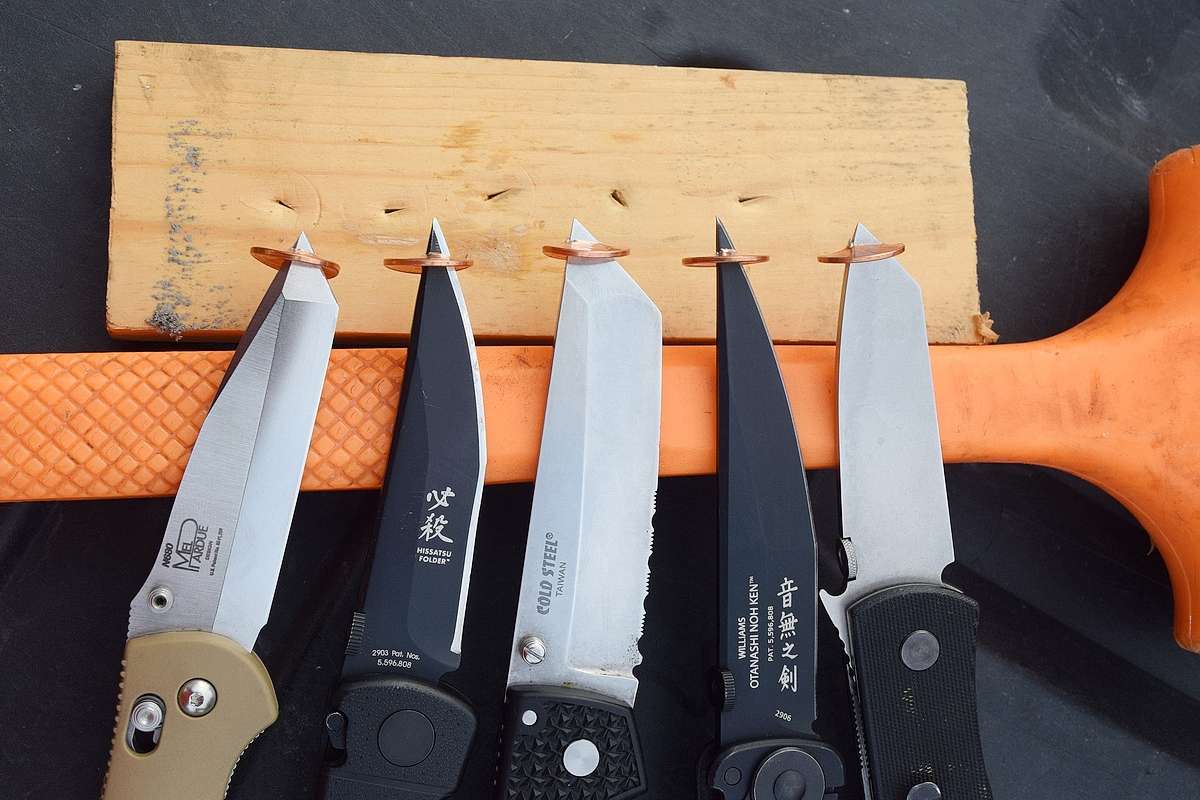
Tantos

The Japanese consider the tanto a short sword. I wasn't playing semantic games.

I totally disagree that it doesn't tell us anything. Everyone knows what general shape the tip will have if you say "tanto." The fact that there are variations in geometry is irrelevant & totally normal.
I could do the exact same thing with pictures of drop points, clip points, spear points, etc. I guess we should just throw out any descriptive terminology unless the blades share identical tip grind geometry.

And yes, I've seen nihonto tantos with kamasu kissaki. Not only was it very common in early swords, it was especially an especially popular repair profile when making one from a broken longer sword throughout the years.
 
I like tanto blades not only for look but for use. Ideal profile for me is that of an Emerson CQC-7V. I know there are other tanto profiles out there, that the original Japanese design is more curved or 'bellied' toward the tip, and that many tanto blades can be called bastardized versions of the original Japanese design. No matter to me---I go with the ones I like the looks of.

I believe the tanto profile "not being good for EDC." is total myth, at least for me. My experience has been that they work fine for everything I've come across with them. What's important is that It's a sharp edge...just like other knives of various profiles. Were I slicing carrots or meat I may want a bit of belly in the blade but most of the kitchen knives used in my house have relatively straight edges. And when my tantos have been called into action TO slice veggies, meat, etc. I discern no real difference---but I'm not a chef and don't cut those things often often at all. About the only place I cut food product to any extent might be in camp.

Yes, a tanto can be two different blades; I sharpen my front edge as sharp as possible for finer or more detailed jobs. I prefer a bit toothier 'working edge' on the longer main edge. I'll EDC a tanto anytime though.
 
Last edited:
Cops all over the place edc "american tantos"'that they use harder than most of us ever will. One of the most beat to hell knives I've ever seen was an Emerson tanto a cop at a party had. Go tell those guys they aren't good for utility/edc.
 
I'm not sure why you would say the geometry variations are irrelevant. The most used part of a blade when carving, gutting and skinning is the last inch. Rounded "tantos" are actually pretty useful all-around knives. The kind with the sharp secondary point are more difficult to use for those mundane tasks. Other tasks are not a problem.

It just doesn't compare to a clip point where all clip points have curved tips. On tantos, some do, some don't, and some have two points - and that's functionally a big deal. Which is what I thought the OP was about.
 
Cops all over the place edc "american tantos"'that they use harder than most of us ever will. One of the most beat to hell knives I've ever seen was an Emerson tanto a cop at a party had. Go tell those guys they aren't good for utility/edc.
You have lots of people here, elaborating on things they never actually used. You Tube generation, explaining what is "tanto" blade and educating you on stuff they learned from videos. Entertaining to some point,
after this it gets boring... There are few other threads here, with some more useful info about tantos, little bit more reading is always beneficial, I guess... "It's American tanto...Oh wait, I meant..." :D

kwtEQh.jpg


Here are more laughable examples of deep understanding of the subject:
...The most used part of a blade when carving, gutting and skinning is the last inch. Rounded "tantos" are actually pretty useful all-around knives. The kind with the sharp secondary point are more difficult to use for those mundane tasks....
Imagine this...Rounded tantos are good all around knives. Sure. If you want to carry a foot long all around short fighting sword...
My guess would be that they don't have to do those mundane tasks for the obvious reason that they are blades designed as weapons, not for carving spoons and skinning, but hey, what do we know... :D
 
Last edited:
The Japanese consider the tanto a short sword. I wasn't playing semantic games.

I totally disagree that it doesn't tell us anything. Everyone knows what general shape the tip will have if you say "tanto." The fact that there are variations in geometry is irrelevant & totally normal.
I could do the exact same thing with pictures of drop points, clip points, spear points, etc. I guess we should just throw out any descriptive terminology unless the blades share identical tip grind geometry.

And yes, I've seen nihonto tantos with kamasu kissaki. Not only was it very common in early swords, it was especially an especially popular repair profile when making one from a broken longer sword throughout the years.
Good post. Let him g-gle "kiriha zukuri" and leave him alone to argue with himself. :D
 
You have lots of people here, elaborating on things they never actually used. You Tube generation, explaining what is "tanto" blade and educating you on stuff they learned from videos. Entertaining to some point,
after this it gets boring... There are few other threads here, with some more useful info about tantos, little bit more reading is always beneficial, I guess... "It's American tanto...Oh wait, I meant..." :D

kwtEQh.jpg


Here are more laughable examples of deep understanding of the subject:
Imagine this...Rounded tantos are good all around knives. Sure. If you want to carry a foot long all around short fighting sword...
My guess would be that they don't have to do those mundane tasks for the obvious reason that they are blades designed as weapons, not for carving spoons and skinning, but hey, what do we know... :D

There is nothing about a Tanto blade shape that means it needs to be long. And as I mentioned earlier, one of the most common Japanese blade shapes is also used in Scandinavia, like this rhomboid Lauri blade:

bb101gab1.jpg


The second blade I ever made was a tanto, with a round tip. I was not an easy grind to get right.

A fellow member emailed me about what you were saying since I ignored you. You are about the rudest person I've met on these boards. Congrats.
 
There is nothing about a Tanto blade shape that means it needs to be long. And as I mentioned earlier, one of the most common Japanese blade shapes is also used in Scandinavia, like this rhomboid Lauri blade...The second blade I ever made was a tanto, with a round tip. I was not an easy grind to get right.
A fellow member emailed me about what you were saying since I ignored you. You are about the rudest person I've met on these boards. Congrats.
Yes, it is. It's called "easy penetration".

I don't think you ever made a tanto with round tip. I don't think you ever made a knife for that matter but I could be wrong. I did ask you to show your knives before, but you ignored this too.
I don't think you understand what people are explaining to you.
You have right to consider me rude as much as I have right to consider you entertaining. I personally don't care what you think about me.
 
Yes, it is. It's called "easy penetration".

I don't think you ever made a tanto with round tip. I don't think you ever made a knife for that matter but I could be wrong. I did ask you to show your knives before, but you ignored this too.
I don't think you understand what people are explaining to you.
You have right to consider me rude as much as I have right to consider you entertaining. I personally don't care what you think about me.

I think if you actually used the search feature on this very board, you would find a picture on one of my knives on the appropriate sub forum.

And I couldn't see the post you're talking about because I had you on "ignore". But you took that as an opportunity to bash me, so I guess I'll just have to keep dealing with your kinda-English.

Case in point: Yes, it is. It's called "easy penetration". Yes to what? Easy penetration of what? What is relevant about this weirdly phrased response? :confused: Are you trying to say that longer blades penetrate better? They don't. Penetration is purely a function of tip shape and cross sectional surface area and blade volume. A 5' sword doesn't penetrate any better than the 2' sword with the exact shame shape.


The point that everyone keeps avoiding is that "tanto" doesn't imply the shape that is being discussed. Moreover, several "tanto" shapes are not actually any stronger through the tip than other blade types (which is supposed to be a virtue), because they have a false edge, like that Mel Pardue.

"What's a tanto good for?" Practically anything, since the term denotes so many different grinds.
 
Last edited:
...Case in point: Yes, it is. It's called "easy penetration". Yes to what? Easy penetration of what? What is relevant about this weirdly phrased response? ...
Yes to this:
There is nothing about a Tanto blade shape that means it needs to be long....
Look, don't make this personal by going after my English, discrediting the opponent with non-related to the subject issues you have,
only means that you can't win the argument with facts and you are changing the subject, that's it. None of the people I'm communicating here have problem with my English,
if you pretend to be so smart you shouldn't to, and you should concentrate on things that people are pointing to, instead arguing.
I wasn't trying to bash you, I was sharing conclusion, pretty much obvious for others but not to you.

Case in point here is that you are failing to look at tantos as a weapons, therefore you are concentrating on properties that are common in blades designed for everyday tasks and tantos are not designed with this primary function in mind.
Penetration does not only mean penetrating barrier material, it also means penetrating deep enough for reaching vital organ. That's why originally those "Japanese" tantos, regardless of tip shape, were long enough for this purpose.
... Are you trying to say that longer blades penetrate better? They don't. Penetration is purely a function of tip shape and cross sectional surface area and blade volume. A 5' sword doesn't penetrate any better than the 2' sword with the exact shame shape.
..."What's a tanto good for?" Practically anything, since the term denotes so many different grinds.
Here is more confusion. Yes, technically, 5" blade will have more momentum because it weights more than 2" blade and will penetrate deeper if both blades are accelerated with same speed.
Of course, 3" will not make noticeable difference, but the statement isn't correct.
Your statement is only correct if we are talking about penetrating barrier material, but this is not the only intended purpose of a blade designed as a weapon, it's also depth of penetration, so in this regard - yes, 5" blade will penetrate more/better than 2" blade.
And one more time "Yes": if longer blade (as the pictured two Williams's blades) have longer curve at the tanto tip, it will penetrate better/easy in soft materials than tip with more blunt angle as the CQC7 and the Voyager's blades.

Going after the tip shape and "semantics" was already addressed in English better than I can do, I guess, but the evolution from the original, Japanese tanto tip to what is called "American" tanto and all such varieties make sense only if you are looking at it not as utility knife but as a weapon. The sharp point by the tip cuts better than the round belly, you are concentrating same power in less surface. It works great in short blades as the once we use today, folders and so on.
In fact if you look at most common shape of the CS tantos for example, the hollow grind looks exactly as a razor blade, hence it has the same hollow grind, but little bit thicker to accommodate the intended purpose of the blade.
So this part of the "american" tanto gives your weapon excellent slashing blade while when cutting with the sharp angle at the tip, the angle of it preserves the actual tip sharpness for use when needs to penetrate barrier material. It's a great design for a weapon, not for carving and skinning game.

The problem is the same as with every sharp weapon - the sharp edge/angle wears out quicker. I guess Japanese recognized this long time ago and they did the same what nowadays the Ferlach's engineers did with the lands of Glock barrel's bores - they rounded it, they artificially wore those sharp corners/edges/angles, prolonging the life of this part of the blade/lands . They sacrificed some of the cutting performance of the tip for wear resistance. The angle of the tip was pretty much the same so it did not affect the barrier penetrating performance.

 
Last edited:
Interesting thread. Firstly I've never seen a Japanese Tanto with a Kamasu kissaki, although I recognize that one made from the
remains of a broken katana may allow for an "anything goes" approach. I have also never seen a double edged Japanese Tanto.
Links to photos would be greatly appreciated.

Secondly, the Japanese Tanto is a weapon, designed to be used for stabbing. It was also used by the Samurai class for cutting one's own or others' topknot, bleeding the thumb to put a thumbprint on a formal document, and to commit seppuku (aka hara kiri), all of which are very "formal" actions. Women of Samurai class familes also had their own Tantos. It was never used to chop wood, cut food, clean fish or dress game. The Japanese had a specific tool for just about every purpose so culturally there was never a need for an all purpose
weapon-tool like the large America knife. That the tanto blade can handle various utilitarian functions is merely a coincidence related to
the general design which is not unique on this planet. From after 1600 to the mid 1800s, the Tanto, in it's shirasaya, was the prefered weapon of the commoner class as they were not allowed to carry katana/wakizashi due to the caste system.
I do not believe that the "American Tanto" is a myth. It is a design that uses the kamasu kissaki commonly seen on Katana and marketed by Lynn Thomson in the early 1980s,. laying the ground for further development as a blade design. I think it's just as good
a label as any to differentiate it from the Japanese design. But even in the 1980s people like Al Mar and Spencer Davis (SOG) chose to go with a tanto tip closer to the traditional Japanese one for their "tantos".
 
Yes to this:
Look, don't make this personal [sic], discrediting the opponent with non-related to the subject issues you have,
only means that you can't win the argument with facts and you are changing the subject, that's it.

Are you f'ing kidding!? How many lies have you written about me in an attempt to discredit me? I don't frequent youtube, I have ground, forged and heat treated knives, I don't buy counterfeit. You're a liar and extremely nasty. I hate having to deal with people like you.


I can't understand you. I have a degree from Northwestern and worked in 6 non-English countries, and your word choices frequently make no sense when you attempt to ask questions.

I have also told you the same thing multiple times like "I don't buy or condone counterfeit" and you clearly couldn't understand me because you kept asking. Maybe you English isn't the problem, but I doubt I'm allowed to comment on what's left after we rule that out.


The OP is not about historical Japanese fighting weapons. We are talking about "the tanto grind", which I'm saying is such an ambiguous term to be entirely meaningless. Just among US designers, the range of blade shaped falling under the term make attempts to talk about what they are good for pointless, as I've illustrated.


You have a bone to pick with me because I got sick of answering the same question 5 times about whether I support counterfeit, and now you attack me at every opportunity. But you simply sound like a little kid doing so. Wise up.
 
Interesting thread. Firstly I've never seen a Japanese Tanto with a Kamasu kissaki, although I recognize that one made from the
remains of a broken katana may allow for an "anything goes" approach. I have also never seen a double edged Japanese Tanto.
Links to photos would be greatly appreciated.

Secondly, the Japanese Tanto is a weapon, designed to be used for stabbing. It was also used by the Samurai class for cutting one's own or others' topknot, bleeding the thumb to put a thumbprint on a formal document, and to commit seppuku (aka hara kiri), all of which are very "formal" actions. Women of Samurai class familes also had their own Tantos. It was never used to chop wood, cut food, clean fish or dress game. The Japanese had a specific tool for just about every purpose so culturally there was never a need for an all purpose
weapon-tool like the large America knife. That the tanto blade can handle various utilitarian functions is merely a coincidence related to
the general design which is not unique on this planet. From after 1600 to the mid 1800s, the Tanto, in it's shirasaya, was the prefered weapon of the commoner class as they were not allowed to carry katana/wakizashi due to the caste system.
I do not believe that the "American Tanto" is a myth. It is a design that uses the kamasu kissaki commonly seen on Katana and marketed by Lynn Thomson in the early 1980s,. laying the ground for further development as a blade design. I think it's just as good
a label as any to differentiate it from the Japanese design. But even in the 1980s people like Al Mar and Spencer Davis (SOG) chose to go with a tanto tip closer to the traditional Japanese one for their "tantos".

Hi Ken,

Here's a page with, among other things like reverse curved and saw blade tantos, is a double edged. Like some other grinds we've been talking about, it is very unusual:
http://www.japaneseswordindex.com/unji.htm

And thank you for also acknowledging that US tantos are their own thing, evolving from the work of CS (and Bob Lum), and not some accurate re-creation of a very rare style of antique short sword.
 
Interesting thread. Firstly I've never seen a Japanese Tanto with a Kamasu kissaki, although I recognize that one made from the
remains of a broken katana may allow for an "anything goes" approach. I have also never seen a double edged Japanese Tanto.
Links to photos would be greatly appreciated.

Do a search for ken & yari tanto.
 
The OP is not about historical Japanese fighting weapons. We are talking about "the tanto grind", which I'm saying is such an ambiguous term to be entirely meaningless. Just among US designers, the range of blade shaped falling under the term make attempts to talk about what they are good for pointless, as I've illustrated.

:rolleyes:
Then the term drop point, spear point, bayonet, etc. is equally meaningless.
You haven't illustrated anything except willful ignorance & an inability to reason. Apparently your ego was wrapped up in giving everyone an erroneous history lesson, when corrected you doubled down on ridiculous tangents easily demonstrated to be false.
 
And thank you for also acknowledging that US tantos are their own thing, evolving from the work of CS (and Bob Lum), and not some accurate re-creation of a very rare style of antique short sword.

Yes, even though they were marketed as a Japanese style tip design and they mirror almost exactly the kamasu tip; they were developed completely independently and it was a huge cosmic coincidental accident that they look exactly like a common traditional Japanese tip design.

Thanks for your insight into this subject.
 
so Tantos are good for piercing and stabs due to having more top strength, but what else are they good for besides that and the look/style? Are there any other benefits of a tanto that I'm missing?

Right now, I own two tanto knives. A US made Kershaw Zing and a M16-02. Both of them see very little pocket time. If I worked construction, though, I would consider a tanto as my work EDC. Maybe a tanto Utilitac II. Beefy and budget priced. If I wanted to spend a little more, there is no question, a Griptillian tanto would be in my pocket.

I have to admit, the first tanto I ever bought was because of the looks. I carried it for years and found it to be decent blade everywhere but in the kitchen. All though, I do not normally recommend it, one of my all time favorite knives is the M16-02 series from CRKT. Yes, I know, it is a little small for a tanto and the steel is...errr...shall we say, lacking. No, I confess, it SUCKS! There, I said it. The steel just sucks. One of my all time favorite knives has wussy steel. Wow! Now that I opened up and said that, I feel much better.

I think that today's carry will be a tanto.:D
 
Yes, even though they were marketed as a Japanese style tip design and they mirror almost exactly the kamasu tip; they were developed completely independently and it was a huge cosmic coincidental accident that they look exactly like a common traditional Japanese tip design.

Thanks for your insight into this subject.

Which historical tanto was ground like Bob Lums? Which historical tanto was hollow ground like Cold Steel's?

I get your insults, but not the logic.
 
Back
Top