
-
The BladeForums.com 2024 Traditional Knife is available! Price is $250 ea (shipped within CONUS).
Order here: https://www.bladeforums.com/help/2024-traditional/
You are using an out of date browser. It may not display this or other websites correctly.
You should upgrade or use an alternative browser.
You should upgrade or use an alternative browser.
Tantos
- Thread starter JJaggar
- Start date


- Joined
- Oct 11, 2013
- Messages
- 823
so Tantos are good for piercing and stabs due to having more top strength, but what else are they good for besides that and the look/style? Are there any other benefits of a tanto that I'm missing?
Wow. I have to say that I've learned (correctly or incorrectly) much more information than I can process or retain. This thread has been informative and entertaining but let's go back to the OP's opening question. Yes! My ZT tanto is kept in reserve until I do my yard work. I find that the tanto portion of my knife will easily penetrate the soil in my yard with a forward thrust thus slicing completely through any stubborn weed root willing to stand up against me. This I have found to be the pinnacle of my weed fighting weaponry...other than weed WMDs.

- Joined
- Nov 21, 2013
- Messages
- 3,416
Than don't. Speak about the subject of this thread and not my English. If you don't understand it, ask someone that does.Are you f'ing kidding!?...You're a liar and extremely nasty. I hate having to deal with people like you...
So far you were discussing those tantos as they are utility knives, that's why you opposed some other opinions with example of Scandinavian blades.
I found that funny and I shared it, never mentioned your love for Chinese knives or whatever you think I got to pick with you.
Than don't. Speak about the subject of this thread and not my English. If you don't understand it, ask someone that does.
So far you were discussing those tantos as they are utility knives, that's why you opposed some other opinions with example of Scandinavian blades.
I found that funny and I shared it, never mentioned your love for Chinese knives or whatever you think I got to pick with you.
Then I'll state this again:
The OP asked about the purpose or utility of the so-called "tanto grind".
My answer is that the tanto grind has many uses, because it is not any one kind of grind, but a constantly evolving, poorly defined kind of grind that may or may not have two points.
For the type of tanto grind that Bob Lum created (which is nothing like any Japanese grind because it is hollow), the knife is useful for all the same things as a other knives with a curved tip and no secondary point. The point is very durable, so it will survive penetration - but not actually be good at it because of the blunter angles than a dagger.
For the type of tanto grind CS used to do (which is also hollow ground, unlike any Japanese grind), with a rounded secondary tip, that tip can be okay for woodcraft, is a little harder for doing things like skinning because of the hump. The point is very durable, so it will survive penetration - but not actually be good at it because of the blunter angles than a dagger.
For the type of tanto that is somewhat like that used on some swords, the secondary tip can be good for slashing. The secondary point is poor for doing something like preparing game. The point is very durable, so it will survive penetration - but not actually be good at it because of the blunter angles than a dagger. The secondary point is also more fragile for penetration.
For the type of tanto that has some sort of swedge or false edge, it will penetrate better, but be less strong through the tip. Daggers still penetrate better. Also unlike any historic Japanese grind.
None of this is comparable to the variations in a clip or spearpoint, because some tantos are the only knives with two tips.
I know that because I have several of those knives and use them for real things. Not because I watch youtube videos, as you've insisted in this very thread, liar.

- Joined
- Sep 21, 2013
- Messages
- 720

After reading the last three pages i am unclear if this is a tanto anymore even though spyderco markets it as the Lum Tanto Folder, anyways i thought id lighten the atmosphere and post a pic, carry on.
This thread is now lessons about knife tip design from a mobile suit gundam.
And ad hominem attacks from a "fiend".
Hi Ken,
Here's a page with, among other things like reverse curved and saw blade tantos, is a double edged. Like some other grinds we've been talking about, it is very unusual:
http://www.japaneseswordindex.com/unji.htm
And thank you for also acknowledging that US tantos are their own thing, evolving from the work of CS (and Bob Lum), and not some accurate re-creation of a very rare style of antique short sword.
Thank you for the link showing rare and unusual Tantos. While I have my doubts if the Kubikiri or the Sawback are actually "tanto's, the others are indeed intersting. The Ken Tanto, clearly is a Buddhist ceremonial tanto, as straght double edged swords (chokuto/tsurugi) of China and Asian mainland style was replaced by the traditional Japanese style around 700-800AD, and it originally came from Tang along with Buddhism. The Yari Tanto in very unique looking like it may have started in the 1600s when the warring states period ended, putting many battlefield weapons into unused surplus.
Anyway very intersting, and none of these represent the majority of Japanese Tantos.
Last edited:
Do a search for ken & yari tanto.
Thank you. But I have still not found an example of a Japanese Tanto with a Kamasu kissaki.
The only one I have found is a modern knife (not a Tanto) made by Custom maker Hiroshi Sasaki.
Would appreciate a link if you have one.
Last edited:

And ad hominem attacks from a "fiend".
Look flying robot/kid,
First you say the "American tanto" tip is an American invention, nothing like any Japanese tanto and post a picture of one with one of several types of tip design claiming it is typical.
You are corrected & shown a chart with several traditional Japanese types, including one that everyone but you can recognize as an "American tanto."
Then you say that the term as used doesn't mean anything because different knifemakers all put their own twist on it.
It is pointed out that different knifemakers put their own twist on all tip designs. We would not even be able to use the term "car" if your lack of logic was applied equally. You keep arguing.
You attempt to obfuscate by saying you've never seen a kamasu-kissaki on a tanto, only on longer swords. Never mind that that is totally irrelevant to the discussion of the tip design.
Etc.
People lose patience with you. I wonder why?
Your vast knowledge of anime robots does not automatically make you an expert in anything else , sorry. It must be very hard to be so picked on. [rolleyes]

- Joined
- Aug 19, 2008
- Messages
- 2,365
And rightly so, it's a bad ass knife. As you know, I've seen it........I'm not stalking your 760.This thread made me pull my BM 760 LFTi out of stasis and into my pocket to rock it.

- Joined
- Nov 21, 2013
- Messages
- 3,416
No he didn't ask about grind at all. Here his original post:Then I'll state this again:
The OP asked about the purpose or utility of the so-called "tanto grind".
so Tantos are good for piercing and stabs due to having more top strength, but what else are they good for besides that and the look/style?
Are there any other benefits of a tanto that I'm missing?
The second post in this thread basically is answering his question very well and than you are stepping in to explain that you loosely speaking, don't make difference between "American" tanto and classic Japanese style:
This is your last statement:...And this is what people like to call a tanto:
...
The first one is about as useful as any other field knife - and is really similar to many Scandinavian knife grinds. It is known as a straight back blade tip, and they all have similar tip strength.
The second one is an American invention.
I have found the that the American style tanto blades can be useful for lots of things if they have a rounded corner - especially for carving a depression in wood.
But the sharp cornered kind is like having a knife with two tips: I would expect penetration to be worse - but slashing might be better because of the second tip.
Now, you cannot call someone "liar" based on his guess, please don't do it. You're still sounding like someone that gets his knowledge about this subject from the Tube, especially when your statements are shifting...My answer is that the tanto grind has many uses, because it is not any one kind of grind, but a constantly evolving, poorly defined kind of grind that may or may not have two points.
.....I know that because I have several of those knives and use them for real things. Not because I watch youtube videos, as you've insisted in this very thread, liar.
Looking at your first post in this thread, I can find few differences with your last statement and also couple other things I was talking about:
1. You are mixing a classic tanto stile tip with "American" tanto, it's an American invention for you.
2. You did not recognize the tanto stile as a weapon related, for you this is utility knife.
Also, I like to make clear, just as I stated before: I don't care about your opinion, because it isn't anything new or related to the subject of this thread, that I can learn. I commented on your posts because I find those entertaining, this is not a reason to be called names. Maybe you should tell your friend not to email you my posts and continue keep me on your Ignore list. This way you won't see my remarks and I 'll have opportunity to enjoy more entertainment when follow your posts.
Last edited:
I love the aesthetics of the Lum design.

It seems that the blade angle with respect to the handle is like the traditional curved sword and better for slashing than for utility knife uses. Other utility knives actually have the blade sloped the other way. I don't know how but I managed to end up with a lot of Tantos and I don't carry any of them as EDC's. I think a tanto makes a good utility knife for me if the tanto part is relatively pointed. Some of them are pretty blunt and those aren't as useful for me. I have read that the place where the 2 edges meet can work the same way as a second point and improve the utility of the blade. So you get a straight edge with somewhat of a point like a wharncliff or sheepsfoot, and also a point like a normal knife.
I like the grinds on this one, the geometry is honest and obvious how the edge is created. OTOH a drop point knife has to play some tricks with the grinding or the point ends up too thick. But I've seen some where the edge angle for most of the edge was reasonable but it got real steep near the point because the grind leaves the blade thick there.
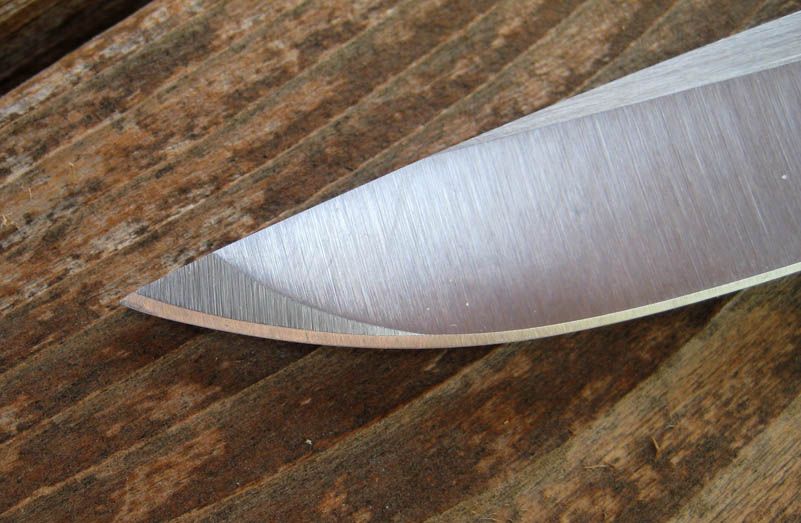
It seems that the blade angle with respect to the handle is like the traditional curved sword and better for slashing than for utility knife uses. Other utility knives actually have the blade sloped the other way. I don't know how but I managed to end up with a lot of Tantos and I don't carry any of them as EDC's. I think a tanto makes a good utility knife for me if the tanto part is relatively pointed. Some of them are pretty blunt and those aren't as useful for me. I have read that the place where the 2 edges meet can work the same way as a second point and improve the utility of the blade. So you get a straight edge with somewhat of a point like a wharncliff or sheepsfoot, and also a point like a normal knife.
I like the grinds on this one, the geometry is honest and obvious how the edge is created. OTOH a drop point knife has to play some tricks with the grinding or the point ends up too thick. But I've seen some where the edge angle for most of the edge was reasonable but it got real steep near the point because the grind leaves the blade thick there.
Look flying robot/kid,
First you say the "American tanto" tip is an American invention, nothing like any Japanese tanto and post a picture of one with one of several types of tip design claiming it is typical.
You are corrected & shown a chart with several traditional Japanese types, including one that everyone but you can recognize as an "American tanto."
Then you say that the term as used doesn't mean anything because different knifemakers all put their own twist on it.
It is pointed out that different knifemakers put their own twist on all tip designs. We would not even be able to use the term "car" if your lack of logic was applied equally. You keep arguing.
You attempt to obfuscate by saying you've never seen a kamasu-kissaki on a tanto, only on longer swords. Never mind that that is totally irrelevant to the discussion of the tip design.
Etc.
People lose patience with you. I wonder why?
Your vast knowledge of anime robots does not automatically make you an expert in anything else , sorry. It must be very hard to be so picked on. [rolleyes]
Look rude poster who also knows a thing or two about knives:
I am not the only one who thinks that the American tanto is not a variation of an established Japanese style. It is my opinion, but not only mine. Here's why:
The first western "tanto" was Ken Lum's, and his grind is not like any Japanese grind.
The second with the CS, also different than any Japanese grind.
Then we actually get to some flat ground blades that bear a resemblance to a Japanese grind most typically used on swords, and so atypically used in tantos that you and everybody else has so far failed to post a single picture of one.
It seems to be your thesis that this last group suddenly had a hankering for historic accuracy and dredged up a tanto grind so uncommon that none of us can find even one to post, but they did it because it is the right thing to do.
It is my belief that flat, angular ground tantos are simply a new variation on the bastardized/kinda tanto that Lum and CS popularized in the US, and the fact that they bear a resemblance to the one slightly more obscure style of tachi is an example of convergent evolution, not purposeful recreation. Flat, angular grinds are the simplest knives to execute - and they have an aesthetic that is refreshingly different than all those curves that normal knives have.
Two opinions. Yours is not more valid because you decide to be insulting while delivering it.
No he didn't ask about grind at all. Here his original post:
The second post in this thread basically is answering his question very well and than you are stepping in to explain that you loosely speaking, don't make difference between "American" tanto and classic Japanese style:
This is your last statement:
Now, you cannot call someone "liar" based on his guess, please don't do it. You're still sounding like someone that gets his knowledge about this subject from the Tube, especially when your statements are shifting...
Looking at your first post in this thread, I can find few differences with your last statement and also couple other things I was talking about:
1. You are mixing a classic tanto stile tip with "American" tanto, it's an American invention for you.
2. You did not recognize the tanto stile as a weapon related, for you this is utility knife.
Also, I like to make clear, just as I stated before: I don't care about your opinion, because it isn't anything new or related to the subject of this thread, that I can learn. I commented on your posts because I find those entertaining, this is not a reason to be called names. Maybe you should tell your friend not to email you my posts and continue keep me on your Ignore list. This way you won't see my remarks and I 'll have opportunity to enjoy more entertainment when follow your posts.
He asked about "tantos". You, me and everyone else realized he wasn't asking about a specific type of archaic Japanese short sword, but all types of knives that the term "tanto grind" is put on. Don't play dumb.
The OP also asked "what else are they good for". That IS a question of their utility. And that's the reason I answered his question about the varying utility of all the different blade grinds that might be attributed to the word "tanto".
I've owned a Cold Steel tanto for 24 years, carried it in 3 war zones and butchered my first deer with it. I haven't stabbed any car doors with it, but I do know what sort of utility jobs it can do with its rounded transition and straight tip. This variation of the American tanto is good for more than just stabbing or slashing.
I don't know why you say that I "don't make difference between "American" tanto and classic Japanese style". In that paragraph I quite clearly do make a distinction between what I consider a typical Japanese tanto grind and the various US variations. The fact that you can't tell that is what I wrote is probably why you so frequently think you're disagreeing with me. You don't read or write well in this language, which causes you to misunderstand others and write unanswerable questions.
And if you tell people lies about me, you are a liar. You said I don't make knives and I get my information from youtube. You made that up, repeated it after I said you were incorrect. You're a liar. Just own it.
Sabre Cat thank you! This is really what I would like to hear is how everyone here in this thread uses their Tantos, where you all personally think they excell and where y'all think they lack, say as opposed to a drop point, I dunno. I appreciate the history lessons and all, it's slot to look into and research, very interesting I guess I'd just rather hear how everyone personally uses these types of blade in their everyday lives..
- Joined
- Nov 21, 2013
- Messages
- 3,416
No I didn't. I was only guessing. Everything written by us is here on the pages on this forum,He asked about "tantos". You, me and everyone else realized he wasn't asking about a specific type of archaic Japanese short sword, but all types of knives that the term "tanto grind" is put on...
You said I don't make knives and I get my information from youtube. You made that up...
let's leave whoever cares what we are, to decide for itself, no need of calling names.
"Tanto" type knife isn't defined only and only by the grind, but mostly by the shape of the blade, he didn't specify that was interested of the grind in particular, don't twist his words to fit your argument.
You didn't recognize the role of the length of the blade in the fighting version of the old Japanese style tantos, they are utility knifes for you, you brought the similar in shape Scandi knife, that have nothing to do with the fighting nature of the original design, because the handle is suited for completely different tasks and the blade have insufficient length when compared it to the old Jap. styles tantos, as you did.. You did this, and it shows that you are not interested of the whole picture but only of winning the argument. IMHO you don't have the complex understanding what a knife is designed for, you are taking bits and pieces and you are putting them together to suit your statement,
that is completely aside of the question of the OP, which tells me that you don't understand the difference between the different purposes of a knife... Modern tantos are much shorter than the old japanese swords, in most cases we are talking about folding knifes with sub 4" blades. Even most of those are deigned as a weapons, we all know that they are used also for everyday tasks, so in most of them the sharp angle at the tip, the "second" tip is preserved in order to give them aggressive cut, just as another member made analogy with the bevel of a wharncliffe - this is what you got in most of the straight or slightly curved tanto bevels in modern knifes up to the second tip. Grind and convexing of the tip (and blade) are emblematic but not a primary requirements for modern tantos, you don't have to concentrate on those to make your argument, the designer and the manufacturer decide this, there are no rules here, only purpose of the knife, and for most part they are designed as a weapons, this is what you are failing to understand. Weapons are built with different priorities than a normal edc knife of same size.
The closest answer to what was OP asking was IMO given by crom, your post moved the whole conversation in different direction, but again - I don't care about your opinion because I believe you don't know what you're talking about.
Let's stick with the thread and don't explain yourself anymore please, it have nothing to do with the subject of this thread and you don't have to share it with me.