Temperature Controlled Forge

Joined
Aug 28, 2009
Messages
7,951
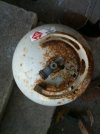
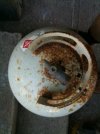
So today I was able to get a pair of used propane cylinders, a 33# and a 30#. I would like to build a temperature controlled forge, and have read the stickies, but my brain just isn't processing the information and I feel even more confused after reading them:o I would like to go with a forced air burner, and I know I need a PID and K type thermocouple, I just don't know what ones I need or what I need in the way of solenoids to make it all work right. Is there a good tutorial that I can follow to build my forge? My next question is about burners, I calculate that the volume of my forge will be 500 and 900 cubic inches, 18" long and an internal diameter of either 6 or 8 inches depending on whether I go with 2 or 3 inches of ceramic wool. Do I need to run 2 burners or would one do it? I am thinking of buying a burner kit from High Temperature Tools & Refractory or just building the one from Indian George's site.

It will be a few more weeks before I am ready order the remaining parts and I probably wont start the build till mid November, so I am just looking for information I can understand right now and to be pointed in the right direction for the temperature control aspect of the forge.

Thanks in advance

George

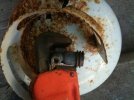
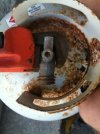
On a side note, boy does it ever take a long time to fill a 33# tank with water when you can't get the valve out. After about an hour of banging and torquing I just gave up and pulled the valve core, leaving about a 3/16" opening to fill the tank through. the other one is sitting out in the rain with the core removed, but I think I may just chance fate and drill a 1/2" hole that i can stick a funnel through to fill that one.
 
don't drill. your odds are good, but is a little time worth the potential downside?
 
Man I would also rather see you either get that valve off or just take the time and fill that tank up. I have a 30# out back been sitting for almost a year without a valve in it. I still will fill that thing up with water first before doing ANY drilling/cutting. I have heard of way too many accidents to do otherwise.
 
On a side note, boy does it ever take a long time to fill a 33# tank with water when you can't get the valve out.
After about an hour of banging and torquing I just gave up and pulled the valve core, leaving about a 3/16" opening to fill the tank through.
The other one is sitting out in the rain with the core removed, but I think I may just chance fate and drill a 1/2" hole that i can stick a funnel through to fill that one.


It took me a while, but I figured out a good removal method.

I bang off the handle / valve shroud with a hammer and chisel.
They have just a few little welds.


The tank bodies are steel & the valve bodies are brass, so it shouldn't be that difficult to turn once you have a way of holding everything.

I turn the tank upside-down & grip the valve body in a bench vise.

Then hook together 2 chain Vise-Grips for a larger loop, put them around the middle of the tank body and turn it off.

The valve is a 3/4"NPT Right hand thread - not left like some gas fittings are.
Since it's upside down - I have to tilt my head and righty-tighty lefty-loosy to figure out which way to turn.

423122035.jpg


I don't know if bike mechanics have those, it seems like not many people do.
If you don't have those, you might have an old bike chain, a pipe & some wire...
You can rig up the equivalent to this so the more you lever on it, the tighter it holds.

500-500---5024209354561.jpg
 
Don't worry I have no intentions of actually drilling the tank without filling it first:eek: and I have over a month before I will start the builds so there is plenty of time for me to fill the second tank if I feel I need it because I screwed up the first one.
 
How about taking it to a place that will fill and service them and have them take out the old valve? Not the mom and pop stores, but the big commercial places that deliver propane to fill household tanks. They might take out the valve for you.
 
No such place within a 50 mile radius of me:( well maybe on the other side of the river, but I don't have a passport so I doubt they would let me cross just to have a valve removed. I have one tank filled and it will sit that way till the middle of next week or longer before I drill and start cutting. The second tank is about 1/4 filled, but it is going slower than the first one. Right now I am filling them by jamming a large funnel in the hole where the valve core was filling it with water and letting it trickle in. It may take a couple of days for the second one to fill because it just doesn't flow as fast for some reason.
 
Do you happen to have a couple of ratcheting straps? Wrap one around the tank and then around a tree. Wrap the second around the strap that is already around the tank then around the tree. Maybe this will hold it still enough to use a big pipe wrench on the valve.
 
Here's one I used for starting my build..

http://www.bladeforums.com/forums/showthread.php/704470-Forge-Assembly-WIP

Here's Wayne Coe's

http://knifedogs.com/showthread.php?16064-Build-a-Gas-Forge-Tutorial

And another

http://www.arscives.com/bladesign/forge.tutorial.htm

My thoughts as a total newbie....

I've spent a couple days with A C Richards at his shop and was all set to make a PID controlled forge. After spending time there I'm leaning more towards finishing my forge with a thermocouple and PID to monitor the temp, but will likely just adjust the temp by hand.... maybe.... since I'm a plumber I might not be able to resist piping up a couple solenoids...
Stacy(Bladsmith) mentioned he would do the PID/blower controls differently than he suggested it to Nathan.. I'd like to see a new drawing/schematic of what an ideal PID controlled forge would be.

I built a blown burner that's like the Hightemptools.com burner but until I get my new place in a couple weeks all my knifemaking, including firing my new forge is on hold...

It "seems" to me that a blown forge is easier to adjust the temps, and still maintain the proper atmosphere....
 
I am thinking I will give building the Indian George burner a try first, cost wise it seems to be cheap enough that if I screw it up I am not out too much coin. Only problem is that the only black iron pipe I can find locally is 1" and not 1.5" like his plans call for. Not sure if everything will work at that size but I am willing to give it a try for the $10 I had to spend on pipe. If it fails I will go online shopping for the proper sized pipe and start over. I think my blower may be a bit over sized though
 
Hi Guys,

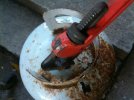
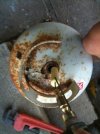
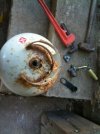
Although those chain grips do look cool, you'd think none of you ever wrapped your legs around a frisky filly ;). Granted it almost seems impossible, but a good size monkey wrench and hammer has always worked for me. You have to fuss a bit with wrench jaw angles and pound a lot, but it should be able to get the job done. Placing the tank on a concrete step with another step behind it helps.
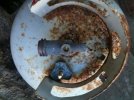
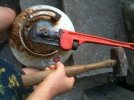
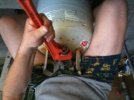
I just did one this morning and snapped some shots with my phone.

All the best, Phil

tank_01.jpgtank_02.jpgtank_03.jpgtank_04.jpgtank_05.jpg
 
Last edited:
What I am having trouble figuring out is how to do the doors. Presently I'm using fiberboard, but I suspect it will not hold up with my high school students. Indeed, the whole kao wool, satanite and ITC100 liner method will likely be put to the test by them. On-the-other-hand, forges that come up to heat and cool off reasonably fast seem appropriate for classes that happen in a one and half hour time frame. I tried the stacked firebrick approach for doors, but they kept getting knocked off. Maybe if I built frames for them. I'm thinking of making hinged doors with cast refractory material. I might even cast an inch or two liner inside the kaowool instead the thinner satanite, but then I guess I'll need to preheat the forges before classes. I wonder what the impact would be on fuel consumption? Use more because of the extra preheat time? Use less because of lower consumption once up to heat? Or about the same because of the two? I look forward on seeing what you do George. All the best, Phil


attachment.php
 
Last edited:
BTW, that first link posted by Brian takes you to my forge assembly thread. If I had it all to do over again, I'd completely forgo the hi/low speed pots for the blower. In theory, it's a great idea; in practice, there are some technical issues with interference and blower motor response. And in reality, the difference between the hi and low stages are so little, that the atmosphere doesn't drastically change. Basically, I have the PID control the SSR which switches the gas solenoid valve on or off.

After bringing the forge up to temperature for a while (30 minutes or so) and coming up to temperature above your set point (which causes the PID to turn your hi stage off via the solenoid valve), you adjust the needle valve on your low, or "pilot", stage so that the temperature slowly falls down to and below your set point. At that point, the high stage will kick on. Adjust your high side needle valve so that the temperature slowly climbs above the set point. Once you have made the adjustments, it only takes a tweak here or there as the forge runs to maintain a constant up and down just above and below your set point.

Like I said, the hi/low speed pots for the blower fan really didn't work as they theoretically should. I can keep a reducing atmosphere on high and low just by closing down the gate valve above the blower.

--nathan
 
I think its the bare legs that let you grip the tank better, its a little chilly here right now for that:p I also don't have a pipe wrench:eek: the shame of it:o

I finally got the second tank filled today so I just may drill a couple of holes the next sunny day we get I figure going slow and inside where I want to cut for the front opening should be safe. I am thinking 1/2" holes will let it breath. After that I will let them sit for a couple more days before going at them with the angle grinder.

I am not sure if this is the right plan of attack, but I plan to first cut off the valve guard ring, then mark the opening I want and cut that out. Once I have the top opened up I can dump the water and cut off the ends then clean up the cut marks. Wash everything out good, clean up the out side and get to work on designing the hinges and handle so I can get them welded up.
 
BTW, that first link posted by Brian takes you to my forge assembly thread. If I had it all to do over again, I'd completely forgo the hi/low speed pots for the blower. In theory, it's a great idea; in practice, there are some technical issues with interference and blower motor response. And in reality, the difference between the hi and low stages are so little, that the atmosphere doesn't drastically change. Basically, I have the PID control the SSR which switches the gas solenoid valve on or off.

After bringing the forge up to temperature for a while (30 minutes or so) and coming up to temperature above your set point (which causes the PID to turn your hi stage off via the solenoid valve), you adjust the needle valve on your low, or "pilot", stage so that the temperature slowly falls down to and below your set point. At that point, the high stage will kick on. Adjust your high side needle valve so that the temperature slowly climbs above the set point. Once you have made the adjustments, it only takes a tweak here or there as the forge runs to maintain a constant up and down just above and below your set point.

Like I said, the hi/low speed pots for the blower fan really didn't work as they theoretically should. I can keep a reducing atmosphere on high and low just by closing down the gate valve above the blower.

--nathan

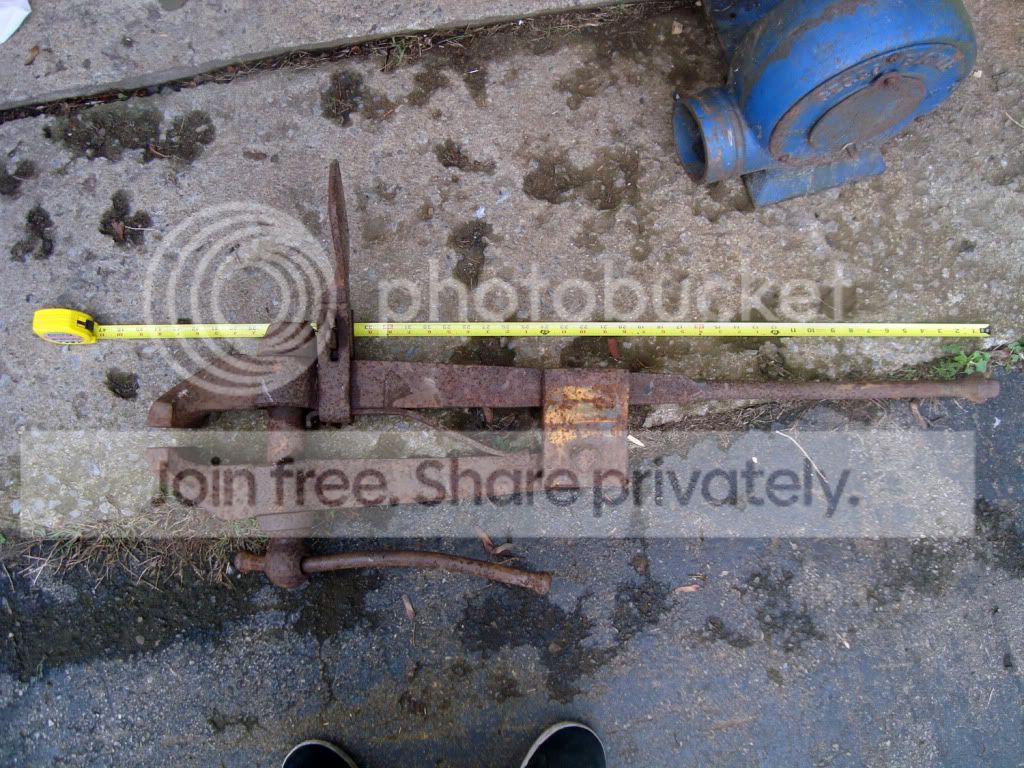
Have you seen my blower:D its just a bit large this is it sitting next to my newly acquired post vise
DSC02748.jpg


It may be big, but it was free and so is the motor that is going to be running it. I may have to build it its own cart though:p My actual plan is to tighten the gate so it is wide open and use a ball valve to control the air flow. I have been trying to find some information on the blower so I know what CFM it is, but I have had no luck so far.
 
I was surprised at how little airflow my forge needed compared to the output on the blower. I have plenty of CFM in the blower, and I have the gate valve closed almost all the way to get my atmosphere right. If I actually opened it up and added some gas, my forge would very likely melt itself.

--nathan
 
BTW, that first link posted by Brian takes you to my forge assembly thread. If I had it all to do over again, I'd completely forgo the hi/low speed pots for the blower. In theory, it's a great idea; in practice, there are some technical issues with interference and blower motor response. And in reality, the difference between the hi and low stages are so little, that the atmosphere doesn't drastically change. Basically, I have the PID control the SSR which switches the gas solenoid valve on or off.

After bringing the forge up to temperature for a while (30 minutes or so) and coming up to temperature above your set point (which causes the PID to turn your hi stage off via the solenoid valve), you adjust the needle valve on your low, or "pilot", stage so that the temperature slowly falls down to and below your set point. At that point, the high stage will kick on. Adjust your high side needle valve so that the temperature slowly climbs above the set point. Once you have made the adjustments, it only takes a tweak here or there as the forge runs to maintain a constant up and down just above and below your set point.

Like I said, the hi/low speed pots for the blower fan really didn't work as they theoretically should. I can keep a reducing atmosphere on high and low just by closing down the gate valve above the blower.

--nathan

Cool.Thanks for taking the time to post this. I have my PID,SSR,Project Box, Etc and was trying to decide if I should get the speed pots...
I'll keep it simple then.
Thanks

Nice Post vice!:D I cleaned mine up after a WD-40 soak with a wirewheel on my 4" grinder then another rub with diesel...

You'll be forging in no time! :thumbup:
 
Nathan, while I can follow your diagram for the layout, I am still lost on what to get for SSR and gas solenoids. You wouldn't have the model or parts numbers would you? then I have to figure out what PID to get to make it all work together. The TC is the easy part, once I know what PID to get I get the K type with the matching connectors.
 
The parts can be a little challenging to round up...

  • PIDs can be sourced from Auber Instruments (PIDs). Any of their models would work. I went with the 32 DIN one. You have to press a button to see the target temp. With a 16 DIN model you get to see both the target and actual temps at the same time.
    .
  • SSRs can also be sourced at Auber (SSRs). 25A ones will work. I went with 40A thinking I might use it to control an electric oven too which would draw more juice. You also need to get a heat sink and the thermal grease.
    .
  • Solenoids might be a bit trickier in that there's more at stake to get it right considering combustible gas is going through it. Make sure its normally closed without power and can handle the gas pressure (15psi). Here's bit of description in another thread, http://www.bladeforums.com/forums/showthread.php/600318-PID-Controlled-Forge?p=6220753#post6220753. The ASCO product they're talking about is the 8040H008. That's the one I got anyway. Are you going to use two; one in front of the idler line and solenoid controlled line like Eric Flemming did?
    .
  • Thermal couples are not too difficult, as you said. Again Auber (TCs) can be a good source. Just make sure it's a K type and rated for high enough temps.

There's GREAT info and numerous links in the PID CONTROL FORGE ; Salt Pots; and more sticky.
 
Last edited:
Back
Top