The Choil/Ricasso thing

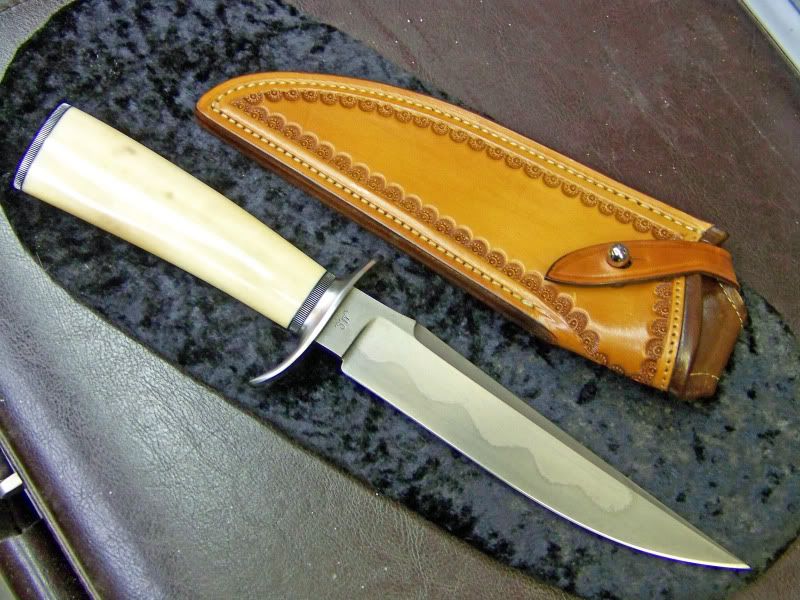
I like this one.
100_3826_edited.jpg
 
From a practical standpiont I can see the benefits/drawbacks of both styles.
:thumbup:

Aesthetically and functionally my preference is for no choil and a rounded spine and ricasso, although as referenced in the original post, a dropped edge may have certain benefits. A cant towards the point of the blade is more important to me than whether the choil is rounded or straight, if one is present, but I prefer a Scagel or Searles style that attempts to eliminate the ricasso altogether in that case. Tiny "sharpening" choils or especially notches in that spot are a real turn off for me. Choils are not necessarily a deal breaker but there are a lot of variables to consider.
 
Last edited:
STeven good thread and excellent idea to bring about discussion on different aspects of blade design

We have spoke about your choil preference and I understand why you prefer it in a useing and asthetic aspect

As for me in the looks department it all depends on the knife

If it is done well and depending on the style of the blade I don't have a preference

On a useing aspect I don't really use the choil for any particular purpose and although the squared version seems to be a bit more snaggy I can't ever remember snagging one

It would also seem a very squared choil would be more prone to damage but for the life of me I can't ever remember tweaking one

So for me since I don't really use the choil area for any particular task it all depends on the knife

Please do tips next :D
 
Last edited:
I don't know what you call it, Jon....but I don't like it(although it is recognized to be a superior shape for a hunting knife, and a demonstration of forging mastery.)

Best Regards,

Steven Garsson

I've never understood the forging mastery aspect of it, there are many ways to "cheat" that area to whatever shape you want.

a REALLY impressive bit of forging mastery is the way Samuel Bell would form his choils, with or with out the fancy notching that I know you dislike
 
Aye-aye, sir!

I just shit myself reading that.

Sorry for the thread drift!

Kevin, I will start looking at the choil on Senderos. Never really thought about that or noticed.

So glad this thread is happening.
 
Last edited:
I like a less rounded choil on a large fighter. I think it just looks more badass. Sorry for all my language.

Here is an example.

1.jpg


And this is interesting now that we are on the subject.. (pic from Hanson site)

walrusfolder1.jpg
 
Last edited:
Steven,

In this thread are you referring only to forged blades?
On most Integrals that I have seen there does not seem
to be any sort of choil...

Not having the chance to talk knives often, I am a little
confused about this choil issue.

Would you care to enlighten me with a short general overview?

Why, for example does a forged knife NOT LOOK LIKE THIS?
See below, with my deepest apologies to Larry....

All the best,
David Darom (ddd)

Fuegen-Preface.jpg
 
Interesting thread STeven. I learned about some characteristics of blade shape that I never really thought much about.

I used to spend a lot of time in the forests and back then, custom knives were not even something I was aware about. Never dressed any game other than fileting fish so my custom knife preferences are mostly aesthetic.

It is interesting to know how subtle differences in blade geometry affect performance.

Peter
 
David Darom,

When forging in the bevels on a forged blade, the material has to go somewhere. The straight -forward and traditional method moves the steel towards what becomes the cutting edge, therefore the "pulled-down" material widens the blade and forms the choil, as well as a blade wider than the ricasso, which remains the same width as the original flat or round bar.

It is certainly possible to move the material within the bevel "down" the blade, leaving the beveled blade the same width as the ricasso, that is, the original bar, however, the longer the blade, the farther you have to move the material.

What we think a blade should look like, often depends on the ways folks have made and used them in the past.

Hope this makes some sense.

John
 
David Darom,

When forging in the bevels on a forged blade, the material has to go somewhere. The straight -forward and traditional method moves the steel towards what becomes the cutting edge, therefore the "pulled-down" material widens the blade and forms the choil, as well as a blade wider than the ricasso, which remains the same width as the original flat or round bar.

It is certainly possible to move the material within the bevel "down" the blade, leaving the beveled blade the same width as the ricasso, that is, the original bar, however, the longer the blade, the farther you have to move the material.

What we think a blade should look like, often depends on the ways folks have made and used them in the past.

Hope this makes some sense.

John

Yes John, it does make sense as I have seen more than one blade being forged
and yet something that I can't put my finger on is tickling me at the back of my
mind - from the pure design and function point of view...
I think much of this blade design does have to do with, as you said it well:
"...What we think a blade should look like, often depends on the ways folks
have made and used them in the past".


All the best,
David Darom (ddd)
 
I like this one.
100_3826_edited.jpg

Hi Bruce, and all...
Here's, I believe, another version of the choil on almost the same knife... I like them both!
But again, I just want enough room in the choil area for the index finger to fit as others have also said...
 

Attachments

  • My Gents Bowie VIII.jpg
    My Gents Bowie VIII.jpg
    43.3 KB · Views: 81
Hi Bruce, and all...
Here's, I believe, another version of the choil on almost the same knife... I like them both!
But again, I just want enough room in the choil area for the index finger to fit as others have also said...

What are your fingers doing front of the guard on a fighting knife, out of curiousity?

I prefer the picture you posted to the one that Bruce posted.

Best Regards,

STeven Garsson
 
>>What are your fingers doing front of the guard on a fighting knife, out of curiousity?<<

Details, details..... :D
 
What are your fingers doing front of the guard on a fighting knife, out of curiousity?

I prefer the picture you posted to the one that Bruce posted.

Best Regards,

STeven Garsson

STeven,

I probably wouldn't do it on a fighter, per se, especially considering the guard, but on a hunting or utility knife, I do like to choke up on the blade for using the belly to slice delicately, controlling the tip or even use the rear portion of the blade in a scooping sort of motion.. if that makes any sense...

And I like mine better, too!!! :D But Bruce knows that...
 

in my opinion the choil is the whole unsharpened part of a blade (edge-side). what we are discussing here (and what kevin highlighted in the picture) is not the choil itself, imo, but the transition from choil to edge. but i might be completely wrong :foot:... makers, please do enlighten me/us!

best regards,
hans
 
in my opinion the choil is the whole unsharpened part of a blade (edge-side). what we are discussing here (and what kevin highlighted in the picture) is not the choil itself, imo, but the transition from choil to edge. but i might be completely wrong :foot:... makers, please do enlighten me/us!

best regards,
hans

Hans, I was simply trying to delineate between the choil/ricasso "Thing" as it's being called in this thread as I'm not sure everyone knows (especially those newer to the knife community) exactly what we are referring to. If you have ever used the box or circle 'paint tools' you will notice they are not very user friendly especially when trying to identify objects close together. I thought most would 'get it' but perhaps not considering my lame attempt. I guess I should just not have made the effort.

But since I'm not usually one to give up, I will attempt to define a choil as the area where the blade edge transitions to a ricasso that's narrower than the blade. Basically creating a recess from rear blade edge to ricasso. This area would include where the rear blade edge either angles or curves up (smaller box in my photo) to the under edge of the ricasso. You don't have a choil when blade and ricasso are the same width.

Edit to add; in regard to my last statement, though rare, there are instances where I believe you could have a choil with like blade/ricasso widths. I believe a choil is one of those things that's much easier to "know it when you see it" then to define it. ;) :D
 
Last edited:
Kevin's pic shows my interpretation of those terms but looking up the definition they both seem to define the unsharpened "ricasso" area. I do believe Steve's thread pertained to the "dropped edge" though. I'm sure he'll correct me if I'm wrong... :D

Edited to add: Dang, Mr. Bump, you make one hell of a knife... I'd accept those "choils" and not complain one bit... :D
 
Last edited:
Back
Top