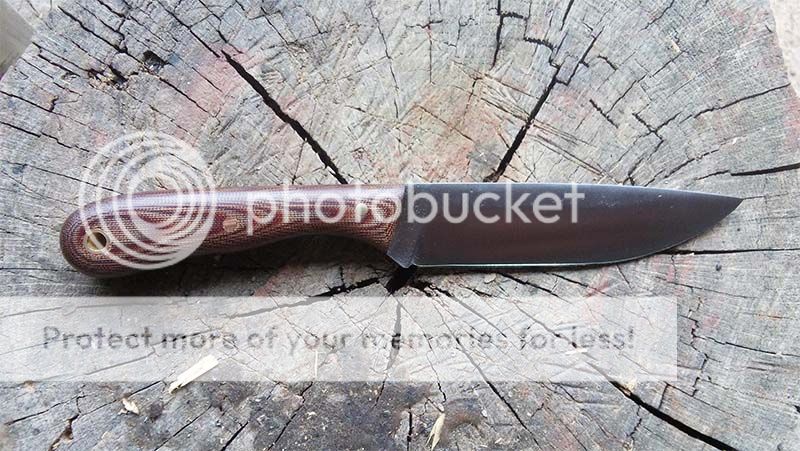
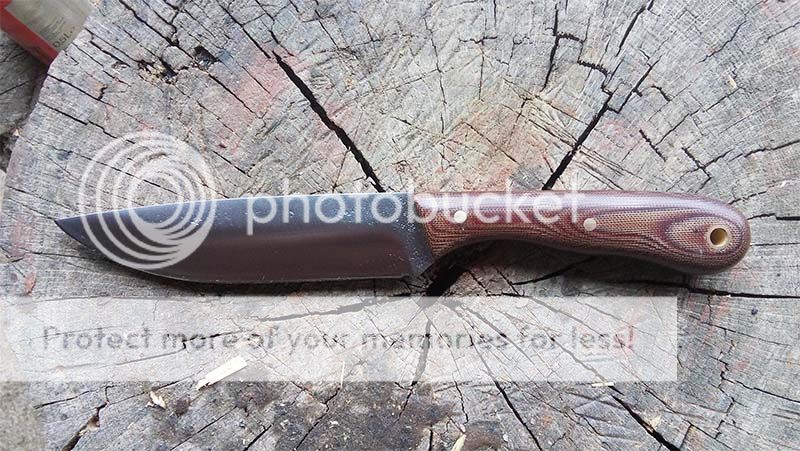
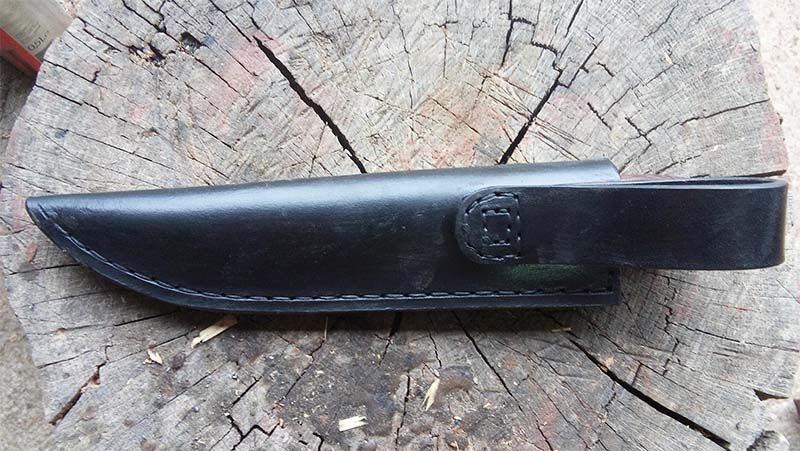
The "do everything" fixed blade shape.

Stone age hominids of limited intelligence figured out long ago that no single tool could "do it all". This primitive understanding predated homo sapiens. I'm struggling to ignore natural instincts that are descendant from 2.6 million year old principles of survival, to choose the one hypothetical "do it all" tool or shape of tool. I'm simply too evolved to limit myself that way.

Honestly, it really isn't about some sort of hypothetical. It is more about what kind of shapes lend themselves most readily to the most tasks. This can be entirely happenstance - the knife that you find yourself using in wider variety of tasks, or could most easily be pressed into service in the most places.
 
I don't know if it can "do everything"... but it has handled everything I've thrown at it...


6y3a7c.jpg

i58aop.jpg

302xthj.jpg

29zbxty.jpg

fwo9bm.jpg
 
I would say that the kephart, nessmuck, hudson's bay, pukko, and bowie patterns have been "do everything" blade shapes for a long time. Also Japanese tanto and keydashi patterns, I'm sure there are others that I'm not as familiar with.
It would be easier to pick out the specialist knife patterns, such as daggers, skinners (including beaver or muskrat pattern skinners) Flensing knives, weapon retention blades (kabar tdi and similar) or the various fighting knives/bayonets/ smatchet blades.

As a general utility blade, I would say that the oldest would likely be blades with flat "scandi" or chisel grinds, or small near full flat grind blades since for a very long time, steel would not be suited to the uses we put it through today. Blades would have likely been rather delicate compated to today's standards, so a lot had to be done with little, where now we can rely on the strength of modern steels.

The blade with the fewest specializing features would be the most generalist, most "vanilla" blade. It would need to have a very neutral handle shape to allow all grips equally well, a moderate belly, but a ratio of belly to straight blade edge. And a strong, but useable point. So basicly a kephart, with a broomstick handle, and no blade extension below the grip line. Useful, but arguably not ideal for really any work at all. Everything else is some evolution to improve some aspect therein. Be it finger clearance, safety, finer or stronger point. Everything is going to have some cost of another aspect.

As to the idea that people would have access to only one blade I think that is pretty limiting. Consider that while many would own a knife that was primarily for food prep, any trade's person would have a knife or knives that pertain to that trade. A soldier would also have weapons, but the practicalities of life in a mobile camp would have included larger blades for breaking up animal carcasses for food, and axes for firewood. A carpenter would have many which over time go from being axes and drawknives, to bent spoke-haves, and adzes. A farmer would have root knives, hoes, and blades for animal surgery as well as butchery. Consider that some sickle knives are cut to be used with either the right or left hand. That level of specialization would have likely been common when farm tools were either made to order, or made by the user. Even a white collar worker would have had blades suited to his profession, penknives, and other such patterns.

Considering all factors, I think the "for me" do all pattern would be a broad bladed, full flat grind knife with a fairly neutral handle, relatively short blade, and fairly thin.
Given the advantages provided by moderns steels, I'm thinking very much along the lines of the ESEE-3-MH, but with a straighter handle, cpm-3V. Nothing really flash there, but probably not suited to hours of woodwork.

 
Most 3-6" blades with a sharp edge "will do anything" for most people until a better tool is required as the "will do" is more "won't do", so stop being lazy and go and get the proper tool for the job.

A lot is tradition, culture and what someone personally likes. The grind and how keen an edge someone prefers. I am going for smaller and keener blades than I used to. A comfortable handle and lighter weight. Small knives I want to cut and I'm unlikely to abuse them. I have a selection of knives for different tasks and they all do anything I want them to do but I don't use them for everything, just what they are good at. So I don't believe in one knife do everything. I have a few that have more utility than others so will do more jobs until its time to get the more efficient one out.

I can hack up a fish with a hunting knife but a filleting knife is better for fish. I've done most things with a Victorinox Huntsman and a CRK Project II but neither do the job as well as a more specialised blade for a particular job.

(It makes me cringe watching Ray Meers hack up a fish with his crap Bushlore knife, or Bear Gryls sawing on something with a blunt blade.)
 
Most 3-6" blades with a sharp edge "will do anything" for most people until a better tool is required as the "will do" is more "won't do", so stop being lazy and go and get the proper tool for the job.

A lot is tradition, culture and what someone personally likes. The grind and how keen an edge someone prefers. I am going for smaller and keener blades than I used to. A comfortable handle and lighter weight. Small knives I want to cut and I'm unlikely to abuse them. I have a selection of knives for different tasks and they all do anything I want them to do but I don't use them for everything, just what they are good at. So I don't believe in one knife do everything. I have a few that have more utility than others so will do more jobs until its time to get the more efficient one out.

I can hack up a fish with a hunting knife but a filleting knife is better for fish. I've done most things with a Victorinox Huntsman and a CRK Project II but neither do the job as well as a more specialised blade for a particular job.

(It makes me cringe watching Ray Meers hack up a fish with his crap Bushlore knife, or Bear Gryls sawing on something with a blunt blade.)

Bunch of great points... ( ;) ) But yes 3-6" is to me a versatile range. I tend to find myself want more length with 3". And while a trailing point give more effective cutting edge for the length I find then harder control when doing fine work with the tip... (maybe partially because I rarely use them.) I prefer a drop point because its harder to catch the tip on thing unintentionally, and the lower point is easier to control for me relative to the axis of the grip. SO much so I had my SPyderco Farid K2 converted to drop point. :)

I prefer keen edges As keen as I can reasonably apply and maintain on my knives. Also I have found that I also prefer thinner grinds and lower secondary bevel angles. While it may make them less strong overall it also makes them sharper, give more edge retention in cutting, and more versatile in terms of angles and depths of cuts in some applications. This suits my general use more. Less force to do more is where I've been heading with my knives. And I have been very pleased with the results.

The OP's picks are some fine general purpose blade shapes.
 
For me, a tie between the traditional puukko and the trailing point. Uncle Ethan hit it out of the park with the BK-15, I think. There is also the big chopper design of the early Spanish belduques, which look for all the world like enormous chef's knives. They all have in common the lack of a finger guard, which permits coming down flush on a flat surface with length of the blade (well, nearly all, in the case of the 15).

Zieg
 
That is exactly why more to go on with the question would be helpful. As it stand you ask for one knife to do everything. No other perimeters. That right there is fiction. No such situation would exist for me. I would not need one knife to do everything. I'd have other tools available, like a SAK. As the vague question stands I answered it!

Oh, craytab...you are missing the point entirely. No doubt deliberately so you can continue your endless bickering.

You see, by presenting this "do everything" premise with no initial conditions, and eliciting responses from people to state their opinions/preferences, then one can pick any of the innumerable things that a knife might do, point out that the blade shape someone prefers does not do that well, and prove their opinion/preference wrong!

It's fun!

I'll toss out some examples for folks to use:

"But you wouldn't be able to cape a Kitti's hog-nosed bat with that. Not a "do everything" shape. Your opinion is wrong."
"Good luck stabbing through a 55 gallon oil drum with that! Not a "do everything" shape. Your opinion is wrong."
"Try making waffle fries with that! Not a "do everything" shape. Your opinion is wrong."

I, for one am enjoying the way the thread is going, and if you dont have a blade shape to add, please stay in W&C. Good day.
 
I have the custom pictured below en route as we speak.
4 3/4" blade (52100), 9 1/4 OAL, just over 1" blade height and built with being my "goto" general duty knife in mind.
finish1_zpsgjfzdzk0.jpg

finish2_zpsvamakyeu.jpg

finish3_zpspe3i8bro.jpg

finish4_zpsvtcirvlu.jpg

finish5_zpsnnt2tuan.jpg

Between this, my Cruwear Manix 2, and a Traditional Whittler, I should be fine on the small knife aspect.

Edit to add:
JK Knives Galley Wag (small) and Cutlass (large) would make for some nice additions too...
Snake wood shown below
DSC_9217.JPG

(Not my photo, the knives belong to Protourist).
 
Last edited:
Bunch of great points... ( ;) ) But yes 3-6" is to me a versatile range. I tend to find myself want more length with 3". And while a trailing point give more effective cutting edge for the length I find then harder control when doing fine work with the tip... (maybe partially because I rarely use them.) I prefer a drop point because its harder to catch the tip on thing unintentionally, and the lower point is easier to control for me relative to the axis of the grip. SO much so I had my SPyderco Farid K2 converted to drop point. :)

I prefer keen edges As keen as I can reasonably apply and maintain on my knives. Also I have found that I also prefer thinner grinds and lower secondary bevel angles. While it may make them less strong overall it also makes them sharper, give more edge retention in cutting, and more versatile in terms of angles and depths of cuts in some applications. This suits my general use more. Less force to do more is where I've been heading with my knives. And I have been very pleased with the results.

The OP's picks are some fine general purpose blade shapes.

3" was just to catch folders, and I've ben using some smaller S?K GSO's. I carried and used a 7" CR Poject II for many years and still love it. Longer blades I prefer the long and slim rather than the fat trout that the trend is at present.
Drop points are tough and fine but I do miss that they don't catch a skin, when first starting a grallock. Skinning then back to a drop point. Some work requires a tip and a lot doesn't.
Completely agree sharp and keen please. I want to cut with less force. I do understand that there has to be some metal behind the edge for cutting tough materials, or for impact toughness, but do we need quite so much? If I want a chopper then I'll take a chopper like the Skrama (my new find), or a real chopper which is an axe.

I also don't like to carry excess weight. There are far to many knives carry far too much weight. Big Mac blades, too wide in the belly, too thick and far too much tang.
 
Any of these four Waterstoneblades work really well for a variety of tasks based on my experience. All are thin behind the edge with thin grinds; the way a knife is supposed to be. ;):thumbup::D

The top knife has a 4.5" blade for size reference. :thumbup::cool:

25237470313_d43358c47d_c.jpg
 
It's so weird to me! A lot of my favorite fixed blade shapes remind me of a Sodbuster blade. In general I don' t like the sodbuster shape on a soddie yet in a fixed blade I think it's totally appropriate!
 
Trailing points are extremely versatile. :thumbup:

I agree. The BK-15 is one of my favorite woods knives. Been thinking about getting something along the same line that Bark River makes. I like the shape a lot and it is quite versatile for me. It is an easy to control shape in a modest sized fixed blade.
 
Last edited:
When I envision a scenario in which I have no choice but to use one knife for all of my needs over an extended period of time I think of an extended camping/backpacking trip. In that type of scenario, out of my knives I'd choose LT's Camp MUK:


I'm sure that there are things that this blade wouldn't do well, but I haven't yet found them. I got this one last spring and it was my go-to knife on a dozen or so camping trips last year and never left me wanting. It wasn't the only knife I used, but it could have been without much trouble.
 
Czechmate, that collection would have been able to be replicated all around the world 100 years ago. That type of selection is more than able to cover the vast majority of cutting tasks that are necessary in life. There were other tools to do the heaver cutting jobs and certainly those heaver tasks were no place for a knife. Yet in these modern times where cutting isn't very important (we have machines and industrial machines that do the donkey work of cutting) the trend is to build and design alternatives. Some modern knives aren't that good at being a cutter.

One reason for the change is not many people use a knife for extended work. Its the recreational market and many designs are more trends than practical. However, there are some excellent items to be had if selective. There is a market, even collectors market. Heck a fantasy market too. Some outstanding craftsmanship too. A true indication of how well we live, me thinks.
 
I second the Survive Knives GSOs...they all have basically the same (ish) blade shape, & it's just a very well rounded do-a-lot shape. For me personally, I like two blade types/shapes in particular...a drop point with a descent belly, and then a pointier Kephart shape - I happen to be receiving an example of each knife this week from two fantastic custom makers; well I've already got the shorter drop point knife in hand & I'm excitedly waiting for the longer pointier knife this week, here they are:

View attachment 631524View attachment 631525View attachment 631526View attachment 631527View attachment 631528
 
I second the Survive Knives GSOs...they all have basically the same (ish) blade shape, & it's just a very well rounded do-a-lot shape. For me personally, I like two blade types/shapes in particular...a drop point with a descent belly, and then a pointier Kephart shape - I happen to be receiving an example of each knife this week from two fantastic custom makers; well I've already got the shorter drop point knife in hand & I'm excitedly waiting for the longer pointier knife this week, here they are:

View attachment 631524View attachment 631525View attachment 631526View attachment 631527View attachment 631528

Despite being practical, those are gorgeous knives.
 
.....As a general utility blade, I would say that the oldest would likely be blades with flat "scandi" or chisel grinds, or small near full flat grind blades since .....where now we can rely on the strength of modern steels.

The blade with the fewest specializing features would be the most generalist, most "vanilla" blade. It would need to have a very neutral handle shape to allow all grips equally well, a moderate belly, but a ratio of belly to straight blade edge. And a strong, but useable point. So basicly a kephart, with a broomstick handle, and no blade extension below the grip line. Useful, but arguably not ideal for really any work at all. Everything else is some evolution to improve some aspect therein.....Considering all factors, I think the "for me" do all pattern would be a broad bladed, full flat grind knife with a fairly neutral handle, relatively short blade, and fairly thin......

I've always felt leukus were best for all around outdoor use. You pretty much nailed it....
 
Back
Top