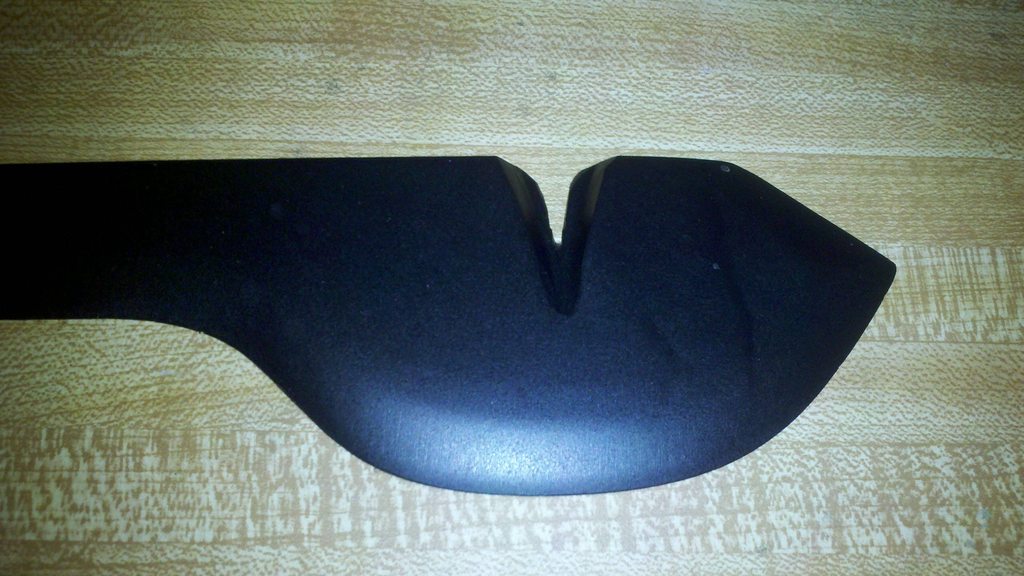
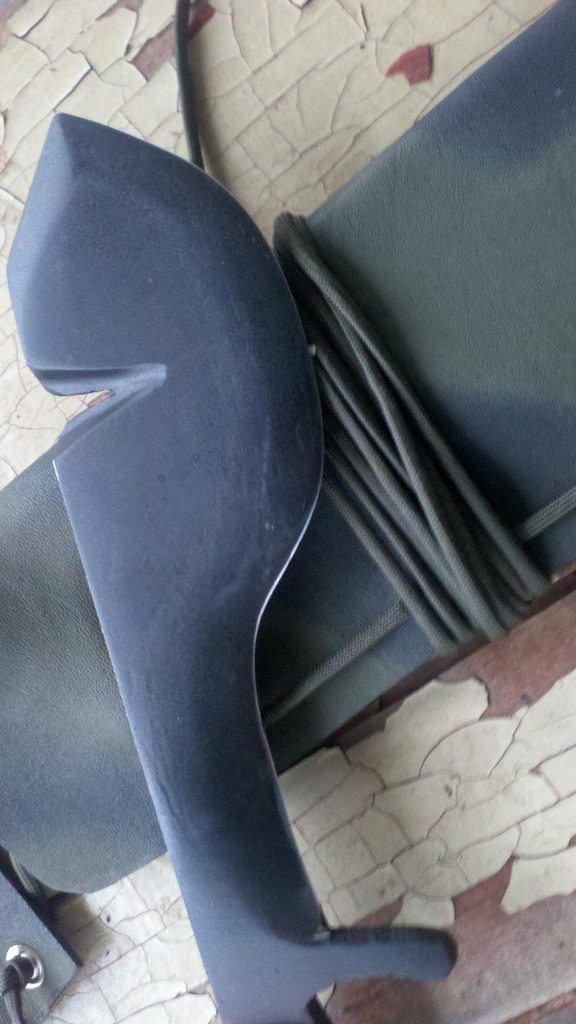
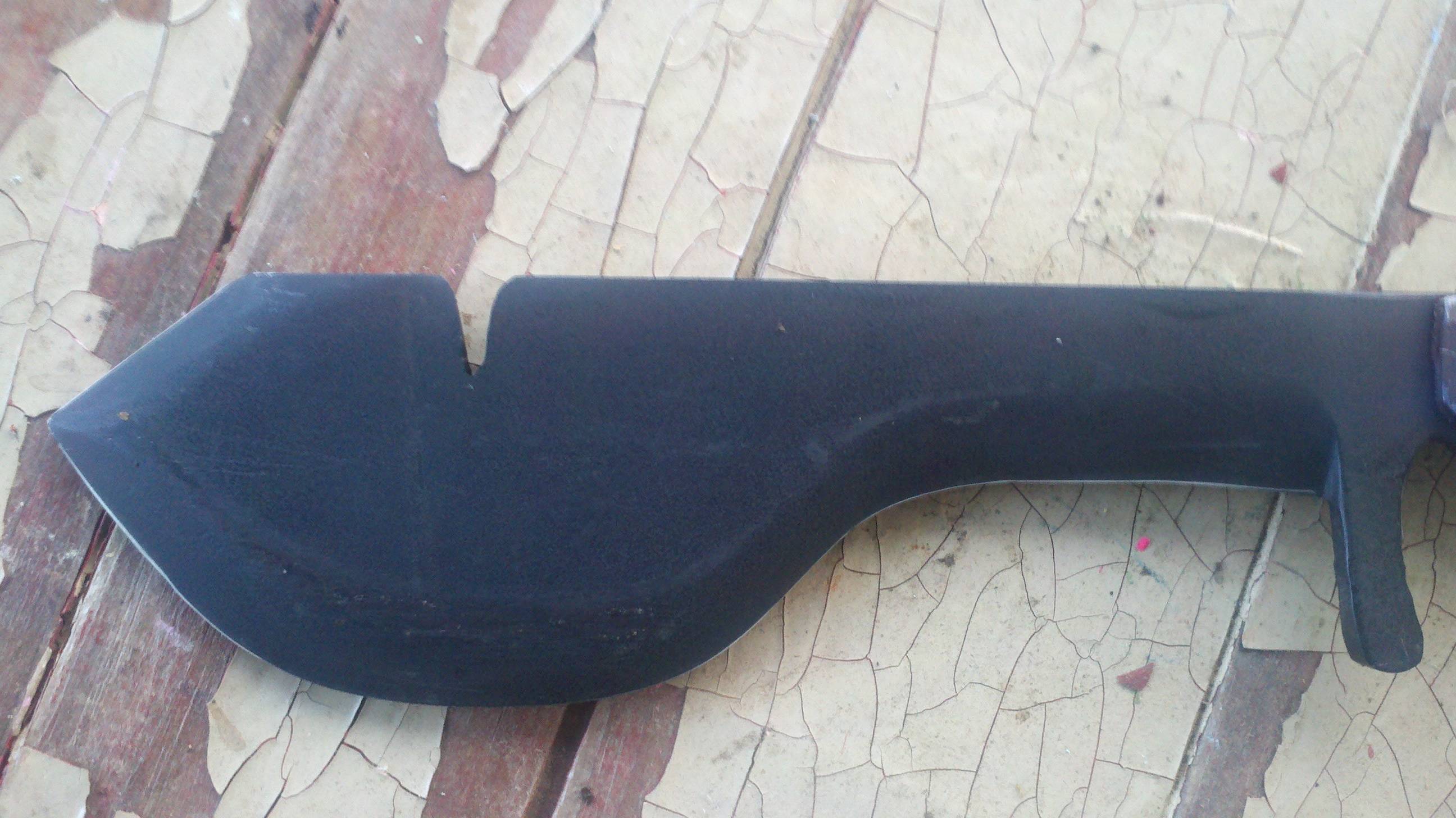
The Knife that Shouldn't Be.

Joined
Feb 2, 2012
Messages
94
Final tests and finished product.

I call this prototype the BHX02 and I'm naming the model "The Hog". I'm very happy with it.

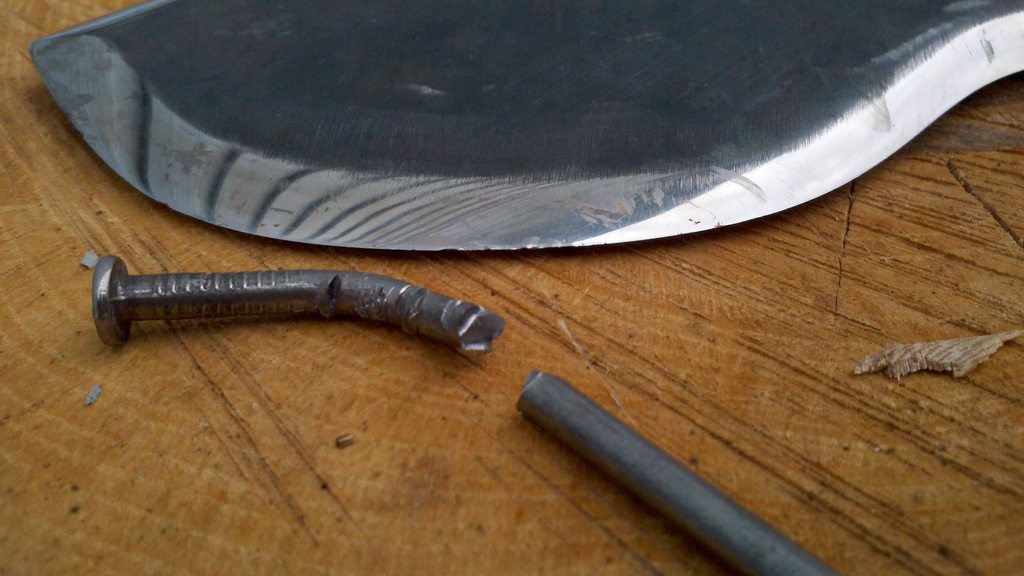
It cut this nail with a firm chop, but both halves went flying and were not recovered. NOTE that there was already a chip in the blade (we've been hard on this thing)
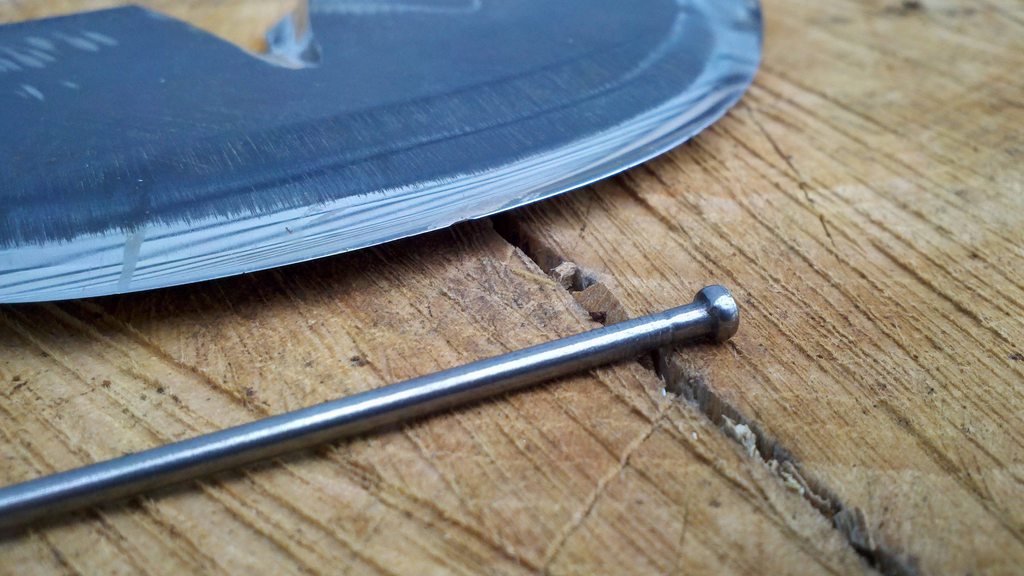
HSXm3h.jpg


Took some practice chops and one monster chop, nicked the blade up a bit.
HNC3qh.jpg


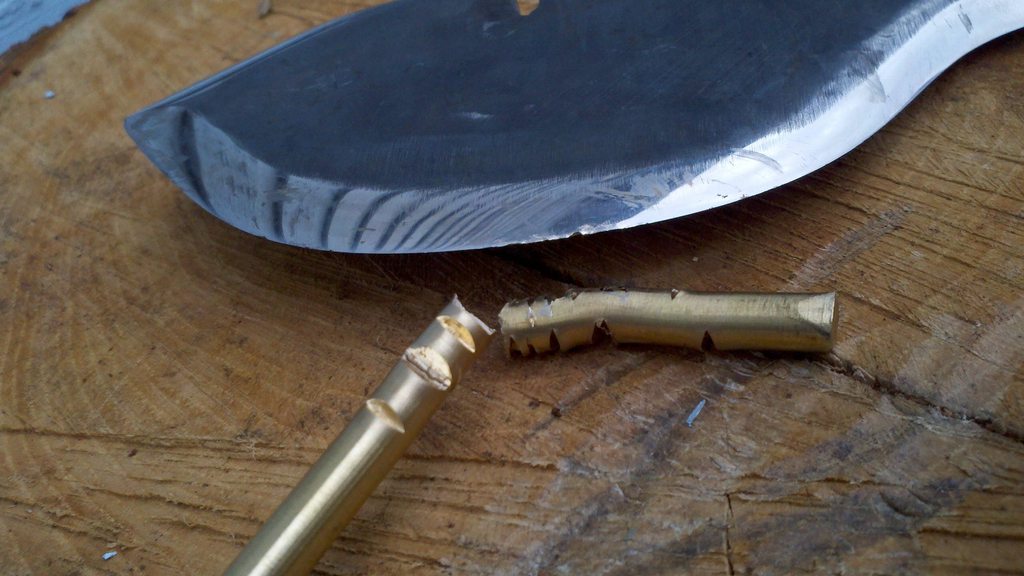
Tough stuff, a lot of work, 1/4" brass rod, no new damage to the knife though.
8K4aTh.jpg


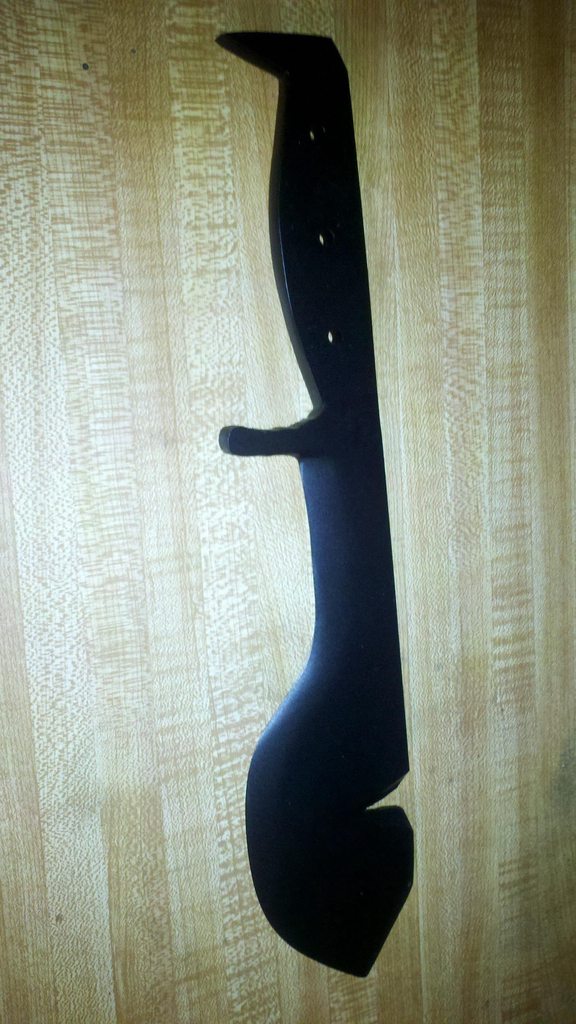
Reformed the edge, sprayed with Gunkote, and ready for bake.
qBjn7h.jpg

sWLCzh.jpg


I made the mistake of doing the final polish on the edge after the Gunkote, and marred it pretty good, the second application of Gunkote already had the handle scales on, and I couldn't bake it properly. It'll flake off.


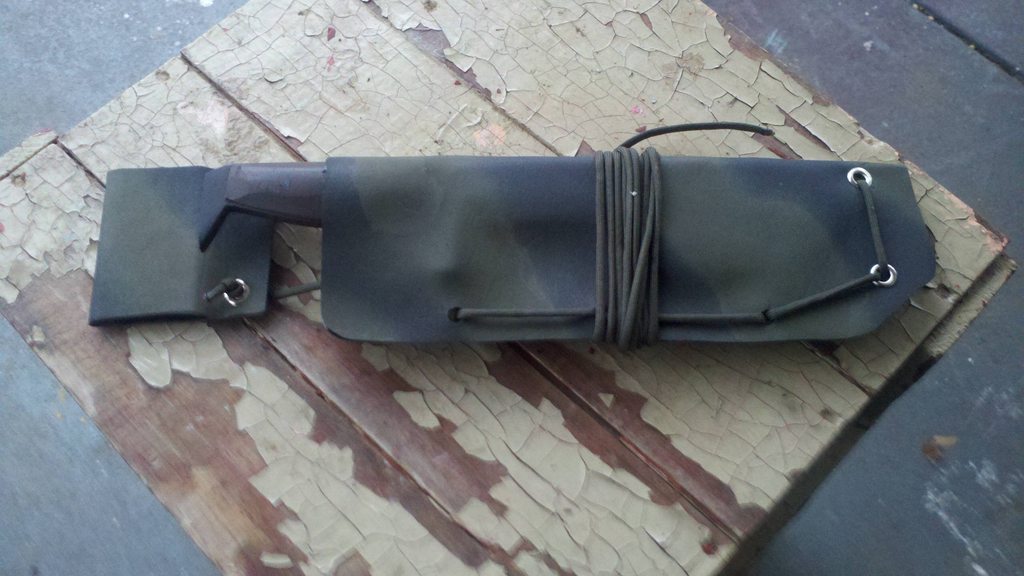
Finished and done. Kydex sheath. Plastic scales. Paint doesn't stick, but it'lll do. I need some good wood. I have access to some. I'll look into it.
h4VObh.jpg

wVKGXh.jpg

zqA2Vh.jpg


My friend has some videos of how some of those nicks got there. I hope to have those up soon.

I'm very satisfied overall with the design aspects. Gut-hook and nail puller do the job but may be more trouble than they are worth. I'd still like some decent Chicago or post and barrel type screws to put the scales on, but the brass brads do very well. The eyelets and setter I got for the sheaths are JUNK. Looking into better of the same there. I'm anxious to make more!

Again, it's A2, hardened and double tempered to 55RC, 20 degree convex edge, 20oz blade.

I'm going to look one last time at different steels, maybe one cheap tool steel option and one higher end option, possibly 1095 and D2.

Album with all photos of process and tests. BHX02 - Imgur

Forum posts with additional info, process and tests.

http://www.gunandgame.com/forums/survival-gear/147702-bhx-02-update-2-a.html
http://www.gunandgame.com/forums/survival-gear/148265-bhx-02-back-heat-treat.html

I came here for two reasons. The first is to say thank you. Some of the people here were exceedingly helpful, and the wealth of information here is unmatched in my findings. While I have been silent I have done some lurking and learned a great deal. More than I should need. So, I extended the sincerest "thank you."

The second reason I came here was to say "I did it." While the information here was very helpful and some of the members were most courteous and obliging, the prevailing attitude I perceived was "You can't do that, and why would you want to?" I never asked if I could do it. You wouldn't know if I could. I knew I could.

The only object of concern should be "this person wants to accomplish his/her objective." And either help, or get out of the way. Time and money were much tighter than I had anticipated, so it has been 2 years, but I did it, and did it without much struggle, just time and money. It would have been much more constructive and less time consuming to offer alternatives for the more expensive or daunting tasks, which I found later.

Never let what you say be demeaning or belittling. If someone can do something, good for them, if they can't, they'll be back for more of your gracious help.

Again, thank you all for your help. I'll be around.
 
Last edited:
I don't see anything that "shouldn't be" with this knife. I do see many flaws from a construction/performance perspective but those kind of things get ironed out with experience. I noticed in your link that you plan on selling these blades as soon as you can. I think that would be a mistake. You need to do more testing and growing before you release it to the public. There is a certain responsibility that a toolmaker owes to the folks who would put their trust in your ability. I don't think you are there yet. You have only just begun... you know this.

I'm glad you didn't let negative comments put you off from trying things but you need to be honest with yourself your craft and your potential customers.
 
Hi Barry,

I was wondering why the nail puller on a knife? Is this designed for a situation where you would not have a hammer or pry bar on hand?

That nail puller right dab smack in the middle of the blade is a HUGE stress riser and at the hardness a knife requires might really cause that blade to break with heavy use over time.

Now if I really had to have a nail puller on a knife I probably would incorporate it at the rear of the tang and heat treat that area accordingly. At a 1/4" thick you could hammer with the spine of the knife and pull nails with the butt..... but then again that is starting to sound like a hammer with and edge :)

Keep us posted as you refine your design.
 
Final tests and finished product.

I call this prototype the BHX02 and I'm naming the model "The Hog". I'm very happy with it.

It cut this nail with a firm chop, but both halves went flying and were not recovered. NOTE that there was already a chip in the blade (we've been hard on this thing)
Tough stuff, a lot of work, 1/4" brass rod, no new damage to the knife though.

I made the mistake of doing the final polish on the edge after the Gunkote, and marred it pretty good, the second application of Gunkote already had the handle scales on, and I couldn't bake it properly. It'll flake off.

Finished and done. Kydex sheath. Plastic scales. Paint doesn't stick, but it'lll do. I need some good wood. I have access to some. I'll look into it.
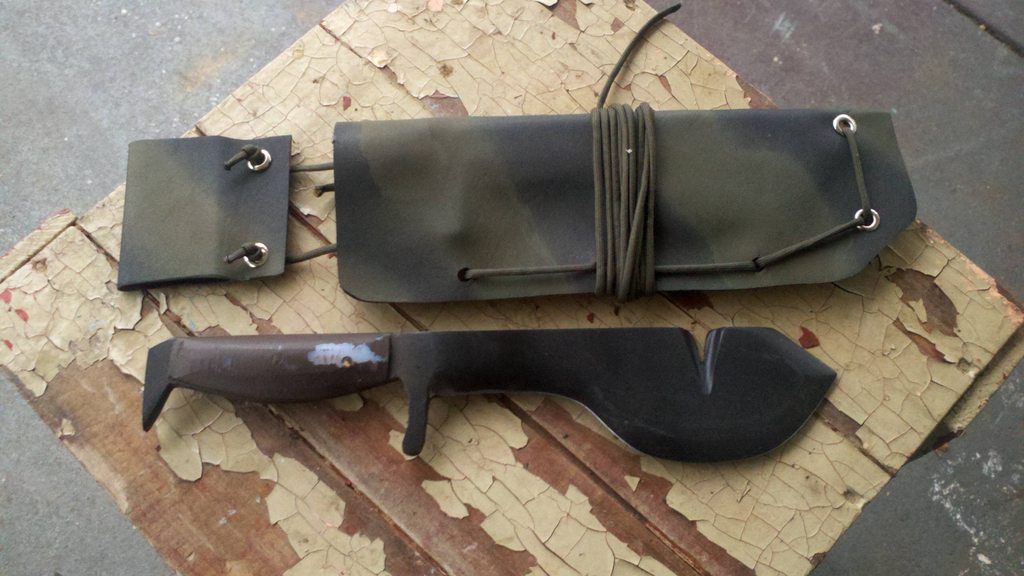
h4VObh.jpg


Again, it's A2, hardened and double tempered to 55RC, 20 degree convex edge, 20oz blade.

I'm going to look one last time at different steels, maybe one cheap tool steel option and one higher end option, possibly 1095 and D2.

I came here for two reasons. The first is to say thank you. Some of the people here were exceedingly helpful, and the wealth of information here is unmatched in my findings. While I have been silent I have done some lurking and learned a great deal. More than I should need. So, I extended the sincerest "thank you."

The second reason I came here was to say "I did it." While the information here was very helpful and some of the members were most courteous and obliging, the prevailing attitude I perceived was "You can't do that, and why would you want to?" I never asked if I could do it. You wouldn't know if I could. I knew I could.

The only object of concern should be "this person wants to accomplish his/her objective." And either help, or get out of the way. Time and money were much tighter than I had anticipated, so it has been 2 years, but I did it, and did it without much struggle, just time and money. It would have been much more constructive and less time consuming to offer alternatives for the more expensive or daunting tasks, which I found later.

Never let what you say be demeaning or belittling. If someone can do something, good for them, if they can't, they'll be back for more of your gracious help.

Again, thank you all for your help. I'll be around.

I don't see anything that "shouldn't be" with this knife. I do see many flaws from a construction/performance perspective but those kind of things get ironed out with experience. I noticed in your link that you plan on selling these blades as soon as you can. I think that would be a mistake. You need to do more testing and growing before you release it to the public. There is a certain responsibility that a toolmaker owes to the folks who would put their trust in your ability. I don't think you are there yet. You have only just begun... you know this.

I'm glad you didn't let negative comments put you off from trying things but you need to be honest with yourself your craft and your potential customers.

Hi Barry,

I was wondering why the nail puller on a knife? Is this designed for a situation where you would not have a hammer or pry bar on hand?

That nail puller right dab smack in the middle of the blade is a HUGE stress riser and at the hardness a knife requires might really cause that blade to break with heavy use over time.

Congratulations on finishing it.
There are many first time makers who start strong and never finish.

I agree with testing and refinement and also agree that that big notch is prone to failure.
at the very least there will be someone who will do it on purpose just to "show you up" because they can.
You can search "blade testing" for people that chop concrete and steel until blades break just for fun.

The brass rod and nail test is interesting and makes me want to try A2 at some point.

I have some questions.

Who HT'ed it for you ? Looks like it was pro done
In the Kydex photo above, why not put eyelets in all the holes ?
Have you used that paracord drop legged sheath before ?
After 4, 5, 6 hours of walking through a rough trail I'd be really really fed up with the way it flapped around against my leg.
Have a look at other similar sheaths and look at kydex with a swivel instead.

Why put that nail puller in the middle of the blade?
In a survival situation I can envision having to pry, pound a nail, cut stuff, chop stuff but not nail pulling


If you had gone concave like a kukri instead of convex I would have had much less resistance.
An inward curve directs force towards the cut, while that outside curve pushes the knife out of the cut and possibly towards you .


Again
I agree with testing and refinement before you sell any. I also agree that that big notch is prone to failure.
I'm sure you would rather be known as the guy that sold me that awesome zombie hacker vs that guy that took me for the awful POS...
 
Last edited:
I don't see anything that "shouldn't be" with this knife. I do see many flaws from a construction/performance perspective but those kind of things get ironed out with experience. I noticed in your link that you plan on selling these blades as soon as you can. I think that would be a mistake. You need to do more testing and growing before you release it to the public. There is a certain responsibility that a toolmaker owes to the folks who would put their trust in your ability. I don't think you are there yet. You have only just begun... you know this.

I'm glad you didn't let negative comments put you off from trying things but you need to be honest with yourself your craft and your potential customers.


Absolutley. It's not perfect, but it fulfills it's purpose. I am satified that they do more than I need them to, but do have a few things to perfect. I got sloppy and in a hurry towards the end. Made mistakes and learned on this one.

I'm only in a hurry to sell some because my friends are breathing down my neck for them. I'm not ready for mass production.
 
Last edited:
Congrat's on your first knife. I definately think there is a lot of improvement needed before you plan to sell them. I too don't think the nail puller thing works? I also think that sheath would be very uncomfortable swinging around and would do much better with a fixed belt loop of some type. Overall as a first knife and sheath it is a great start. Congrat's.
 
Hi Barry,

I was wondering why the nail puller on a knife? Is this designed for a situation where you would not have a hammer or pry bar on hand?

That nail puller right dab smack in the middle of the blade is a HUGE stress riser and at the hardness a knife requires might really cause that blade to break with heavy use over time.

Now if I really had to have a nail puller on a knife I probably would incorporate it at the rear of the tang and heat treat that area accordingly. At a 1/4" thick you could hammer with the spine of the knife and pull nails with the butt..... but then again that is starting to sound like a hammer with and edge :)

Keep us posted as you refine your design.


I wanted to explore the concept of totally replacing a hatchet and hammer, but it's not worth what it takes from the blade. I prefer the gut hook or wire breaker.

I proved that I could make it work, but it's not totally for me. I could do it a bit differently and 'make do' as a nail puller and retain more strength.
 
Congratulations on finishing it.
There are many first time makers who start strong and never finish.

I agree with testing and refinement and also agree that that big notch is prone to failure.
at the very least there will be someone who will do it on purpose just to "show you up" because they can.
You can search "blade testing" for people that chop concrete and steel until blades break just for fun.

The brass rod and nail test is interesting and makes me want to try A2 at some point.

I have some questions.

Who HT'ed it for you ? Looks like it was pro done
In the Kydex photo above, why not put eyelets in all the holes ?
Have you used that paracord drop legged sheath before ?
After 4, 5, 6 hours of walking through a rough trail I'd be really really fed up with the way it flapped around against my leg.
Have a look at other similar sheaths and look at kydex with a swivel instead.

Why put that nail puller in the middle of the blade?
In a survival situation I can envision having to pry, pound a nail, cut stuff, chop stuff but not nail pulling


If you had gone concave like a kukri instead of convex I would have had much less resistance.
An inward curve directs force towards the cut, while that outside curve pushes the knife out of the cut and possibly towards you .


Again
I agree with testing and refinement before you sell any. I also agree that that big notch is prone to failure.
I'm sure you would rather be known as the guy that sold me that awesome zombie hacker vs that guy that took me for the awful POS...

Friends of mine own and run a machine and tool shop. They did the plasma cut and heat treat for me.

My forge build is on the back burner.

I like the convex, very sturdy. Chops fine, slpits like a champ. Easy to form. By making it gradual chopping and cutting are a breeze.

I haven't worn a paracord drop leg into the woods before. Looking forward to it. I'd love a swivel.

The eyelts I got were junk. The pliers bent and the eyelets fell out. I'll get some better ones.

Did I leave anything out? Thanks Count.
 
This is a different perspective on the nail puller.

XoFbG.jpg


It leaves plenty of steel for strength, I think. It's not totally worth the labor, tool, stress point, and chance of ruining a knife by cutting so much by hand.

It works, it can be done, but it's not for me.
 
It works, it can be done, but it's not for me.
I still don't understand why someone would tell you it couldn't be done. Almost anything can be done... whether it should be is usually the dilemma.

My suggestion is to reduce the angle of your bevels and go with a full convex or v-grind. Thinning out the bevels would increase cutting performance with little to no effect on strength/toughness. You would be surprised at how thin you can go with proper geometry.

I also question the 55HRC tempering. That is WAY low for A2. You could do much better at 58HRC and probably get away with 60HRC. Your over-engineered geometry is compensating for the lack of hardness, but at the expense of cutting performance.

Your design resembles the Spetsnaz machete... which is held with high regard by many, so you are in good company.
 
I still don't understand why someone would tell you it couldn't be done. Almost anything can be done... whether it should be is usually the dilemma.

My suggestion is to reduce the angle of your bevels and go with a full convex or v-grind. Thinning out the bevels would increase cutting performance with little to no effect on strength/toughness. You would be surprised at how thin you can go with proper geometry.

I also question the 55HRC tempering. That is WAY low for A2. You could do much better at 58HRC and probably get away with 60HRC. Your over-engineered geometry is compensating for the lack of hardness, but at the expense of cutting performance.

Your design resembles the Spetsnaz machete... which is held with high regard by many, so you are in good company.

I did 2 knives, one with very smooth shallow bevels, almost a flat grind (the one not pictured here) and I MUCH prefer the way it cuts and chops, while this one seems stronger. I deemed that the shallower bevels were more practical, and smoothed the bevels out on this knife a bit between the top uncoated pictures and the lower pictures of the finished knife, though it may not look it in the pictures.

My ideal would be an almost flat grind, with a convex bevel at the rear. That is a lot more time and tool, but it is totally worth it for the cutting performance.

I had looked around at some other hard use knives and they were as low as 53-54, so I shot for 56 on my heat treat which seemed to be a good balance point for strength/hardness for A2 in my hard use knife, but after the double temper 55 is what it tested at. Given the chipping I was experiencing I thought that 55 may be too brittle and it held an edge better than any knife I have bought while working with the wood. I had hoped to shoot for 58, but my machinist friend talked me into 56, but it didn't take much persuasion. I was already worried about it being brittle.

Still I'd love to see maximum edge retention and 59HRC but that's worthless if the edge chips under hard use. I'm perfectly open to suggestion to any alternatives to the steel used, and any points on how much strength I need for 1/4" steel. The price was good, and the air cooling was a huge benefit, as with the odd shapes it did still warp a little. After hitting it some more with the belts it wasn't noticeable.

If I did another nail puller design I'd like a teardrop hole in the center of the belly, with the point/V towards the tip, but that's a great deal more precision than I'm prepared to execute. Perhaps I should start practicing that.
 
Hi Barry,

Take a look at this on what causes stress risers

http://en.wikipedia.org/wiki/Stress_concentration

I do see, and I see how any notch creates a dramatic reduction in strength by creating an unsupported load bearing surface, like a floating balcony on a building.

I read that the fine point, like a crack increases the stress dramatically again by concentrating the stress to a fine point, this had not occurred to me, and is not at all desirable. I now understand how even though I have sufficent width in the steel, the manner in which the stress concentrates on the fine point is unacceptable.

If I should hope to include a nail puller in the design, is there a way to do it better? I had considered a tear drop inside of the blade, but thought better of the skill required, but the over all usefulness and appearance would be much more desirable to me, and worth inclusion in my own knife.
 
Well, seeing as you really have showed no interest in having your design, methods, or things your machinist friend told you critiqued, then I will just say this:

I am overjoyed that you like your knife. Keep having fun.
 
How is your machinist friend heat treating your blade? With what equipment? I worked in the tool & die industry for 15years and we did all our heat treating in-house. I can honestly tell you that the equipment we used would NOT work with knife geometry. I am speculating that your blade was severely overheated or the issue of retained austenite was not addressed, leaving untempered martensite over time. That is why is had to take such a low HRC to avoid chipping. Could you get him to outline his method?

I would be interested to see your source for the hard use blade at 53-54HRC.

A2 seems to be notorious for being "chippy" at any range of hardness. Perhaps another steel would serve your purpose better. On the other hand, Scott Gossman makes excellent hard-use knives using A2. He would be a good resource on that subject.
 
Last edited:
How is your machinist friend heat treating your blade? With what equipment? I worked in the tool & die industry for 15years and we did all our heat treating in-house. I can honestly tell you that the equipment we used would NOT work with knife geometry. I am speculating that your blade was severely overheated or the issue of retained austenite was not addressed, leaving untempered martensite over time. That is why is had to take such a low HRC to avoid chipping. Could you get him to outline his method?

I would be interested to see your source for the hard use blade at 53-54HRC.

A2 seems to be notorious for being "chippy" at any range of hardness. Perhaps another steel would serve your purpose better. On the other hand, Scott Gossman makes excellent hard-use knives using A2. He would be a good resource on that subject.[/QUOTE

He used a small programmable heat treating ovenand air quench. He suggested that he had worked with A2 before and made cutting surfaces with it and the more agressive temper would be better for the metal. Given the chips. I think he was right.

I went into The Steel Store (Bohler Uddelholm) for D2, but they would have to order it in the thicknesses I was interestrd in, and after shipping or surcharges for such a small order or whatever they were, the cost difference was silly, so I took the A2 they had on hand.Everything I have read suggests that D2 would be tougher and resist wear and chipping better than A2 and if I order enough and wait for the scheduled shipping the cost difference per knife is perfrctly acceptable, but looking at the data has me scratching my head. The data from Uddelholm suggest that A2 is tougher. But it's all graphs, maybe I'm reading it wrong.

Frankly I am disappointed with the chipping. The edge retention is impressive, but again, useless if it chips.

Should I look more to D2 or somewhere else?

I may have been wrong on the HRC, it has been 3 years since I looked closely, but they were all commercial knives, Buck for one had many knives at that range and I saw many more made of 440c at that range. Of course Kabar keeps them closer to 58-60 and that's the survival knife to beat.

Not that it is perfect but there is a certain benchmark set by that sort of prolification.


The aparent flaw in my nail puller is driving me mad. It was only just passing, not completely satisfactory as I perceived it before. Now that I see it as unacceptable, it is driving me mad. I want to either drill the crotch of the V and give the knife away, or else destroy the knife, and I MUST create an adequate nail puller to satisfy my own . . . gumption. . .

Thanks for the positive and constructive comments.
 
What temperatures did he use?
What about after he heated it and air quenched it?(what did he do prior to tempering?)
Experience with cutting surfaces... like shear and blanking dies... or knives?
I would research different steels and when it comes time to HT, try out a professional that has experience with knives. No offence to your friend... the guys in our HT'g department were great at what they did(blanking, shearing, punches, endmills, drillbits, lift hooks, etc...) but would have screwed up a knife, for sure).
How much stock did you leave on the edge, prior to heat treat?
 
Last edited:
A2 is a great knife making steel. If it is chipping you need to look into the heat treatment technique.
 
What temperatures did he use?
What about after he heated it and air quenched it?(what did he do prior to tempering?)
Experience with cutting surfaces... like shear and blanking dies... or knives?
I would research different steels and when it comes time to HT, try out a professional that has experience with knives. No offence to your friend... the guys in our HT'g department were great at what they did(blanking, shearing, punches, endmills, drillbits, lift hooks, etc...) but would have screwed up a knife, for sure).
How much stock did you leave on the edge, prior to heat treat?

I left no stock prior to heat treat. I formed the edge down with 80 grit and sent it off, got it back, polished it up, and began testing. I think this suggests that the fault is my own. I have moved down reforming the edge below chips twice now. Perhaps I've gotten down the steel I ruined. How much should I leave to heat treat and them remove?

He's made dies and shears of course. He has made some knives and heat treated them, but only for one other person. He did all of the plasma cutting and heat treating for a total of $20 on 2 knives, and I was able to walk in so I couldn't argue.

He heat treated (if memory serves) to 1760F, and tempered both times to 980. Give or take 20 degrees for my memory.
 
Back
Top