The Knife that Shouldn't Be.

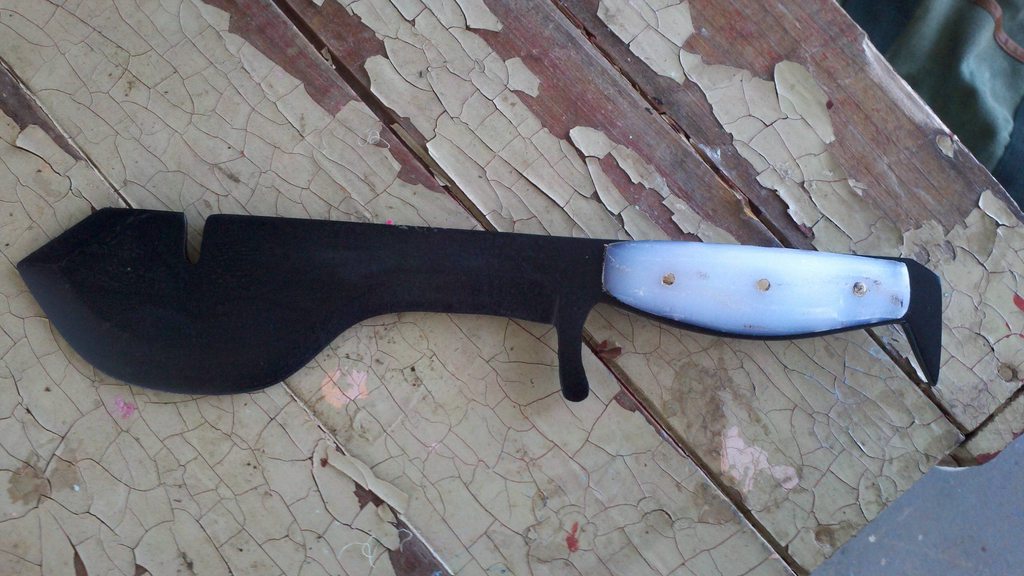
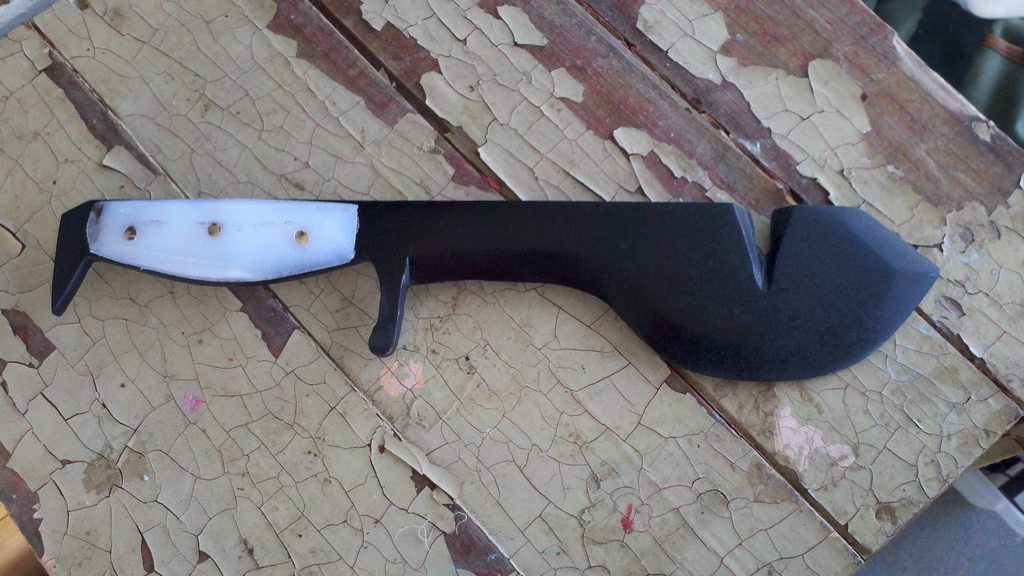
You guys really pushed me. I can't say that I like being scrutinized and criticized by some of the best (can anyone say that they enjoy that?), but you have caused me to rework the knife. I opened up the nail puller notch (still not keen on my own implementation of it, but it makes the crotch stronger), evened out the bevel, smoothed out the hand guard and even squared up the edges of the spine. I had originally posted this knife and called it "done" because I so hoped that it should be done, that I was done. Fact is that the knife was not up to my standards. I would not be satisfied with it for myself. You guys made me realize that I should not be so eager just to be done, but to have it done right, as is my custom and motto. Instead of looking at the knife hoping to call it done I went back to it and looked at it asking "what's not perfect?"

I fixed and touched up a lot. I can still see blemishes, damage I can't sand out, but that's where I learned what not to do. I'll avoid those mistakes in the future.

Thank you all for pushing me, making me realize what I need to do to be satisfied with these knives.

Here it is all sanded up. http://imgur.com/a/cbS53#0

The paint is drying now, then into the oven.
 
Last edited:
You guys really pushed me. I can't say that I like being scrutinized and criticized by some of the best (can anyone say that they enjoy that?), but you have caused me to rework the knife. I opened up the nail puller notch (still not keen on my own implementation of it, but it makes the crotch stronger), evened out the bevel, smoothed out the hand guard and even squared up the edges. I had originally posted this knife and called it "done" because I so hoped that it should be done, that I was done. Fact is that the knife was not up to my standards. I would not be satisfied with it for myself. You guys made me realize that I should not be so eager just to be done, but to have it done right, as is my custom and motto. Instead of looking at the knife hoping to call it done I went back to it and looked at it asking "what's not perfect?"

I fixed and touched up a lot. I can still see blemishes, damage I can't sand out, but that's where I learned what not to do. I'll avoid those mistakes in the future.

Thank you all for pushing me, making me realize what I need to do to be satisfied with these knives.

Here it is all sanded up. http://imgur.com/a/cbS53#0

The paint is drying now, then into the oven.

Very good to hear that! Listening to input and making improvements is a big part of what makes a good knifemaker.


I really like the concept and the general design, keep at it! :D
 
I think you have gotten some great advice already.

I would only add that I dislike the nail puller on aesthetic grounds, as well as the stress riser problem . Second I wonder if it might look better with some curves on the spine side, maybe an arched back like a kukri, or some relief to give balance to the curves on the edge.
 
I think you have gotten some great advice already.

I would only add that I dislike the nail puller on aesthetic grounds, as well as the stress riser problem . Second I wonder if it might look better with some curves on the spine side, maybe an arched back like a kukri, or some relief to give balance to the curves on the edge.

I agree.

Aesthetics aren't big. I try not ignore them, but my focus is on function. Clean lines make a blade glide, and look great though. The nail puller does add resistance stabbing, but over all makes it look rough and rugged. I like the look of it in that aspect, but it also just looks weaker, clunkier. Not what I'm going for.

Such curves and aesthetic balancing take away from the feel I want. I like the function of a Kukri, great choppers, but I like the straight spine for a more all round function, and it still chops like a beast.

Bottom line. The nail puller as it is is hard to use, and creates a huge stress riser. So, I can't recommend it. I'm still really looking at a tear drop in the center of the belly. It would be easier and safer to use, and much stronger. Of course it would be much more difficult to make, but I think I can manage it.

I'm open to suggestions. Naturally I have an angle grinder and a Dremmel and access to about anything else. What do you guys think the easiest way would be to create a teardrop nail puller in the center of the blade??

Before the count asks why I still want a nail puller, the real answer is, "to prove I can." I want to pack as much function into one knife as possible. Some of the guys asking about it are concerned about urban SHTF and I want to have an urban alternative to a gut-hook, just to say I can provide it. It's a challenge I hope to conquer.

Also, a bit inspiration is the hatchets I had as a kid which had nail pullers. Did I ever use nail puller in the bush? PSSSSH!. . . NO! But I loved having another useful doodad on my favorite tool! :-p

I did use the hatchets and nail puller around the house though. MIGHTY handy for pulling nails out of scrap wood before it went into the stove.

One other motivation was to dismantle my back deck with this very knife this spring. A good torture test. I still think I might. I like the idea of it. Might not pull too many nails now that I think about just chopping, prying and pulling though. :)
 
Last edited:
I'm a big fan of Gunkote for gun parts. As the coating wears the Molybdenum Disulfide in the epoxy lubricates the action. Great stuff, but I'm open to suggestions about coatings. I'd love to implement my air brush.

I've seen a lot on cerakote. It's supposed to be very long wearing and easy to stensil or air brush.
 
As good as this knife will get until I get some good scales. I'm thinking of using some hickory blocks I have ( cut 5 years ago kept in doors). The finish isn't sticking like it did the first time around. Perhaps I missed something in the directions.


I may break this one through use. I may give it as a gift.

Sorry I had some pics but the upload keeps failing.
 
Last edited:
I'm glad to see you guys diagree with each other, not just with me!

SO, what should I do differently to keep it from chipping under hard use?
 
The proto knife in the thread I posted is tempered 58-60 Rc. and it's a pretty standard recipe. Consistency is key. I'm not doing anything special other than plate quench. Also a major factor regardless of heat treat is edge geometry. I can't say my knife would hold up any better against nails...LOL I haven't tried it, but I soon shall.....just because.
 
So whether or not I grind to an edge before heat treating shouldn't matter?

I went with the angle I did and convex for strength. I think I made the right desicion.

So the consensus is, for a hard use Knife I need to shoot for 58+? I can do that but I worry about chipping and stress fractures.

I had thought about a freeze after quench. I think I can make negative 40 with only a little work.
 
So whether or not I grind to an edge before heat treating shouldn't matter?

I went with the angle I did and convex for strength. I think I made the right desicion.

So the consensus is, for a hard use Knife I need to shoot for 58+? I can do that but I worry about chipping and stress fractures.

I had thought about a freeze after quench. I think I can make negative 40 with only a little work.
 
So whether or not I grind to an edge before heat treating shouldn't matter?

I went with the angle I did and convex for strength. I think I made the right desicion.

So the consensus is, for a hard use Knife I need to shoot for 58+? I can do that but I worry about chipping and stress fractures.

I had thought about a freeze after quench. I think I can make negative 40 with only a little work.

You should always leave a bit of stock before heat treat. At least .010", IMO.

With your steep bevels, convex wouldn't make much difference in strength.

Hardness, geometry, and steel type ALL play an important part in performance. To paraphrase Roman Landes, "Geometry cuts, heat treat dictates how long".

-40F/C isn't cold enough to do anything... -200F is more like it.
 
You should always leave a bit of stock before heat treat. At least .010", IMO.

With your steep bevels, convex wouldn't make much difference in strength.

Hardness, geometry, and steel type ALL play an important part in performance. To paraphrase Roman Landes, "Geometry cuts, heat treat dictates how long".

-40F/C isn't cold enough to do anything... -200F is more like it.

Alright. Thanks.

I intend for the bevels to be very shallow. It cuts much better that way.

I had left them very steep on this knife because I figured it was much stronger, taking stress off the edge and adding heft to the blade from tip to hilt. Was I wrong? Do you still deem them steep on my rework? They are over 1" wide and very smooth/shallow to the touch. Much more like my other knife which had no visible bevel, just a very subtle curve.

I think I need to torture this knife some more to be convinved that A2 is appropriate and that I should go harder. I want it to be strong throughout to resist chipping and bending/breaking.

Thanks for all of the info guys. This is so much more than I could learn anywhere else.
 
Last edited:
Bevel lowered, hand guards refined, notch rounded (to reduce stress), spine squared up, grips stripped (as good as they can be [I'll do wood before too long, I hope]) and painted (bake on epoxy).

UYdeph.jpg


iQ8OTh.jpg


Apart from wood grips, this may be as good as it gets in my possession. I intend to test it some more, so I know It'll be going back to the sander and paint before 2014.
 
I've used Duracote, Cerakote and Gunkote, in my experience the Duracote chipped off in places, Gunkote was cheap Duracote and Cerakote is stupid hard. In guns, you have to watch out on cerakote because it can cut into a chamber from the bolt face it is that hard, in knives that may not be a bad thing to have another hardness layer, however, I don't know how well it would hold up to abuse, it may crack off. I know gunsmithing, but I'm new to knifemaking, so this info is from that point of view.

On your nail puller, an idea that I thought of while reading through this thread was, what if you put it at the pommel? You have a piece sticking out, could you split that down the middle and use that for a nail puller? Just a thought, then you wouldnt be putting any stress points into your blade.

Jake
 
I'm not being critical for the sake of it, but I just don't get the design. You could weld an axehead to a handle and basically get the same function. But, with that said, I think with some refinement you are on to something. I see this evolving more into a tool used to cut/break into building/cars, etc., in emerency situations. Something firefighters might carry, for example.
 
Putting a nail puller in the pommel is impractical and dangerous. Think about what happens when you actually try to use it to pull a nail... the blade will be facing the user, and they will be applying pressure to remove the nail. What happens if the nail comes out more easily than they thought (or breaks)? What happens when they need more leverage than the length of the handle provides? Under the best of circumstances it would be challenging to use with any degree of safety.
 
Back
Top