The merits of a Lock-back on a Tactical folder?

Status
Not open for further replies.
Joined
Jun 5, 2006
Messages
229
This debate started in "Custom Knives" under "General". I brought it here to see what the Engineers have to say. What is the merits of the lock-back mechanism in the production of todays Tactical Folder? My position is that todays Tactical Folders need to open and close with one hand. Liner and Frame-locks evolved to accommodate this. Any locking mechanism I.E. Lock-backs, that requires two hands to open and close cripples a tactical folders. This is theoriginaltread;http://www.bladeforums.com/forums/showthread.php?t=589398 What is your say, does a lock-back cripple a modern Tactical Folder?
 
I think that it is alright to need two hands to close, often you can close a lockback one handed with your index finger. Once you have cut what was needed to be cut, you can take your time closing it with two hands.
 
Personally, I'd rather have a fixed blade tactical knife. Which I suppose doesn't really answer the question, but if you're really doing serious work with a knife wouldn't you prefer the one-hand open, one-hand close, and stability of a fixed knife to any folder?
 
I can close a lock back more easily with one hand than I can a liner lock. I do need the side of my thigh though.
 
I bought a CRKT m21 with the assisted open, and I do like it, but personally i think that unless your in a Field that you need a knife (and there aren't really alot left) you should never really need a one handed knife. that's just my opinion. it takes 2 secs to open a lock folder and well, aside from all you oldies, we got alot of time to spare.
 
Well, I carried a knife for a long time before I ever knew what a liner lock was, I don't think time or two hands was ever a problem for me.

There is a line of thinking that the lockback is a stronger locking mechanism and more capable in a knife fighting capacity. Never done any testing to say either way, I mostly use them for cutting, not bashing against the spine.
 
I'm curious as to how you say:

Any locking mechanism I.E. Lock-backs, that requires two hands to open and close cripples a tactical folders.

As opening is in most cases a function of what's on the blade (nail nick, hole, thumbstud or disk &c.). The only lock I know of that doesn't fit this rule is the one on the Opinel. As Steven has said, depending on how it's designed, a lockback can be closed with one hand quite easily. It all depends on where the cutout is.

What? Lockbacks stronger than Linerlocks and I suppose Framelocks? Where is STR or some of the other heavy-hitters to chime in on this one. Have I owned lock-backs? No doubt. I have also developed my own methods to closes them one handed. That does not make them as efficient to close as frame-locks.

From Sal Glesser on the Spyderco forum:

Hi Poodle,

We've gotten to the point where we can make most locks as strong as we plan for. The Lockback as seen on the Chinook (Manix & 83mm), the ball bearing, Compression and the new Stop-lock can be built into the Very Heavy Duty (MBC - 200 inch/lbs per inch of blade length) range. We select materials and dimentions to meet the requirement we sedt for the model.

We've not been able to get Walker linerlocks or "framelocks" into that range due to the long spring.......yet. But we're still developing.

I think most locks can be made to be strong and reliable if the manufacturer extends the effort.

sal
http://spyderco.com/forums/showthread.php?t=24676

For transparency, that was posted in 06, and to date we still don't have any liner/framelocks that meet that rating. Lockbacks, compression locks, ball locks, yes, liner/framelocks, no.

Can liner/framelocks be strong? Yes, definitely. But I think it says something that the man who has developed several new lock styles, and can get all of them, including ye olde lockback, into that strength range hasn't been able to make a liner/framelock that strong. If the design is right (and let's face it, we've all seen badly designed liner/framelocks as well), lockbacks can be closed as easily, and can be stronger than liner/framelocks. Truth be told, I find it quicker to close some lockbacks (e.g. my Mini Persian from Spyderco), simply because I don't have to turn the knife in my hand to access the lock.
 
Last edited:
I can close a lock back more easily with one hand than I can a liner lock. I do need the side of my thigh though.

Any Spyderco lock back i have i can open and close one handed

I concede the point that most of us through hand acrobatics are able to close our Lock-backs with one hand. Does that mean that Lock-backs are more efficient or easy to close than Frame-locks. Hardly. Not even close. I have some replies for some of the other comments after I put in a hard days work.
 
I don't think the efficiency or ease of closing is quite some important in a tactical folder. Deploying seems like the important side of this - the knife as a weapon is what is generally considered a weapon of opportunity, meaning you're already in a pretty bad situation when you get to the knife. In any other situation, a knife is a cutting tool that may have deployment needs, but still won't have that necessity to get it closed right now.

Even most liner lock knives require some sort of "hand acrobatics" to close one handed, it's not like you can keep your hand in the exact same position and close your knife with the ease and speed that you opened it.

For what it's worth, I still use the side of my leg to close a knife, even my liner locks.
 
It's harder to keep a linerlock or framelock to gum up through fouling (though I've seen it done), but it's harder to unlock a lockback by twisting the blade while cutting. Since the locking parts on lockbacks tend to be entirely made of steel, they tend to be stronger than the popular slivers or slabs of titanium used in linerlocks and framelocks.

Every lock has advantages and disadvantages and it's the experience and preferences of the individual user that makes one lock better than another.
 
If I had the money, I'd choose a custom SAR lockback over a custom framelock or linerlock for a hard use folder. If it wasn't for hard use, the locktype wouldn't matter.
 
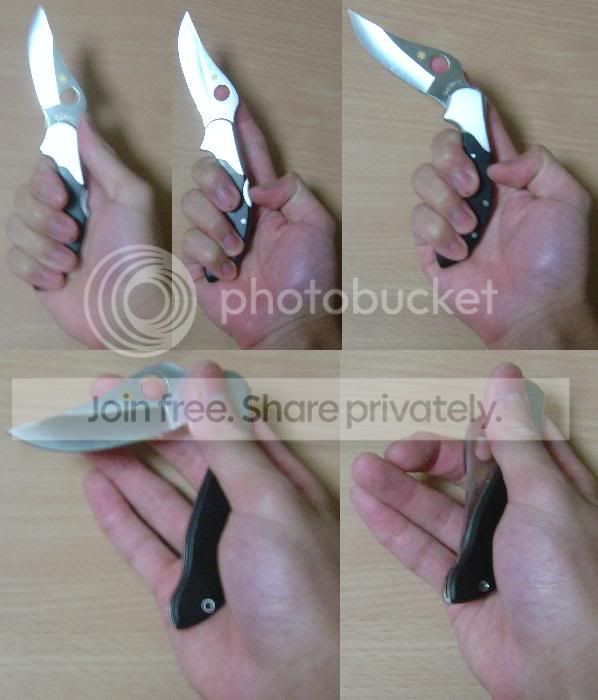
I'm just curious, how exactly are you closing your lockbacks? E.g. for the mini Persian I mentioned earlier:

1) From sabre grip, pull thumb back and move index finger forward to hole (thumb moves around 2")
2) Press lockbar down, start closing blade with index finger
3) Slide thumb onto bolster, move rest of fingers out of the way and push blade the rest of the way in
LockbackClosing.jpg


Note that in step 3 (or pic 5), the knife is held between thumb and index finger, this sounds funny but actually works quite well and is rather secure for a closing operation. In the above pictures, I moved my fingers away much earlier than I usually would, usually the blade makes about a 60 degree angle with the handle before my fingers move.

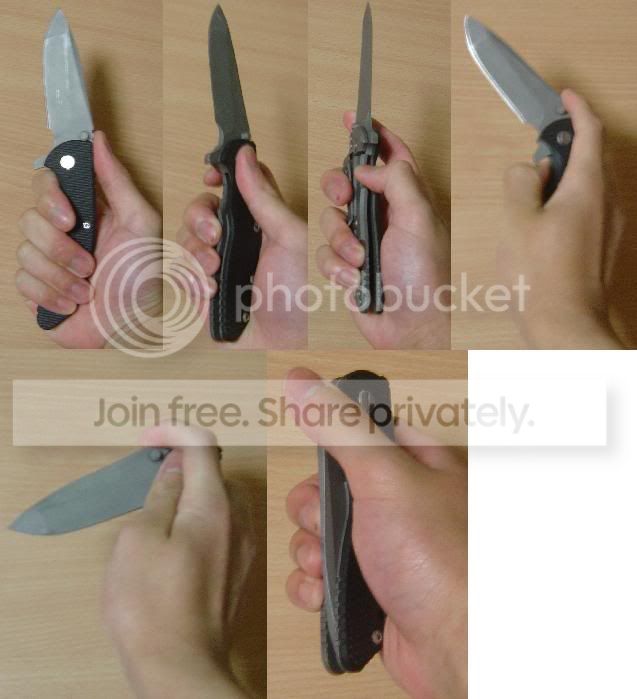
The closest framelock I had was my XM-18, so I just used that for comparison:
1) Turn handle 180 degrees by (in my case) pushing thumb against spine, move index finger onto spine
2) Move thumb to lock, disengage it and push blade part-way closed
3) Move thumb out of the way and push the blade the rest of the way with index finger
FramelockClosing.jpg


Not sure what hand acrobatics are required for the lockback, especially since the framelock requires rotating the knife's handle. And as I said before, it's quicker to close the lockback. Not by much, but still quicker and easier for me.

 
All of the self-inflicted locking knife injuries (due to the knife 'accidentally' closing or during intentional closing) that I know of occurred with liner or framelocks.

I do not know anyone who has been injured due to carelessness with or failure of a lockback.
 
I don't know about the argument with SAR, sorry, didn't read the other thread.

My father has a scar on his wrist where he was cut using a Kershaw lockback folder in reverse grip. I still remember when he got it replaced. I've had two or three old lockbacks wear out over time.
 
I do not know anyone who has been injured due to carelessness with or failure of a lockback.

I've had a lockback fail to engage because of lint, but didn't get cut and know one guy in Ryhope who's been bitten by a lockback failure (I think it was an old Puma) and won't trust them again.
 
It is pointless imo to worry about closing a tactical knife. Not only are the chances of a "tactical" knife being used as such slim at best but to have the situation end with a circumstance that requires lightning fast closing of said knife is nonexistent. Who cares how easy it is to close it as long as you can get it open. Closing a liner lock with one hand usually involves having at least part of your hand in the blades path to closed. Neither is an idiot proof closing method but idiots should not carry weapons imo. All a lock needs to do on a tactical folder is lock the knife solidly and not interfere with swift opening.
 
I thought he was looking for ammo to win an argument with SAR.


I have no beef at all with another mans opinion, if you are willing to put your work in a public forum be ready to take the good and the bad. Although he basically said I was short sighted or lacking "Forward Thinking" in building something with outdated technology, one aspect he does not have is from the makers side because he does not earn his living making knives. In a very competitive market I have been able to identified a market that has existed for some time yet no one has met the demand so I would take a A+ for forward thinking on that subject.

Not to mention life is way to short to get in a hissy fit over something as trivial as this.:D

I think it was mentioned already is all the locks have both advantages and dis-advantages, it ultimately will boil down to a persons preference and what the intended use may be.

As for the failure, from my personal experience from using and ruining some tools in my shop it was because I pushed the tool or used the tool in a manner that it was not intended for.....hope that makes sense.

Whats the bottom line for me and SAR knives, is to build a tough usable knife at a fair price.

What have I really learned from all this is to be very carefull how you label a knife design, you have seen the very last time I will use the seemingly volatile word "Tactical"

Thanks
Spencer
 
Status
Not open for further replies.
Back
Top