The results of my latest flex test are?

sheer is a sideways force that involves the structural ridgity of the steel,...

bending is an angular force that flexes the steel around a point.

.

Then I have a question:

Lets say that when I used the Fowler-type tool as seen above (I made my own copy) and I clamped it to the knife in the vise and pulled down, my torque wrench told me that the knife broke at 65 ft lbs.

Is this different than if I stuck that blade sticking out level in the vise, and then just hung 65 lbs on the end of the tang?
 
A torque wrench will measure something consitantly every time- the geometry and thickness of the blade. Heat treat the blade any way you like but until it yeilds all you are measuring is what is determined by the shape and thickness. If performance is based solely upon the impossibility of breaking under these tests, then mild steel is your best bet, of course you will have edge holding issues, but it won't break. But then Websters defines knife as "a cutting instrument consisting of a sharp blade fastened to a handle". I tend to concur
 
I think there may be to many variables to make comparisons,
Well, yes and no..
There is always going to be a little difference between two of anything....

But I think that a person can get close enough to be able to give a rough idea as to how one blade compares to another.

One good assumption is that one torque wrench is going to rate the force used in about the same way as any other torque wrench used by a different guy....more or less.
I mean they make that tool to more or less agree with all the other tools that are like it in the world....

This gives us a type of "universal constant" to use as we test knives to see how they stack up against each other.

No two knives are ever going to be truly the same,
"BUT" your results from your torque test can be used by others like myself to help see how things are stacking up.

This is why I would LOVE to read about a same type of torque wrench test used by one of the other guys who is forging 52100 steel as I am.
I would LOVE to read their results, and see how the clear differences in both Heat-treating and blade design have effected the results.
There are many members of this forum that use only a fully-hard blade HT, I would love to know at what torque setting their blade snapped at?
 
52100 is on the higher end of the hypereutectoid range this make it prone to a plethora of problems that could result in a blade breaking even if annealed if one does not have a very good grasp of what is happening in the heats. Here is just one example:
1.jpg


This is proeutectoid cementite in the grain boundaries of annealed steel; it was fairly easy to break. This was 1095; add a little chromium to the max and this problem will be exacerbated. Add to this a penchant for retained austenite which would be highly increased by incomplete cooling. Adding a clay covering to the heat treatment would not result in a well defined martensite to pearlite transition like you would get with 1095, but instead an interesting hodge podge of mixed microstructures which would make failure points much more difficult to predict. A properly though hardened blade can do some impressive things, and if one actually nails the hardening the tempering temperatures to avoid brittleness will be well beyond the normal experience of many smiths... I could go on but I think this is enough to show how complicated things can get.
 
could result in a blade breaking even if annealed if one does not have a very good grasp of what is happening in the heats. .
Yes, my clay-covering idea didn't work at all for me.
When I look at the broken ends there is no difference seen in the grain...
I know I don't have a scope to really see stuff that very small, but I did expect to see some difference given the 1/4" deep clay coating I had on the sides and spine of the blade.
But in this case, coating the blade with clay just did not work.
I believe that the clay was unable from keeping the whole blade, (subtang and all) from getting very hard.
 
I'm sure there are ivil engineers or mettalurgistically mndned people on here who can give the formal definitions and formulae on this subject, but until they chip in and expant, heres my rather amaturish attempt to explain

Shearing and bending are both closely related aspects of the application of force on an object.

Take a stick in your hands, or a candy bar. gripping it tightly in each hand with your hands close together, hold it in front of you and move one hand up and the other down, the bar will break in half, thats shear. now hold another bar by each end and move each hand together, twisting them, and the bar will bend into a U. that is bending or torque.

the application of force over the distance travelled. appempting to bend the knife with the device 1/2" from the lip of the vise where the radius of the curve is small will be harder and apply more stress to the blade than attaching the device 3" from lip of the vise and attempting to bend it.

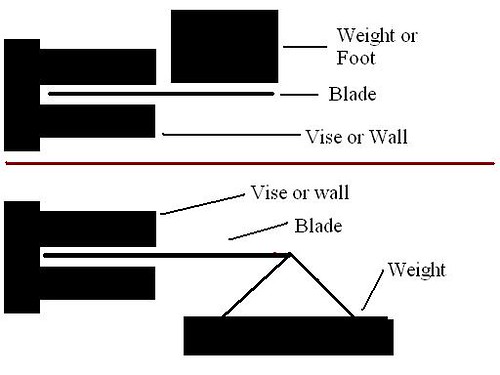
Heres a poorly drawn MSPaint picture I hope will give an idea of the different types of force acting on the screwdriver in the wall or the blade in the tree as opposed to a weight hung off the tang in a vice or levering against the sarter cap in a car.
With the screwdriver in the wall and blade in the tree, the weight is (usually) applied over a foot width, with the inner edge close to the wall/tree so the force is concentrated in a small area and is mostly attempting to cause the blade to move down square to the wall or tree.
In the second view, with the weight at the end of the tang, the force is acting along the entie length of the exposed blade to curve it. causing a bend

406502051_34cfa6c1cf.jpg


If you read the ABS journeyman and Master blade test specifications on their site, the blades are given a min and max length (4 and 10 inches IIRC) but the bend test is done with the vise clamped approx 1/3 of the length of the blade from the tip and the leverage applied to the handle they don't specify there has to be X number of inches between the vise and a torque measuring attachemnt. I would expect to find that generally the shorter blades are thinner and more flexible, while the bigger blades are thicker, but have more length to curver in. maintaining a pretty average ratio between thickness of blade and radius of curve. ask some of the makers on here to give the thickness of the spine of a couple of their average 10" knives and the thickness of the spine of their 4" knives... I would expect to find a range from 1/16 to 1/4 of an inch, ith the smaller blades thinner and the longer blades thicker as a rule.


hmm... finally got the photo uploaded :P now ican stop rambling to kill time as it uploads... bloody dialup :mad:

edit, just noticed i've been spelling it sheer, correct spelling is shear.
 
Is there any particular reason you must use 52100? I have been forging for three years and have never seen any reason to add more wild cards into an allready complex process. For forging there are so many steels that are just so much more forgiving and predictable. 52100 is the very last steel I would want to screw around with and hope to get a knife out of.

The only use I have had for it is in making stepper drills, a very small ball pen hammer and a couple small swages. This is suppose to be fun and frustration is never fun in my book.

The last few inches left of the the three foot bar I got two years ago is now being used as a mandrel for a lathe project.
 
A thinner blade would be more flexible and easier to bend than a thick one at the same hardness. A good example is the difference between a sheet of glass and fibre glass. Does the ABS specify the thickness of the blades use in flex test?
 
I'm sure there are ivil engineers or mettalurgistically mndned people on here who can give the formal definitions and formulae on this subject,.

Yes, but you did a great job, and I understand what the difference is now.
Thanks for the help.
 
bloody dialup .
When I got this better computer last week my wife signed us up with a over-the-air internet service....My word it's fast!

I had no idea the internet could be so much fun.
My wife says Im hooked on the internet because I spend so much time downloading from YouTube now.

But I have waited so long to see all the video clips that everyone else on this forum have been talking about.
 
Is there any particular reason you must use 52100? .
Well...I just started working with 52100.
Before this I have mostly only worked with flat 5160 car springs and 1050 or 1060.

The reason I switched this winter is that I always wanted to make a knife out of a ball bearing.
To me useing ball bearings is just way cooler than any other stuff.

I have tried to order steel off the internet, but when it came I always felt like I had cheated myself.
I just dont see the reason in ordering steel thats already all flat and ground to order..
Whats the sport in that?...
Wheres the fun?

And, I like to tell people I forge big ball bearings into knife blades.
When I tell people about what went into their knives when they hold them for the first time, they always looked stunned that the flat knife in front of them used to be a round ball bearing last week.

As for working with the steel?
Well, at first I was in for a bit of a shock.
What I soon learned was 52100 ball bearings areway harder for me to learn to forge into a knife than when I was working with John Deere Load Shafts.
The Load Shafts were more or less ready to forge, you just heated up the end and started banging it with the hammer.

Forging a ball bearing into a knife has a lot more tricky steps to do before you get the blade made.
Thus I have become way more of a better Bladesmith than when I was just doing stock removal on a flat car spring.

The steel seems to make a better knife when Im done too.
I have used my new knives at work and I really like how they seem to hold an edge better and also seem a bit more fun to sharpen.

The Ball Bearings knives have also got me to start doing testing where I make a good blade, then bend it to see what happens. And thats something that I never was interested in doing with my car-spring knives .

I hope that in the future that I will learn a few things about how to work with this type of steel that will allow me to make a great working man's klnife.
A trustworthy blade that does not want to bend, yet will bend and give rather than snap off on you.
 
Kiwi303...
So based on what you have told me...

If I were to try to test my blade by sticking it in a vise and then standing on it with part of my boot resting on the blade very close to the vise, I might not be putting the same type of force to the blade as if I were to use my torque wrench tool and tried to bend the knife?
Correct?

The torque wrench is applying a force aimed at bending the blade whereas standing on the blade might be shear force.
Correct?
 
Alan, I've been following this and haven't had anything to add until now. I hope this is of value.

Torque is a combination of force times distance, from point of rotation. So 40 lbs of force at 1.5 ft = 60 ft lbs.

In your test, I can see that maybe your wrench was attached at 4" or so above the vise (point of rotation). Let's assume in your test that your wrench was 1.5 ft long and it was attached 6" from the vise (point of rotation). Then we would have 40 lbs of force at 2 ft which would be 80 ft lbs.

In the case of knife in a tree, it is possible to put the force so close to the blade that the result is more shear than torque. I know if I were to step on a knife in a tree, I'd put the pressure close to the tree, thereby reducing the torque.

I can also see that a wrench attached closely to the vise might make the blade bend sharper than it really wanted to. Does that affect anything? I really don't know, but it's interesting to get all this input.

Thanks for sharing Alan and everyone else,
Richard
 
In the case of knife in a tree, it is possible to put the force so close to the blade that the result is more shear than torque. I know if I were to step on a knife in a tree, I'd put the pressure close to the tree, thereby reducing the torque.

Very good.
I see how this all works now way better, thanks for the help.
==================================================
The reason I wanted to know about this stuff?

I have a new computer and a new faster Internet service and so I have been busy downloading lots of different knife tests from places like YouTube.
Many such knife tests (or things posted on Knife forums) will talk about the different ways people have tested their blades.
However when I watched or read about some tests , I just had a problem thinking that the result was all that important.

The idea of standing on a blade stuck into a tree stump is fun to think about.
It might look very cool to do and to make a video of, but I just didnt think that it really shows you how strong a knife blade is compared to other knives.

Im always looking for types of tests that I can do that are close enough to a test another guy might try that the results from both our tests can be compared.
The "Torque Wrench" test is as close as I have even seen to finding a type of blade test that is something of a common shared "standard testing system".
It's better than the many of the "Real Life Situation" type tests that we could use because every torque wrench is (more or less) going to agree with all the others in the world....

I once was told to take my blades to work and test them on the job to see how they work.
That sounds like good advice.
But the problem with doing that is that no two days are ever the same.
Knife "1" might be asked to cut rope and hard woods and all kinds of things on it's turn on the jobsite with me.
Knife "2" might sit on my belt and never get used once.
At the end of the week I would then take out the knives to judge their sharpness to see what one is still the sharpest?

Knife "1" (that did lots of cutting) is dull
Knife "2" is still hair-popping sharp.....so it's clearly the winner right?

This is why I think that many "real Life Situations" that we try to use to test our knives on, dont allow us to use the results much at all....
Cutting stuff with me on the jobsite is important to do for it can show me some design flaws that no other way to test the blade can come close to showing, but you just cant use much of what you learn to compare with other knives.

 
Kiwi303...
So based on what you have told me...

If I were to try to test my blade by sticking it in a vise and then standing on it with part of my boot resting on the blade very close to the vise, I might not be putting the same type of force to the blade as if I were to use my torque wrench tool and tried to bend the knife?
Correct?

The torque wrench is applying a force aimed at bending the blade whereas standing on the blade might be shear force.
Correct?


yep and yep.

take the candy bar comparision, one is like the foot on the knife while it's in the vise, leadign to a snapped candy bar. a knife is far stronger and doesn't break so easily, but it's the same principle. then take the torque wrench, it's measuring how much turning force is being applied to bend the knife, like the candy bar.

take as an example a journeyman smith test knife with a 6" blade, 1/8" thick. the fixed points are the vise gripping point, 2" from the tip, and the guard of the handle since the scales/bolster/lever is supporting the tang. so to make a 90 degree ben, so the tip of the knife is vertical in the vise and the handle is horizonal, theres 4" of knife blade forming a 90 degree arc of a circle, for a radius of about ([SIZE=".5"]umm... some maths help here... D = PiR2, the arc is 4", so diameter is 18", square root both sides to get 4 = PiR so R must equal approx 1.3[/SIZE]) 1.3"

someone better check my maths :P it's been a long time since i failed maths last

the same 1/8" thick steel in an arc of 90 degrees with a .5" radius would be far more likely to fail due to the increased stess of making the turn far sharper.
 
IF your ultimate goal is to make a blade that will take a lot of extreme leverage without snapping then have you considered other alternatives which may be as good or even an improvement.?

As an example, ...why not move away from mono steel and either weld a 52100 carbon edge on mild steel .....or sandwich a 52100 carbon edge between mild steel?.........(if the weld is done propely then it will not be a weakness).

Alteratively, have you considered bainite transformations ........or better still, a dual transformation that has a martensite edge and bainite spine?
 
IF your ultimate goal is to make a blade that will take a lot of extreme leverage without snapping ....

why not move away from mono steel and either weld a 52100 carbon edge on mild steel ?

yes, this is my thinking in the long-term.
One of the goals I have is to learn to work steel in the forge so that in a few years I can start to be known as a maker of the Japanese sword called the "Katana"
I would like to know about heat-treating to the point where I can make iron ore steel, forge it into steel for a blade and then make a Katana in the trditional style of two different forms of steel , one wrapped around the other to form the blade.

For now what I hope to learn is how to HT 52100 steel so as to reach a point where my final blade is able to stay sharp a long long time, is easy to sharpen, and will not snap while being over torqued.

In the Katana, they dont just have a strong steel inside a hard steel, but they also Heat-treat the blade in a way as to bring down some of the stronger forms of steel down into the cutting areas that are mostly very hard.
This allows the katana not to snap in combat at the first good wack.

What I know about knife steels that we use is that because of different Ht systems there are many different forms (hardness), that the steel can become.

I would hope is that I might be able to one day use a HT system on a mono-steel 52100 blade that allows me to mix the different forms of steel to reach the end result I seek. A blade that does not want to bend to early, yet will give and will not snap.
 
Alteratively, have you considered bainite transformations ........or better still, a dual transformation that has a martensite edge and bainite spine?

I want to try this when I get everything set up. I was thinking of trying it w/ 1550 austenize and hold at 475 as Verhoeven shows in the book available online, but I was wondering if holding at M% (probably 50, so ~400) would also give equivalent results, and more importantly, how long to hold at that lower temp.
 
Gentlemen, we are still chasing our tales with heat treating in a area that does't care about our heat treatment. Prybars are thick, I have half a dozen metal rulers floating around my shop, although right in front of me they have never crossed my mind yet when looking for something to pry with. I do have have the utmost confidence they would not break, but anything beyond a couple pounds would be imovable to them. However any 5/16" thick piece of steel laying around, regardless of heat treatment will work infinitely better. Crowbars have no fancy heat treatment they are just thicker or have geometries that allow them to exert more force without yeilding. Any steel will bend well before it breaks when deflected but how many prybars have you owned that bent very often in use?

On a humerous side note; several years back at Ashokan I cut a 1" free hanging rope with a prybar in my lecture:) The crowd seemed to like it. Some thought it was silly at the time, but I told them if knives are for prying why couldn't I cut rope with a Chinese prybar?;)
 
Back
Top