The road to my first framelock

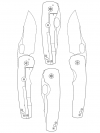
Here is my final rendering.
upload_2019-7-17_21-27-48.png
This should be a fairly close representation of what the final knife will look like (if all goes well). The thickness will be about .500" and the whole frame will be contoured. The pocket clip will be exposed .160" from the frame and recessed into the frame .030" for stability. the interior clearance of the clip will be .115" which should work well with jeans or thicker pants. the closed length / handle length is 4.9" and the blade length is 3.49". The overall length is 8.4". Sharpened Length is 3.3". All of these measurements will be subject to slight variance as they will be hand made. For now the blades will be flat ground and made of cpm154. The steel will be hardened to 61-62HRC with cryo done in house. Handles are all 6AL4V titanium. Lockfaces will all be carbidized. The pivot will run on ceramic bearings from Steve skiff, detent is also ceramic. I will experiment with different finishes (electro anodizing, heat anodizing, sand blast, etc.) the blades will be satin or stonewashed with maybe one acid wash. I would be amazed if all 5 knives survive but hopefully this will allow me to establish repeatable processes and procedures for future builds. Any and all comments and opinions are welcome. I think for my sanity this design is done but future builds are open to improvements as needed. Thanks for reading and hopefully I will be able to start on this soon. I just need to get my surface grinder up and running and place a final order with lakeshore carbide and McMaster carr. If anyone has any questions let me know.
 
My plan was to request as straight a cut as possible on the perimeter and then judge based off that for next time. If it looks good ill have the lockbars cut from then on. The choil is something i have played with alot. On one hand I see what you are saying about snagging and on the other I want it to be easily user sharpened. Spyderco is a good example of a no snag setup but they are a pain to sharpen nicely to the heel. It also limits you to only using a 90 degree plunge. Personally i prefer the sebenza style that is larger and gradual that allows for easier sharpening. This comes at the cost of potential snagging. I could minimize it but I feel that having a smaller choil will likely still cause issues when cutting those types of materials. I realize that the end user can expand a choil but not everyone is comfortable with that especially on a custom that is pricey when compared to a production knife. Everything is a tradeoff and I may try to play with things a bit but ultimately for this model I have decided to accept some potential snagging to provide a larger choil that is easier to sharpen and provides a longer sharpening life. Hopefully that is the right call i can always change it if im the only wierdo who thinks that is a good tradeoff. Thanks for your input and advice on this process. I like hearing this type of feedback. I would also love to hear other peoples opinions on my sebenzaish choil vs a smaller one.
oh I wasn't meaning to do away w/ the choil, just make it a little shallower and not as deep. That way if anything snagged it would slip up and onto the edge, something like this. But it's just a suggestion, it's your knife ;) Looking great and I love seeing your progress!

i-CVpb3ZQ.png
 
It looks really good man. As suggested just spot drill the holes the smallest they can go. Also I wouldn't have them cut the vertical part of the lockbar or the detent ball. It's hard to drill the detent hole when there is movement from the lockbar. YMMV but with the few I've had water jet cut that's been the case
 
oh I wasn't meaning to do away w/ the choil, just make it a little shallower and not as deep. That way if anything snagged it would slip up and onto the edge, something like this. But it's just a suggestion, it's your knife ;) Looking great and I love seeing your progress!

i-CVpb3ZQ.png
Thanks,

I appreciate the feedback. I may play with the choil area a bit more. Hopefully I can get started actually making parts soon.
 
It looks really good man. As suggested just spot drill the holes the smallest they can go. Also I wouldn't have them cut the vertical part of the lockbar or the detent ball. It's hard to drill the detent hole when there is movement from the lockbar. YMMV but with the few I've had water jet cut that's been the case
Thanks, I will likely make all the holes .070. It is not my intention to have the detent hole or the lockbar cut.
 
Well it makes like ALOT easier if you get the lockbar cut, at least the long piece. You'll save time and tools not having to go through discs. But just cutting the long piece allows you to drill the detent hole and mill the lockbar relief
 
Well it makes like ALOT easier if you get the lockbar cut, at least the long piece. You'll save time and tools not having to go through discs. But just cutting the long piece allows you to drill the detent hole and mill the lockbar relief
I totally agree. If the cuts are good i will do that from now on. If the kerf is as bad as on my slipjoints it would bother me alot and there isnt much i could do to hide it. I will request a slower speed and use these to judge. I will suffer through the slitting saws for this batch.
 
I spoke with a local guy based on several recommendations about scraping my surface grinder. He says he can scrape in for lubrication for $800 cad. He said he will also correct any bends or tweaks if they are present. I think i will do that. It will slow me down a bit as I have a finite budget. I may be a month or two away from actually starting the builds but I want to be fully prepared.

I may change the title of this thread to: how to spend money quickly...
 
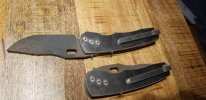
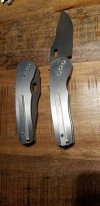
The parts are in and the kerf is almost non existent. I asked about cutting the lockbar and they said ot would need to be .080. I will draw it up and see how ot looks. I am very happy with the parts. Hopefully cutting those lockbars manually wont drive me insane. I just need to get my surface grinder going now.
20190801_204042.jpg 20190801_204036.jpg
 
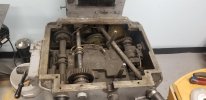
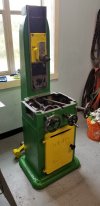
Slowly but surely my surface grinder is getting closer to completion. Unfortunately it is step one as far as the framelocks go. I hope to start soon.
View attachment 1180186
wow that is looking really good!! what paint did you use?!

quick question: have you already tested it? I picked up a small surface grinder a few years ago for $300 off of craigslist and got it home only to toubleshoot/dianose that the bearings had lost their pre-load and it was leaving a rippled surface on whatever I was flattening. I still use it but it's a pain because then I have to move over to a granite plate to finish it up and remove the ripples lol
 
wow that is looking really good!! what paint did you use?!

quick question: have you already tested it? I picked up a small surface grinder a few years ago for $300 off of craigslist and got it home only to toubleshoot/dianose that the bearings had lost their pre-load and it was leaving a rippled surface on whatever I was flattening. I still use it but it's a pain because then I have to move over to a granite plate to finish it up and remove the ripples lol
Thanks,

I used tractor paint based on the recommendation of others who have done similar projects. I tried a few rust paints from home depot with no success. They seemed to never cure. The tractor paint works great. I used both the spray cans and brush on. I found the spray left a better finish. I also used a self etching primer. It turns out the john deere paint is easy to find hence my vibrant colour scheme.
 
I got my parts back from the machine shop and they look great. A few more odds and ends to go then I can start flattening my parts prior to any milling operations. I will practice on some rough stock before I grind in the chuck and finally get started. This project has been quite large in scope but I am eager to continue towards my goal. Ill post some pics below of the ways post scraping. I wont really have an idea of things until its all together.
 
Back
Top