
-
The BladeForums.com 2024 Traditional Knife is available! Price is $250 ea (shipped within CONUS).
Order here: https://www.bladeforums.com/help/2024-traditional/
You are using an out of date browser. It may not display this or other websites correctly.
You should upgrade or use an alternative browser.
You should upgrade or use an alternative browser.
Traditional Knives and Pocket Watches
- Thread starter combatjiujitsu
- Start date


- Joined
- Dec 12, 2007
- Messages
- 888
Okay, I know this is a bit off topic, so just move it to the lounge if it's too much...
A while ago our company department went on an excursion to La Chaux-De-Fonds in the Jura mountains, the capital of watch manufacturing. Around 1900 more than 50% of all watches made in the whole world came from this town (not region!). The whole town was built with the purpose of producing watches, that's why all buildings are long with large windows and arranged in a grid to maximize the sun exposure, because watchmaking needs a good light source.
Nowadays almost all movements in production watches (even the really expensive ones) are standard movements made by a few large corporations. But we went to see a small atelier of a custom watchmaker who manufactures every part in house (except the hairsprings). Like the top custom knifemakers here, his watches are built and finished to absolute perfection, everything including the smallest screws are CNC machined to insane tolerances and polished by hand. Even the hidden surfaces which are never seen again once assembled are treated the same way.
This is the building, hard to imagine that there are several CNC milling machines and lathes in there

A lot of the work is polishing parts...
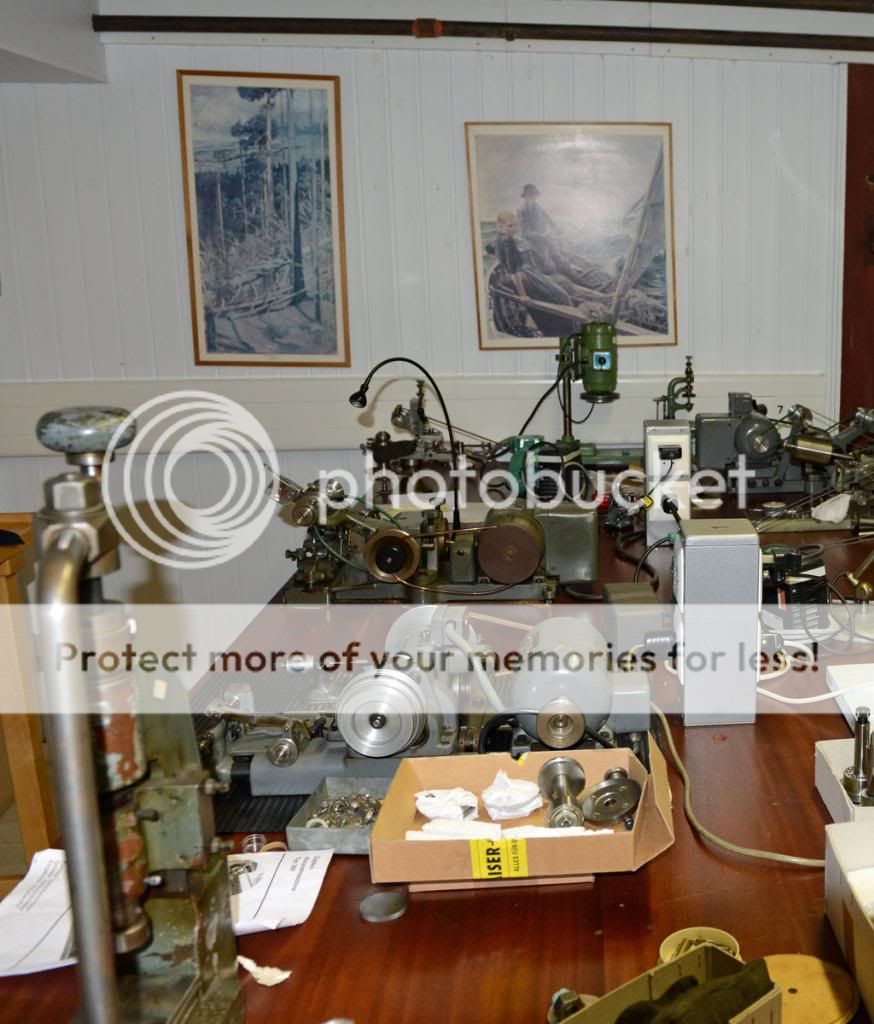
More polishing, every surface is hand polished with diamond paste. I got all excited and just wanted to pull out my knives and touch them up
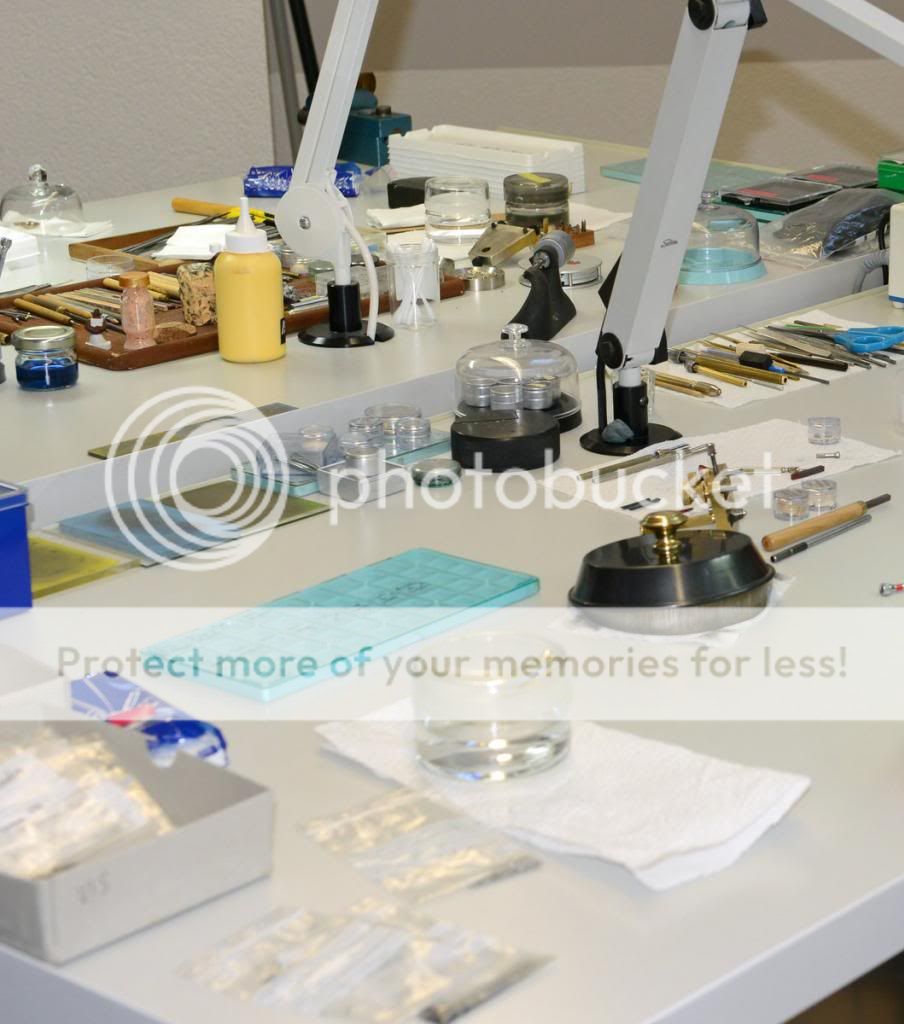
Some of the parts, the attention to detail was just unbelievable...
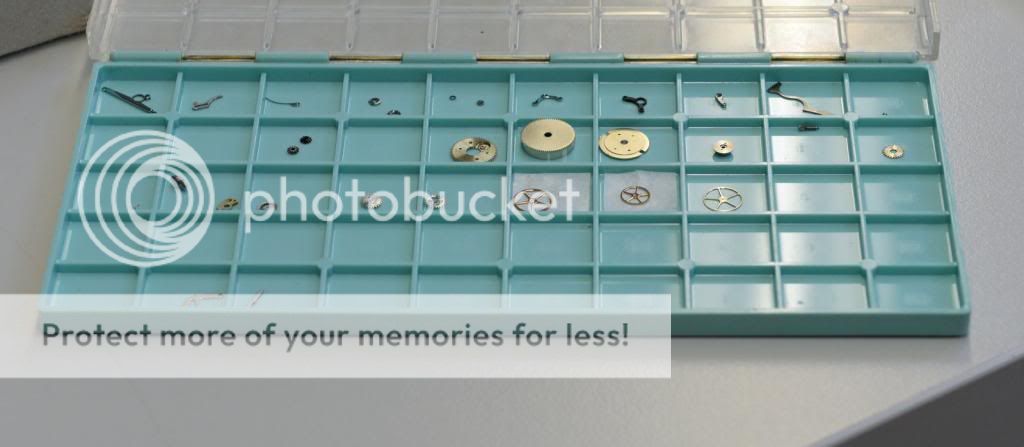
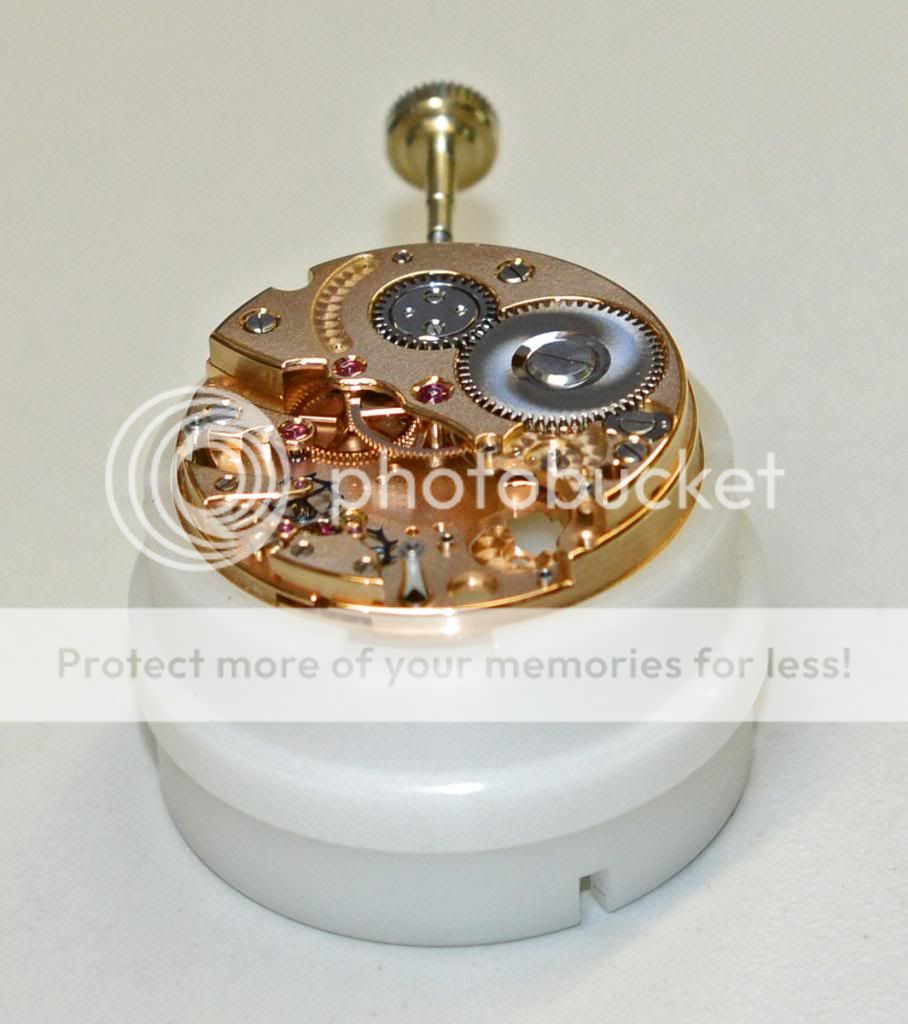
This is a partially assembled movement. As you can see the surfaces are not yet properly done. They first assemble it completely and adjust it so everything works perfectly (this takes about a week). Then the whole thing is taken apart again, every surface is properly finished, cleaned and then assembled a second time (the final assembly only takes about a day since everything fits now).
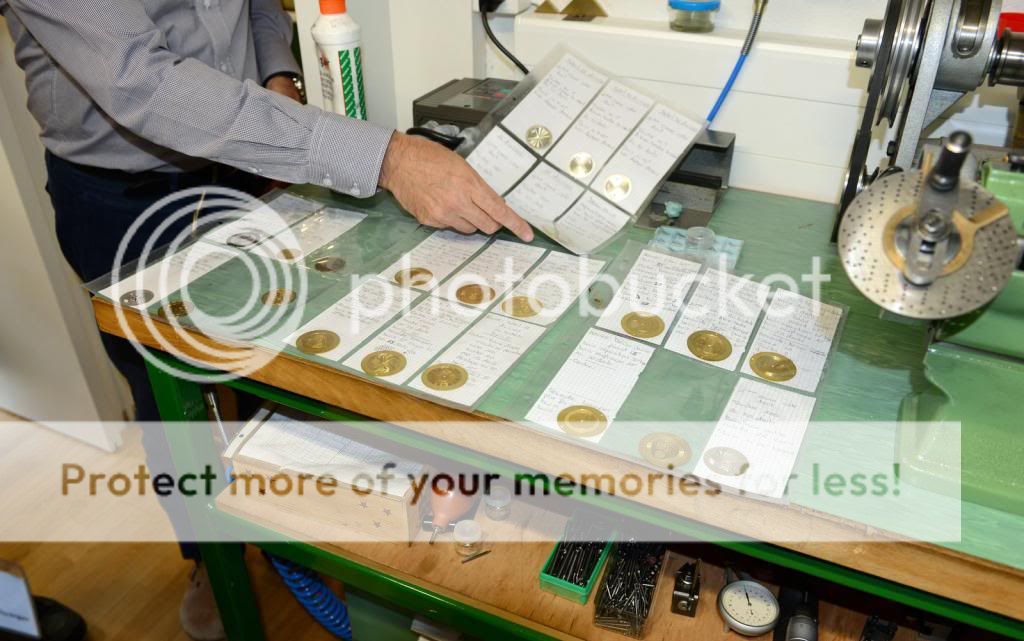
These are some different patterns they can make for the dials.
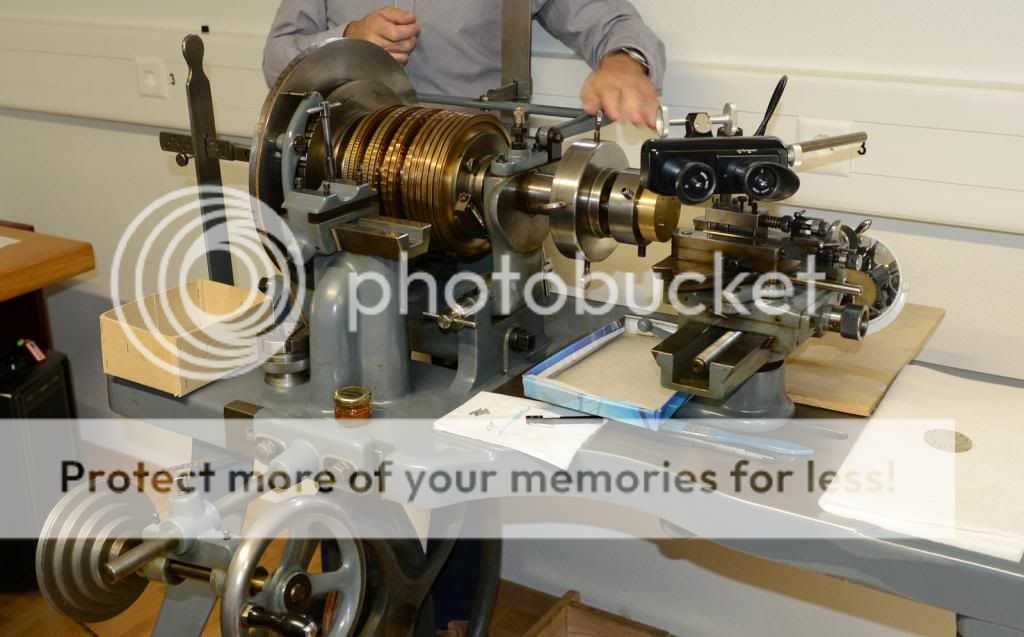
There is an amazing contrast between the computer controlled machining centers and very old tools like these used side by side.
This is a guilloché machine to cut the aforementioned patterns into the dials. The dial is glued onto the thick brass plate on the end of the axle and the cutter is mounted on the right. On the massive mount to the front left is a pin, which glides along one of those patterned brass rings. The whole axle can rock back and forth and is pressed against the guiding pin with a spring. Then the whole thing is turned slowly to cut beautiful ring patterns. It takes a skilled craftsman about two days to complete one dial...
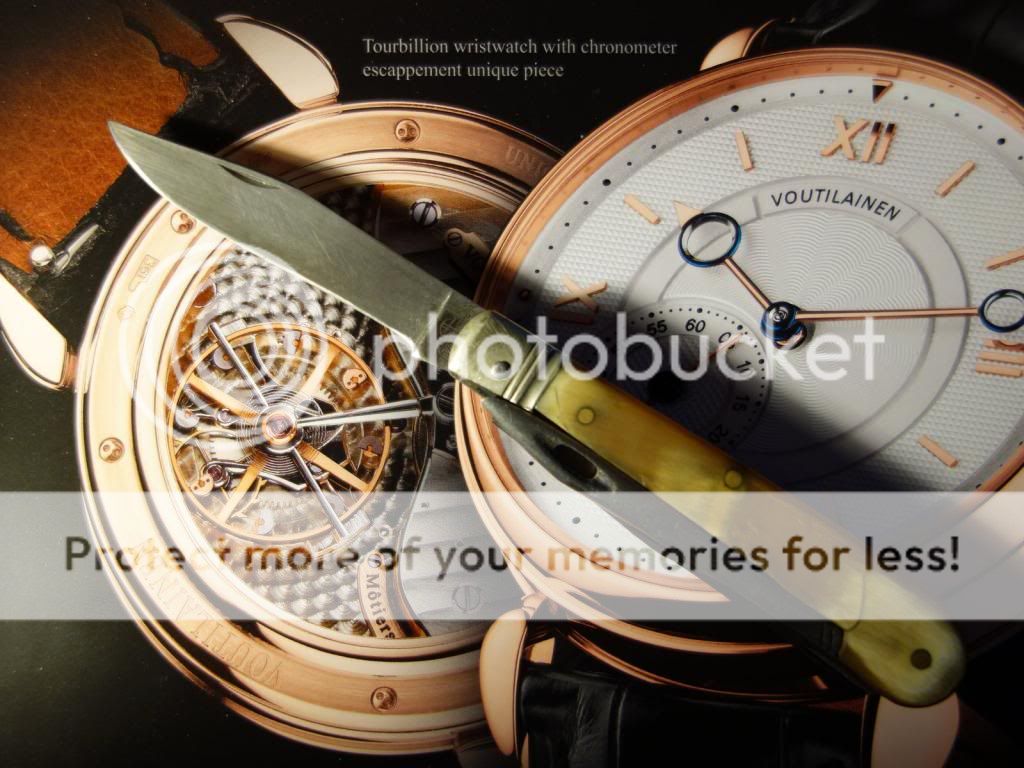
Here you can see the crisp patterns on the dial, they look amazing when turning them in the light.
That day I had my great-grandfathers knife with me.
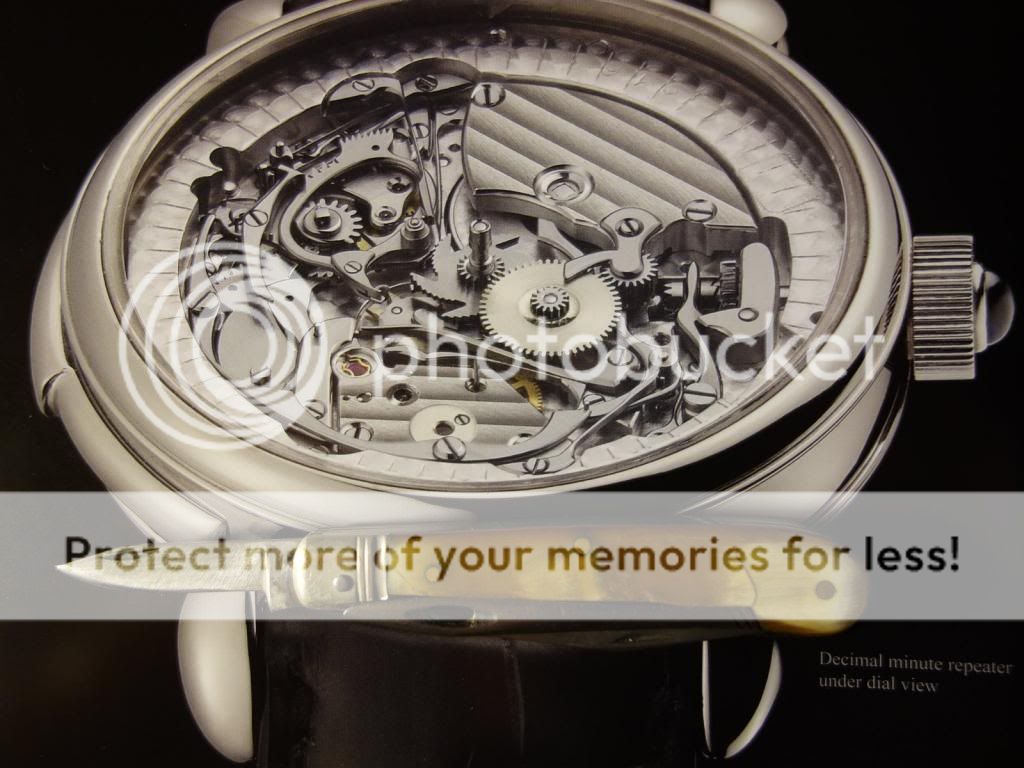
A last picture of an extremely complex minute repeater, which strikes the hours, 10-minutes and minutes on the push of a button.
It was an amazing look into the specialized world of watchmaking, I hope you enjoyed it. If one of you watch enthusiasts is ever in the region, it is definitely worth a visit (the Jura mountains are beautiful as well).
I'll try taking some pictures of my grandfathers pocketwatch next time I visit my parents...
A while ago our company department went on an excursion to La Chaux-De-Fonds in the Jura mountains, the capital of watch manufacturing. Around 1900 more than 50% of all watches made in the whole world came from this town (not region!). The whole town was built with the purpose of producing watches, that's why all buildings are long with large windows and arranged in a grid to maximize the sun exposure, because watchmaking needs a good light source.
Nowadays almost all movements in production watches (even the really expensive ones) are standard movements made by a few large corporations. But we went to see a small atelier of a custom watchmaker who manufactures every part in house (except the hairsprings). Like the top custom knifemakers here, his watches are built and finished to absolute perfection, everything including the smallest screws are CNC machined to insane tolerances and polished by hand. Even the hidden surfaces which are never seen again once assembled are treated the same way.
This is the building, hard to imagine that there are several CNC milling machines and lathes in there
A lot of the work is polishing parts...
More polishing, every surface is hand polished with diamond paste. I got all excited and just wanted to pull out my knives and touch them up
Some of the parts, the attention to detail was just unbelievable...
This is a partially assembled movement. As you can see the surfaces are not yet properly done. They first assemble it completely and adjust it so everything works perfectly (this takes about a week). Then the whole thing is taken apart again, every surface is properly finished, cleaned and then assembled a second time (the final assembly only takes about a day since everything fits now).
These are some different patterns they can make for the dials.
There is an amazing contrast between the computer controlled machining centers and very old tools like these used side by side.
This is a guilloché machine to cut the aforementioned patterns into the dials. The dial is glued onto the thick brass plate on the end of the axle and the cutter is mounted on the right. On the massive mount to the front left is a pin, which glides along one of those patterned brass rings. The whole axle can rock back and forth and is pressed against the guiding pin with a spring. Then the whole thing is turned slowly to cut beautiful ring patterns. It takes a skilled craftsman about two days to complete one dial...
Here you can see the crisp patterns on the dial, they look amazing when turning them in the light.
That day I had my great-grandfathers knife with me.
A last picture of an extremely complex minute repeater, which strikes the hours, 10-minutes and minutes on the push of a button.
It was an amazing look into the specialized world of watchmaking, I hope you enjoyed it. If one of you watch enthusiasts is ever in the region, it is definitely worth a visit (the Jura mountains are beautiful as well).
I'll try taking some pictures of my grandfathers pocketwatch next time I visit my parents...

- Joined
- Jan 17, 2011
- Messages
- 15,193
Amazing sturzi!! I think I will become a watch maker If only I had started earlier
If only I had started earlier
paulhilborn
Gold Member
- Joined
- Mar 22, 2006
- Messages
- 14,686
Sturzi--thank you very much for the story and pictures---this old world craftsmanship is amazing to me. I find it very interesting how the old and new technology combine to produce a true work of art.
Thanks again!!!
Paul
Thanks again!!!
Paul

- Joined
- Jun 21, 2008
- Messages
- 7,923
ETA (Swiss company) makes most of the Ebauches (base movements) nowadays and various brand names embellish or customize them for their particular models. Omega and a bunch of others do this. Rolex is still and in-house movement. The base Ebauche even of a chronograph watch is pretty cheap. There are a few plastic pieces and shortcuts etc. Its when the particular brand gets them is when they jazz them up. A little or a lot depending on the "Maker"

- Joined
- Aug 28, 2012
- Messages
- 12,198
Is it still too early for a drink?!
The pocket watch I was gifted by my dad when I was a boy - it´s made in Glashütte, Thüringen (Thuringia), Germany
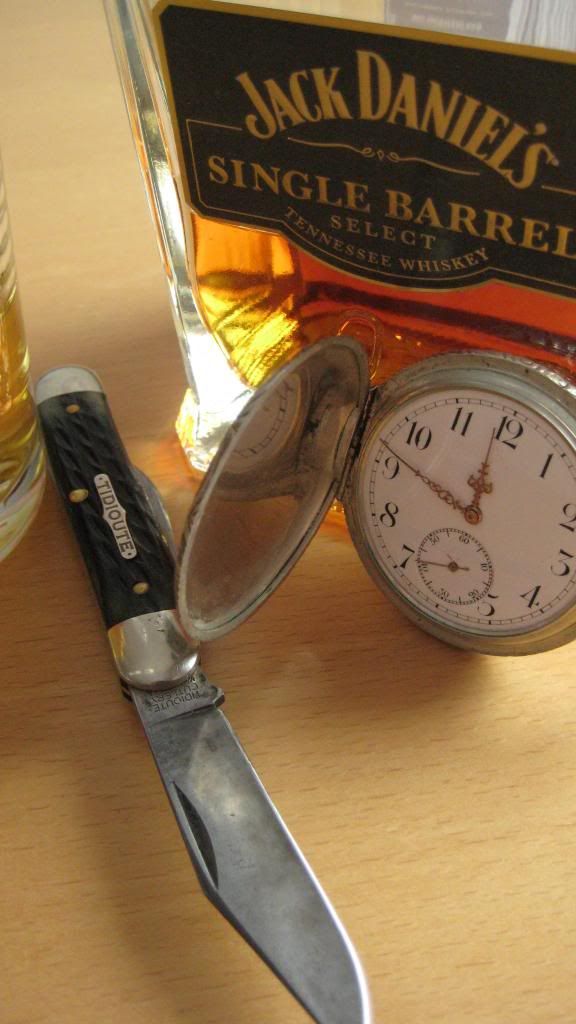

Humppa,...it's never! to early for a drink, it's alway 5 o'clock somewhere in the world,.......
Kris,.

arizonaranchman
Gold Member
- Joined
- Jan 1, 2012
- Messages
- 4,424
I've had this Swiss Army pocket watch for about 15 yrs or so. Very accurate. The Ascorti is my relaxation therapy...
And of course the single-spear #55

And of course the single-spear #55
arizonaranchman
Gold Member
- Joined
- Jan 1, 2012
- Messages
- 4,424
Sturzi,
"Okay, I know this is a bit off topic, so just move it to the lounge if it's too much..."
Fear not! I'm sure he has a traditional pocket knife in his pocket when making these!
Fascinating post, thanks for sharing.
"Okay, I know this is a bit off topic, so just move it to the lounge if it's too much..."
Fear not! I'm sure he has a traditional pocket knife in his pocket when making these!
Fascinating post, thanks for sharing.


- Joined
- Dec 2, 2005
- Messages
- 73,901
The mods have been known to let a non-knife post slide occasionally.
It IS a good one

This thread is making me want to buy another pocket watch!

- Joined
- Mar 25, 2012
- Messages
- 9,287
hey Arizonaranchman, it looks like we have the same watch. As I have been a mechanic most of my life I never wore a wristwatch or jewelry of any kind (you don't want things to get caught in moving machinery and tearing off what ever body part that thing is attached to) I have had this pocket watch for over ten years and it is still going strong. I love the nice old beautiful watches you folks are posting.
 [/url] SAK pocket watch & Alox Farmer by pokeyoureyeout, on Flickr[/IMG]
As I have been a mechanic most of my life I never wore a wristwatch or jewelry of any kind (you don't want things to get caught in moving machinery and tearing off what ever body part that thing is attached to) I have had this pocket watch for over ten years and it is still going strong. I love the nice old beautiful watches you folks are posting.

meako
Gold Member
- Joined
- Sep 4, 2006
- Messages
- 10,321
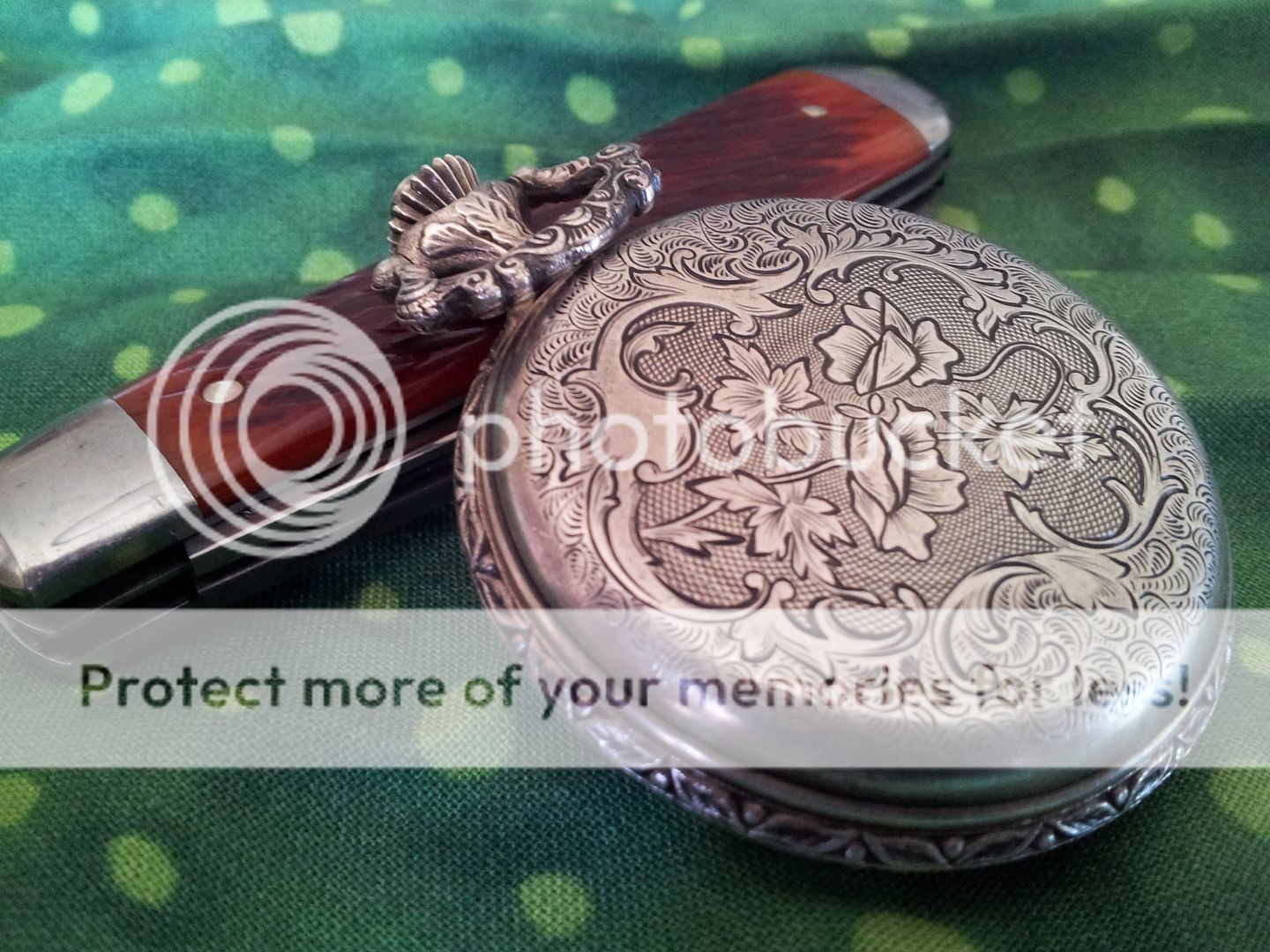

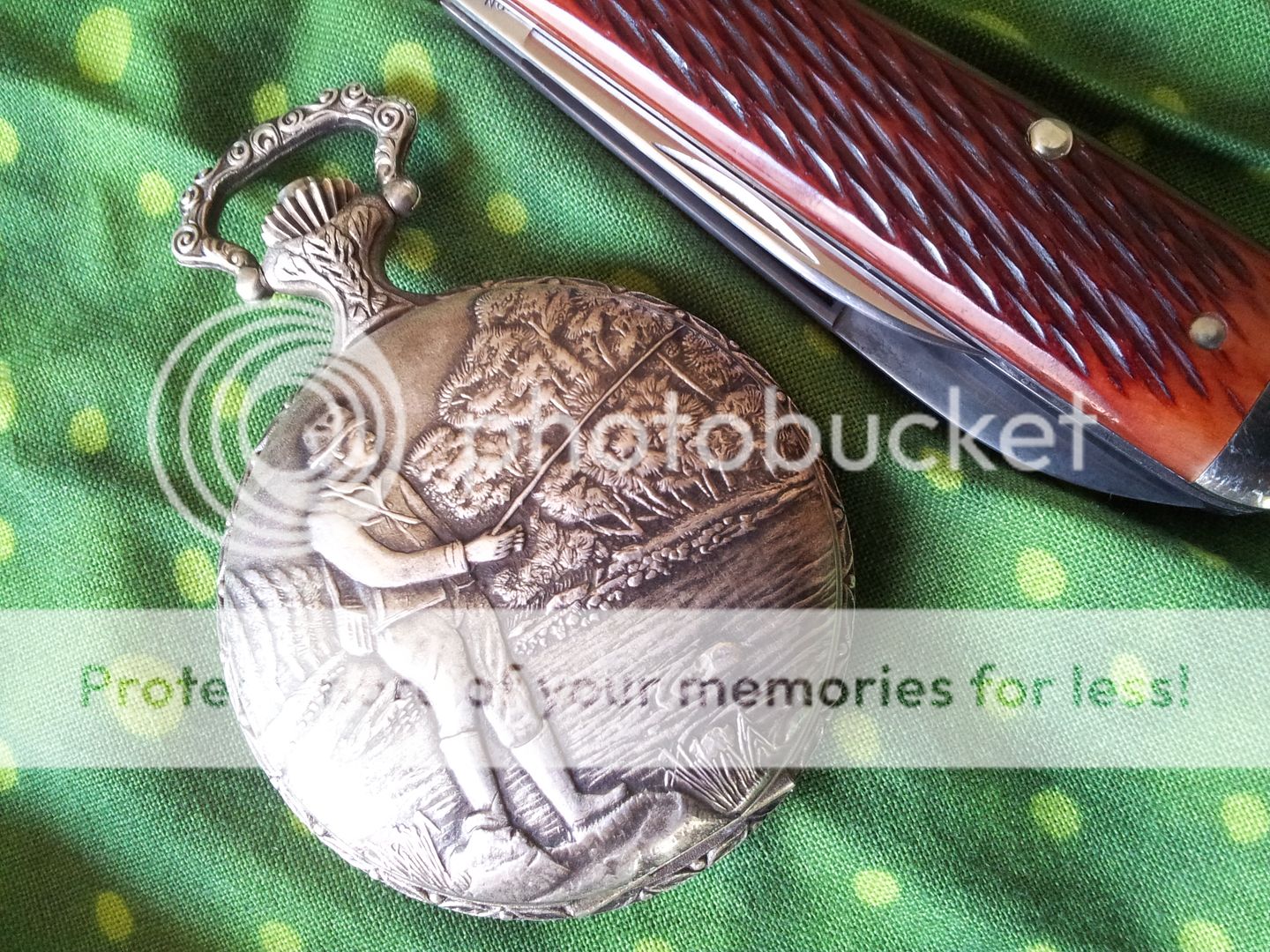
any one know anything about Valina? I've looked everywhere to avail. I had to have it serviced when the battery was replaced 2weeks ago(when i dug it out for this thread). It was given to me an old girlfriend back in the 80s and I never used it but kept it in a drawer.The jeweller reckoned in the region of 600AUD to replace it with something similar new.!! wow I didn't think she loved me all that much.
cheers
arizonaranchman
Gold Member
- Joined
- Jan 1, 2012
- Messages
- 4,424
hey Arizonaranchman, it looks like we have the same watch.
[/url] SAK pocket watch & Alox Farmer by pokeyoureyeout, on Flickr[/IMG]
We sure do! Nice! Whats that leather casing around it? Mine has a simple leather slip it came with.
- Joined
- Dec 2, 2005
- Messages
- 73,901
As I have been a mechanic most of my life I never wore a wristwatch or jewelry of any kind (you don't want things to get caught in moving machinery and tearing off what ever body part that thing is attached to)
I was an apprentice mechanic as a youngster and carried a pocket watch then. I'd actually forgotten WHY until I read your post!
My dad was a machine-tool fitter most of his life, similar job, and he didn't wear a watch or wedding ring for the same reason. He didn't have a pocket watch either, so he never knew the time! He was in his mid 50's, and in a different job by then, when I bought him a decent wrist-watch, and managed to persuade him to wear it.


- Joined
- Dec 2, 2005
- Messages
- 73,901
Wow guys, some real quality tackle in those pics! :thumbup:

- Joined
- Jul 2, 2013
- Messages
- 7,037
Thank you Jack! My camera won't show it but sometime in it's past, an owner of the watch had an oncoming train engraved on the back of the case...trying to make up for the fact it isn't a real railroad watch I guess...that really adds to the appeal for me!
- Joined
- Dec 2, 2005
- Messages
- 73,901
It's a beauty I like the Barlow too :thumbup:
I like the Barlow too :thumbup: