Trestle Pines Grand Portage

So then here's one more observation for you. The sheepfoot blade closed in the handle is not good at all for providing leverage to lift the cap. If you're not carefull, you'll squeeze the blade too much and rap the edge into the spring. Well, on the Grand Portage, I can get a full finger on the bottom end of the handle because the wharncliffe slopes down fast enough. No blade squeeze, no blade rap. Hope that makes sense. I don't have a GEC Radio Jack with clip point blade, but I would assume it works better than a sheepfoot too.

Makes plenty of sense. It is also one of my unspoken concerns with the upcoming Beer Scout run. I may just turn my reservations into catch-and-release and check out some of the other GP finishes.
 
I agree that people may have been more accepting of the unique pattern if it came from GEC since they're known for having non traditional elements to some of their designs. However, I think most of us are being much less critical of the build quality of the GP because it's not a GEC. I guess you could say that I've become spoiled but I tend to hold GEC to a higher standard than most other companies. The weirdness around the back of my bolsters is no big deal to me, but I've certainly never seen it on a GEC. I hope Trestle Pines continues to produce fun and unorthodox patterns/materials and I look forward to picking more up in the future. I love my brass and boxelder!

I just realized while skimming this thread that I completely misread this comment yesterday. And to Cannonball970, I'm only using your comments as a jumping-off point -- I am not singling you out at all. That being said...

I don't know if I agree that people are being less critical of the knife just because it's a Queen build instead of GEC. I see it as quite the opposite. When the Portage came out, the reviews were nothing short of brutal. The blade didn't ride high enough, the tang was too sharp, the knife didn't look enough like a #69, or it looked too much like a #69, or it was derivative, or it was too different,m or it was just more of the same, or or or...

Then the GP came out in a dazzling array of wonderful woods and all I saw was more criticism.

"Anything but nickel steel bolsters is no good with a stainless blade!" Where was the criticism of CSC for copper+steel or Schrade for slapping bronze bolsters all over their carbon serpentines for Craftsman back in the day?

"The tree stamp is too shallow!" An opinion, sure, but there is clearly a lot of detail to it and I've never once seen someone complain about the variance in the Bokers over the years or the shields on the Kabar copper Barlows.

"Too trendy with a Wharncliffe!" Seriously? People fell all over themselves when GEC jumped the sheepsfoot trend. It bordered on severe cheesiness for quite some time. And how many TCs were released with full-sized Wharnie secondary blades? Or Vipers? Or Coyotes? C'mon, people.

"Too much going on!" Seriously?!? It's wood, brass and steel. If that's too much for you, I've got a bunch of Delrin-handled single-blade Barlows for you. Nice, uniform colors and sawcut. No scary burl or variations in color. And I could probably choke on the number of posts in this subforum that have positively begged GEC for matchstrike pulls.

"Not as refined as the TC!" OK. I've held two TC Barlows in my life. One had a blade that veered almost entirely to one side, to the point where I was shocked that it didn't rub the liner (and this is on a single-blade non-crinked knife). The other had what I'd term "only adequate" F&F. Refined? These aren't customs we're talking about, a point I find myself bringing up repeatedly to answer the people who think $350 is a fair price for a TC on the secondary market.

"The Wharncliffe looks weird!" I am massively inclined to do a little Photoshop work using one of my Coyotes and superimposing a photo of the GP's master atop the GEC's Wharnie. From my (admittedly unscientific, at least to this point) observations, including holding my own up to a dead-on perpendicular photo of the GP, the proportions are nearly identical to both the Coyote and the Viper. Not one time in either the #18/#47 threads or the GEC thread itself did I see a complaint about the Wharncliffe on those knives looking "weird".

Anyway, excuse the extended length of my post. I've just become highly disillusioned with the free passes GEC gets on so many of these "complaints" and the pile-on other makers get for the same thing. Let slip the dogs of rebuttal; I can handle it. :D
 
I saw that you disagreed with my comment on the knife not being as refined as the TC barlow. I sort of skimmed but will reread later. It's fine that we disagree. People have different opinions. That comment was made based on the dealer photos. Forum members took much better photos. I still think it's not quite as refined as the TC barlow but less so now. I do own Queen knives that I would say are as refined as knives made by GEC. They're from the late 80s and early 90s. I have a $20 Schrade USA 8OT that is pretty close to my $100+ GEC 81. I think I'm being fair.

I did spend (waste?) a considerable amount of time defending this knife and the design. If you look through the prior posts in this thread, it should be clear that I had a favorable opinion about the design. The original Portage was a flawed design. That flaw was corrected/omitted with the new knives. I hope the new knives are a success and I hope they don't repeat the mistakes from the earlier run.

I'm rooting for Queen. But I won't be buying the knife. You can't please everyone and a knife with bronze bolsters isn't something that I want. And at this price point, I'm not going to buy a knife unless I love it. I think others will love it. There is a lot to love about the knife.

Buy one and post lots of photos!!
 
Last edited:
OK, I bought one, and I'll post photos when it comes in. No matter what you think about the design of the knife, no one will mistake it for another brand. It can only be a Trestle Pine.
 
I don't know if I agree that people are being less critical of the knife just because it's a Queen build instead of GEC. I see it as quite the opposite. When the Portage came out, the reviews were nothing short of brutal. The blade didn't ride high enough, the tang was too sharp, the knife didn't look enough like a #69, or it looked too much like a #69, or it was derivative, or it was too different,m or it was just more of the same, or or or...

Gonna use this as another jumping off point. :)
So let's be realistic for a moment. There has to be a benchmark. And it's pretty obvious that the consensus benchmark on this here internet forum for a barlow is a GEC brand TC 15. Even GEC's other barlows: 77 NFs, 25's, and the Madison Barlows are often compared to the TC 15's. They've been made with other blade shapes. Doesn't matter which brand a new barlow is created under, people are going to compare/contrast it to the TC 15 eventually. It has set the bar, and set it pretty high.

The secondary market price on them, as we all know, is only valid if somebody is willing to pay it. That doesn't make all the other barlows in the world undesirable to interested collectors, but perhaps a bit curious why the market price is that high for that make/model. There are many avenues of collecting. There will be many trends that come and go such as wharncliffe and lambsfoot blades. Profit is a great motivator. So if one business see's another cashing in, they typically want to ride that wave too.

Rolling this back to the Grand Portage. Maybe this is a trendy knife. On paper it sure seems that way. Barlow. Wharncliffe main. Stainless Steel. Cap lifter. But in hand it doesn't seem like a trendy knife to me. It is just straight up quality. In Greg's blog in multiple posts he details why he chose all of those features for the Grand Portage. He also details why he chose the woods and the risk associated with some of the woods, and also shares some of his lessons learned with his past knives. Greg also includes a very lengthy write-up about Trestle Pines and the Grand Portage with your order. It's clear he's passionate about his business and this hobby. And he tries to put that passion back into the patterns he's commissioning. The retail price is higher than some competing brands similar models, but there is nothing like this one that all the same elements as this one has on the market. The materials used are primo and are materials that I personally share a liking for (understandably not that way for everybody). So that price tag was worth it to me, minor cosmetic machining blemishes and all. Is it as good as a TC 15 or GEC Beer Scout? I don't think this one can be compared to one without the other, and that my friends means this Grand Portage has set a new benchmark for Stainless Barlow Wharncliffe Cap Lifter. :cool:

(uggg I gotta get out more)
 
Rolling this back to the Grand Portage. Maybe this is a trendy knife. On paper it sure seems that way. Barlow. Wharncliffe main. Stainless Steel. Cap lifter. But in hand it doesn't seem like a trendy knife to me. It is just straight up quality.

I quite agree. It begs to be used and carried.
 
I have a quick minute to respond and continue this conversation. And after having this in hand all morning (literally can't seem to put this GP down or let it out of my sight) I agree with Cannonball and the others that we're not as critical with other brands as we are with GEC. We expect, falsely, as I've argued in other threads, that GEC put production flawlessness in little white tubes. It's just not reality. And neither is it for other brands. And after I figured out to accept that (the CSC 2015 BF Knife really was the turning point for me) it opened up a new world of joyous collecting!

This Grand Portage is a very solid well built, well designed knife, that feels organic, unique and utilitarian. And I'm very happy with the purchase. It is not perfect. There are many flaws that somebody can nit-pick to death over but really if you're purchasing this knife as an investment I think you're missing the design intentions. I'm pretty sure this is going to be a popular carry for me, beyond the honeymoon phase. And I'd happily pass this one down to the next generation.

I have noticed the cap lifter works better on this one than the GEC flavor. More leverage to pull the cap up in one swipe, rather than multiple stabs at it (but maybe that's just me).

So then here's one more observation for you. A sheepfoot blade closed in the handle is not good at all for providing leverage to lift the cap. On the GEC's if you're not carefull, you'll squeeze the blade too much and rap the edge into the spring. Well, on the Grand Portage, I can get a full finger on the bottom end of the handle because the wharncliffe slopes down fast enough. No blade squeeze, no blade rap. Hope that makes sense. I don't have a GEC Radio Jack with clip point blade, but I would assume it works better than a sheepfoot too.

jrawk,

Thanks for the photos and honest feedback. That walnut really does look great and I am a big fan. my Portage also has a variety of minor F&F flaws but in no way is it poorly made and I enjoy it quite a bit. From the look of the photos and reviews by those who have picked up a GP I'd say that with every new Trestle Pine release the F&F continues to improve. I like my Scout but would have to agree about the Sheeps foot. Personally I get a lot more use out of other blade shapes and this one factor will stop me from buying another in the same configuration and gives the one I have far less pocket time then other knives with some belly. I was happy to hear that the opener is also stout as I have experienced the multi pulls to remove a cap but honestly that could be operator error. I bought the Portage before the GP was released and if I had to choose now I'd go with the GP for the addition of the cap lifter. Greg continues to do a great job and offers beautiful and historic wood options in super stainless now with the addition of a production Barlow with a cap lifter!

Here's my portage after 3.5 months of carry and use, still love it!
Looks great, holds a wicked edge and disappears in the pocket. Looking forward to the TP future releases :thumbup:

 
Last edited:
That's a beauty, stonebeard. I'm going to follow the Trestle Pine series more closely, for sure.
 
Gonna use this as another jumping off point. :)
So let's be realistic for a moment. There has to be a benchmark. And it's pretty obvious that the consensus benchmark on this here internet forum for a barlow is a GEC brand TC 15. Even GEC's other barlows: 77 NFs, 25's, and the Madison Barlows are often compared to the TC 15's. They've been made with other blade shapes. Doesn't matter which brand a new barlow is created under, people are going to compare/contrast it to the TC 15 eventually. It has set the bar, and set it pretty high.

The secondary market price on them, as we all know, is only valid if somebody is willing to pay it. That doesn't make all the other barlows in the world undesirable to interested collectors, but perhaps a bit curious why the market price is that high for that make/model. There are many avenues of collecting. There will be many trends that come and go such as wharncliffe and lambsfoot blades. Profit is a great motivator. So if one business see's another cashing in, they typically want to ride that wave too.

Rolling this back to the Grand Portage. Maybe this is a trendy knife. On paper it sure seems that way. Barlow. Wharncliffe main. Stainless Steel. Cap lifter. But in hand it doesn't seem like a trendy knife to me. It is just straight up quality. In Greg's blog in multiple posts he details why he chose all of those features for the Grand Portage. He also details why he chose the woods and the risk associated with some of the woods, and also shares some of his lessons learned with his past knives. Greg also includes a very lengthy write-up about Trestle Pines and the Grand Portage with your order. It's clear he's passionate about his business and this hobby. And he tries to put that passion back into the patterns he's commissioning. The retail price is higher than some competing brands similar models, but there is nothing like this one that all the same elements as this one has on the market. The materials used are primo and are materials that I personally share a liking for (understandably not that way for everybody). So that price tag was worth it to me, minor cosmetic machining blemishes and all. Is it as good as a TC 15 or GEC Beer Scout? I don't think this one can be compared to one without the other, and that my friends means this Grand Portage has set a new benchmark for Stainless Barlow Wharncliffe Cap Lifter. :cool:

(uggg I gotta get out more)

I guess I just don't understand why some of you folks continue to run this thread off topic. The thread topic is the Trestle Pine Knife. Not Trestle Pine Versus GEC. These knives have nothing to do with GEC. They were not designed by GEC. They were not built by GEC. They were not marketed by GEC. GEC had, and has, absolutely nothing to do with them. They are totally independent from GEC. I think Greg deserves a lot of credit for working hard to bring out a new line of Traditional Cutlery. He deserves a lot of credit for bringing us these wonderful, old growth wood handle options. He deserves a lot of credit for risking his butt and his business to do it. Maybe we could talk about the Trestle Pine Knives line in and of themselves. Not everything in Traditional Knives relates to Great Eastern Cutlery.
 
Gonna use this as another jumping off point. :)
So let's be realistic for a moment. There has to be a benchmark. And it's pretty obvious that the consensus benchmark on this here internet forum for a barlow is a GEC brand TC 15. Even GEC's other barlows: 77 NFs, 25's, and the Madison Barlows are often compared to the TC 15's. They've been made with other blade shapes. Doesn't matter which brand a new barlow is created under, people are going to compare/contrast it to the TC 15 eventually. It has set the bar, and set it pretty high.

The secondary market price on them, as we all know, is only valid if somebody is willing to pay it. That doesn't make all the other barlows in the world undesirable to interested collectors, but perhaps a bit curious why the market price is that high for that make/model. There are many avenues of collecting. There will be many trends that come and go such as wharncliffe and lambsfoot blades. Profit is a great motivator. So if one business see's another cashing in, they typically want to ride that wave too.

Rolling this back to the Grand Portage. Maybe this is a trendy knife. On paper it sure seems that way. Barlow. Wharncliffe main. Stainless Steel. Cap lifter. But in hand it doesn't seem like a trendy knife to me. It is just straight up quality. In Greg's blog in multiple posts he details why he chose all of those features for the Grand Portage. He also details why he chose the woods and the risk associated with some of the woods, and also shares some of his lessons learned with his past knives. Greg also includes a very lengthy write-up about Trestle Pines and the Grand Portage with your order. It's clear he's passionate about his business and this hobby. And he tries to put that passion back into the patterns he's commissioning. The retail price is higher than some competing brands similar models, but there is nothing like this one that all the same elements as this one has on the market. The materials used are primo and are materials that I personally share a liking for (understandably not that way for everybody). So that price tag was worth it to me, minor cosmetic machining blemishes and all. Is it as good as a TC 15 or GEC Beer Scout? I don't think this one can be compared to one without the other, and that my friends means this Grand Portage has set a new benchmark for Stainless Barlow Wharncliffe Cap Lifter. :cool:
(uggg I gotta get out more)

You and me both, sir! :D

I have to agree with you regarding the retail price, which to date was my only real sticking point with this knife. It definitely creeps into the higher end of the production slipjoint line, but some of the more special knives out there have proven to be worth the premium (short of the customs, of course -- two different ballparks if not two entirely different sports) and each time I look over the GP line my resolve weakens more and more. :p

I have little doubt that this would make an extra special user, and the fact that it would bolster (no pun intended :D) my wooden-handled Barlow collection is a well-appreciated added bonus.

A question, if you will entertain it: How does the thickness compare to one of Queen's 2-blade #69s in, say, walnut? I imagine the lifter is a wee bit thicker than the average Barlow's pen blade, but I am so woefully unfamiliar with Trestle Pine's awesome woods that I can't even venture a guess as to how much thicker (or thinner?) it might be than the #69. I do have big hands, and the standard one-blade #69 has always seemed a little on the slim side to me -- though that's never prevented me from carrying any of mine. :cool:

I quite agree. It begs to be used and carried.

And to open many, many ales and stouts. :D

Thanks for the photos and honest feedback. That walnut really does look great and I am a big fan. my Portage also has a variety of minor F&F flaws when compared to GEC but in no way is it poorly made and I enjoy it quite a bit. From the look of the photos and reviews by those who have picked up a GP I'd say that with every new Trestle Pine release the F&F continues to improve.
...
Here's my portage after 3.5 months of carry and use-

The more Trestle Pine knives I see, the more I believe that the pine tree bolster stamp is indeed right on the money. There is some outstanding wood on these knives! If I'm lucky enough to score one of my desired woods when I finally get out of the office today I think I'm going to pull the trigger.

I guess I just don't understand why some of you folks continue to run this thread off topic. The thread topic is the Trestle Pine Knife. Not Trestle Pine Versus GEC. These knives have nothing to do with GEC. They were not designed by GEC. They were not built by GEC. They were not marketed by GEC. GEC had, and has, absolutely nothing to do with them. They are totally independent from GEC. I think Greg deserves a lot of credit for working hard to bring out a new line of Traditional Cutlery. He deserves a lot of credit for bringing us these wonderful, old growth wood handle options. He deserves a lot of credit for risking his butt and his business to do it. Maybe we could talk about the Trestle Pine Knives line in and of themselves. Not everything in Traditional Knives relates to Great Eastern Cutlery.

I think this is quite clear in reading the context of every post in this thread that even mentioned GEC. Compare and contrast is a valid option in the scope of the traditionals subforum, especially when (as jrawk pointed out) the product being compared is a direct competitor to the current "gold standard" (and I say this as someone whose own personal gold standard doesn't even have a "TC" or "NF" on the bolster).

As for that final sentence, I feel like that's something you should take up with the majority of the subforum. They might disagree, and what is a forum if not the sum total of the contributions of its users? Again, my personal agreement or disagreement is not at issue here, but instead the organic method by which content becomes the subject matter.
 
I guess I just don't understand why some of you folks continue to run this thread off topic. The thread topic is the Trestle Pine Knife. Not Trestle Pine Versus GEC. These knives have nothing to do with GEC. They were not designed by GEC. They were not built by GEC. They were not marketed by GEC. GEC had, and has, absolutely nothing to do with them. They are totally independent from GEC. I think Greg deserves a lot of credit for working hard to bring out a new line of Traditional Cutlery. He deserves a lot of credit for bringing us these wonderful, old growth wood handle options. He deserves a lot of credit for risking his butt and his business to do it. Maybe we could talk about the Trestle Pine Knives line in and of themselves. Not everything in Traditional Knives relates to Great Eastern Cutlery.
i thought i did a pretty good job of acknowledging previous discussion and pulling it back to the GP. Besides didnt you yourselfjust do what you are accusing others of? No worries. its pretty hard and boring to talk about one knife only without providing context and insight as to why the said knife should be heralded. After all this is primarily a discussion board, not a photo gallery.

A question, if you will entertain it: How does the thickness compare to one of Queen's 2-blade #69s in, say, walnut? I imagine the lifter is a wee bit thicker than the average Barlow's pen blade, but I am so woefully unfamiliar with Trestle Pine's awesome woods that I can't even venture a guess as to how much thicker (or thinner?) it might be than the #69. I do have big hands, and the standard one-blade #69 has always seemed a little on the slim side to me -- though that's never prevented me from carrying any of mine. :cool:
to. .
i dont have a two blade queen 69 to compare sorry


jrawk, what's the finish feel like on yours? Is smooth and waxy or does it have more of a sanded wood feel?

it is smooth but not waxy. i am fairly sure the walnut is stabilized.
 
i dont have a two blade queen 69 to compare sorry

Would you say that the slabs of wood run thicker than, thinner than, or about the same as a typical natural-covers Barlow (e.g. Case, Queen, bone Bokers, etc.)?
 
Goodness me there's an awful lot of passion on this page :D I love it when people get together and can discuss and compare their opinions, it's what the forum is for :)

I'll happily put my hand up and say I was one of the first to critique - and that from a distance as I haven't handled one. Here is what I said;

I find this quite difficult, I've been a loyal customer of Greg's for a long time and when he started the Trestle Pines project I was very excited about it.

- First offering was a fixed blade which I think looks great and ticks all the boxes but I know it would sit on a shelf and never be carried so I passed.

- The second just didn't look right. The size was great and I like barlows, love the high end steel but the blade didn't look proper on a barlow and I'm not a fan of EO notches, especially not on barlow's so I passed again. I've often gone back and thought about it but again I know it wouldn't get used.

- The third just makes no sense to me as a traditional pocket knife fan at all. Sort of a hybrid of the three most popular current trends. Barlow, tick. Wharncliffe, tick. Caplifter, tick. I don't get it; I like milkshakes, orange juice and whisky but wouldn't put them in the same glass. I must say that the bolster stamp looks good though, and if more barlows are forthcoming I hope he keeps it.

I feel bad because I think the old reclaimed woods are brilliant, and when the concept of using high end super steels on traditional patterns at an affordable price was first brought up on his blog I was very supportive, but can't see any way that I'll go for the end product here. I feel guilty about it because Greg has gone a long way to assist me in the past but I can't buy one of these. I'm sure that it will be a hit with many though, it does tick plenty of boxes.

:(

Note - no mention of GEC or indeed any other maker apart from the man himself.

I follow Greg's blog and thanked him in one of his latest posts for clearing up some of the detail that I couldn't work out.

For me, the reason that I personally won't go for one is purely aesthetics; traditionally barlows have neither wharncliffe blades nor caplifters, and that's about it. I think had this pattern been a jack and not a barlow, I would have been very interested indeed but in it's current form it doesn't do it for me.

I'm really glad that they're working out though, like Bob said;

I think Greg deserves a lot of credit for working hard to bring out a new line of Traditional Cutlery. He deserves a lot of credit for bringing us these wonderful, old growth wood handle options. He deserves a lot of credit for risking his butt and his business to do it.

- Paul


ps. Those who are familiar with my collection will know that I do own a couple of WLST barlows with wharncliffe blades - so I'm prepared to take a bashing for being hypocritical for that :)
 
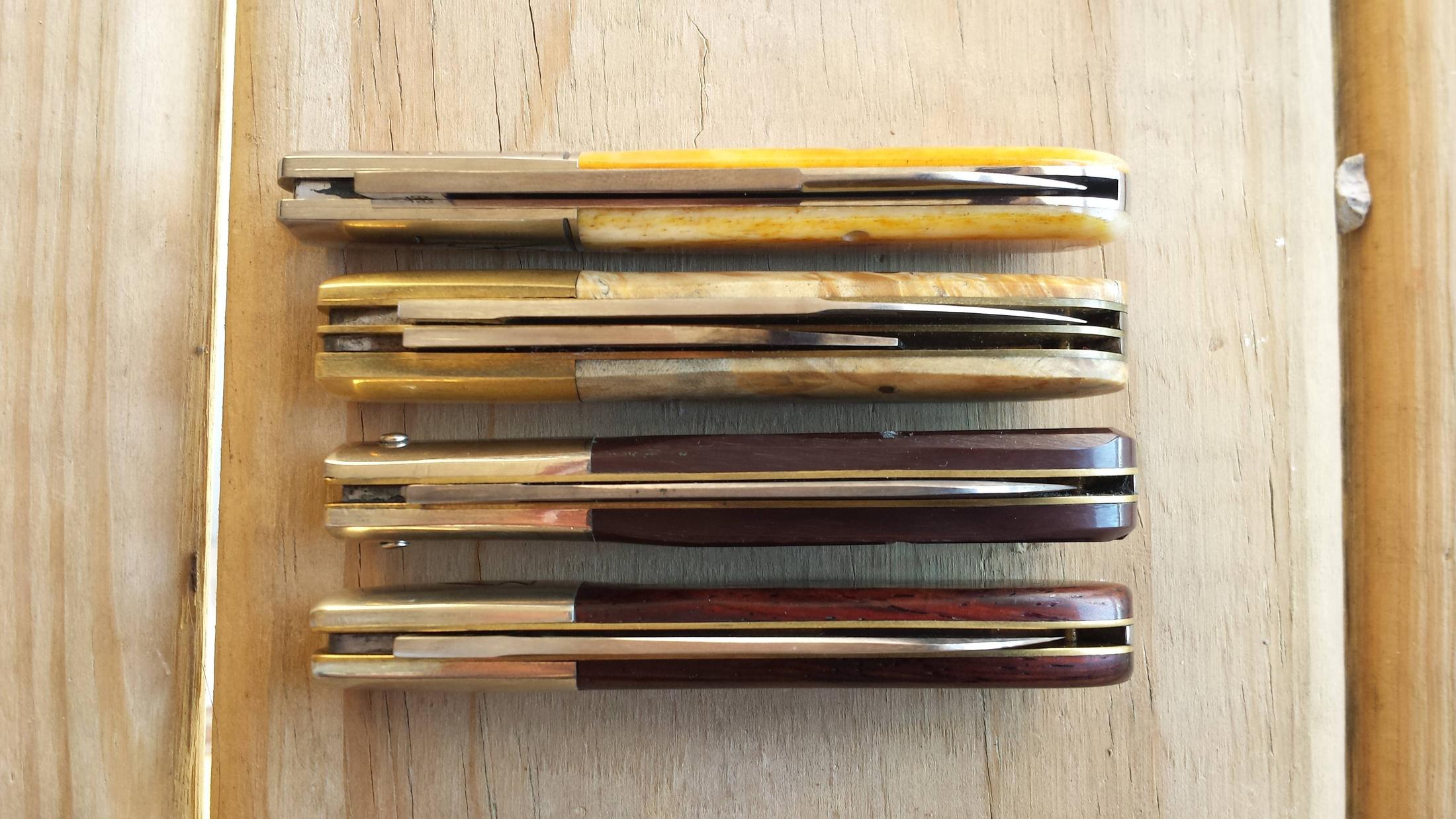
I don't have any other two-bladed barlows but here it is next to a Northfield 77, delrin 69 Queen workhorse, and a Queen-made Northwoods:

cAKS4gV.jpg


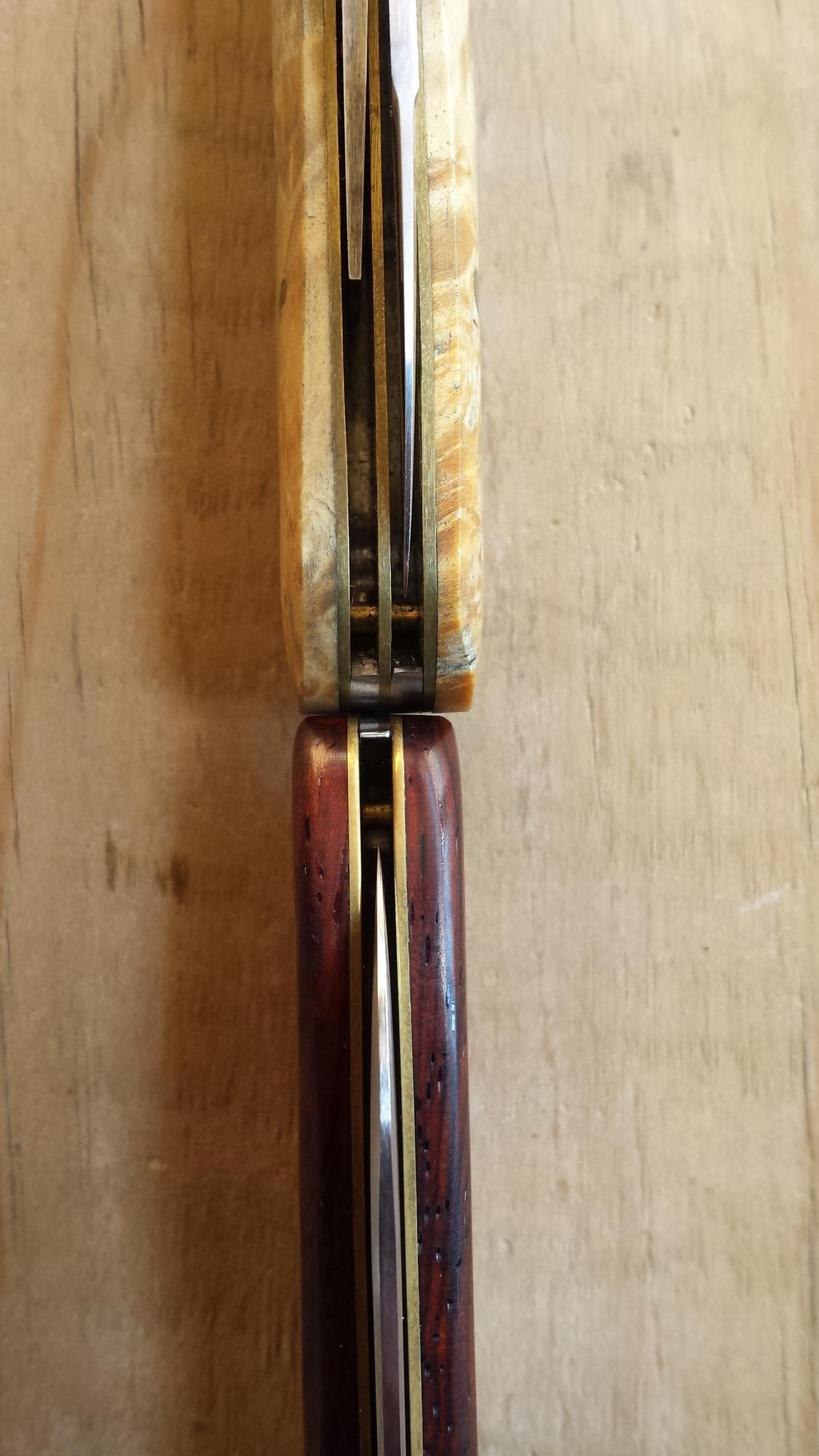
And butt to butt with the Northwoods:

4slwdcN.jpg
 
Last edited:
Would you say that the slabs of wood run thicker than, thinner than, or about the same as a typical natural-covers Barlow (e.g. Case, Queen, bone Bokers, etc.)?
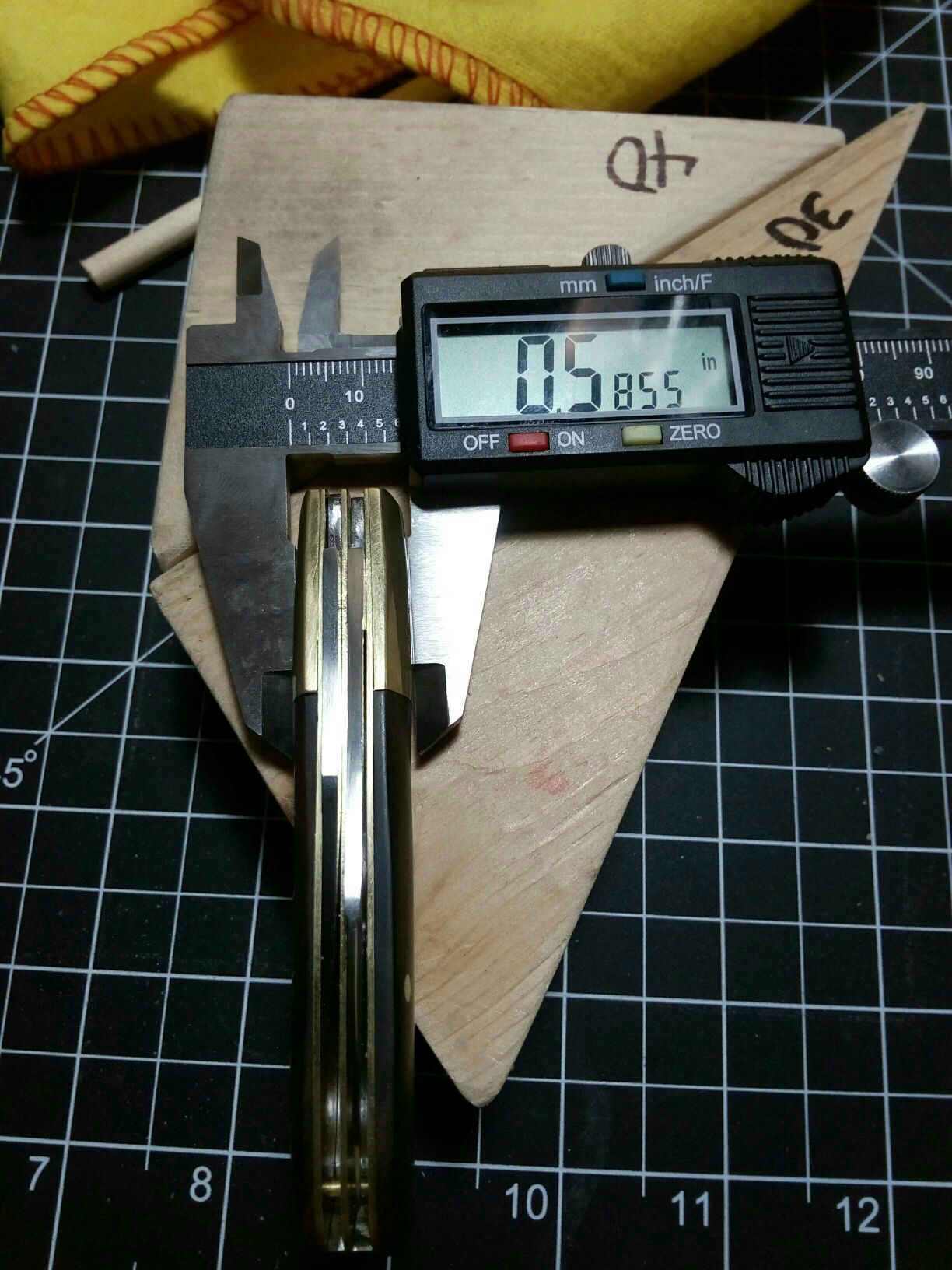
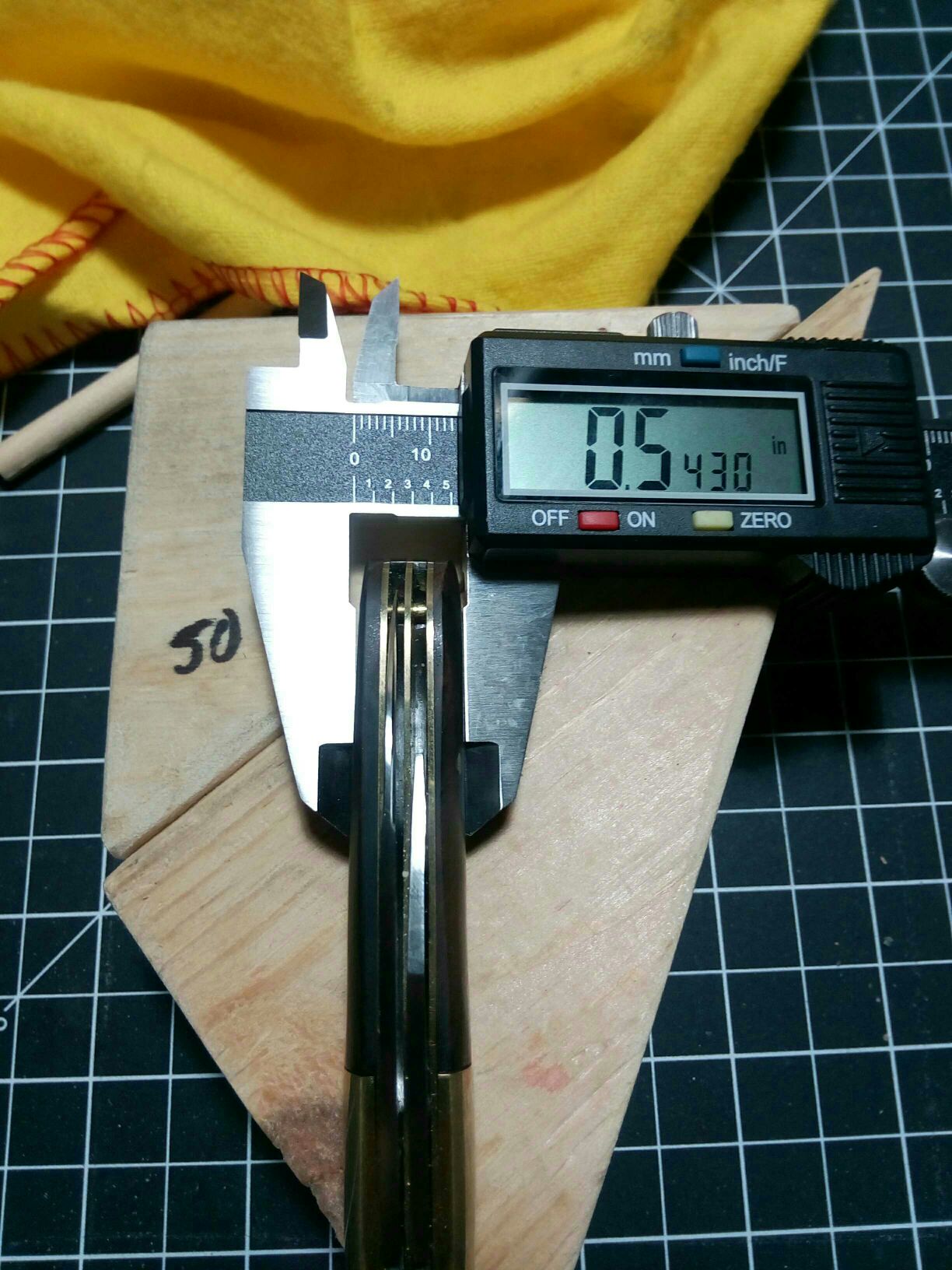
i have a couple S&M heritage jacks that the covers are ever so slightly thinner. The GP is fairly beefy. wider than the brand im trying to avoid naming again.
 
I'm not sure why it would be OK to compare to Case and Boker but not to GEC. Comparing production knives to customs is sort of like comparing your mom's cookies to store bought... not particularly respectful. But production knives often get compared to other production knives throughout the forum. Generalizations can be misleading but direct comparisons can be helpful in making decisions.

I don't have a dog in this race. I hope my prior comments were helpful both to buyers and to Trestle Pines. I think they're headed in a good direction with this latest run.
 
I don't have any other two-bladed barlows but here it is next to a Northfield 77, delrin 69 Queen workhorse, and a Queen-made Northwoods:
And butt to butt with the Northwoods:

Awesome, thank you! I can't really do much with the Northwoods but that single-blade Queen is perfect for comparison's sake. I have bone, walnut and Winterbottom delrin workhorses and the are all pretty much identical in thickness.

the widest part is the bolster measured in top photo.

Wow! Thank you, sir! I may have to bust out the micrometer and check out a few of my favorites here but I think between these two posts I've got a good handle on the size (and it really is as close to ideal as you can get, for me). Much appreciated, both of you!

i have a couple S&M heritage jacks that the covers are ever so slightly thinner. The GP is fairly beefy. wider than the brand im trying to avoid naming again.

I noticed that the recent runs from The Maker Which Shall Not Be Named seemed to run slimmer than I recalled from the last time I handled one of the Barlows produced on the same frame, but it might have just been time and perspective. I carry a lot of two-blade Barlows and I came into the hobby thinking of an "ideal Barlow" as a thicker knife. The GP seems to play right into that (plus, like I said earlier, Beerlow!).

I'm not sure why it would be OK to compare to Case and Boker but not to GEC. Comparing production knives to customs is sort of like comparing your mom's cookies to store bought... not particularly respectful. But production knives often get compared to other production knives throughout the forum. Generalizations can be misleading but direct comparisons can be helpful in making decisions.
I don't have a dog in this race. I hope my prior comments were helpful both to buyers and to Trestle Pines. I think they're headed in a good direction with this latest run.

I agree, but apparently (according to my visitor messages) the mods are now involved and they do not. So as for The Maker That Shall Not Be Named, I will at least thank Cannonball970 and jrawk for providing excellent information for me regarding the GP's relative thickness so I can understand and visualize what a buyer gets with that knife.

It really is pretty awesome, criticisms aside. I'm going to think long and hard about it tonight.
 
Back
Top